ICD-10 code S61.201A: Open wound of left index finger without nail damage
ICD-10 code S61.201A covers a left index finger wound of unstated type ICD-10 co...

Last Updated: Oct 16, 2026
Billable Code Specific Code
T25.112S is the billable ICD-10-CM code for burn of first degree of left ankle, sequela.
Choosing between the 7th characters D and S decides whether the claim pays. It also covers the documentation payers expect, the neighboring T25 codes, and the errors that cause denials.
Let Pabau's smart automation suggest the right codes, reduce claim denials, and keep your practice compliant—effortlessly.
Automate repetitive tasks and focus on what matters most—your patients.
Reduce coding errors and ensure compliance with the latest regulations.
Clean claims, fewer denials, and faster reimbursements.
Powerful insights and reporting to help your practice thrive.
HIPAA compliant SOC 2 certified GDPR-compliant Trusted by 4,000+ clinics worldwide

T25.112S is a billable ICD-10-CM code for burn of first degree of left ankle, sequela, and it is current in the FY2026 code set.
The 7th character S marks a sequela, meaning the original burn has healed but a residual condition persists. Do not confuse it with D, which covers an encounter during active healing.
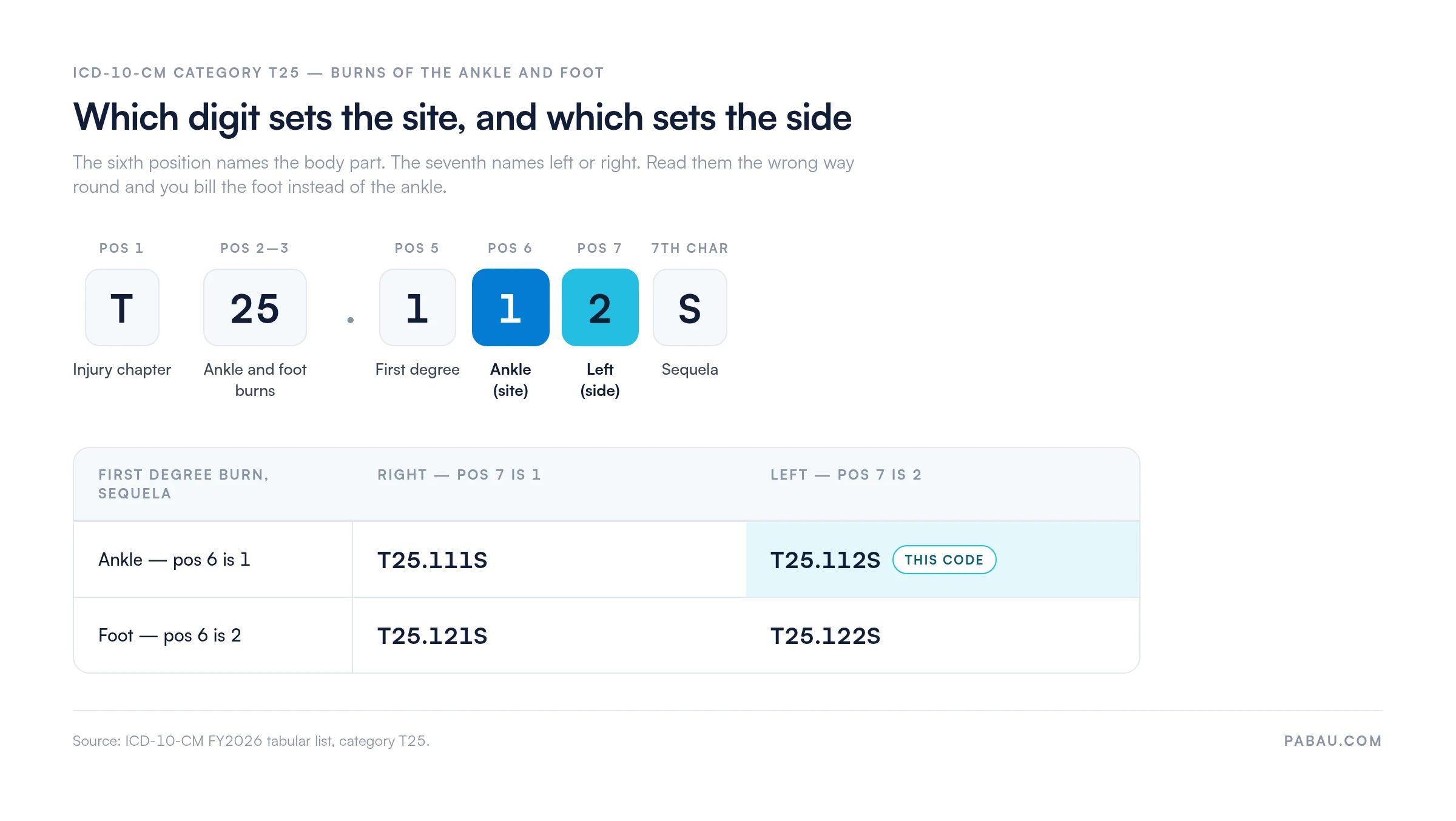
Position 6 sets the site, where 1 is the ankle and 2 is the foot. Position 7 sets the side, where 1 is right and 2 is left.
Sequencing rule: The code for the nature of the sequela is listed first, and T25.112S follows as the cause code.
Practice management software like Pabau submits claims through Claim.MD, so payer edits run before a sequela claim ever leaves the practice.
T25.112S is a current, billable code in the FY2026 ICD-10-CM code set. The Centers for Medicare and Medicaid Services (CMS) and the National Center for Health Statistics maintain that code set. The ankle and foot burn codes in category T25 have been part of ICD-10-CM since the US adopted it in October 2015.
Each character in T25.112S carries clinical meaning. Misreading any one character leads to a wrong code and, in most payer systems, a denial. Here is what each position means.
The first three characters (T25) place this code within category T25 of ICD-10-CM, which covers all burns and corrosions of the ankle and foot. Burn sites above the ankle leave T25 for category T24, where a second-degree burn of the right knee codes to T24.221A. The digit “1” at the fifth position signals first-degree burn severity.
The second “1” identifies the ankle rather than the foot within that category. The digit “2” then specifies left-side laterality, which ICD-10-CM requires for injury codes on paired body parts. The final character “S” is the 7th character extension denoting sequela, covered in depth below.
Reading those two digits the wrong way round turns a left ankle burn into a right foot burn. Four first-degree sequela codes make the pattern obvious. T25.111S is the right ankle, T25.112S the left ankle, T25.121S the right foot, T25.122S the left foot.
Accurate degree selection is the foundation of burn coding. Using T25.112S requires documentation that the original injury was a first-degree burn. Upcoding to second degree without clinical evidence is an audit risk. Downcoding causes its own problems when the record supports a more severe burn.
First-degree burns involve damage confined to the outermost layer of the skin, the epidermis. They produce erythema (redness) and pain without blister formation. No full skin-thickness damage occurs. Second-degree burns, by contrast, involve partial-thickness epidermal and dermal damage with blistering.
When the original first-degree burn has healed and a residual condition persists, the sequela encounter uses T25.112S. That residual condition might be skin discoloration, pruritus, or hypersensitivity at the ankle. The record from the original encounter should be available to confirm the initial degree classification. See the CDC/NCHS ICD-10-CM web tool for the official tabular description and applicable-to notes.
The 7th character is the single most consequential element in T25.112S for billing purposes. ICD-10-CM uses three 7th characters for the burn codes in categories T20 to T25, and confusing them generates denials and compliance exposure.
The distinction between D and S drives more coding errors than any other element in burn injury claims. The rule is straightforward. Use D while the burn wound is still healing. Use S once the burn has healed and the current complaint is a residual consequence of that injury.
A patient returning three weeks after a first-degree ankle burn for a follow-up wound check uses T25.112D. That same patient returning six months later with persistent hyperpigmentation at the healed burn site uses T25.112S. The clinical note must document that the original burn has resolved and describe the current late-effect condition.
The ICD-10-CM Official Guidelines for Coding and Reporting, Section I.C.19.d, establish the sequencing rules that govern T25.112S. These rules are mandatory, not advisory. Incorrect sequencing is a coding error even when the individual codes are otherwise correct.
Coding a burn sequela usually takes two codes. The code describing the nature of the sequela is sequenced first, such as a scar contracture or post-burn pruritus. T25.112S then follows as the cause code, identifying the original burn as the underlying etiology. Correct sequencing keeps the claim compliant and reduces the risk of audit findings.
The Official Guidelines also note that S covers any condition resulting from a prior injury once active treatment has concluded. This applies however much time has passed since the original burn. A sequela encounter can happen years later, if the residual condition is only now being addressed. Applying that rule is what produces a clean claim submission on the first attempt.
Run a query on your practice management system for all T25.11_D claims older than 90 days. Any still using the D suffix after confirmed wound closure should be reviewed for rebilling with the S suffix. Sequela miscoding is a common OIG audit trigger for injury code clusters.
Payers require specific documentation before accepting a sequela code. Miss one element and the record cannot answer an auditor’s first question. These five points are what a reviewer looks for.
Without all five elements above, a claim for T25.112S is coding without adequate documentation. That creates audit liability even when the clinical picture genuinely supports the code.
T25.112S sits within a structured code hierarchy. Knowing the adjacent codes prevents errors when laterality, degree, or encounter type differs from what you first assumed.
The codes above all describe burns. Corrosion subcategories sit further down T25 and apply when a chemical agent caused the injury. Third-degree corrosion across multiple sites of the left ankle and foot carries ICD-10 code T25.792S in the sequela phase. A first-degree foot corrosion still healing takes T25.529D when the record never names a side.
Corrosion records sometimes name neither the degree nor the side of the ankle. A sequela encounter in that position takes ICD-10 code T25.419S. The specificity rule still applies, so query the chart before settling for the unspecified option.
The WHO ICD-10 classification system holds the global parent categories that ICD-10-CM derives its burn coding structure from. US coders should reference the ICD-10-CM tabular list rather than the international version for billing purposes.
Submitting T25.112S means pairing it with the appropriate sequela condition code on the claim. Many clearinghouses run edits on that pair before transmission, so a reversed order can bounce back before it reaches the payer at all.
Reimbursement follows the service performed, not the burn code. T25.112S carries no payment of its own. It explains why the residual condition exists, which is what supports medical necessity for the evaluation or treatment billed alongside it.
Five errors account for the bulk of T25.112S rejections on burn injury claims. Each one is preventable with a short check before submission.
A pre-bill review takes about two minutes. Check these four points before the claim goes out:
When one of these slips through, the denial codes on the remittance advice name the edit that fired. That tells you what to correct before you resubmit.
Build a coding checklist specific to T25 burn sequela codes. Before submitting a claim with a 7th character S burn code, confirm four things. Wound closure is documented, the residual condition is named in the note, T25.112S is in the secondary position, and laterality matches the chart. Four checks, two minutes, far fewer denials.
ICD-10-CM includes approximate synonyms and applicable-to notes that help coders and CDI specialists confirm T25.112S is the right code. These terms appear in coding software, EHR pick lists, and code reference tools.
These synonyms help when you are querying an encoder or an ICD-10-CM database and the exact code is not to hand. The CMS ICD-10-CM code files carry the full tabular list and index entries, which are the definitive source for resolving a synonym.
A sequencing error usually surfaces weeks later, on the remittance. A coder reopens the chart, puts the two codes in the right order, and resubmits. The work gets done twice and the payment lands a month late.
Practice management software like Pabau moves that check upstream. Claims go out through a built-in Claim.MD connection, which runs payer edits before submission to thousands of US insurance payers. A pair a payer’s edits reject comes back while the claim is still in your system.
Electronic remittance advice then returns into the same patient record, so a CARC denial reason sits on the claim line it belongs to. Pabau’s approach to cleaner claims management means a coder reviewing T25.112S rejections works from the record, not a separate portal export.


Pabau sends claims through Claim.MD, so payer edits run on your ICD-10-CM code pairs and sequencing before submission. You catch sequela errors in the workflow instead of in the appeals queue.

The choice between D and S decides whether a burn sequela claim pays. Degree, site, and side all come straight off the chart. The 7th character is the only one you have to reason about, which is why it is the one that goes wrong.
So make wound closure a documented event rather than an assumption. Once the note says the burn has healed and names the residual condition, T25.112S is defensible. The only step left is putting it second, behind the code for the condition the patient actually has today.
Fix the process at the front end and these claims stop coming back. Book a demo to see how Pabau catches a sequencing problem before the claim leaves your practice.

Need to understand how clearinghouse integrations catch sequela errors before submission? Our guide to Claim.MD as a medical claims clearinghouse explains how payer edits and sequencing checks work at the clearinghouse level.
Want to see where a sequela code fits in the wider claim lifecycle? What is medical billing covers the end-to-end process, from encounter through to payment posting.
Looking for guidance on building a clean ICD-10-CM claim? Superbill documentation and structure walks through what a complete superbill looks like when injury sequela codes are involved.
T25.112S is an ICD-10-CM code meaning burn of first degree of left ankle, sequela. It identifies a late-effect encounter, where the original first-degree burn of the left ankle has healed. The patient now presents with a residual condition caused by that prior burn, such as scarring, discoloration, or hypersensitivity.
Yes. T25.112S is a billable and specific ICD-10-CM code in the FY2026 code set, valid for reimbursement submission. It indicates a diagnosis for insurance billing when the documentation supports a sequela encounter for a prior first-degree left ankle burn.
A subsequent encounter (7th character D) applies while the burn is still actively healing, such as a follow-up dressing change or wound check. A sequela encounter (7th character S) applies after the burn has fully healed and a residual condition remains. Using D when the wound has already closed is the most common burn coding error.
Use S when the original burn wound has completely healed and the current encounter addresses a direct result of that burn. Examples include post-burn pruritus, scarring, contracture, or pigmentation changes. The note must document that the burn has resolved and that the current complaint is a late effect.
Position 6 sets the body site, where 1 is the ankle and 2 is the foot. Position 7 sets laterality, where 1 is right and 2 is left. That is why T25.111S is the right ankle, T25.112S the left ankle, T25.121S the right foot, and T25.122S the left foot.
A first-degree burn is a superficial burn involving only the epidermis. It presents with erythema, pain, and tenderness, without blistering or an open wound. First-degree burns typically heal within 3-7 days without scarring. That separates them from second-degree burns, which blister, and third-degree burns, which destroy the full skin thickness.
The note must include a documented history of a prior first-degree burn of the left ankle. It must confirm the original burn has healed, state left-side laterality explicitly, and describe the current residual condition as a consequence of that burn. Without all four elements, the documentation does not support T25.112S.
Per ICD-10-CM Official Guidelines Section I.C.19.d, the code for the nature of the sequela is sequenced first. T25.112S, the burn sequela cause code, follows in the secondary position. Putting T25.112S in the principal diagnosis position without a companion nature-of-sequela code is a sequencing error.