ICD-10 Code Y76.0: Diagnostic obstetric and gynecological devices
ICD-10 Code Y76.0: Definition and billable status ICD-10 Code Y76.0 is a valid, ...

Last Updated: Oct 23, 2026
Billable Code Specific Code
T24.221A is the billable ICD-10-CM code for burn of second degree of right knee, initial encounter. It covers a partial-thickness thermal burn of the right knee while the patient receives active treatment. The code is valid for FY 2026 and FY 2027.
Correct assignment depends on three details in the provider note: the right side, a stated second-degree or partial-thickness depth, and active treatment at the visit. Chemical burns of the right knee are coded as corrosion instead, with T24.621A.
Let Pabau's smart automation suggest the right codes, reduce claim denials, and keep your practice compliant—effortlessly.
Automate repetitive tasks and focus on what matters most—your patients.
Reduce coding errors and ensure compliance with the latest regulations.
Clean claims, fewer denials, and faster reimbursements.
Powerful insights and reporting to help your practice thrive.
HIPAA compliant SOC 2 certified GDPR-compliant Trusted by 4,000+ clinics worldwide

T24.221A is valid and billable in FY 2026 and FY 2027 ICD-10-CM. It covers a second-degree burn of the right knee during active treatment.
7th character A applies to every visit while active treatment continues, including later visits. Switching to D too early is a frequent audit finding.
The tabular note instructs an additional external cause code for the burn source and place of occurrence. Reporting is required only where a payer or state mandates it.
External cause codes always sequence after T24.221A and are never the principal diagnosis.
Laterality mismatch, such as coding the left knee when the provider documented the right, is a common denial reason. Check it before submission.
ICD-10 Code T24.221A is the billable ICD-10-CM code for a second-degree thermal burn of the right knee while the patient receives active treatment.
The 7th character A marks that initial encounter and completes the code. According to the CDC/NCHS ICD-10-CM web tool, T24.221A is valid for claims with service dates in FY 2026 and FY 2027.
The code sits in chapter S00-T88, which covers injury, poisoning and certain other consequences of external causes. Its category is T24, burn and corrosion of lower limb, except ankle and foot. The hierarchy runs T24 > T24.2 (second-degree burns, lower limb) > T24.22 (burn of second degree of knee) > T24.221 (right knee, requires 7th character) > T24.221A. Neighboring burn and injury codes from the same chapter sit in our library of diagnostic codes for coders.
Burns of the ankle and foot (T25.-) and hip region (T21.-) are Excludes2 at T24. Corrosion of the right knee has its own code, T24.621A.
Burn depth determines both clinical management and which ICD-10 code to assign. The table below maps each degree to its right-knee ICD-10-CM code and clinical indicators.
Provider documentation must use the term “second degree” or “partial thickness” explicitly. A note that only says “burn to right knee” does not support a second-degree code. Payers cite that missing depth as a documentation deficiency on audit.
The three valid 7th characters for T24.221 are A (initial encounter), D (subsequent encounter), and S (sequela). Selecting the wrong one is an OIG audit target and a common payer denial trigger.
Per ICD-10-CM Official Guidelines Section I.C.19.a, “active treatment” is the key test, not visit number. Apply this decision sequence before assigning the 7th character:
A patient who returns for wound debridement on visit six still gets T24.221A, not T24.221D. The AHA Coding Clinic reinforces that “initial encounter” in ICD-10-CM refers to active-treatment encounters throughout the episode of care, not only the first calendar visit.
Laterality errors are among the most common reasons T24.221A claims are denied. Payers can compare the provider’s note against the submitted code, and a left/right mismatch triggers an automatic edit rejection. The table below covers the five codes most often confused with T24.221A.
Coding T24.229A (unspecified knee) when the provider documented “right” can also raise a medical necessity question. Some payers deny it because a less specific code may not support the treatment intensity billed.
The tabular note under T24 instructs an additional external cause code to identify the burn source and place (X00-X19, X75-X77, X96-X98, Y92). Guideline I.C.20.a sets no national mandate, so reporting is required only where a payer or state mandates it. External cause codes are never the principal diagnosis, and T24.221A always sequences first.
Three companion code categories are commonly reported with it.
X-category external cause codes carry the same 7th character as T24.221A. Y92 and Y93 codes have none, as the claim line below shows.
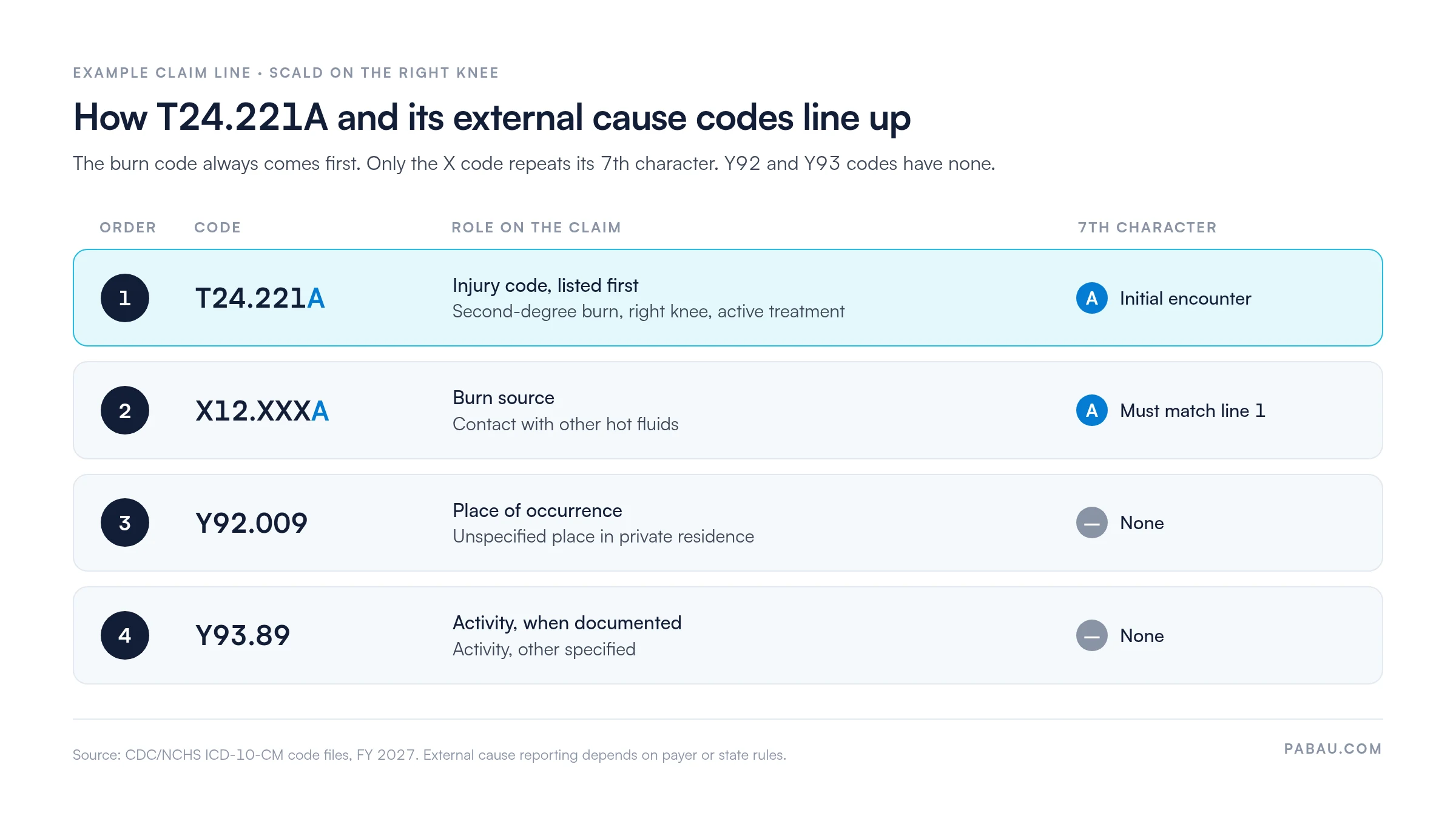
Pairing T24.221A (initial encounter) with an X code carrying 7th character D creates a conflict that payer edits will flag. Match the 7th character on every code that carries one.
Before submitting, check that T24.221A and its X-category external cause code carry the same 7th character. A claim with T24.221A (initial) alongside X12.XXXD (subsequent) triggers an automatic edit rejection at many clearinghouses. The mismatch signals conflicting encounter data.
Provider documentation must support T24.221A on six points before the claim can go out clean. Missing any one of them exposes the claim to a medical necessity denial or downcoding for lack of specificity.
Each item on the checklist maps to a field payers audit under medical necessity review. Together they are what turns a burn encounter into a clean claim.
T24.221A is a diagnosis code, not a procedure code. It pairs with a CPT code that reflects the work done at the encounter. The table below covers the most frequently billed pairings, drawing on standard medical billing workflow guidance for wound care encounters.
NCCI bundling edits apply to CPT 16020 and 97597 when billed on the same date of service. Append modifier 59 or XS only when a distinctly separate wound site or service session is documented. A superbill that captures wound size, anatomical location, and debridement method at the point of care prevents the most common pairing denials.
Denied T24.221A claims fall into a predictable set of error patterns, which makes structured denial management pay off quickly. The table below maps each denial reason to its root cause and the fix.
Many of these denials can be fixed with a corrected claim rather than a formal appeal, as long as the note already supports the change.
Run a monthly audit of all T24.221-series claims using your clearinghouse denial report. Filter by CARC 16 (lacking information), 29 (timely filing) and 197 (authorization absent). Burn claims denied for “lacking information” often trace back to a missing external cause code or an undocumented TBSA.
In many wound care practices, a coder copies the diagnosis, external cause codes and CPT pairing from the note into a separate billing tool. Each re-key is another chance to swap right for left or drop the X code.
Pabau, the practice management platform we build, keeps the treatment note, the invoice and the claim in one patient record. Its claims software for practices runs validation checks each time a claim is sent, confirming details like membership numbers and authorization codes. US claims go to payers electronically through the Claim.MD integration.
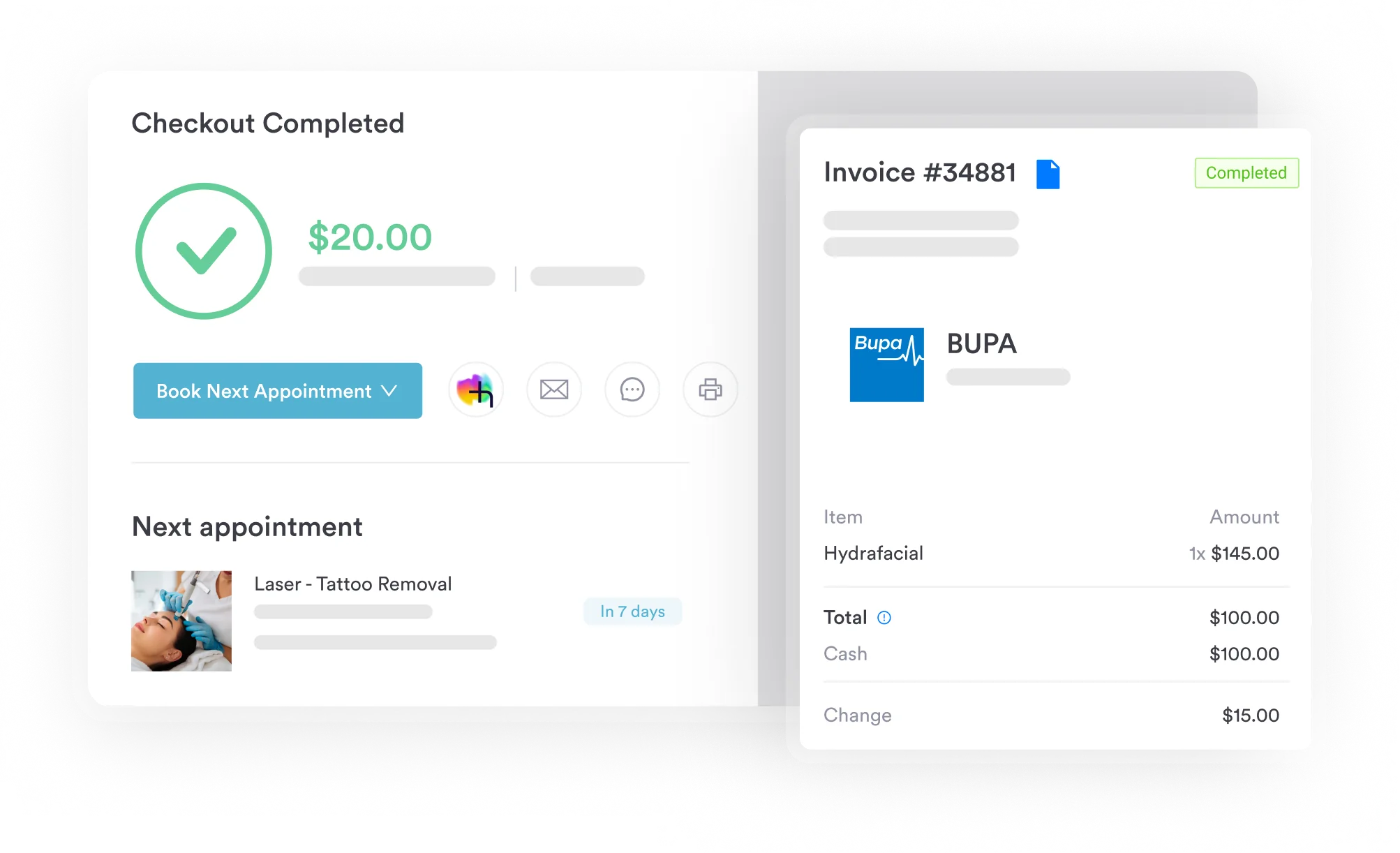
Eligibility checks, claim status and ERA remittance posting sit on the same dashboard. Catching errors at the practice level reduces the number of claims that reach the appeals cycle, and your billing team spends less time reworking denials.

Pabau keeps the burn note, the invoice and the claim in one record. Your coder sends T24.221A with the codes the note supports, from the same dashboard.

T24.221A is rarely hard to code. The provider note is where these claims are won or lost. A coder can only assign A, the right side and second degree when the note states all three.
So build laterality, depth, active treatment and the heat source into your burn note template. The trade-off is a slightly longer note at each wound care visit, which costs far less than a corrected claim and a delayed payment.
Book a demo to see how Pabau keeps burn and wound care claims accurate from the first note to the final payment.

Need a framework for tracking denied burn claims by denial code? Denial codes in medical billing covers the most common CARC and RARC codes that appear on burn claim remittances and how to work each one.
Want to understand how clearinghouse validation catches code errors before the payer sees them? Claim.MD clearinghouse overview explains how electronic claim scrubbing flags diagnosis-code issues such as a missing 7th character or companion code.
Looking for guidance on revenue cycle management for wound care practices? Revenue cycle management in healthcare walks through the end-to-end billing workflow from code assignment through payment posting.
ICD-10 Code T24.221A is the billable ICD-10-CM diagnosis code for a burn of second degree of the right knee at an initial (active-treatment) encounter. It is valid for FY 2026 and FY 2027 and sits in category T24. Corrosion of the right knee uses its own code, T24.621A, and ankle or foot burns go to T25.-.
Yes, T24.221A is a fully billable ICD-10-CM code. The parent code T24.221 is not billable without a 7th character. Only the complete forms T24.221A, T24.221D and T24.221S are valid for claim submission.
T24.221A applies during active treatment of the burn wound. T24.221D applies once care is routine and the wound is healing without active intervention. A patient receiving debridement on visit six still gets T24.221A, and switching to D while active wound care continues is a coding error.
T24.221S applies when the second-degree right knee burn has fully healed. The patient now presents for a condition the burn caused, such as a scar contracture or keloid. The sequela code sequences after the complication code. Never use S while the burn is still healing or under active treatment.
Only where a payer or state mandates it. Guideline I.C.20.a sets no national requirement, but the tabular note under T24 instructs an additional code for the place of occurrence (Y92). Some payers treat a missing Y92 code as grounds for denial, so check each payer’s rules.
Yes. T24.221A is valid in both FY 2026 and FY 2027 ICD-10-CM, according to the CDC/NCHS code files. The FY 2027 update, effective October 1, 2026, made no change to this code.