ICD-10 Code Y76.0: Diagnostic obstetric and gynecological devices
ICD-10 Code Y76.0: Definition and billable status ICD-10 Code Y76.0 is a valid, ...

Last Updated: Oct 23, 2026
Billable Code Specific Code
X14.1XXS is the billable ICD-10-CM code for other contact with hot air and other hot gases, sequela. It records that a residual condition, such as a scar or joint contracture, was caused by an earlier skin-contact burn from hot air or gas.
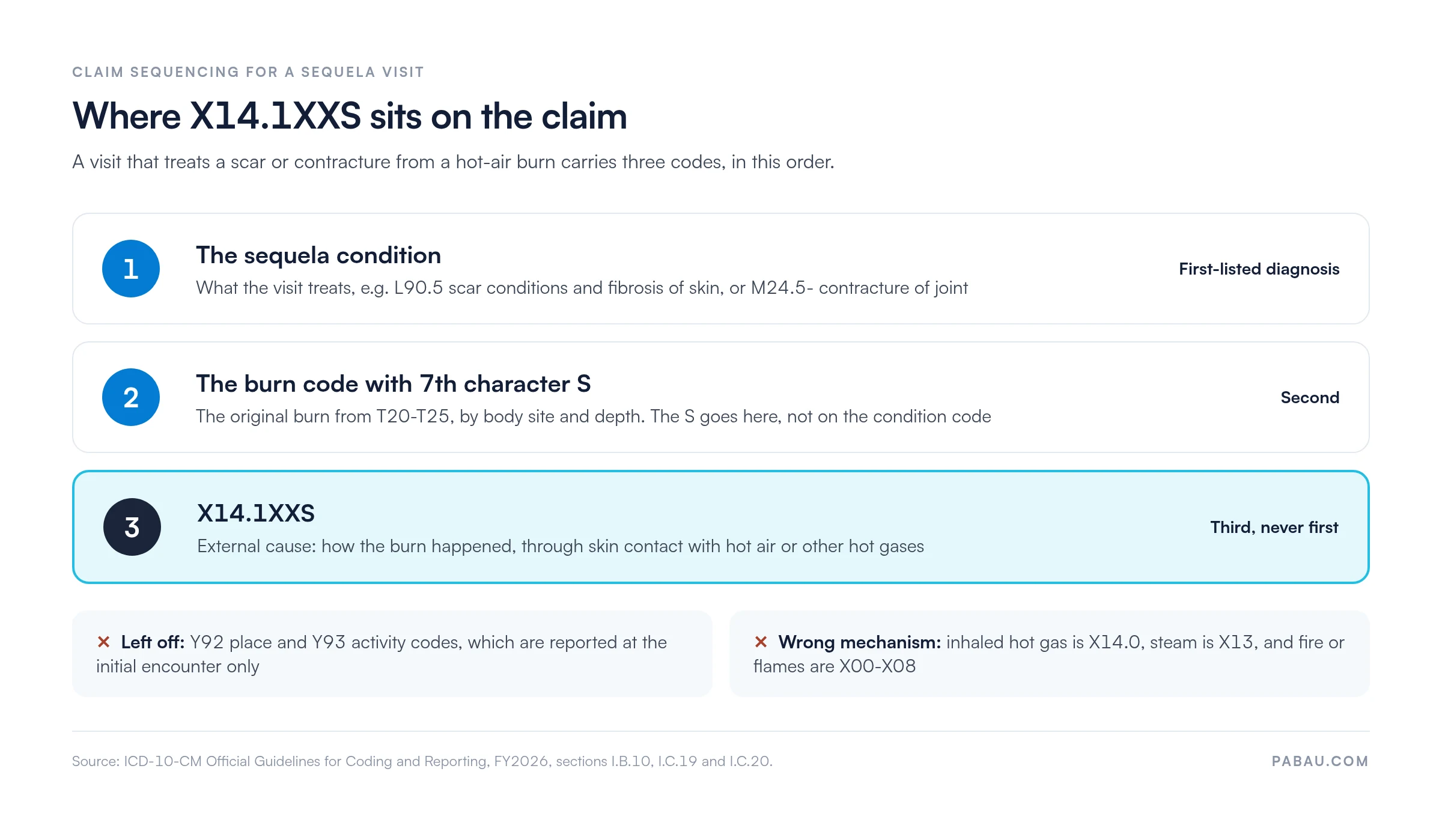
As an external cause code, it is never the principal diagnosis. The sequela condition is coded first, then the burn code with 7th character S, then X14.1XXS. Inhaled hot gases belong under X14.0, and steam burns under X13.
Let Pabau's smart automation suggest the right codes, reduce claim denials, and keep your practice compliant—effortlessly.
Automate repetitive tasks and focus on what matters most—your patients.
Reduce coding errors and ensure compliance with the latest regulations.
Clean claims, fewer denials, and faster reimbursements.
Powerful insights and reporting to help your practice thrive.
HIPAA compliant SOC 2 certified GDPR-compliant Trusted by 4,000+ clinics worldwide

X14.1XXS is a billable external cause code for skin contact with hot air or other hot gases, once the injury has reached the sequela phase.
The 7th character S applies when the visit treats a condition the burn left behind. Routine care of the healing burn itself takes D instead.
X14.1XXS can never be the principal or first-listed diagnosis. The sequela condition comes first, then the burn code with 7th character S.
Steam burns belong to X13 and inhaled hot gases to X14.0, so confirm the documented mechanism before you assign X14.1XXS.
A claim that carries X14.1XXS without the sequela condition code is denied, whatever the payer’s external cause policy.
ICD-10 code X14.1XXS reports a late effect, such as a scar or contracture, of a burn from skin contact with hot air or gases. It is billable but always secondary, listed after the code for the residual condition. The table below gives the lookup data from the CDC/NCHS ICD-10-CM tabular list, valid for FY2026 and FY2027.
X14.1XXS captures injury from direct skin or surface contact with hot air or other hot gases. The 7th character S shows the patient is now in the sequela (late-effect) phase.
It does not cover breathing in hot air or gases, which falls under X14.0. A worker who inhaled hot exhaust gas is coded at X14.0. A worker scarred by a blast of hot air from an industrial dryer, now treated for that scar, is coded at X14.1XXS.
The X14 category sits in the X10-X19 block, “Contact with heat and hot substances.” Hot gases here include compressed hot air, hot exhaust gases and blasts of heated air from industrial equipment. Steam and other hot vapors have their own category, X13, and fire and flames fall under X00-X08.
The 7th character is the easiest part of X14.1XXS to get wrong. Section I.C.19 of the ICD-10-CM Official Guidelines for Coding and Reporting (OGCR) defines the three 7th-character values for injury codes. External cause codes take the same three values, and the wrong one can get the claim rejected.
The critical distinction: D and S can both apply months after the burn, so time since injury settles nothing. D covers routine care of the burn itself while it heals. S applies when the visit treats a condition the burn left behind, such as a hypertrophic scar or a joint contracture. A wound that still needs debridement is under active treatment, which takes A.
According to the CMS ICD-10-CM coding guidance, a sequela always needs a companion code for the specific late-effect condition. That condition code is sequenced before the injury and external cause codes.
X14.1XXS inherits its instructional notes from the X10-X19 block, and the sequela guidelines fix its position on the claim.
Check whether the payer requires external cause codes before adding X14.1XXS. Medicare and many commercial payers accept but do not require them for outpatient claims. Medicaid policies vary by state. Whatever the payer’s external cause policy, a claim that carries X14.1XXS without the sequela condition code first will be denied.
The X14 category has a small set of sibling codes. Telling them apart prevents the same miscoding from repeating across every claim for one mechanism.
Confusing X14.1XXD with X14.1XXS is a frequent error in this group. Both describe surface contact with hot gases. If the provider is caring for the healing burn itself, use D. If the provider is treating what the burn left behind, use S.
Coding X14.1XXS correctly means confirming the clinical phase and putting three codes in the right order. The diagram below shows where each one sits on the claim.
The medical record must support both the sequela condition code and the external cause code. Under the OGCR and standard payer medical-review criteria, documentation for X14.1XXS claims should include the following.
Structured clinical notes that capture the mechanism, the causal link and the current condition give the coder all three facts in one place. Practices new to external cause coding can start with these medical billing fundamentals.
X14.1XXS denials follow predictable patterns. They usually come from sequencing errors or missing codes rather than coverage disputes. A practice-level denial management workflow catches these patterns before they compound.
Knowing the medical billing denial codes behind each rejection helps billing teams route X14.1XXS denials to the right fix instead of writing them off.
Run a monthly audit of all claims containing X14.1XXS. Filter for claims where the code appears in the first position, which catches the most frequent sequencing error before it becomes a pattern. Pabau, the practice management platform we build, flags denied claims in its claims dashboard. The rejections that need this check surface without a manual chart pull.
X14.1XXS is a secondary external cause code. It generates no reimbursement on its own, because payment is tied to the sequela condition code that precedes it.
Medicare and Medicaid: the OGCR chapter 20 guidelines set no national requirement to report external cause codes. Reporting becomes mandatory only under a state-based mandate or a specific payer’s policy. Some MAC (Medicare Administrative Contractor) jurisdictions and state Medicaid programs set their own rules, so check the guidance for yours.
Commercial payers: requirements vary. Some payers require external cause codes on all injury-related claims, while others treat them as informational. A few reject claims carrying external cause codes that are not on their approved secondary-code list. Check the payer’s policy through its provider portal or your remittance advice history before building X14.1XXS into a claim template.
Without claim checks, an X14.1XXS slip such as a missing condition code often surfaces weeks later as a denial. Someone then has to trace it back through the chart and resubmit.
Pabau includes claims management software that connects to the Claim.MD clearinghouse and its network of more than 4,000 US payers, including Medicare and Medicaid. Claims go out electronically from the same system that holds the appointment and the clinical note.
Before a claim leaves, clean claim validation scrubs it for missing or invalid details. If a payer still denies it, the claims dashboard flags the denial and matches the electronic remittance advice (ERA) back to the claim. Your billing team sees which X14.1XXS claims came back, fixes them and resubmits without re-keying data.

Pabau connects to Claim.MD to send claims to 4,000+ US payers, scrubs each one for missing or invalid details and flags denials in one dashboard. Your team spends less time chasing rejected X14.1XXS claims.

Before X14.1XXS goes on a claim, settle one question: is the visit treating the burn, or something the burn left behind? Only a scar, contracture or nerve deficit earns the S, and then the code goes third, behind the condition and the burn code.
The trade-off sits at the front end. A causal-link statement and a mechanism check add a minute to each note. Skipping them can cost a denial, a provider query and a resubmission.
Book a demo to see how Pabau’s claim checks and denial tracking help your billing team get sequela claims paid the first time.

Need to understand how clearinghouse submissions work? Claim.MD clearinghouse guide explains how electronic claims travel from practice to payer and where rejections come back.
Want to reduce your denial rate across ICD-10 external cause codes? Medical billing compliance best practices covers documentation standards and audit workflows for injury and external cause codes.
Looking for a structured guide to ICD-10 coding in context? Revenue cycle management fundamentals explains where diagnosis coding fits in the broader claims and payment workflow.
X14.1XXS is the ICD-10-CM code for “other contact with hot air and other hot gases, sequela.” It is an external cause code for a past skin-contact burn from hot air or gases. It is reported when the patient now has a late effect, such as scarring.
Yes, X14.1XXS is a billable ICD-10-CM code, but it can never be the principal or first-listed diagnosis. It is sequenced after the code for the sequela condition and the burn code with 7th character S.
X14.1XXD (subsequent encounter) covers routine care of the burn while it heals, after active treatment has ended. X14.1XXS (sequela) covers treatment of a residual condition the burn caused, such as post-burn scarring or restricted range of motion.
Use the 7th character S when the visit treats a condition that arose as a direct result of the original injury, such as a scar. The injury itself is no longer what is being treated. Routine healing-phase care of the injury takes D instead, and active treatment takes A.
Report the specific sequela condition first, for example L90.5 for scar conditions and fibrosis of skin, or a code from M24.5- for a joint contracture. Next comes the burn code from T20-T25 with 7th character S, then X14.1XXS. Place and activity codes are not repeated on a sequela claim.
The usual reasons are X14.1XXS listed as the principal diagnosis, a missing sequela condition code, or the wrong 7th character. Routine care of a healing burn takes D, not S. Some payers also reject external cause codes that are not on their accepted secondary-code list.