ICD-10 Code S82.242H: Displaced spiral tibial shaft fracture, delayed healing
ICD-10 Code S82.242H: Definition and code details ICD-10 Code S82.242H designate...

Last Updated: Oct 15, 2026
Billable Code Specific Code
S91.154D is the billable ICD-10-CM code for open bite of right lesser toe(s) without damage to nail, subsequent encounter.
Practices billing wound care follow-up visits lose this claim at two points. The first is applying 7th character A after the initial encounter has closed. The second is omitting right-side laterality from the clinical note. Precise documentation of the visit type and the injured side prevents both.
Let Pabau's smart automation suggest the right codes, reduce claim denials, and keep your practice compliant—effortlessly.
Automate repetitive tasks and focus on what matters most—your patients.
Reduce coding errors and ensure compliance with the latest regulations.
Clean claims, fewer denials, and faster reimbursements.
Powerful insights and reporting to help your practice thrive.
HIPAA compliant SOC 2 certified GDPR-compliant Trusted by 4,000+ clinics worldwide

S91.154D covers open bite of the right lesser toe(s) only, without nail involvement, for subsequent (follow-up) encounters
The 7th character D is required when active initial treatment is complete and the patient returns for routine healing care
Missing right-side laterality or the wrong 7th character are the two most common reasons this code is denied
Pabau’s claims management software links clinical documentation to billing codes, reducing post-encounter coding errors
ICD-10 Code S91.154D is the billable ICD-10-CM diagnosis code for an open bite of the right lesser toe(s) without damage to the nail.
It applies at a subsequent encounter, when the patient returns for routine healing care. The code is valid for fiscal year 2026 and is used across all US healthcare settings.
Each element of the S91.154D description carries a distinct coding requirement. Missing any one of them means assigning a less specific code, which risks payer rejection or audit scrutiny. The four segments below show which fact in the note fixes each part of the code.
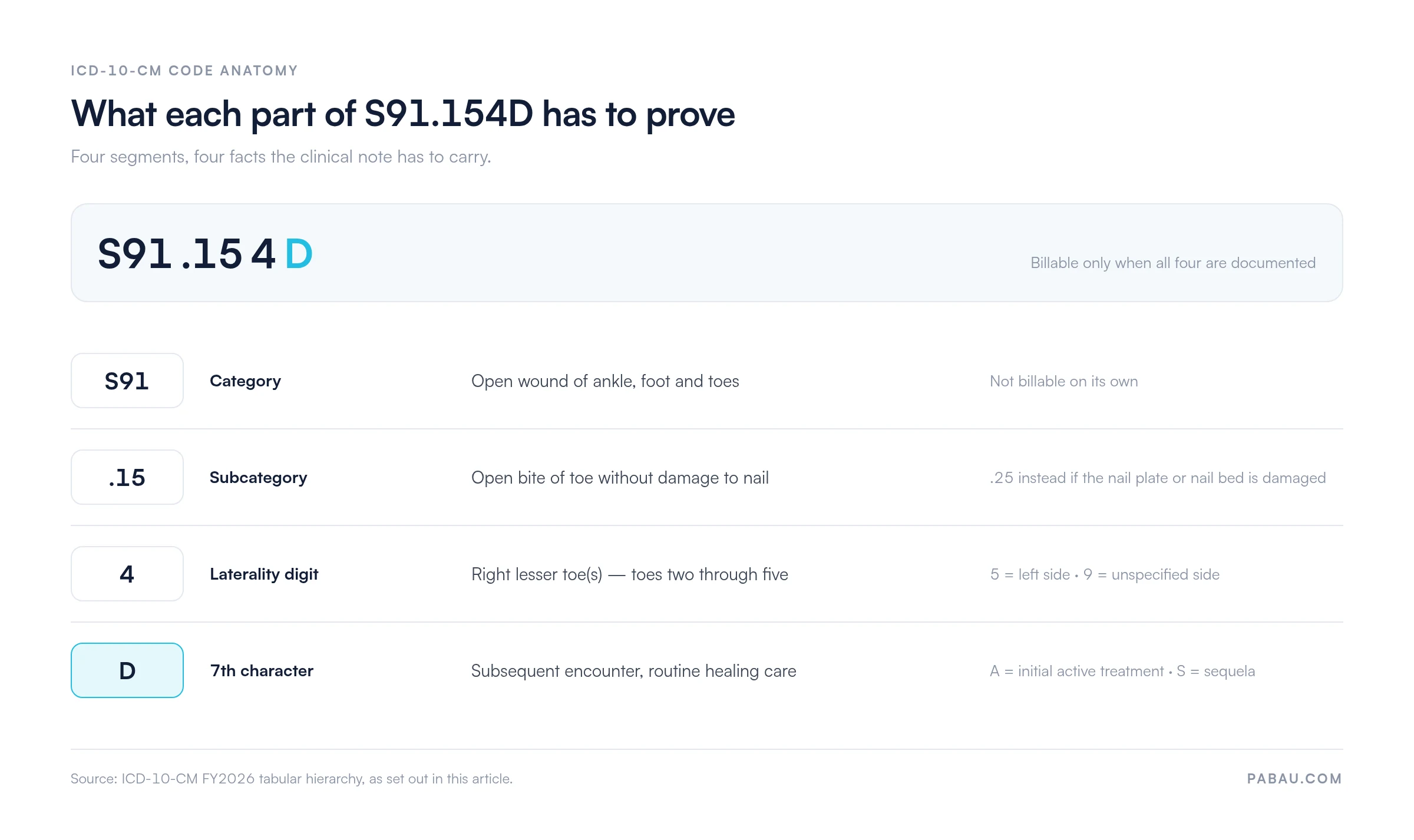
An open bite wound is a skin break caused by teeth, human or animal, that leaves an entry wound without a corresponding exit wound. It differs from a laceration (which is a tearing injury) and from a puncture (which is caused by a sharp object rather than teeth).
Coding an open bite correctly requires documented evidence of the bite mechanism. “Open wound, right toe” without a stated bite mechanism does not support S91.154D. The note must record that teeth caused the wound. Per the CMS ICD-10-CM annual update guidance, specificity of injury mechanism is a documentation requirement, not optional detail.
The lesser toes are toes two through five on either foot. The great toe (hallux) is excluded from this code family. S91.154D specifies the right foot. If the bite is on the left lesser toe(s), use S91.155D. If laterality is genuinely undeterminable, use S91.159D, though payers may flag unspecified codes for review.
Right-side laterality must appear explicitly in the clinical record. Documentation that says “lesser toe wound” without specifying right or left does not support S91.154D. Query the clinician before the claim goes out.
The S91.15 code family excludes nail involvement. If the bite wound also damages the nail plate or nail bed, the correct parent moves to S91.25. That family is titled open bite of toe with damage to nail. Billing S91.154D when the nail is involved is an inaccuracy that can surface in post-payment audits.
The clinical note must explicitly state that the nail is intact. “Wound noted to right lesser toe, nail intact” is sufficient. Absence of any nail comment is not equivalent to documented nail-intact status.
The 7th character D means the patient is receiving routine care during the healing phase after active initial treatment is complete. Under ICD-10-CM Official Guidelines, active treatment ends when the definitive management of the injury has been rendered, not when the wound has fully healed.
The most common 7th character error on wound follow-up visits is applying A when D is correct. Suppose an ED physician gave the active treatment. The patient then presents to a primary care or podiatry office for wound checks. That visit takes D, because the character follows the nature of care given today.
S91.154A, S91.154D, and S91.154S describe the same injury to the same anatomical site. They differ only in where the patient sits in the care continuum. What decides the choice is how clearly the note records the purpose of the visit.
A practical test: ask whether the clinician is managing the acute wound or a consequence of it. Healing-phase care of the wound itself takes D. A new problem caused by the original injury, after it has resolved, takes S.
The hierarchy helps coders navigate the ICD-10-CM injury classification and land on the most specific valid code.
Each step down the hierarchy adds specificity. S91 alone is not billable. S91.15 is not billable. Only the fully specified codes with a valid 7th character are billable. The CDC/NCHS ICD-10-CM web tool confirms billable status and hierarchy for the current fiscal year.
Several codes sit alongside S91.154D in the same code family. Selecting the correct one depends on laterality, nail involvement, and encounter type. The full set of neighboring entries sits in our diagnostic code library. Below is a summary of the most frequently confused sibling codes.
Every element of the code description must map to a documented fact in the clinical note. Payers conducting post-payment audits match code specificity against the medical record line by line. Missing any of the following items creates an audit exposure for the practice.
Structured clinical notes that capture injury mechanism, laterality, and nail status at the point of care reduce post-encounter documentation queries. The superbill should then carry those specifics straight through to the claim.
The laterality standard is the same across every ICD-10-CM code family. The note needs explicit text confirming the side, not a chart template default.
The AAPC ICD-10-CM coding guidelines and the ICD-10-CM Official Guidelines for Coding and Reporting are the controlling sources here. CMS and NCHS publish the latter, and the guidance below reflects both.
Three errors account for the majority of claim rejections on S91.154D and its sibling codes. Knowing them in advance is the fastest route to cleaner claims.
Validating the code before submission catches most of these errors while they are still cheap to fix. For practices handling a volume of injury follow-up visits, claims management software removes the manual re-keying step. It ties the encounter note directly to the submitted code. That step is where most 7th character errors enter the claim.
When S91.154D is the reason for the encounter, it is sequenced as the principal diagnosis. A complication such as wound infection may be added as a secondary code. S91.154D remains the principal diagnosis for that encounter.
External cause codes are reported additionally where facility or payer policy requires them. Use W54.x for a dog bite, W55.x for another animal bite, or the appropriate human bite code. They supplement S91.154D rather than replace it.
Post-payment audits on injury follow-up visits frequently focus on 7th character accuracy and laterality specificity. CMS Recovery Audit Contractor reviews have historically targeted wound care E/M claims where the encounter type code does not match the documented visit purpose. Effective denial management starts with a pre-submission documentation review rather than a post-denial appeal.
Aligning documentation workflows to the Official Guidelines before submission is the cheaper half of compliance. A clearinghouse review layer between the practice and the payer then catches format and code-level issues.
Run a monthly audit on all S91.15x subsequent encounter claims submitted in the prior period. Filter for S91.159D (unspecified laterality) and S91.154A at follow-up visit types. Both patterns point to notes that failed to record the side or the visit type, which is cheaper to fix prospectively than to appeal.
Accurate billing for S91.154D depends on three parts working together.
Practices handling wound care follow-up at volume see the same 7th character error repeat across clinicians. The usual cause is a documentation template that never prompts for encounter-type context. Adding a structured “nature of visit” field at the note level moves the decision back to the clinician.
The E/M code for the visit must also match the documented complexity of the wound assessment. Established patients fall in the 99211-99215 range. A complex wound with infection earns a higher level than a simple healing check. Both visits may carry S91.154D, so the E/M level has to carry the difference.
Today the coder reads the note after the visit and decides the encounter type from whatever language the clinician used. When the template never asked about the side or the visit type, that decision becomes a guess or a query.
Practice management software like Pabau moves that decision into the encounter itself. Structured note fields capture the injury mechanism, the side, the nail status, and whether this visit is initial treatment or healing care. The diagnosis code attaches to the note, and the claim is built from the same record.
That removes the re-keying step where wrong characters and missing laterality get introduced. Claims go out matching the documentation that supports them, and denied wound care follow-ups stop repeating across your clinicians.

Pabau links encounter notes to billing codes at the point of care, reducing the 7th character and laterality errors that generate wound care claim denials.

Assigning S91.154D is straightforward. Keeping the claim is harder, because the two facts it turns on live in the clinician’s note. The side of the foot and the purpose of the visit have to be written down before the coder ever sees the chart.
The cheapest place to fix this is the documentation template. A note that prompts for mechanism, side, nail status, and visit type supports S91.154D on the first submission. The same prompt protects every other code in the S91 family.
Pabau links the encounter note to the code that gets submitted, so the 7th character stops depending on memory. Book a demo to see how it handles wound care follow-up claims.

Need to understand the full ICD-10-CM submission workflow? Revenue cycle management covers how encounter documentation flows through to claim payment.
Struggling with payer denials on injury follow-up codes? Denial codes in medical billing explains the most common CARC codes and how to respond.
Want to validate ICD-10 codes before submission? Insurance eligibility verification and real-time claim validation through Pabau reduce denial rates on wound care visits.
ICD-10 Code S91.154D is the billable diagnosis code for an open bite of the right lesser toe(s) without damage to the nail. It is assigned at a subsequent encounter, when the patient returns for routine care during the healing phase.
Yes. S91.154D is a fully specified, billable ICD-10-CM code valid for fiscal year 2026. It includes all required elements: injury type, anatomical site, laterality, nail status, and encounter type.
S91.154A covers the initial encounter, where active treatment is given. S91.154D covers follow-up visits during the healing phase. S91.154S covers a sequela, meaning a late effect that persists after the wound resolves. The injury and site are identical in all three.
Use the 7th character D when the patient is receiving routine care after the initial active treatment of an injury is complete. This includes wound checks, dressing changes, suture removal, and infection monitoring visits, even if the wound has not yet fully healed.
No. S91.154D excludes nail damage. If the wound also involves the nail plate or nail bed, the correct family is S91.25x. That family is titled open bite of toe with damage to nail. The clinical note must state nail status either way.
Select the injury code from the S91.15x family based on the toe(s) affected, laterality, and nail involvement. Then apply 7th character D for the subsequent encounter. The note must document the follow-up context, such as a wound check or dressing change.