

ICD-10 Code S53.013D: Anterior subluxation of unspecified radial head
ICD-10 Code S53.013D: Quick reference summary Use the table below as your first ...

Last Updated: Nov 6, 2026
Billable Code Specific Code
S82.456G is the billable ICD-10-CM code for nondisplaced comminuted fracture of shaft of unspecified fibula, subsequent encounter for closed fracture with delayed healing.
Coders use it at a follow-up visit when the fibula shaft has broken into three or more aligned pieces and healing is lagging. The chart also has to be silent on which leg. If the record names the side, the code is S82.454G for the right or S82.455G for the left. Routine healing takes D, and a confirmed nonunion takes K.
Let Pabau's smart automation suggest the right codes, reduce claim denials, and keep your practice compliant—effortlessly.
Automate repetitive tasks and focus on what matters most—your patients.
Reduce coding errors and ensure compliance with the latest regulations.
Clean claims, fewer denials, and faster reimbursements.
Powerful insights and reporting to help your practice thrive.
HIPAA compliant SOC 2 certified GDPR-compliant Trusted by 4,000+ clinics worldwide

ICD-10 code S82.456G reports a nondisplaced comminuted fibula shaft fracture with delayed healing when the record never states the side.
If the chart names the leg, code S82.454G for the right fibula or S82.455G for the left.
The 7th character G means a subsequent encounter for a closed fracture with delayed healing, distinct from D (routine healing) and K (nonunion).
Support G with a clinician note or imaging read that says healing is slower than expected, plus an updated plan.
When the record is silent on displacement, ICD-10-CM defaults to displaced, so nondisplaced has to be documented.
ICD-10 code S82.456G reports a nondisplaced comminuted fracture of the fibula shaft at a follow-up visit where healing is delayed. It is the unspecified-side version of the code. So it fits only when the record never says right or left.
The code is billable and has been valid since October 1, 2015, the start of FY2016. You’ll find it in the CMS ICD-10-CM code set.
Read the code from left to right and it builds the diagnosis one piece at a time. A slip on any character changes the bone, the pattern, the side, or the visit type.
Comminuted means the bone broke into three or more fragments. Nondisplaced means those fragments stayed in alignment. Both words need to appear in the record.
Here’s the catch. Under the ICD-10-CM fracture guidelines, a fracture not documented as displaced or nondisplaced is coded as displaced. So a note that only says “comminuted fibula shaft fracture” leads to S82.453G, not S82.456G.
S82.456 takes 16 valid 7th characters, all listed in the CDC/NCHS ICD-10-CM tool. At a closed-fracture follow-up, the choice usually comes down to four.
Open fractures follow their own track. Delayed healing of an open fracture uses H for Gustilo type I or II, or J for type IIIA, IIIB or IIIC. Initial encounters use A, B or C, and S marks a sequela.
Side and pattern shift the group too. A right fibula shaft fracture that the index files under “other” takes S82.491H when the open wound is Gustilo type I or II.
The trap sits between the G and K characters. A note that says “delayed union” points to G. Only a documented nonunion supports K, so never upgrade on a hunch. Likewise, a note that reads “healing as expected” keeps you on D.
Put together, the full code comes from three checks. Run them in this order on every follow-up note.
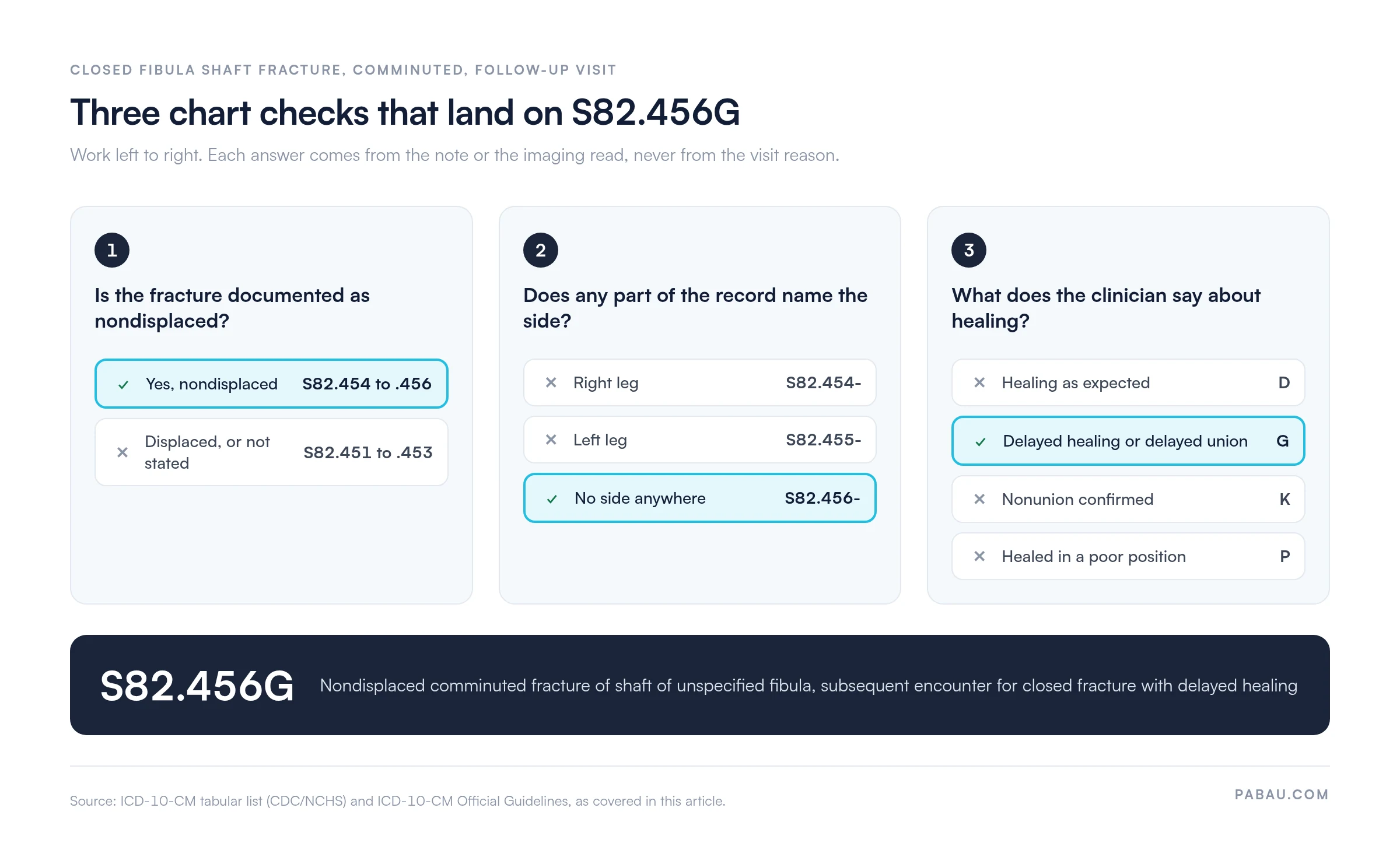
Here’s how a typical case moves through the codes. A patient falls and takes a blow to the outer leg. The ED note describes a nondisplaced comminuted fibula shaft fracture but never records the side.
Now for the twist. At the ten-week visit, the orthopedist’s note also says “left fibula.” From then on, code the side the record states, which makes it S82.455G. Unspecified codes cover missing details. They aren’t a shortcut.
Auditors look for a clear line from the record to the 7th character. Check for these points before you assign S82.456G.
Add a required healing-status field to your fracture follow-up template, with routine, delayed, nonunion and malunion as the options. Coders can then read the 7th character straight from the note instead of inferring it from the plan.
S82.456G exists for records that never name the leg. That does happen, often with outside referrals or brief ED notes. Even so, most fibula fractures have a documented side somewhere in the chart.
Check the imaging report, the referral and any operative note first. If one of them states the side, use the lateral code. Some payers question unspecified-side codes, and a specified code holds up better on audit.
One more pitfall to watch. The fibula has no condyle, so a note or lookup that pairs this code with a “lateral condyle” has confused it with the tibia. A lateral tibial condyle fracture codes to S82.12-, a different subcategory altogether.
There’s no national mandate for external cause codes, but some states and payers require them. When you report one at a follow-up, give it the D character to match the subsequent encounter.
The diagnosis explains why the visit happened. The CPT code describes what the provider did. These pairings are common on delayed-healing claims. The follow-up films that show lagging callus usually bill as 73590.
Watch the global period closely. If your practice billed 27780, 27781 or 27784, related follow-up within 90 days is usually part of the surgical package. That includes visits for delayed healing. Report them with 99024 and keep the G-coded diagnosis on the record.
A delayed-healing claim passes four stops before payment. Here’s the route, and what tends to go wrong at each one.
Our guide to denial codes in medical billing explains each remittance code. Then trace every denial to its cause in a denial management workflow. A documentation problem and a coding problem need different fixes.
Run through this list on every S82.456G claim. It takes about a minute.
The official guidelines set the floor. Payers then add their own layer, and Medicare’s local coverage determinations (LCDs) vary by contractor.
Bone growth stimulators show the difference clearly. Medicare’s osteogenesis stimulator policy covers noninvasive stimulators for long-bone nonunion, not for delayed healing. A G-coded record alone usually won’t support that order.
Extended physical therapy may need prior authorization too, so attach the imaging report to the request. If you carry many fracture cases, give them a dedicated queue in your revenue cycle management workflow. That way, claims don’t age while a payer waits for records.
Many delayed-healing denials start with retyping. Details from the note get re-entered on the claim, and the side or healing status slips along the way.
Pabau, the practice management and billing platform we build, pre-fills claims from the invoice and validates required fields before a claim goes out. Eligibility checks run through Claim.MD before the visit, and the finished claim submits through Claim.MD too.
Your team still owns the 7th character and the laterality call. The difference is that they spend that time on coding decisions rather than rework. You can see the full workflow on our claims management software page.

Pabau pre-fills claims from the invoice, validates required fields, and submits through Claim.MD, with eligibility checks through Claim.MD before the visit. Your coders keep their time for the diagnosis instead of retyping.

S82.456G is a narrow code. It fits one fracture pattern, one healing status, and a record that never names the side. That last condition should be rare, so treat every S82.456G as a prompt to search the chart once more.
Get three facts on paper before you code: delayed healing, a nondisplaced comminuted shaft pattern, and the side if it exists. With those in place, the 7th character holds up on audit.
Book a demo to see how Pabau pre-fills fracture claims from the invoice and checks them before they reach the payer.

Need a denial management framework for fracture claims? Denial management in healthcare covers how to build a denial tracking and appeal workflow by denial category.
Submitting fracture claims electronically? Clean claim submission checklist walks through the pre-submission steps that reduce first-pass denial rates on musculoskeletal claims.
Want to understand the clearinghouse behind the submission? Claim.MD clearinghouse overview explains how electronic claim routing works and what happens between the practice and the payer.
S82.456G took effect on October 1, 2015, with the FY2016 ICD-10-CM release. It has remained a valid, billable code in every annual update since.
No. The G character applies only to closed fractures. Delayed healing of an open fracture uses S82.456H for Gustilo type I or II, or S82.456J for type IIIA, IIIB or IIIC.
No. ICD-10-CM guidelines say aftercare Z codes don’t apply to injuries. For fracture follow-up, report the injury code with the matching subsequent-encounter character, such as D or G.
Yes. In outpatient settings, list it first when the delayed healing is the main reason for the visit. If another condition drives the encounter, sequence that condition first.
Yes, when the documentation supports delayed healing. Match the 7th character to the referring orthopedist’s latest note. Then tie the evaluation’s functional limits to that healing status.



