

ICD-10 Code S42.444P: Medial epicondyle fracture, right humerus
ICD-10 Code S42.444P: full descriptor and code validity ICD-10 Code S42.444P car...

Last Updated: Oct 13, 2026
Billable Code Specific Code
S82.456C is the billable ICD-10-CM code for nondisplaced comminuted fracture of shaft of unspecified fibula, initial encounter for open fracture type IIIA, IIIB, or IIIC.
Let Pabau's smart automation suggest the right codes, reduce claim denials, and keep your practice compliant—effortlessly.
Automate repetitive tasks and focus on what matters most—your patients.
Reduce coding errors and ensure compliance with the latest regulations.
Clean claims, fewer denials, and faster reimbursements.
Powerful insights and reporting to help your practice thrive.
HIPAA compliant SOC 2 certified GDPR-compliant Trusted by 4,000+ clinics worldwide

ICD-10 code S82.456C covers a nondisplaced comminuted fracture of the fibular shaft, initial encounter, with a Gustilo type IIIA, IIIB, or IIIC open wound.
The sixth character 6 means the side was never documented. Use S82.454C for the right fibula and S82.455C for the left whenever the record names a side.
Comminuted means three or more bone fragments. Nondisplaced means those fragments stayed in anatomic alignment, which the radiology report has to state outright.
The 7th character C signals active treatment of a type III open fracture. The operating surgeon assigns the Gustilo grade, and the coder never infers it.
S82.456C is billable for FY2026, the fiscal year running from October 1, 2025 through September 30, 2026.
Pabau’s claims management software integrates with Claim.MD to validate ICD-10 codes and submit claims electronically to thousands of US payers.
The table below carries the complete quick-reference data for ICD-10 code S82.456C.
Every character in ICD-10 code S82.456C carries a specific clinical meaning. Misread one segment and the code shifts to a different bone, a different fracture pattern, or a different side of the body.
The 6th character does double duty in this family. It encodes displacement and laterality in a single digit. Characters 1, 2, and 3 are the displaced options, while 4, 5, and 6 are the nondisplaced ones.
So S82.456 sits on the nondisplaced branch, paired with the laterality the record never supplied.
Reading the code from the top down makes the site and pattern obvious. Each level narrows the description by one attribute.
The fibular shaft subcategories sit beside each other under S82.4, split by fracture pattern rather than by severity. Knowing the neighbors keeps you from landing on the wrong one when the radiology wording is loose.
A report that names neither the pattern nor the displacement falls to S82.40 instead of S82.45. On a left fibula, a subsequent visit for a type III open fracture that healed in malalignment is S82.402R.
None of these describe a condyle. ICD-10-CM has no fracture code for a lateral condyle of the fibula, because the fibula has no condyle. Condyle fracture codes belong to the tibia (S82.12- and S82.13-), the femur (S72.42-), and the humerus (S42.45-).
S82.456C is valid and billable, but it is rarely the code your documentation actually supports. A Gustilo type III open fracture means a large wound, a trip to the operating room, and an operative report. Reports like that almost always name the side.
The ICD-10-CM Official Guidelines are explicit on this point. Where a code offers laterality and the record does not state a side, the unspecified option is assigned. It is a last resort after a provider query, not a shortcut past one.
Payers treat unspecified laterality on a surgical trauma claim as a documentation failure. Many will deny or pend the claim for records. Auditors flag the same pattern, because the chart usually contains the answer the coder did not use.
Before you submit S82.456C, search the chart for the words right and left in the imaging report, the operative report, and the anesthesia record. If any one of them names the side, code S82.454C or S82.455C instead. Unspecified laterality on a type III open fracture is one of the easiest denials to prevent.
The six base codes under S82.45 differ only by displacement and side. The table shows all of them with the C extension applied, so the comparison is like for like.
Two neighbors outside the S82.45 family also get confused with this code. S82.446C is the nondisplaced spiral pattern, and S82.466C is the nondisplaced segmental pattern. Both share the shaft site and the unspecified side, so only the radiologist’s pattern wording separates them.
Within S82.44, a displaced spiral fracture of the right fibula shaft codes to S82.441J at a subsequent encounter. That code applies when the fracture was open type IIIA, IIIB, or IIIC and the provider documented delayed healing.
Oblique wording in the radiology report sends the claim to S82.43 rather than S82.45. A nondisplaced oblique fracture of the right fibula that stays closed and unites in malalignment is S82.434P at the subsequent visit.
The 7th character extension is where most S82.456 coding errors happen. It captures the encounter type and, for open fractures, the Gustilo-Anderson grade. The FY2026 tabular list sets all 16 options, and they fall into a pattern once you stop reading them as a flat list.
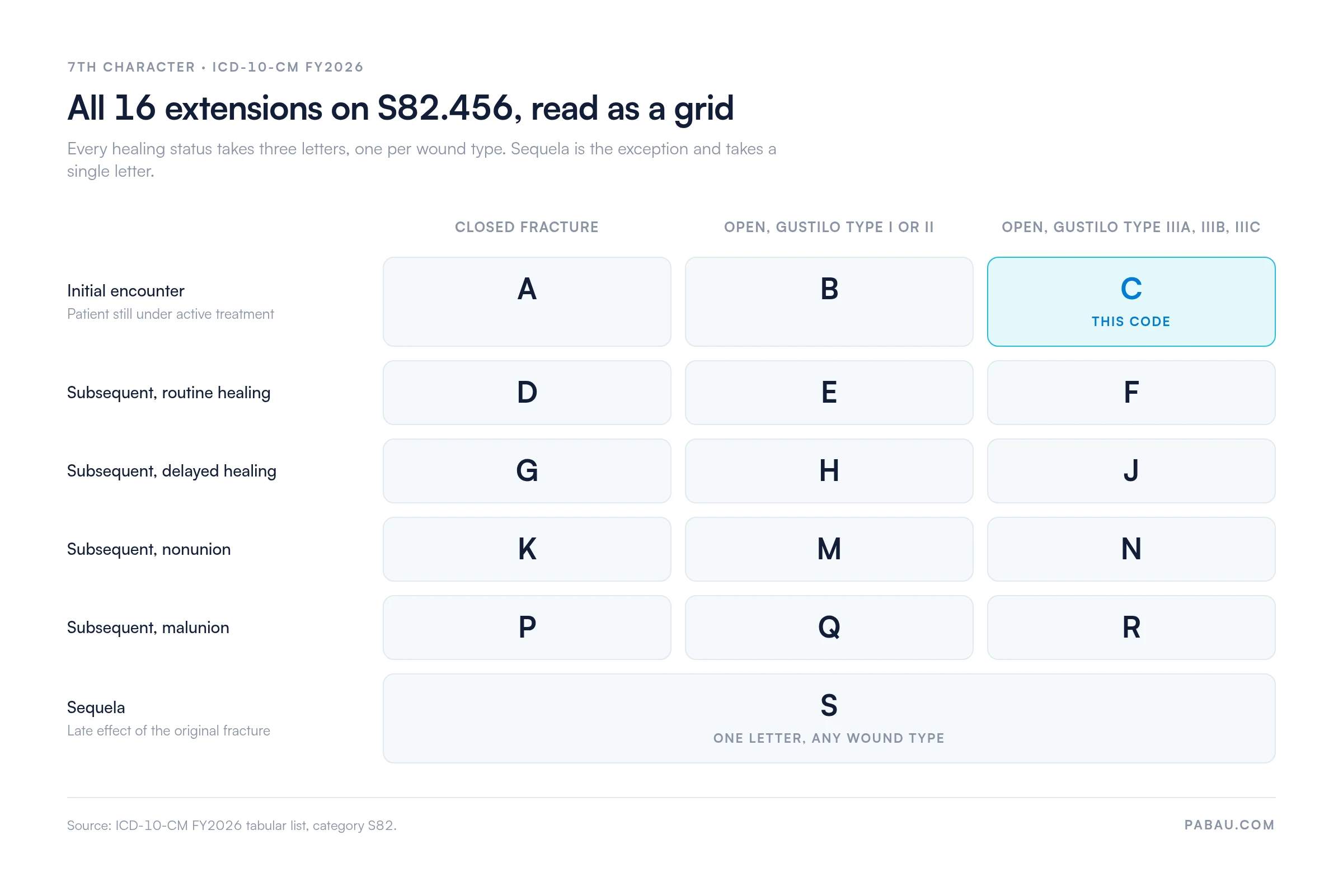
One audit trigger shows up again and again. Coders drop the C on a follow-up visit because the case feels like it moved on. Under the official guidelines, initial encounter means the patient is still under active treatment, not that this is the first visit.
A surgeon performing a second debridement in post-op week two is still delivering active treatment, so C still applies. The encounter type shifts to F only once active treatment ends and routine follow-up begins.
The Gustilo-Anderson system is the accepted standard for open fracture grading in ICD-10-CM. Gustilo and Anderson published it in 1976, and a 1984 revision split type III into the IIIA, IIIB, and IIIC subtypes. The operating surgeon assigns the grade, and the coder reads it from the operative report.
The same 7th character C covers all three type III subtypes. The tabular list does not separate IIIA from IIIB or IIIC at code level. That detail stays in the operative report, where it serves clinical and audit purposes.
Search the operative report for the exact phrase Gustilo grade or Gustilo type before assigning any open fracture 7th character. If the surgeon wrote open fracture with no grade, query the surgeon rather than defaulting to a type I grade. An ungraded open fracture on a claim is an audit flag.
The fibula runs down the lateral side of the lower leg, parallel to the tibia. Its shaft is the long middle section between the fibular neck below the knee and the flare into the lateral malleolus at the ankle. That middle section is the territory S82.4 covers.
The fibular shaft carries only a small share of body weight. Its main jobs are muscle attachment and stabilizing the ankle mortise through the interosseous membrane. It sits close to the skin along much of its length. Direct blows therefore break the bone and open the soft tissue in one go.
Comminuted means the bone broke into three or more fragments. That pattern points to a high-energy mechanism such as a motor vehicle collision, a fall from height, or a direct crush. Isolated fibular shaft fractures are less common than fractures paired with a tibial shaft injury, which is coded separately from S82.2-.
Nondisplaced comminution is an unusual combination. The bone can shatter into several pieces and still hold anatomic alignment. The interosseous membrane and surrounding muscle splint the fragments in place. The radiologist has to state it, because a payer reviewing the claim will not assume it.
One more distinction matters for coders. The nondisplaced label describes the bone fragments, not the wound. A nondisplaced fracture with a Gustilo IIIA wound is still S82.456C, and the open wound does not push it to a displaced code.
Section I.C.19.c of the ICD-10-CM Official Guidelines for Coding and Reporting governs traumatic fracture coding. These are the rules that bear directly on ICD-10 code S82.456C.
Section I.C.20 of the guidelines asks for external cause codes as secondary codes alongside S82.456C. Many payers require them, and injury surveillance data depends on them. The ResDAC guide to ICD codes in Medicare files explains how they flow through claims data.
Sequence the external cause code after S82.456C on the claim. Match its 7th character to the injury code, so an initial encounter injury pairs with an initial encounter external cause.
On a surgical claim, S82.456C usually travels with fracture care and wound management CPT codes. The procedure performed drives the CPT selection, not the diagnosis code. Verify every pairing against current AMA CPT and the payer’s local coverage determinations before submission.
Reimbursement varies by payer, geography, and facility type, so treat this table as a reference rather than a fee guarantee. Building a clean superbill that carries the diagnosis and the procedure together is what keeps medical necessity denials down.
Incomplete documentation drives most denials on complex fracture codes. Work through this checklist before the claim leaves the practice.
Checklists work best when they sit inside the clinical workflow at the point of care. Applied retrospectively at billing, they turn into rework. Laterality and grading omissions on this code family come back as common denial codes weeks after submission.
These six mistakes account for most of the denials and audit findings on this code.
Code descriptions move between fiscal years, so check the current source before you submit. FY2026 runs from October 1, 2025 through September 30, 2026.
In most practices the side of the injury is recorded once, in the imaging report, and then re-keyed by hand at billing. That hand-off is where S82.455C quietly becomes S82.456C, and the denial arrives three weeks later.
Practice management software like Pabau keeps the clinical record and the claim in the same system. Laterality, the fracture description, and the operative note stay attached to the encounter, so the biller codes from the chart instead of a summary.
Pabau’s claims management software then validates diagnosis and procedure codes before submission. Our Claim.MD integration reaches thousands of US payers electronically. Mismatches surface while you can still fix them, so fewer trauma claims come back for records.

Pabau integrates with Claim.MD to validate ICD-10 diagnosis codes against procedure codes before submission. That cuts denials on complex fracture and trauma cases across thousands of US payers.

ICD-10 code S82.456C describes a nondisplaced comminuted fracture of the fibular shaft. It applies at an initial encounter, with a Gustilo type IIIA, IIIB, or IIIC open wound. Three details have to line up in the record: the shaft site, the comminuted and nondisplaced pattern, and the surgeon’s Gustilo grade.
The fourth detail is the one that decides the claim. S82.456C carries unspecified laterality, so it is the code you use when the chart never named a side. Check for one first, because S82.454C or S82.455C is usually the code the documentation supports.
Keeping laterality and fracture detail attached to the encounter is a workflow problem more than a coding one. To see how Pabau handles it for orthopedic and trauma billing, book a demo.

Coding the tibia alongside the fibula? ICD-10 code S82.222E covers the tibial shaft fracture that often travels on the same claim.
Losing money to denials on complex injury codes? Denial management in healthcare covers the most common denial patterns and how to work through them.
Want to see how a diagnosis code moves through billing? What is revenue cycle management follows the code from the encounter to the payment.
New to the mechanics of claim submission? What is medical billing explains how diagnosis and procedure codes reach a payer.
S82.456C is a billable ICD-10-CM code for a nondisplaced comminuted fracture of the shaft of the fibula, side unspecified. The 7th character C means the patient is under active treatment for an open fracture graded Gustilo type IIIA, IIIB, or IIIC.
Neither. The 6 in S82.456 is the unspecified-laterality option, which applies when the record never states a side. Code S82.454C for the right fibula and S82.455C for the left. Query the provider before defaulting to the unspecified code.
No. ICD-10-CM has no code for a lateral condyle of the fibula, because the fibula has no condyle. S82.456C covers the shaft, or diaphysis. Condylar fracture codes exist for the tibia, the femur, and the humerus.
All three describe the same fracture at an initial encounter: nondisplaced, comminuted, fibular shaft, side unspecified. They differ by wound type. A is a closed fracture. B is an open fracture of Gustilo type I or II. C is an open fracture of type IIIA, IIIB, or IIIC.
Use an initial encounter character while the patient is receiving active treatment, including surgery and repeat wound management. Move to a subsequent character once active treatment ends and routine monitoring begins. The type of care decides it, not the number of visits.
Common pairings include W19.XXXA for an unspecified fall and W01.XXXA for a fall on the same level from slipping or tripping. Use V49.9XXA for an unspecified motor vehicle traffic accident. Sequence them after S82.456C with a matching 7th character.
CPT 27784 covers open treatment of a proximal fibula or shaft fracture with or without internal fixation. Debridement at the open fracture site uses 11010 through 11012, depending on tissue depth. Verify every pairing against current AMA CPT and the payer’s coverage policies.
Yes. S82.456C is a billable, specific ICD-10-CM code for FY2026, the fiscal year that runs from October 1, 2025 through September 30, 2026. Check the CDC ICD-10-CM browser tool each October, since descriptions can change with the annual update.




