ICD-10 Code S42.444P: Medial epicondyle fracture, right humerus
ICD-10 Code S42.444P: full descriptor and code validity ICD-10 Code S42.444P car...

Last Updated: Oct 13, 2026
Billable Code Specific Code
S82.245N is the billable ICD-10-CM code for nondisplaced spiral fracture of shaft of left tibia, subsequent encounter for open fracture type IIIA, IIIB, or IIIC with nonunion.
The sixth character is where this family trips coders up. In S82.24-, the digit 4 is the right tibia, 5 is the left, and 6 is unspecified. Bill the wrong digit and the claim names the wrong leg.
Let Pabau's smart automation suggest the right codes, reduce claim denials, and keep your practice compliant—effortlessly.
Automate repetitive tasks and focus on what matters most—your patients.
Reduce coding errors and ensure compliance with the latest regulations.
Clean claims, fewer denials, and faster reimbursements.
Powerful insights and reporting to help your practice thrive.
HIPAA compliant SOC 2 certified GDPR-compliant Trusted by 4,000+ clinics worldwide

ICD-10 code S82.245N is a nondisplaced spiral fracture of the shaft of the left tibia. You report it at a follow-up visit, once an open type IIIA, IIIB, or IIIC injury reaches nonunion.
Laterality sits in the sixth character: S82.244 is the right tibia, S82.245 is the left tibia, and S82.246 is unspecified.
Category S82 has no bilateral code, so two-sided spiral shaft fractures take the right-side code and the left-side code together.
The seventh character N carries three facts at once: a subsequent encounter, an open type IIIA, IIIB, or IIIC wound, and nonunion.
Nonunion needs its own evidence, so the record must show dated imaging or clinical findings that the fracture has not united.
The official descriptor is: Nondisplaced spiral fracture of shaft of left tibia, subsequent encounter for open fracture type IIIA, IIIB, or IIIC with nonunion.
Coders reach for it at a follow-up visit, once imaging shows that a severe open tibial shaft fracture has stalled short of union.
The code is billable, valid for HIPAA-covered transactions, and active in the fiscal 2025 and 2026 code sets per the CDC/NCHS ICD-10-CM official web tool.
Every character in that string carries clinical and billing meaning. Miss one and the claim says something the chart does not support, which is the usual reason orthopedic and trauma claims come back unpaid.
Tibial fracture codes pack a lot of detail into seven characters. S82.245N reads left to right, with each position adding one clinical dimension. Read it this way and a wrong digit shows up before the claim leaves the practice.
S82.245 on its own is not billable. It is a base code, and a claim only clears an edit once the seventh character is attached to it.
In the S82.24- family the sixth character does two jobs at once. It states whether the fracture is displaced or nondisplaced, and it states the side.
Digits 1 to 3 cover displaced fractures, and digits 4 to 6 cover nondisplaced fractures. Within each set, the order runs right, left, then unspecified.
Two habits protect the claim here. Read the side off the operative or radiology report rather than the referral. Never treat 6 as a shortcut for a side the provider did not write down. Query the provider instead, because an unspecified-laterality code invites a records request.
Bilateral cases work the same way. ICD-10-CM gives category S82 no bilateral character. A patient with spiral shaft fractures of both tibiae takes two codes, one from S82.244- and one from S82.245-. Each code carries its own seventh character. If the right tibia is healing routinely after an open type IIIA, IIIB, or IIIC injury, that side takes S82.244F.
The seventh character is where most fracture claims go wrong. For S82.245N, the letter N states three facts at once. The patient is at a subsequent encounter, the original wound was graded IIIA, IIIB, or IIIC, and the fracture is in nonunion. All three have to be in the record.
S82.245 accepts 16 seventh characters in total. The letters I, L, and O are skipped across the fracture chapter. A set that jumps from H to J is complete, not broken.
Before you assign N, find the sentence that supports it. A radiology report or an orthopedic note confirming failed union will carry the code. A note that says only “not yet healed” will not. Without that evidence, the visit belongs to F for routine healing or J for delayed healing.
These three outcomes get mixed up more often than any other pair of characters in the family. Delayed healing means the fracture is still uniting, only slowly.
Nonunion means it has stopped uniting. Malunion means it united in a poor position. The grid below pairs each outcome with the wound type.
Read the grid down the column that matches the original wound, then across to the outcome the provider documented at this visit.
That order keeps the wound grade fixed and lets the healing status change from visit to visit, which is how the classification is built.
The Gustilo-Anderson system grades open fractures by the extent of soft-tissue injury. ICD-10-CM folds that grade into the seventh character.
Coders therefore need to know what separates type III from types I and II, and what sets IIIA apart from IIIB and IIIC.
S82.245N applies when the original left tibial injury was graded IIIA, IIIB, or IIIC, and the patient now returns with confirmed nonunion.
That grade has to appear in the operative or emergency department note before a coder can use any C, F, J, N, or R character. If the grade was never recorded, code to the most specific character the record does support.
Document the Gustilo-Anderson grade at the initial encounter. Coders working the follow-up visit rely entirely on what was written the day of the injury. A note that says only ‘open fracture’ forces the coder back to an unspecified character. That choice can trigger payer edits or a request for records.
The seventh character changes as the patient heals, while the first six stay put. That is the most useful habit to build with this family.
The timeline below follows one left tibial shaft fracture from the emergency department to a revision procedure.
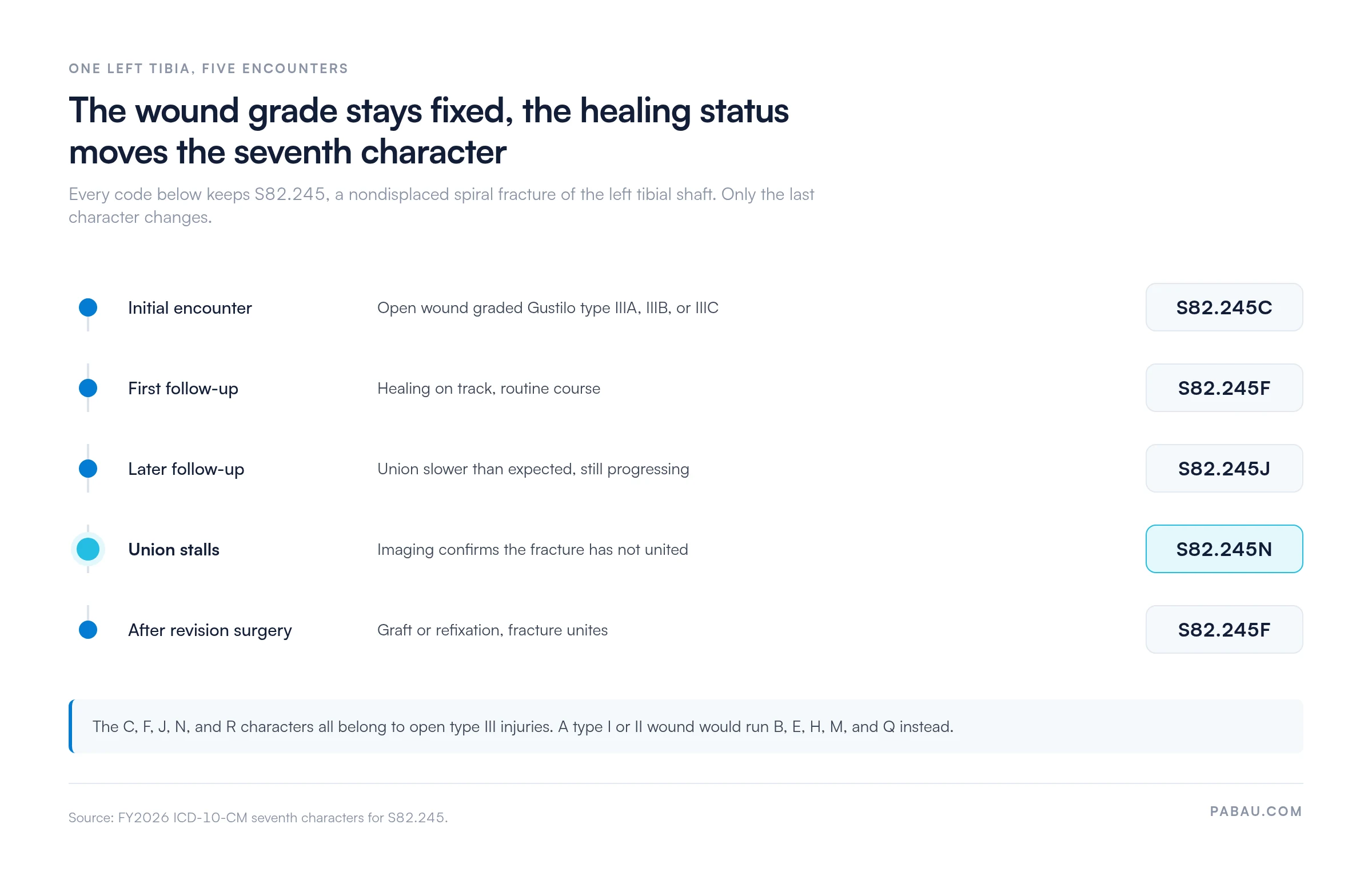
Two moments in that course cause most of the errors. The first is the switch from C to F, which happens when active treatment ends and follow-up care begins. The second is the switch from J to N, which needs imaging evidence rather than a clinical hunch.
The claim itself moves like any other professional claim. A coder pulls the diagnosis from the encounter note, and a biller drops it onto the 837P professional claim file.
The payer then reads that diagnosis against the procedure billed the same day. A revision graft or a bone stimulator makes the nonunion character the line they check first.
Every member of the S82.245 family describes that same injury, a nondisplaced spiral fracture of the shaft of the left tibia. They differ only by encounter, wound type, and healing status.
Picking the wrong member is a routine source of claim edits in orthopedic and trauma practices. The AAPC Codify ICD-10-CM lookup is a quick way to cross-check the family before submission.
Three codes account for most of the confusion around S82.245N. Use S82.245K when the original fracture was closed. Use S82.245M when the open wound was graded type I or II. Use S82.245R when the same type III fracture has healed in a poor position instead of failing to unite.
Walking the hierarchy from the category down is the safest way to land on the right level of detail. It also shows which sibling codes cover the other side and an unspecified side.
The same walk shows which sibling to reach for when the note names the other leg. Our diagnostic code library covers those siblings and the rest of the S82 branch.
Coding the right leg when the note says the left is one of the easiest denials to prevent. A hierarchy check catches it in seconds.
Clinicians rarely write the ICD-10-CM descriptor word for word. These are the phrasings that map to S82.245N, so you can recognize the code behind an ordinary orthopedic note.
Phrases such as “failed healing”, “no callus formation”, “persistent fracture gap”, or “nonunion confirmed on radiograph” support the N character at a follow-up orthopedic visit.
Subsequent encounter also covers post-acute settings, including outpatient orthopedics, rehabilitation, and wound care, as long as someone is actively managing the fracture.
The ICD-10-CM Official Guidelines for Coding and Reporting decide how fracture codes are sequenced and which encounter character applies.
The Centers for Medicare and Medicaid Services publishes the guidelines alongside the code set. Five rules do most of the work on this code.
Those five rules settle most cases. What is left is usually a documentation problem rather than a coding problem, which the next section deals with.
S82.245N asks the record to prove four facts at once: the fracture pattern, the side, the original wound grade, and the current healing status.
Work through the three checks below before the claim leaves the practice.
A note that says nonunion is not always enough for the payer. Medicare’s national coverage policy for osteogenic stimulators, NCD 150.2, spells out the standard most plainly. It treats a long-bone nonunion as established only when serial radiographs show healing has stopped for at least three months.
That means two sets of films taken at least 90 days apart, each with multiple views and a written interpretation by a physician. ICD-10-CM does not demand that evidence before you assign N. A record that clears NCD 150.2 satisfies any reviewer who asks later.
Billing a tibial shaft nonunion runs through several checkpoints. The original Gustilo grade has to be on file, and the encounter has to read as follow-up care.
The nonunion also has to be confirmed before anyone assigns S82.245N. When one of those links breaks, the claim comes back for more information.
Practice management software like Pabau keeps that chain in one place. Its connected claims management lets coders attach ICD-10 codes to the encounter note itself, so the diagnosis and the supporting record stay together.
Claims then leave through the Claim.MD clearinghouse integration, which reaches thousands of US payers. The same connection checks eligibility in real time and posts electronic remittance advice against the original claim.
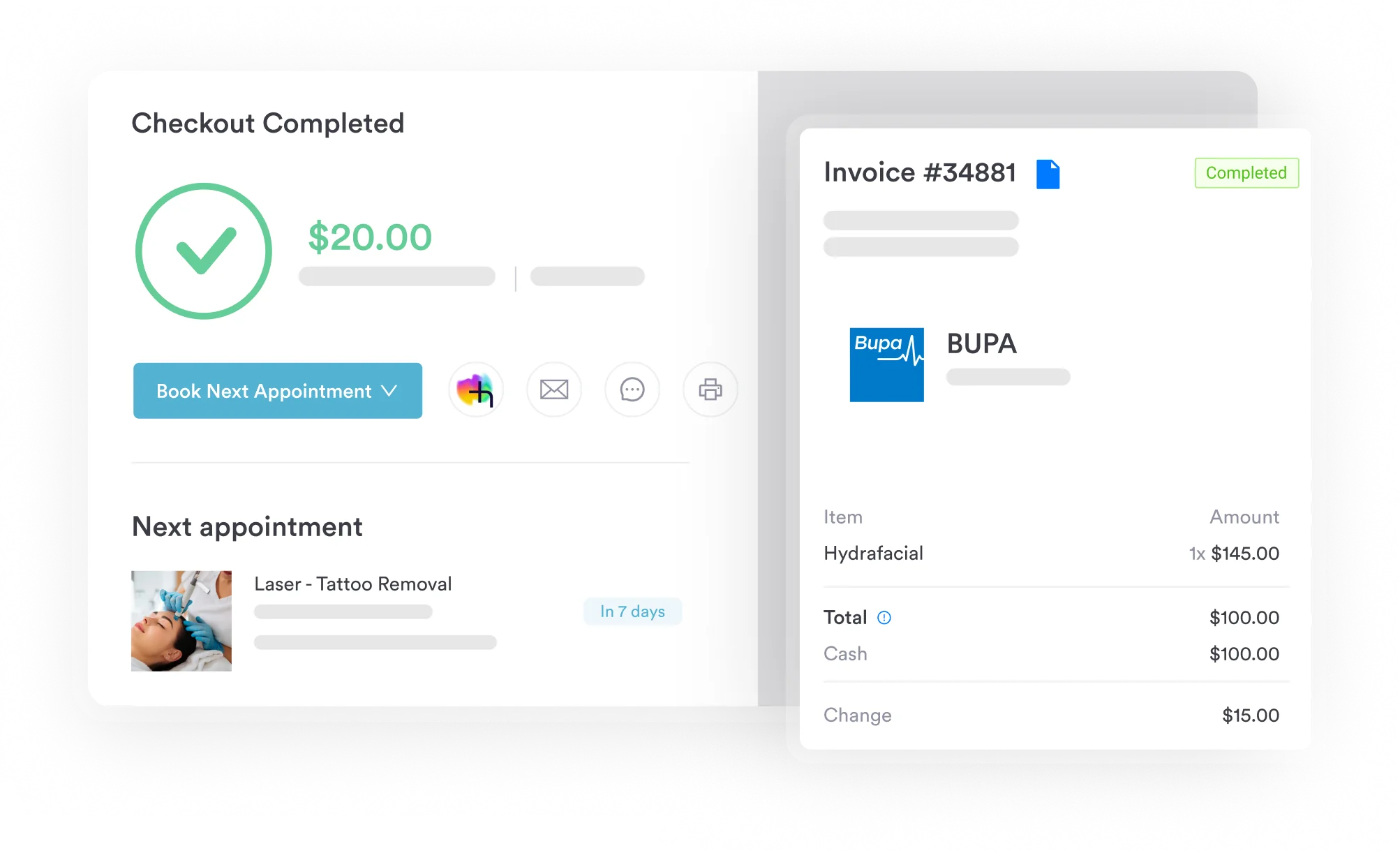
Nonunion cases stay open for months, so the paperwork has to survive a long follow-up course. When a payer rejects a line, Pabau shows the denial reason next to the original claim data.
The billing team can correct the code and resubmit, without rebuilding the claim. Submitting a clean claim first time removes one of the most common causes of payment delay on these cases.
Audit the S82.245 family once a quarter. Pull every claim that carries a seventh character of K, M, N, P, Q, or R, and open the encounter note behind each one. It needs dated imaging or clinical findings of nonunion or malunion. Claims without that evidence are the ones a retrospective review will ask you to repay.

Pabau ties ICD-10 code selection to your clinical notes and claim submission. Your orthopedic and trauma billing team spends less time fixing errors, and more time getting paid.

S82.245N covers one narrow scenario. The patient had a nondisplaced spiral fracture of the left tibial shaft, from an open Gustilo-Anderson type IIIA, IIIB, or IIIC injury. It now shows confirmed nonunion at a follow-up visit. Two checks keep it accurate: the sixth character 5 for the left side, and dated evidence of nonunion in the note.
Get those two right and the rest of the code follows from the original injury. To see how Pabau keeps that documentation trail connected from clinical note to claim, book a demo with the team.

Need a reference for denial codes on fracture claims? Denial codes in medical billing covers the most common remittance adjustment codes and how to respond to each one.
Looking for guidance on claim submission best practices? Medical billing compliance outlines the documentation and submission standards that reduce claim rejections across musculoskeletal and trauma cases.
Want to understand how clearinghouses process orthopedic claims? Medical claims clearinghouse explains how electronic claim routing works and what to look for when evaluating a clearinghouse partner.
Exploring the 837P claim format for fracture billing? 837 file breaks down the electronic claim file structure used for professional claims, including how diagnosis codes map to claim segments.
It is not required nationally, but report the cause code when the record says how the injury happened. Give it a subsequent-encounter character too. Place, activity, and status codes belong to the initial encounter only.
No. Injury aftercare is reported with the injury code plus the seventh character for a subsequent encounter, so S82.245N does that work by itself.
ICD-10-CM sets no clock, so the provider’s documentation decides. Medicare’s osteogenic stimulator policy is stricter: it wants radiographs showing healing has stopped for at least three months.
No. Diagnosis codes take no laterality modifier, because the sixth character already says left. LT and RT belong on the procedure lines instead.
Not at that visit. You still report S82.245N while the fracture has not united, and the procedure code carries the repair. Once imaging shows union, move to S82.245F.
Yes. If the record also documents a failed plate, nail, or screw, add a mechanical complication code from category T84 for that device.