

ICD-10 code S61.201A: Open wound of left index finger without nail damage
ICD-10 code S61.201A covers a left index finger wound of unstated type ICD-10 co...

Last Updated: Oct 16, 2026
Billable Code Specific Code
S82.132K is the billable ICD-10-CM code for displaced fracture of medial condyle of left tibia, subsequent encounter for closed fracture with nonunion.
Coders reach for it when a left tibial plateau fracture has stopped healing rather than healing slowly. A strong medical billing workflow starts with precise diagnosis coding.
The Centers for Medicare and Medicaid Services (CMS) and the National Center for Health Statistics (NCHS) co-maintain the ICD-10-CM code set. S82.132K became effective October 1, 2025 under the FY2026 release and remains valid for the current coding year.
Let Pabau's smart automation suggest the right codes, reduce claim denials, and keep your practice compliant—effortlessly.
Automate repetitive tasks and focus on what matters most—your patients.
Reduce coding errors and ensure compliance with the latest regulations.
Clean claims, fewer denials, and faster reimbursements.
Powerful insights and reporting to help your practice thrive.
HIPAA compliant SOC 2 certified GDPR-compliant Trusted by 4,000+ clinics worldwide

S82.132K is the billable ICD-10-CM code for a displaced, closed fracture of the left medial tibial condyle that has failed to unite.
Character K applies only after active treatment has ended and the provider has documented that healing stopped.
The common error is selecting K when the fracture is still healing at follow-up. Use D for routine subsequent encounters and G for delayed healing.
S82.132K is exempt from present on admission reporting, so an inpatient claim carries no POA indicator for it.
Pabau supports ICD-10 diagnosis code entry and electronic claim submission, which reduces coding errors on complex fracture encounters.
ICD-10 Code S82.132K is a specific, billable ICD-10-CM diagnosis code. Its full official long description is: Displaced fracture of medial condyle of left tibia, subsequent encounter for closed fracture with nonunion.
S82.132K already encodes five clinical elements. They are left laterality, displacement, a closed fracture, a subsequent encounter, and nonunion. No additional code is needed to capture any of them, and the code stands alone as a diagnosis on a HIPAA-covered claim. Submit it via your claims management software alongside the CPT procedure code for the encounter.
Each word in the ICD-10 Code S82.132K description carries coding weight. Understanding the anatomy and clinical terms prevents the most common documentation mismatches.
Practices managing orthopedic follow-up workflows can use physical therapy documentation software to track healing progress notes across encounters. That record is what supports an accurate encounter type at each visit.
The 7th character is the most consequential element of S82.132K for coders. It specifies both the encounter type and the healing status. The full 7th character set for S82.132_ closed fractures is shown below.
Character K applies only when all three of these conditions hold:
Confusing K with G is one of the most common errors on tibia fracture claims. Delayed healing (G) means the fracture is still progressing toward union, even if slowly. Nonunion (K) means it has stopped progressing.
That distinction changes the clinical and the billing picture. Understanding ICD-10-CM 7th character coding rules across code families reinforces the same logic.
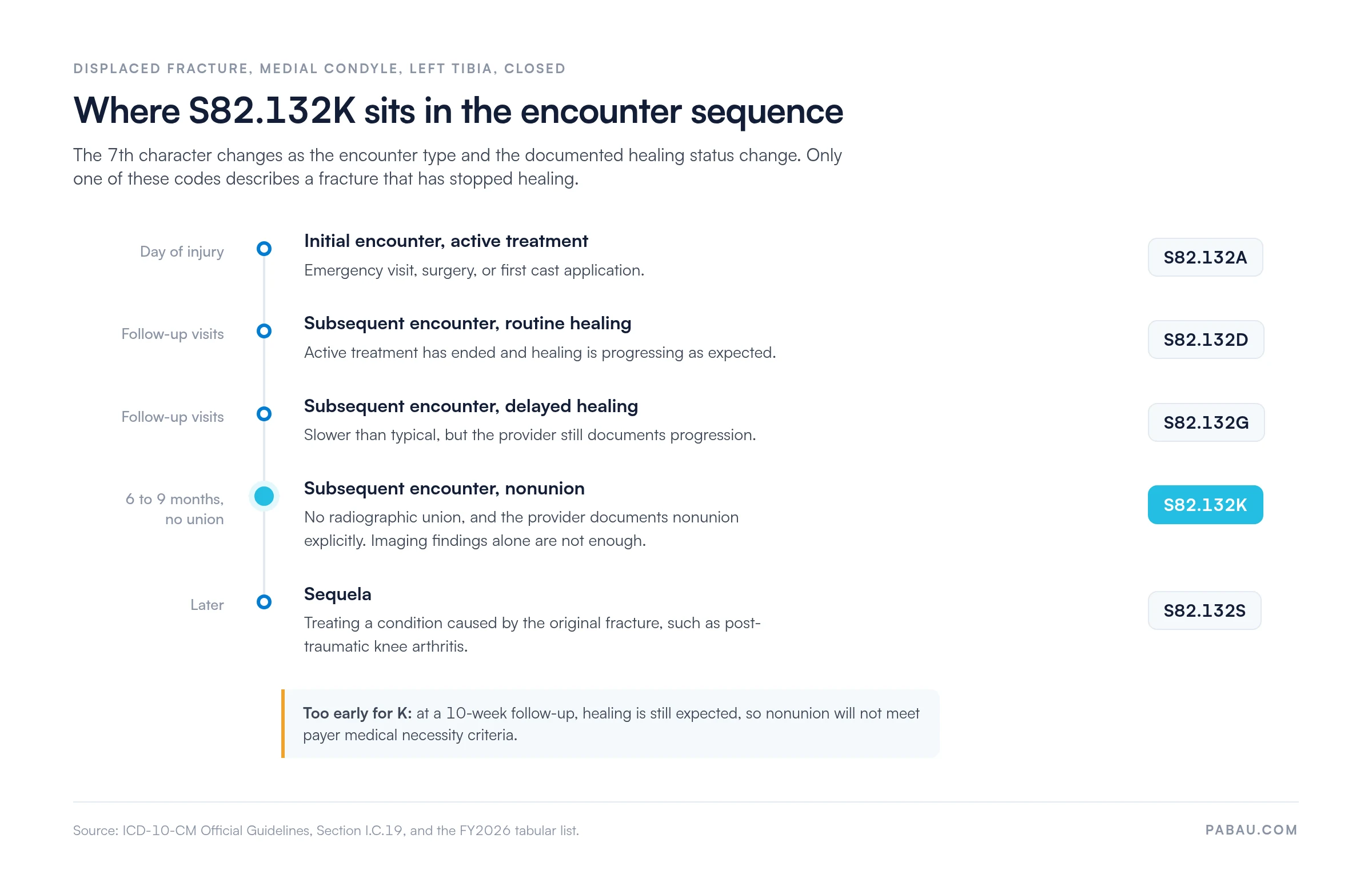
Laid out across a single patient’s care, the choice is a sequence rather than a menu. The visual below shows where each 7th character lands.
S82.132K sits within a defined hierarchy in the ICD-10-CM tabular list. Knowing the full parent chain helps coders navigate to the correct code. It also helps them use the ICD-10 diagnostic code hierarchy correctly when referencing related injury chapters.
Never bill S82.132 (without the 7th character) or any of its parent codes. CMS claims systems require the most specific code available. An unspecified or truncated code at the S82.132 level will reject on submission.
The S82.132 family covers every encounter type and healing status for a displaced fracture of the left medial tibial condyle. Coders also need the sibling laterality codes for right-sided and unspecified presentations. Understanding laterality coding in ICD-10-CM helps avoid the common error of picking the wrong side.
S82.139K (unspecified laterality) belongs on a claim only when the operative or imaging report does not say which side was fractured. Most encounters document laterality. Using the unspecified code when a specific one exists can prompt a payer query.
Clinical documentation does not always use the exact ICD-10-CM descriptor language. The terms below appear in operative notes, discharge summaries, and radiology reports. Each maps to ICD-10 Code S82.132K once the encounter and healing-status criteria are met.
Phrases like “failed union” or “no evidence of healing” can appear at a follow-up for a case previously coded S82.132A or S82.132D.
Query the provider before you select the 7th character, and ask them to confirm nonunion (K) or delayed healing (G). Accurate superbill documentation at the point of service reduces how often those queries are needed.
Per the CMS ICD-10-CM Official Guidelines, Section I.C.19 governs traumatic fracture coding. The key rules for S82.132K are below.
Coders cannot assign K from imaging findings alone. The attending provider has to document nonunion in a clinical note, operative report, or progress note. Phrasing that supports the assignment includes:
A radiology report describing “no callus formation” or “fracture line still visible” is supportive. On its own, without a provider-level interpretation, it is not enough.
Delayed healing (G) and nonunion (K) are not interchangeable. Use G when the provider documents that healing is progressing but slower than typical. Use K when healing has ceased or the provider has formally diagnosed nonunion.
Query the provider whenever the documentation is ambiguous, because selecting K without explicit nonunion wording risks a medical necessity denial. Good fracture claim denial management starts with precise 7th character selection at the coding stage.
S82.132K is typically the principal diagnosis when the nonunion is the reason for the encounter. If the patient presents for surgical repair, sequence S82.132K first and pair it with the CPT code for the procedure. That is usually open reduction and internal fixation or bone grafting.
Where the encounter treats a complication secondary to the nonunion, such as knee joint instability, the complication code may be sequenced first. Practices that see high volumes of orthopedic follow-up patients benefit from sports medicine practice management tools that track multi-encounter diagnostic journeys.
Check the imaging date against the fracture date before assigning K. Nonunion is typically diagnosed after 6 to 9 months without radiographic union. Assigning S82.132K at a 10-week follow-up, when healing is still expected, will not align with payer medical necessity criteria and may trigger a documentation audit.
S82.132K is used at any follow-up encounter where the provider has documented that the closed left medial condyle fracture failed to unite. Reference pages tend to stop at the descriptor, so the scenarios below show the documentation trigger and the reasoning behind the code choice.
S82.132K sits on the ICD-10-CM present on admission exempt list, so an inpatient claim carries no POA indicator for it. That holds even when the nonunion repair is the reason for admission. The exempt list is republished with the code set each fiscal year, so confirm the current edition before you build a coding policy around it.
The other diagnoses on that same inpatient claim still need an indicator. CMS requires POA reporting to separate conditions that existed at admission from those that developed during the stay.
POA reporting is a Medicare and Medicaid inpatient requirement, so outpatient orthopedic visits never carry an indicator at all. Practices that admit patients for nonunion repair should still confirm the wider compliance documentation for physical therapy and orthopedic settings.
Do not treat the POA exemption as permanent. The exempt list is republished with each annual ICD-10-CM update. Check S82.132K against the current CMS file at the start of every fiscal year, rather than carrying last year’s coding policy forward.
A nonunion diagnosis never shows up at the first visit. It emerges across months of follow-up. The 7th character moves from A to D or G, and finally to K once the provider records nonunion. Where those encounters sit in separate notes and a billing spreadsheet, the coder rebuilds that history by hand at every visit.
Practice management software like Pabau keeps the sequence in one client record. The orthopedic progress note, the imaging date, and the code submitted last time all sit against the same patient. A coder can see the visit where the documentation shifted from delayed healing to nonunion.
Claims then leave from the same record. Pabau’s electronic claims via Claim.MD integration submits ICD-10-CM diagnosis codes, including complex injury codes like S82.132K, to thousands of US payers.
Built-in validation flags incomplete or mismatched code sets before the claim leaves the practice, which is where a wrong 7th character is cheapest to catch.

Pabau puts ICD-10 diagnosis code entry inside the billing workflow, so complex fracture encounters like nonunion reach the payer with the right 7th character. See how Pabau tracks a diagnosis from initial injury through every follow-up.

Nonunion coding errors on tibia fracture claims are almost always 7th character errors. Four conditions have to align before K is correct. The fracture is closed and displaced, it is in the left tibia’s medial condyle, the encounter is subsequent, and the provider has written down nonunion. Change any one of those and a different code applies.
The practical safeguard is the documentation trail rather than the code lookup. If the note that turns G into K is easy to find at the next visit, the claim holds up under review. If it is not, no amount of care at the coding stage will rescue it.
Pabau’s claims management software keeps that trail against the patient record. Book a demo to see how Pabau handles multi-encounter fracture billing from the initial injury onward.

Need to understand how claims clear before reaching the payer? Medical claims clearinghouse guide explains how clearinghouses validate ICD-10 codes and flag claim errors before submission.
Want to reduce ICD-10 claim rejections across your practice? Clean claim requirements for ICD-10 billing covers the documentation and coding standards that prevent rejections on injury-related diagnoses.
Looking for guidance on electronic remittance and ERA processing? Electronic remittance advice (ERA) in medical billing covers how payer responses to fracture claims are structured and how to read denial reason codes.
ICD-10 Code S82.132K is a billable ICD-10-CM diagnosis code for a displaced fracture of the medial condyle of the left tibia. It applies at a subsequent encounter, where the closed fracture has failed to achieve bony union. Each part of the code carries a clinical detail: laterality (left), displacement status (displaced), fracture openness (closed), encounter type (subsequent), and healing status (nonunion).
Yes. S82.132K is a specific, billable ICD-10-CM code valid for FY2026 and accepted for HIPAA-covered electronic transactions. It became effective October 1, 2025. Its parent codes (S82.132, S82.13, S82.1, S82) are not billable, so always submit the full 7-character code.
The 7th character K designates a subsequent encounter for a closed fracture with nonunion. The fracture has failed to achieve bony union and active treatment is no longer occurring. It is distinct from D (routine healing) and G (delayed healing), both of which imply the fracture is still on a healing trajectory.
S82.132G applies when the fracture is healing more slowly than expected. S82.132K applies when the fracture has stopped healing and the provider has formally documented nonunion. Delayed healing implies progression is still occurring; nonunion implies it is not. Using K without explicit provider documentation creates medical necessity risk.
No. S82.132K appears on the ICD-10-CM present on admission exempt list, so an inpatient claim carries no POA indicator for it. Other diagnoses on the same claim still need one. The exempt list is republished with each annual code set update, so check the current CMS file each fiscal year.
Common pairings include office or outpatient evaluation and management codes such as 99213 or 99214 for follow-up visits. Surgical repair of the nonunion uses procedure codes for open reduction and internal fixation or bone grafting. The specific CPT depends on the service provided, so verify every pairing against current payer guidelines.
Fracture nonunion is the failure of a fractured bone to achieve bony union within the expected healing timeframe, generally accepted as 6 to 9 months. ICD-10-CM encodes it with the 7th character K for closed fractures, or M, N, P, Q and R for open fractures by Gustilo type. The provider must document nonunion explicitly, because coders cannot assign these characters from imaging alone.



