ICD-10 code S61.201A: Open wound of left index finger without nail damage
ICD-10 code S61.201A covers a left index finger wound of unstated type ICD-10 co...

Last Updated: Oct 16, 2026
Billable Code Specific Code
S82.046Q is the billable ICD-10-CM code for nondisplaced comminuted fracture of unspecified patella, subsequent encounter for open fracture type I or II with malunion.
Coders reach for S82.046Q more often than the record justifies. Laterality appears in most orthopedic notes, and when it does, S82.044Q or S82.045Q is the correct code. The 7th character Q carries the rest of the story. It marks a follow-up visit after an open type I or II injury, on a bone that healed out of line.
Let Pabau's smart automation suggest the right codes, reduce claim denials, and keep your practice compliant—effortlessly.
Automate repetitive tasks and focus on what matters most—your patients.
Reduce coding errors and ensure compliance with the latest regulations.
Clean claims, fewer denials, and faster reimbursements.
Powerful insights and reporting to help your practice thrive.
HIPAA compliant SOC 2 certified GDPR-compliant Trusted by 4,000+ clinics worldwide

ICD-10 code S82.046Q covers a nondisplaced comminuted fracture of the unspecified patella, subsequent encounter for open fracture type I or II with malunion. It is billable for the 2025-2026 fiscal year.
The 7th character Q carries three facts at once. The visit is a follow-up, the original wound was Gustilo type I or II, and the bone healed out of alignment.
Q and R differ only by wound severity. Q takes an open type I or II injury, while R takes an open type IIIA, IIIB, or IIIC injury.
S82.046 is the unspecified-patella branch of the family. Use S82.044Q for a documented right patella and S82.045Q for a documented left one.
Practice management software like Pabau integrates with Claim.MD. Codes such as S82.046Q then get validated on 837P and CMS-1500 claims before submission.
S82.046Q is a billable ICD-10-CM diagnosis code valid for the 2025-2026 fiscal year. The complete official description is: Nondisplaced comminuted fracture of unspecified patella, subsequent encounter for open fracture type I or II with malunion.
S82.046Q falls under the S82 category, which covers fractures of the lower leg including the ankle. Per the CMS ICD-10 codes page, the code is valid on UB-04 (CMS-1450) inpatient claim forms and CMS-1500 outpatient forms.
Practices using Pabau’s Claim.MD clearinghouse integration can submit claims carrying S82.046Q electronically to thousands of US payers. Code validation runs at the point of submission.
The patella (kneecap) is the small, triangular sesamoid bone that sits in front of the knee joint. A comminuted fracture means the bone has shattered into three or more fragments rather than breaking into two clean pieces.
Nondisplaced means those fragments have not moved out of their normal anatomical alignment. Displaced comminuted patella fractures take a separate set of codes, S82.041 through S82.043.
Pattern splits the codes too. When the kneecap breaks in two across its width instead of shattering, ICD-10-CM assigns S82.03 rather than S82.04. A displaced transverse break of the right patella, closed and at the initial visit, takes S82.031A.
An open fracture communicates with the outside environment, which adds infection risk and complicates soft tissue management. The Gustilo-Anderson classification grades how severe that exposure was. S82.046Q applies only to the milder end of that scale, types I and II.
Malunion is the healing status encoded by the 7th character Q. It occurs when fractured bone fragments unite in an incorrect position. In the patella, malunion can cause extensor mechanism dysfunction, chronic knee pain, and reduced range of motion. Malunion is clinically distinct from nonunion, where the bone never unites at all. The two outcomes also take different 7th characters.
Query the provider when the note records only poor healing without naming malunion or nonunion. The two outcomes map to different 7th characters, and the reimbursement follows the character. Coding rules require the code to reflect the documented clinical condition exactly.
Comminuted patella fractures split across six base codes. Three cover displaced fractures and three cover nondisplaced ones, and each set offers right, left, and unspecified. S82.046 is the unspecified branch of the nondisplaced set, so S82.046Q states no side at all.
The 7th character behaves the same way across all six base codes. Attach Q to any of them and you get the malunion-after-open-type-I-or-II version of that fracture. Only the side changes.
ICD-10-CM guidelines treat unspecified laterality as a last resort. Operative notes and radiology reports name the knee almost every time, so S82.046Q should be rare in a well-documented chart. Reach for it only when the record genuinely does not state a side, and send a query before you do.
ICD-10-CM fracture codes in the S82 category require a 7th character that encodes two things at once. The first is the encounter type, meaning initial, subsequent, or sequela.
The second, on subsequent encounters, pairs the original fracture’s open or closed status with its healing status. The full S82.046 family spans 16 codes using 7th characters A through S.
Read the table in threes and the logic falls out. Each healing status runs closed, then open type I or II, then open type IIIA, IIIB, or IIIC. The malunion trio is P, Q, and R, which puts Q on the milder open injury and R on the type III grades.
The grid below lays the same twelve subsequent-encounter characters out on two axes.
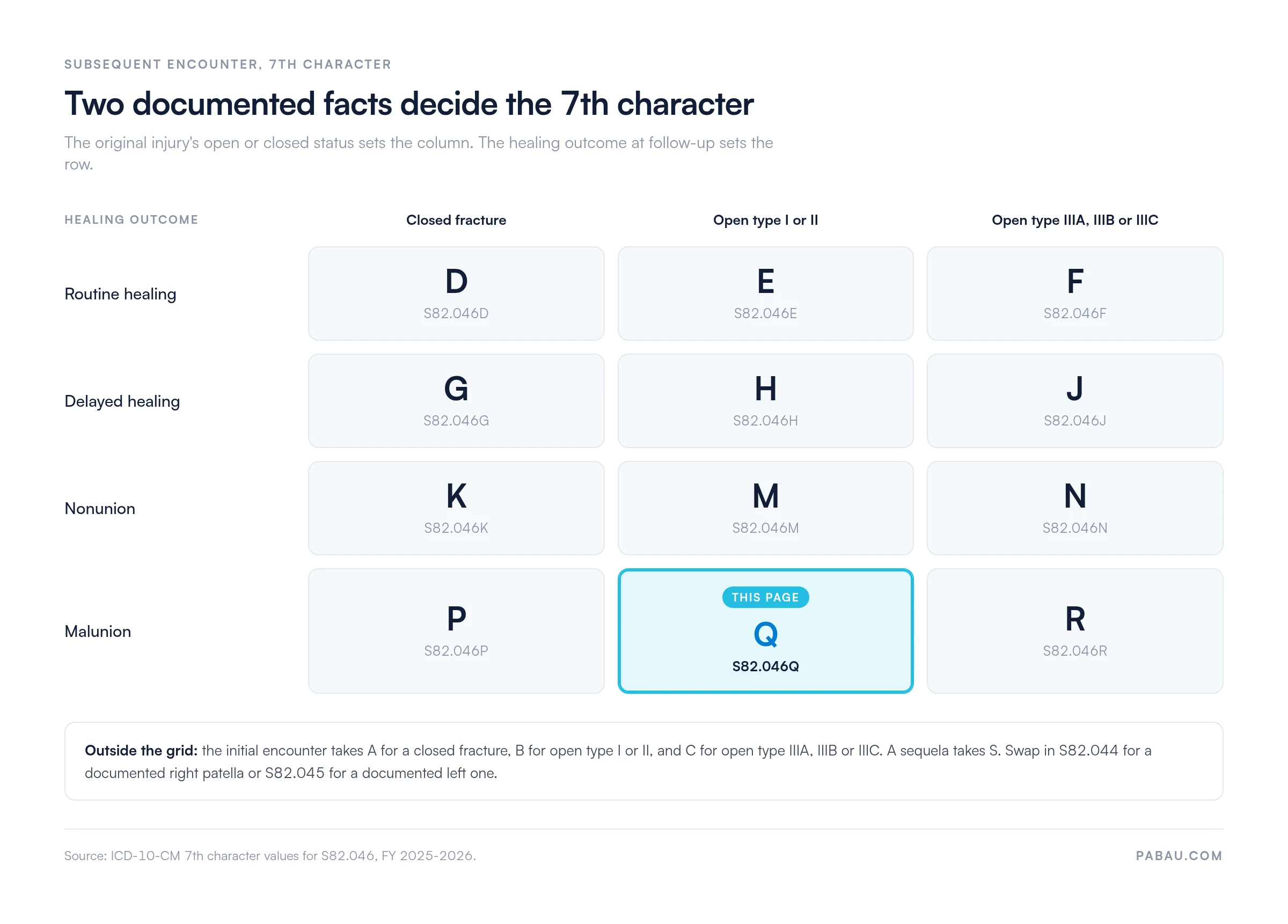
The 7th character at a subsequent encounter reflects the open or closed status of the original injury, not the current wound status. If the skin is now intact but the original fracture was an open type II, character Q still applies once malunion is documented.
Errors here trigger claim denials that need costly appeals. Solid denial management workflows help coders catch and correct them before submission.
Correct assignment of S82.046Q depends on the surgeon documenting a Gustilo-Anderson type I or type II open fracture at the time of the original injury.
The classification grades open fractures by wound size, contamination level, and soft tissue involvement. Verify the specific criteria against current orthopedic surgery references before applying them to code selection.
ICD-10-CM collapses the five Gustilo grades into two groups. Types I and II share one set of 7th characters, and types IIIA, IIIB, and IIIC share another. That is why S82.046Q covers a type I or type II injury while S82.046R covers the three type III grades.
That same two-group split runs across the other patella fracture patterns. A displaced transverse fracture of an unspecified patella, open at type IIIA, IIIB, or IIIC on the initial visit, takes S82.033C.
Operative and emergency department notes therefore need to state the Gustilo grade in so many words. A generic reference to an open fracture will not support either character. The AAPC Codify ICD-10-CM lookup gives you a searchable reference for the full S82 code range.
Query the provider when an operative note records an open patella fracture without a Gustilo grade. Type I or II sends the subsequent-encounter malunion claim to S82.046Q, while type IIIA, IIIB, or IIIC sends it to S82.046R. Guessing the grade produces systematic undercoding or overcoding across every follow-up visit for that patient.
Six codes in the S82.046 family describe abnormal healing. Each one pairs a specific open or closed status with either malunion or nonunion, and the pairs are easy to confuse.
Picking the wrong one produces a valid claim that misstates the clinical picture, which payers flag during retrospective audits. Compliance reviews treat that specificity as seriously as billable status.
The decision tree is short once the original fracture documentation is in front of you. Step 1 asks whether the original fracture was open or closed. Step 2 asks, if it was open, what the Gustilo-Anderson grade was. Step 3 asks what healing outcome the provider documented. Each step narrows the choice until one code is left.
Providers covering musculoskeletal trauma should confirm those details appear in the operative note or discharge summary. Healing status recorded at each follow-up visit then feeds straight into subsequent-encounter code selection.
For inpatient hospital claims, S82.046Q contributes to MS-DRG assignment through the CMS MS-DRG grouper. The grouper evaluates the principal diagnosis, secondary diagnoses, and procedure codes together, and S82.046Q maps into the lower extremity fracture DRG groupings.
The specific MS-DRG depends on whether a major complication or comorbidity is present, which shifts both the DRG weight and the reimbursement rate.
CMS updates MS-DRG weights annually at the start of each fiscal year on October 1. Any DRG weight cited in an older coding reference may not match the current FY2026 grouper. Verify current weights against the CMS MS-DRG files for the current fiscal year.
On CMS-1500 professional claims, S82.046Q usually works as a supporting diagnosis that ties the encounter to the fracture history.
Electronic submission benefits from clearinghouse-level validation before the claim reaches the payer. Pabau’s claims management module integrates with the Claim.MD clearinghouse. It checks ICD-10-CM codes against the current CMS code set and flags invalid or inactive ones before submission. That cuts the denial rate tied to coding errors.
The integration supports 837P and CMS-1500 formats, which are the claim types where S82.046Q usually appears as a secondary diagnosis.
S82.046Q sits at the seventh level of the ICD-10-CM hierarchy. Reading the parent codes helps coders navigate the tabular list and confirm they have selected the most specific code available. The CDC/NCHS ICD-10-CM web tool carries the official U.S. tabular list with hierarchy navigation.
The base code S82.046 is not billable on its own, because ICD-10-CM guidelines require the full 7th character for fracture codes in the S82 category. Submitting S82.046 without one generates an edit rejection. The ICD-10-CM code index is where the neighboring S82 entries and the rest of the diagnostic code set are listed.
Four documentation elements have to be in the record before S82.046Q can be assigned with confidence. A missing element is grounds for a provider query rather than a coder assumption.
Three pitfalls turn up repeatedly on S82.046Q claims. The first is assigning the initial-encounter character B to a patient seen after active treatment ended. Any visit from that point on is a subsequent encounter, so B belongs to the original episode only.
The second is using Q for a fracture originally graded type IIIA, IIIB, or IIIC, which belongs to S82.046R. The third mixes malunion up with delayed healing, which takes character H, or with nonunion, which takes character M instead.
Practices handling high volumes of orthopedic trauma claims benefit from systematic documentation review. A standing query workflow surfaces these problems before the claim goes out.
The ICD-10-CM Official Guidelines for Coding and Reporting, maintained jointly by CMS and NCHS, govern 7th character assignment. Under those guidelines, a fracture not documented as open or closed defaults to closed at the initial encounter.
That default stops applying once the patient moves into a subsequent-encounter phase. The original fracture type is fixed, and it carries forward from the first record. Use the WHO ICD-10 browser for international classification context, and the CDC tool linked above for year-specific U.S. validation.
Build a fracture coding checklist for orthopedic follow-up encounters. Pull the original encounter record. Confirm the Gustilo grade from the original operative note. Check the current imaging or provider note for healing status. Confirm whether the record names a side. Then match open or closed status plus healing outcome to the 7th character. Running the check at intake, before the encounter note is finalized, cuts query lag and downstream denial risk.
Coders reach S82.046Q through several entry paths in the ICD-10-CM Alphabetical Index. The primary route is: Fracture, traumatic > patella > comminuted > nondisplaced > subsequent encounter > open > type I or II > malunion. Approximate synonyms in clinical documentation that map to this code include:
These phrasings turn up in provider notes, referral letters, and surgical summaries. S82.046Q applies whenever the clinical facts all line up. The fracture is nondisplaced and comminuted, it sits in the patella, and no side is documented. The visit is a subsequent encounter, the original injury was open type I or II, and malunion is confirmed.
Most orthopedic practices rebuild the same three facts by hand at every follow-up visit. A coder opens the original operative note for the Gustilo grade and checks the radiology report for the side. The current note supplies the healing status. Three lookups per encounter is normal, and each one is a chance to carry the wrong 7th character forward.
Pabau keeps that history in one client record instead. The original encounter note, the imaging, and every follow-up sit on the same timeline. The Gustilo grade and the documented side stay one click from the coder. Claims management then routes the claim through Claim.MD, which validates ICD-10-CM codes against the current CMS code set before anything reaches the payer.
That means fewer 7th-character corrections after the fact, and fewer unspecified-laterality codes going out when the chart actually names a knee. For a practice running orthopedic trauma follow-ups every week, that pre-submission layer is where coding accuracy pays for itself.

Pabau integrates with Claim.MD to validate ICD-10-CM codes including S82.046Q before they reach the payer. Electronic claims go out with built-in code edits, so fewer complex fracture encounters come back as coding denials.

S82.046Q needs three documented facts arriving together. The fracture is nondisplaced and comminuted, the original injury was an open Gustilo type I or II, and malunion is confirmed at the subsequent encounter. One more check belongs on that list. The record has to be genuinely silent on which knee, or the claim moves to S82.044Q or S82.045Q.
Pabau’s integrated billing workflows support clean submission of ICD-10-CM codes through the Claim.MD clearinghouse. Built-in validation catches 7th character errors before the payer sees them.
For practices managing orthopedic trauma caseloads, catching a wrong 7th character early saves an appeal later. To see how it handles complex fracture claims, book a demo with our team.

Need guidance on managing billing denials for complex fracture claims? Denial codes in medical billing covers the most common CARC denial reasons and how to respond to them effectively.
Want to understand how electronic remittance fits into fracture claim workflows? Electronic remittance advice (ERA) explains how 835 transaction files return payment and denial information for each submitted claim.
Looking for a clean claim checklist before submitting ICD-10 coded encounters? Clean claim standards outlines what payers check before adjudicating a diagnosis-coded claim.
S82.046Q is a billable ICD-10-CM diagnosis code. Its full description is nondisplaced comminuted fracture of unspecified patella, subsequent encounter for open fracture type I or II with malunion. It carries four facts. The fracture is nondisplaced and comminuted, and the visit is a follow-up. The original injury was an open Gustilo type I or II, and the bone healed out of position.
Yes. S82.046Q is a billable ICD-10-CM diagnosis code valid for the 2025-2026 fiscal year. It is accepted on UB-04 (CMS-1450) inpatient claim forms and CMS-1500 outpatient claim forms. The base code S82.046 has no 7th character, so it is not billable and will generate an edit rejection.
The two codes differ only in the severity of the original open wound. S82.046Q covers a Gustilo type I or type II open fracture that healed with malunion. S82.046R covers the same malunion outcome after a type IIIA, IIIB, or IIIC open fracture. Both are subsequent-encounter codes for the unspecified patella, so the operative note’s Gustilo grade decides between them.
Character Q marks a subsequent encounter for an open fracture originally graded Gustilo-Anderson type I or type II, with malunion as the healing outcome. All three elements have to be in the record. The visit is follow-up care rather than initial treatment. The injury was an open type I or II fracture, and the bone united in the wrong alignment.
Use S82.046Q when the original fracture was open and graded Gustilo type I or II. Use S82.046P when the original fracture was closed. Both codes describe malunion at a subsequent encounter, so the open or closed status of the first injury is the deciding factor. The wound’s current condition does not change the character.
No. S82.046 is the unspecified-patella branch of the comminuted fracture family, so S82.046Q states no side. Use S82.044Q when the record documents a right patella and S82.045Q when it documents a left one. Query the provider before defaulting to the unspecified code, because orthopedic notes usually name the knee.
S82.046D is a subsequent encounter for a closed fracture with routine healing. S82.046Q is a subsequent encounter for an open type I or II fracture with malunion. The two codes differ on both axes. D records normal recovery from a closed injury, while Q records abnormal healing after an open one.
S82.046Q sits at the end of a four-level chain. Its immediate parent is S82.046, nondisplaced comminuted fracture of unspecified patella, which is not billable on its own. Above that sit S82.04 (comminuted fracture of patella), S82.0 (fracture of patella), and S82 (fracture of lower leg, including ankle). The code belongs to the S80-S89 block for knee and lower leg injuries.