ICD-10 Code S82.299K: Other tibial shaft fracture nonunion, unspecified leg
ICD-10 Code S82.299K: Official description and quick reference ICD-10 Code S82.2...

Last Updated: Oct 21, 2026
Billable Code Specific Code
S80.851A is the billable ICD-10-CM code for superficial foreign body, right lower leg, initial encounter. It covers a splinter, glass fragment, or gravel embedded in the skin below the right knee, with no open wound.
The code sits within chapter S00-T88, in the S80–S89 block of injuries to the knee and lower leg. Assignment turns on three details in the note: the right side, active treatment for the 7th character A, and unbroken skin.
Let Pabau's smart automation suggest the right codes, reduce claim denials, and keep your practice compliant—effortlessly.
Automate repetitive tasks and focus on what matters most—your patients.
Reduce coding errors and ensure compliance with the latest regulations.
Clean claims, fewer denials, and faster reimbursements.
Powerful insights and reporting to help your practice thrive.
HIPAA compliant SOC 2 certified GDPR-compliant Trusted by 4,000+ clinics worldwide

S80.851A is a valid, billable ICD-10-CM code for the right lower leg only. The left leg takes S80.852A, and an unspecified side takes S80.859A.
The 7th character A applies to every visit during active treatment, including follow-ups with a new provider, not just the first appointment.
Pair it with an external cause code such as W45.8XXA, and confirm right or left from the clinical note before submitting. Unspecified laterality is a known denial trigger.
Claims software such as Pabau runs claim validation that scrubs every claim for missing or invalid details before submission.
ICD-10 Code S80.851A is an official ICD-10-CM diagnosis code with the full descriptor Superficial foreign body, right lower leg, initial encounter. It is valid and billable for FY2027, which began on October 1, 2026. The code covers foreign material embedded in the superficial tissue of the right leg between the knee and ankle, with no open wound.
The CDC/NCHS ICD-10-CM web tool is the authoritative source for verifying current billable status and code descriptors each fiscal year.
Every character in S80.851A carries a specific meaning. Understanding the structure lets coders navigate the entire S80.85x family without memorizing every code.
This code applies when a foreign body sits in the superficial tissue of the right lower leg. It has not reached deeper structures, and the skin surface is not broken into an open wound.
Included scenarios:
Excluded (use a different code):
The line between “superficial” and “open wound” decides the code. If the note documents a laceration, puncture, or other break in the skin caused by the injury, S80.851A is incorrect. Use the matching S81.8- open-wound code instead, and work through the three questions below in order.
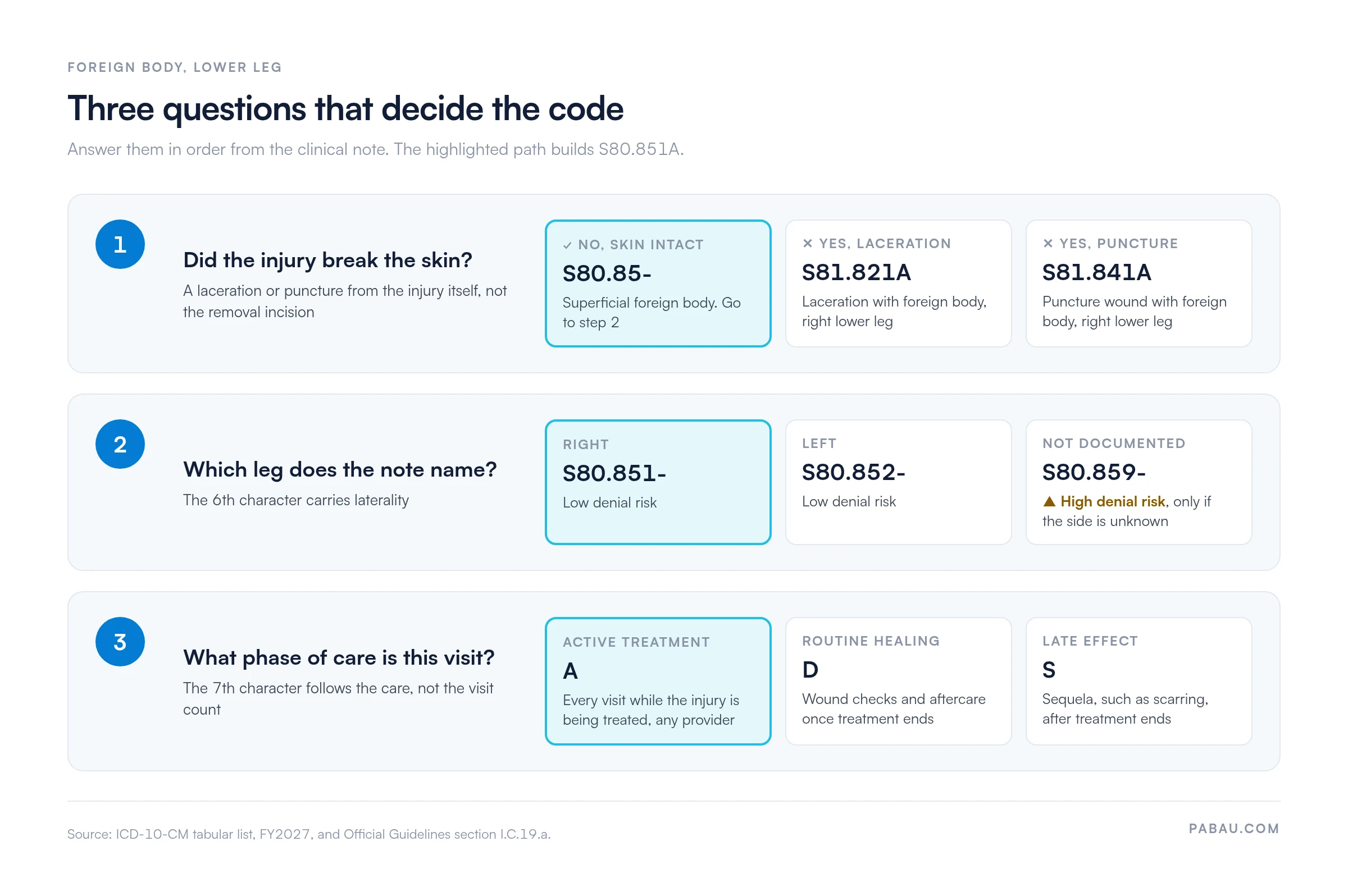
The 7th character is the single most misapplied element of this code family. The ICD-10-CM Official Guidelines for Coding and Reporting (Section I.C.19.a) define each value precisely.
The most common coder error is switching to D at the second or third visit. That happens even while foreign body removal and wound care are still ongoing. If the treating provider is still actively managing the injury, A is correct, regardless of how many visits have occurred. The switch to D happens when care transitions to routine healing checks, not when the patient returns for the second time.
A patient referred mid-treatment to a specialist dermatologist still uses S80.851A at that specialist visit. The 7th character follows the phase of care, not the provider count. The guidelines explicitly state that initial encounter (A) applies to all providers delivering active treatment, not only the first provider seen.
ICD-10-CM requires laterality documentation for lower leg injury codes. Submitting an unspecified laterality code when the clinical note documents “right” is a common denial trigger that payers flag during automated edits.
The same laterality pattern applies to the D and S encounter variants. If the note says “right leg” and the claim shows S80.859A, expect a payer query or denial. Verify laterality before coding, not after submission.
S80.851A goes first on the claim as the injury diagnosis. Most payers, and the CMS ICD-10-CM coding guidelines, expect secondary codes that explain how, where, and during what activity the injury occurred. Solid medical billing compliance includes these companion codes on every injury claim.
The ICD-10-CM guidelines treat external cause codes as recommended, not mandatory. Many commercial payers and workers’ compensation carriers still treat them as required for injury claims. Missing them is a common soft-denial trigger. Always check the payer’s local coverage policy before assuming they are optional.
Choosing the right CPT code alongside S80.851A depends on the removal technique documented in the clinical note. A simple incision and removal fits CPT 10120, while CPT 10121 covers complicated removals. A mismatch between the ICD-10 and CPT complexity levels is a known audit risk flagged by payers and the AAPC CPT-to-ICD-10 crosswalk guidance.
Some payers require an RT modifier (right side) on procedure codes to confirm laterality matches the ICD-10 diagnosis. Check the payer’s modifier policy before submission. Pairing S80.851A with CPT 10121 without documentation of deep tissue dissection is one of the most common audit triggers for this code family.
The clinical note must support every element of the code before submission. Vague notes like “leg wound” or “possible foreign body” do not meet the specificity threshold required by payers. Fixing a thin note before billing, instead of after a denial, is where clean claim submission pays off most.
The minimum documentation checklist:
S80.851A claims are denied for predictable, preventable reasons, and each one traces back to a documentation or coding error. Strong denial management workflows address these before submission. When a rejection does arrive, the denial codes on the remittance point you to the matching row below.
ICD-10-CM became mandatory for all HIPAA-covered entities on October 1, 2015. Pre-2015 claims used ICD-9-CM, which lacked the anatomical specificity of modern codes. The General Equivalence Mappings (GEMs) published by CMS provide approximate crosswalks, but they are not exact equivalents.
ICD-9’s superficial injury codes (910–919) did not capture laterality. The GEMs crosswalk helps with historical record review. Never use an ICD-9 code for a service dated on or after October 1, 2015, as CMS and commercial payers reject them.
Getting S80.851A right still starts with a coder reading the note. Laterality, the 7th character, and the CPT pairing all come from what the provider documented, so that judgment stays with your team.
Pabau, the practice management platform we build, takes over once the claim is coded. Its claims management software runs claim validation that scrubs every claim for missing or invalid details before submission. Through its Claim.MD integration, your front desk can also check a patient’s eligibility before the visit.
When the payer responds, ERA settlement posts the remittance back against the claim. Your team reconciles payments and spots denials without keying each remittance in by hand.

Pabau’s claim validation scrubs every claim for missing or invalid details before submission, so fewer S80.851A claims come back from the payer.

S80.851A holds up on review only when the note supports every character. Name the foreign body, confirm the right lower leg, and keep the A for as long as active treatment continues.
The trade-off worth remembering sits on the procedure side. Bill CPT 10121 against a superficial code only when the note describes deep dissection. Once the skin is broken, move to an S81.8- open-wound code.
Claim validation catches missing or invalid details before a claim leaves the practice, but the coding call stays with your coders. Book a demo to see how Pabau’s claim validation and Claim.MD eligibility checks fit your injury-coding workflow.

Need to understand denial codes after a rejection? Denial codes in medical billing explains the most common CARC and RARC codes that appear when S80.851A claims are rejected.
Billing a complicated removal? CPT code 10121 covers the complicated foreign body removal code and what the note must show to support it.
Want to reduce claim rejections across the practice? Revenue cycle management covers the end-to-end workflow from coding through payment posting that keeps denial rates low.
Looking for clearinghouse options for US claims? Medical claims clearinghouse guide explains how clearinghouses work and how electronic 837P submissions reach payers.
ICD-10 Code S80.851A is the billable ICD-10-CM diagnosis code for a superficial foreign body of the right lower leg, initial encounter. It covers splinters, glass, or gravel embedded in the skin below the right knee, with no open wound. It is valid for FY2027 claims, from October 1, 2026.
S80.851A specifies the right lower leg, and S80.852A specifies the left lower leg. The only difference is laterality. Use S80.859A (unspecified) only when the side is unknown and not documented, since unspecified laterality is a known denial trigger.
The 7th character changes from A (initial encounter) to D (subsequent encounter) when active treatment ends and care transitions to routine healing or surveillance visits. If the provider is still actively managing the foreign body injury, A is correct regardless of how many visits have occurred.
CPT 10120 (simple incision and removal) pairs appropriately with S80.851A for superficial extractions. If no incision is performed, bill only the E/M visit. Pairing CPT 10121 (complicated removal) with S80.851A is an audit risk unless the note documents deep dissection. Deep dissection sits awkwardly with a superficial ICD-10 code.
External cause codes are recommended by ICD-10-CM guidelines and required by many commercial payers and workers’ compensation carriers for injury claims. The most common external cause companion is W45.8XXA (other foreign body entering through skin, initial encounter). Check the specific payer’s policy before assuming these codes are optional.
If the note documents a laceration or puncture from the injury, use the matching S81.8- open-wound code instead of S80.851A. Examples are S81.821A (laceration with foreign body) and S81.841A (puncture wound with foreign body), right lower leg, initial encounter. Submitting S80.851A when an open wound is present is a code-level mismatch and may lead to denial or audit.