ICD-10 Code S72.446C: Lower Femur Epiphysis Fracture
ICD-10 code S72.446C: code definition and quick reference ICD-10 code S72.446C i...

Last Updated: Oct 23, 2026
Billable Code Specific Code
S78.922D is the billable ICD-10-CM code for partial traumatic amputation of left hip and thigh, level unspecified, subsequent encounter.
Coders most often use S78.922D at post-acute rehab visits, wound checks and outpatient follow-ups after the initial emergency or surgical care. The two most common errors are the wrong 7th character (A, D or S) and the wrong side. A right-side injury takes S78.921D, and S78.929D applies only when no record documents the side.
Let Pabau's smart automation suggest the right codes, reduce claim denials, and keep your practice compliant—effortlessly.
Automate repetitive tasks and focus on what matters most—your patients.
Reduce coding errors and ensure compliance with the latest regulations.
Clean claims, fewer denials, and faster reimbursements.
Powerful insights and reporting to help your practice thrive.
HIPAA compliant SOC 2 certified GDPR-compliant Trusted by 4,000+ clinics worldwide

S78.922D is a billable ICD-10-CM code for partial traumatic amputation of left hip and thigh, level unspecified, at a subsequent encounter.
7th character D means active healing is still underway. Switch to S (sequela) only when healing is complete and only a late effect remains.
S78.922D is the left-side code. Use S78.921D for a documented right-side injury, and S78.929D only when no record names the side.
A knee-level amputation takes S88.0- instead of S78, never both, because S78 carries an Excludes1 note for the knee.
Pabau, the practice management software we build, submits claims through Claim.MD and tracks their status, so a rejected claim surfaces quickly.
ICD-10 Code S78.922D is the billable code for a partial traumatic amputation of the left hip and thigh, level unspecified, at a subsequent encounter. Use it for follow-up care while the residual limb heals.
The table below lists the fields to confirm before a claim goes out. Confirm the code is valid for the current fiscal year at the CDC/NCHS ICD-10-CM web tool at point of submission.
S78.922D covers a partial traumatic amputation of the left hip and thigh, meaning the limb was not fully severed. The record documents the left side but not the exact anatomical level. Each element of that descriptor carries a distinct coding decision:
Coders meet those decisions in a fixed order, and the path below traces each one to the character it sets.
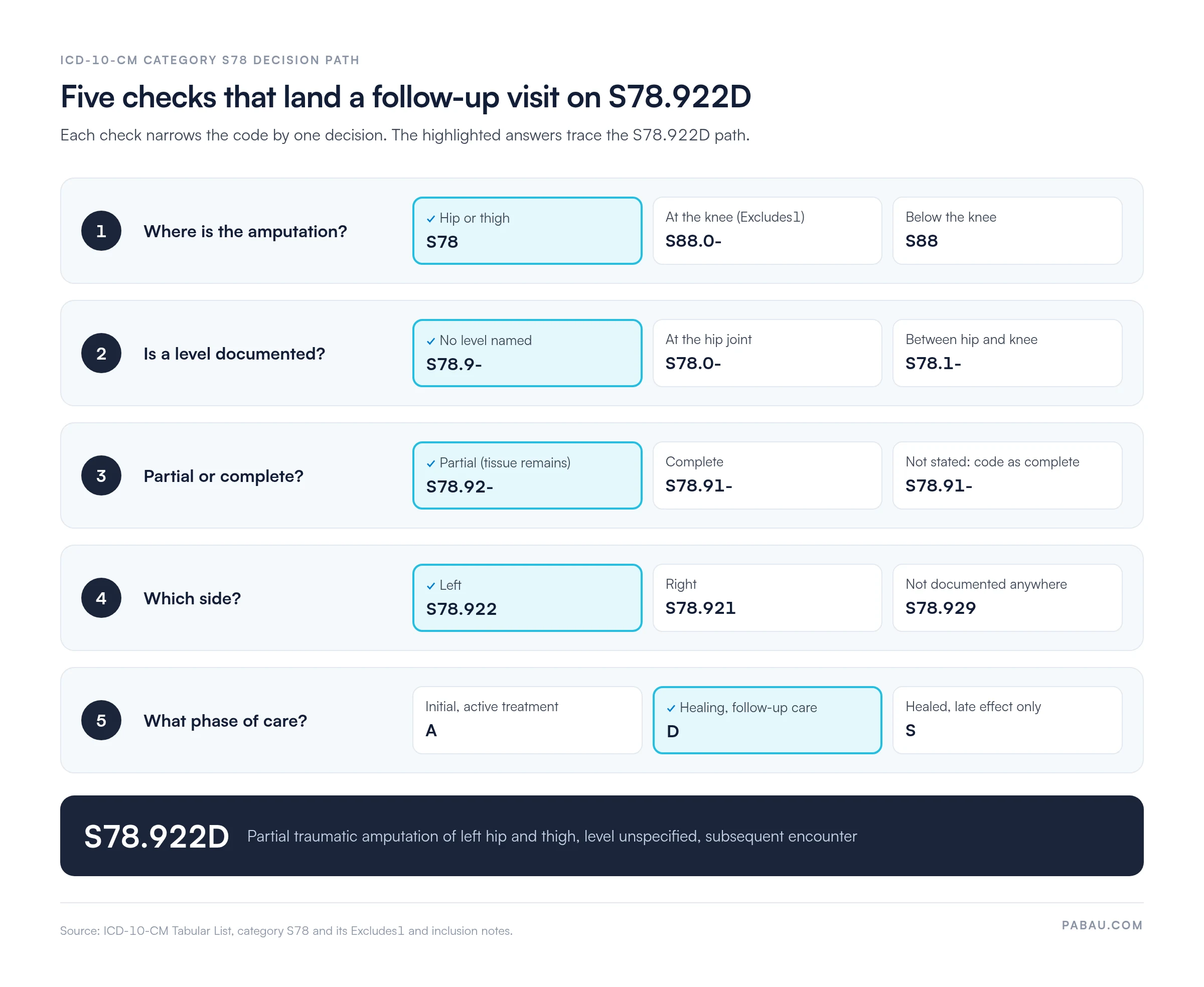
The 7th character D signals a subsequent encounter. The patient is still healing but no longer receives the initial acute management of the injury. The three 7th character options for S78.922 are mutually exclusive, so only one applies to any given visit.
A useful clinical rule: use D while the wound or residual limb is still healing, with dressings changed, the wound open or sutures recently removed. Switch to S only when healing is complete and the visit treats a consequence of the injury rather than the injury itself. With S, the code for the late effect itself is listed first and S78.922S follows it.
The S78 category splits into two parallel series based on whether the amputation is complete or partial. Choosing the wrong series invalidates the code regardless of how accurately the other elements are documented.
An operative note may describe a degloving injury with partial tissue separation without calling it an amputation. Query the surgeon before assigning any S78 code. ‘Partial traumatic amputation’ requires explicit documentation of incomplete limb loss, not presumed inference from injury severity.
ICD-10-CM coding guidelines require the highest level of specificity the documentation supports. S78.922D is correct only when the record places the injury on the left side. A right-side injury coded as S78.922D is simply the wrong code, and the claim can be denied or recouped.
Payers running post-payment audits often flag S78.929D in trauma categories, because the side is almost always known. A steady pattern of side-unspecified codes on a provider’s claims can trigger a targeted review even when each claim is technically valid.
S78 carries an Excludes1 note for traumatic amputation of the knee (S88.0-). It has no Excludes2 notes. Excludes1 means the two codes are never reported together, so a knee-level amputation takes S88.0- instead of S78, never both.
The S78 Excludes1 (knee, S88.0-) is the only exclusion. Companion conditions such as blood loss anemia (D62) and post-traumatic wound infection (T79.3-) may be coded alongside.
Five codes sit close enough to S78.922D that selection errors are routine. The table below shows the distinguishing criteria for each.
S78.922D is a diagnosis code, and it pairs with procedure codes on the same claim. The CPT codes below are commonly associated with traumatic lower-extremity amputation care. Exact applicability depends on the clinical scenario and must be verified per claim. Solid medical billing fundamentals require confirming payer-specific pairing rules before submission.
CPT code pairings in this category are generally reviewed by payers for medical necessity. Submitting S78.922D with a wound-care CPT at a follow-up visit is straightforward. Pairing it with a major surgical CPT may prompt a review if the payer expects an initial-encounter code on the operative claim.
A partial traumatic amputation that a surgeon later completes in the operating room is still coded to S78. Coders often assume the operation moves the case to a planned-procedure category. It does not.
Per ICD-10-CM coding guidance, when a traumatic partial amputation requires surgical completion during the same hospitalization, the injury remains the causative diagnosis. The S78.922x code, with the 7th character for that encounter, stays on the claim alongside the surgical CPT code. The S78 code reflects what happened to the patient. The CPT code reflects what the surgeon did in response.
The exception arises when the surgical amputation is entirely planned and elective, unrelated to a trauma event. A scheduled transfemoral amputation for peripheral vascular disease is coded to the underlying condition, not S78. Check current AHA Coding Clinic guidance before finalizing, because some scenarios carry their own advisory rulings.
Maintaining medical billing compliance on these claims means recording in the coding note why S78 (traumatic) was chosen over an elective-procedure category. This matters most when the operative report is ambiguous about the precipitating event.
Assignment of S78.922D must be supported by documentation that establishes each descriptor element. A clean claim submission for this code generally requires the following to be present across the encounter record.
Most S78.922D denials trace back to three choices: the 7th character, the side, and partial versus complete. The table below pairs each one with the claim adjustment reason code (CARC) a payer typically returns. Pabau submits claims through the Claim.MD clearinghouse and tracks their status, so a rejection surfaces quickly.
Structured denial management workflows that track CARC codes by ICD-10 category show practices which of these patterns repeats most often. Coders can then be retrained on that pattern first. For what each code on the remittance means, see our guide to medical billing denial codes.
Medicare and most commercial payers do not require prior authorization for emergency traumatic amputation care. Post-acute follow-up visits with S78.922D can still attract medical necessity scrutiny. Coverage expectations generally include the following, though they vary by payer and are subject to Local Coverage Determination (LCD) updates.
Request the payer’s specific LCD for amputation follow-up care before the patient’s first post-acute visit. Many MACs publish LCDs covering prosthetic care, wound management and rehabilitation tied to traumatic amputation diagnoses. Knowing those documentation rules upfront prevents denials at 60-90 days post-discharge.
Most S78.922D errors start when the coder cannot see the note that names the side or the phase of care. The ED record, operative report and follow-up notes often live in different systems. The coder then guesses, or falls back to S78.929D.
Pabau keeps every visit note on one patient record. The claim is pre-filled from that record and sent through Claim.MD, which also runs eligibility checks and tracks claim status. The coder still chooses the code, with the documentation that supports it on the same screen.
The result is fewer wrong-side and wrong-phase claims, and faster fixes when a payer rejects one.

Pabau keeps clinical notes and claims on one patient record and submits through Claim.MD. Coders can confirm the side and phase of care before a claim goes out.

S78.922D is right only when three facts line up in the record. The amputation is partial, the injury is on the left side, and the patient is still healing after initial treatment. If the record says right, the code is S78.921D. If no note names the side, it is S78.929D.
Check those three facts before each follow-up claim, and most denials on this code never happen. Pair that check with denial tracking that shows which errors recur. Book a demo to see how Pabau keeps notes and claims together for traumatic injury follow-up visits.

Need to understand how traumatic injury claims move through the revenue cycle? What is revenue cycle management covers the end-to-end claim lifecycle from diagnosis coding through payment posting.
Want to know how electronic remittance advice maps denial codes back to your ICD-10 submissions? Electronic remittance advice (ERA) explained breaks down 835 transaction codes and CARC denial patterns.
Want to see how a claim travels from your practice to the payer? Claim.MD clearinghouse review explains how the clearinghouse submits claims, checks eligibility and reports claim status.
Coding a visit after the limb has fully healed? ICD-10 Code S78.922S covers the sequela code for late effects of the same left-side injury.
ICD-10 Code S78.922D is the billable diagnosis code for a partial traumatic amputation of left hip and thigh, level unspecified, at a subsequent encounter. It applies to follow-up care during active healing of an incomplete traumatic limb loss of the left upper leg. The record names the left side but not the precise amputation level.
Yes. S78.922D is a valid, billable ICD-10-CM code for a partial traumatic amputation of the left hip and thigh. It requires all seven characters, and the parent code S78.922 without a 7th character is not billable. Confirm the code’s status for the current fiscal year using the official CDC/NCHS tool.
S78.922A is for the initial encounter, when active treatment of the traumatic amputation is being delivered. S78.922D is for subsequent encounters while healing is still underway. S78.922S is for visits where healing is complete and only a sequela (late effect) remains. The 7th character must match the phase of care at that visit, not at the original injury.
Common pairings include CPT 27590 (amputation, thigh, any level) when the traumatic amputation is surgically completed, and CPT 27592 (open/guillotine technique). CPT 97597 covers wound debridement at follow-up visits. Evaluation and management codes cover post-operative or outpatient follow-up encounters. Exact pairings must be verified per claim against payer-specific medical necessity policies.