ICD-10 Code Y76.0: Diagnostic obstetric and gynecological devices
ICD-10 Code Y76.0: Definition and billable status ICD-10 Code Y76.0 is a valid, ...

Last Updated: Oct 23, 2026
Billable Code Specific Code
S78.019D is the billable ICD-10-CM code for complete traumatic amputation at unspecified hip joint, subsequent encounter. It covers follow-up visits after a traumatic hip disarticulation, once active treatment has ended and the chart doesn't say which side was lost.
Three details decide whether it holds up on a claim. The 7th character D must match a healing-phase visit. The record must call the amputation complete and place it at the hip joint. And unspecified side is a last resort, since a physician query usually turns it into S78.011D or S78.012D. Here's how to check each one before you submit.
Let Pabau's smart automation suggest the right codes, reduce claim denials, and keep your practice compliant—effortlessly.
Automate repetitive tasks and focus on what matters most—your patients.
Reduce coding errors and ensure compliance with the latest regulations.
Clean claims, fewer denials, and faster reimbursements.
Powerful insights and reporting to help your practice thrive.
HIPAA compliant SOC 2 certified GDPR-compliant Trusted by 4,000+ clinics worldwide

S78.019D is a billable FY 2026 ICD-10-CM code for follow-up care after a complete traumatic hip amputation when the side isn’t documented.
The 7th character D applies once active treatment has ended, so stump care, rehab and prosthetic evaluation visits qualify.
Unspecified laterality invites specificity edits, so query the physician and move to S78.011D or S78.012D wherever the chart allows.
External cause codes are reported where a payer or state mandate requires them, and recommended otherwise.
Pabau, the practice management platform we build, pre-fills claims from the record, checks required fields, submits through Claim.MD and tracks ERAs.
ICD-10 code S78.019D reports a complete traumatic amputation at the hip joint, side unspecified, at a subsequent encounter. In plain terms, the patient lost the whole leg at the hip through injury. Active treatment is over, and the chart doesn’t say which side.
It’s a valid, billable FY 2026 code in category S78, Traumatic amputation of hip and thigh. Each part of the descriptor needs support in the record, so the reference table below is worth checking against your chart.
Every position in the code answers one question about the injury or the visit. The breakdown below shows the answer each character gives, and what the alternatives would be.
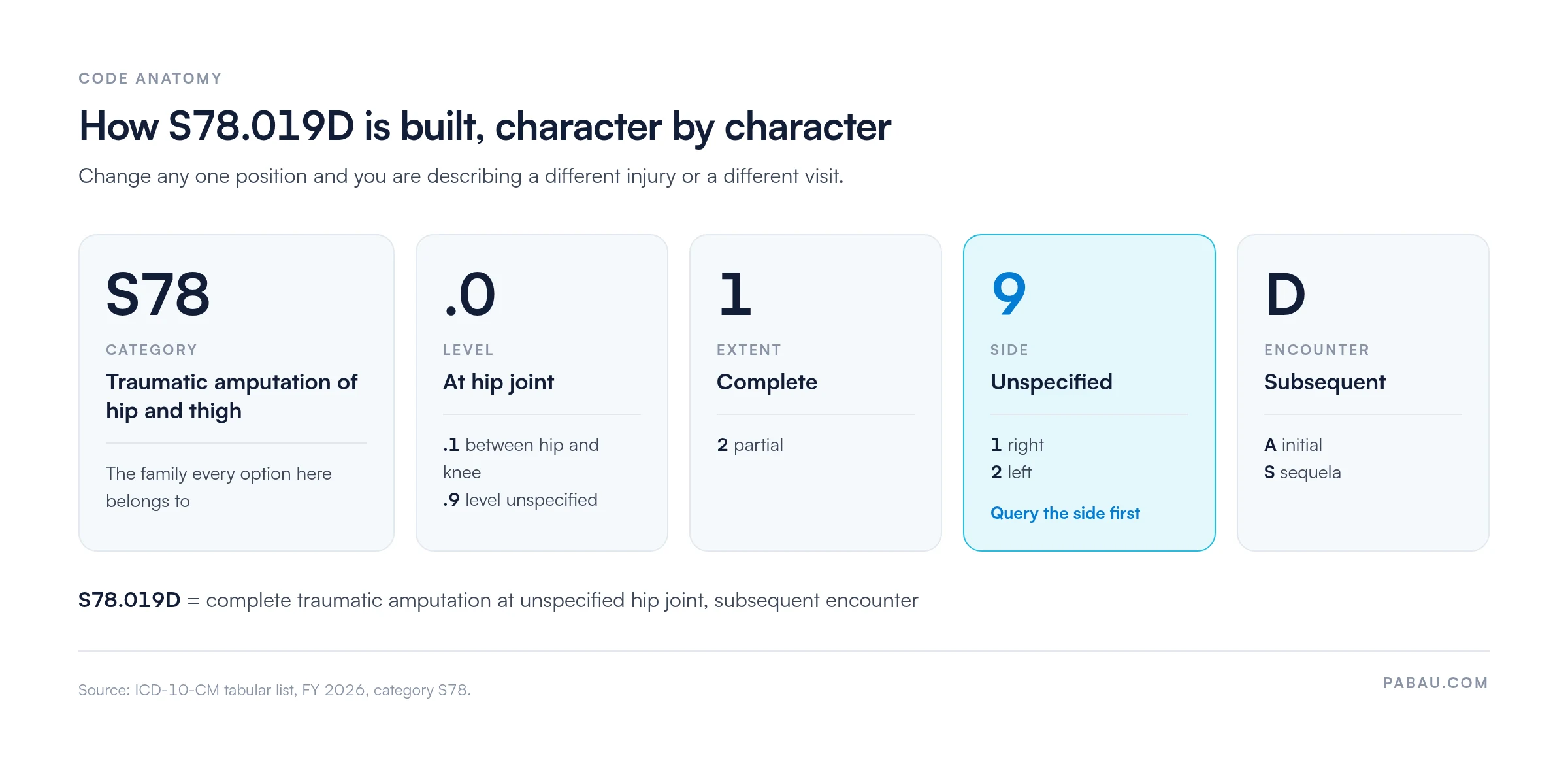
Here’s what each word in the descriptor asks of the record.
The 7th character is where this code goes wrong most often. Under the ICD-10-CM Official Guidelines, the phase of care sets the character. The number of visits doesn’t.
So how do you choose between D and S? If the visit treats a late effect of the amputation, such as phantom pain, the S character applies. It goes on the injury code, sequenced after the condition that resulted from it. If the visit is routine recovery care, use D.
S78.01 holds three subsequent-encounter codes that differ only by side. Picking one is easy when the chart is clear. The harder call is deciding when unspecified is legitimate and when it should prompt a query.
The ICD-10-CM guidelines expect a physician query when laterality is missing and a query is reasonable. Keep unspecified for charts that genuinely can’t support a side, not as a way to skip the query.
Level matters as much as side. Once the injury sits between the hip and knee, the codes move to S78.11-, such as S78.112D for the left leg.
Use it for these subsequent-encounter visits:
Don’t use it in these situations:
Clean medical billing starts in the note. These four elements keep S78.019D from drawing a payer query.
Payers may ask for records when an unspecified code is billed for a body part that has sides. Our guide to medical billing compliance explains how to keep an audit trail that holds up.
Query the physician for laterality before accepting unspecified as final. Trauma charts, operative reports and imaging usually name the side. A one-line query upgrades S78.019D to S78.011D or S78.012D and removes the specificity edit.
S78.019D rarely sits alone on a claim. A clean claim for hip amputation follow-up often adds an external cause code. Where it applies, a Z code for prosthetic care joins it.
Section I.C.20 of the guidelines sets no national requirement for external cause codes. Report them where a payer or state mandate requires it, and we recommend them otherwise. When you do report one, the 7th character D carries over from the injury code.
It helps to know where a follow-up claim can stall. Here’s the usual path for a professional claim.
Most problems start at steps one and two, then surface at step five. That’s why the fixes below sit in the chart rather than the claim form.
Most S78.019D denials follow four patterns. Good denial management starts with knowing which edit is likely to fire.
After a denial, review the electronic remittance advice (ERA) to see which edit fired. Our breakdown of denial codes explains how to act on each one. Then correct and resubmit within the payer’s timely filing window.
Check your ERA remark codes after every S78.019D denial before resubmitting. CO-16 (claim lacks information) can indicate missing documentation. Check the RARC for the specific edit.
Run through this list on every follow-up claim. It takes a minute and catches the four denial patterns above.
S78.019D is valid for Medicare and Medicaid billing. Coverage for the services billed with it is a separate question. Prosthetic devices and their L-codes follow Local Coverage Determinations (LCDs), which vary by Medicare Administrative Contractor (MAC). A valid diagnosis doesn’t guarantee a covered prosthesis.
Per the CDC/NCHS ICD-10-CM tool and AAPC’s ICD-10-CM code reference, S78.019D is active in the FY 2026 release with no revision notice. Confirm its status against the current tabular list before you submit. Each October 1 update can add, revise or retire codes.
Medicare billers should also check that the procedure or HCPCS code is covered under their MAC’s LCD. ICD List offers a searchable FY 2026 reference for quick lookups.
Follow-up claims for a hip amputation usually stall on small things. A missing membership number or a code keyed by hand from the chart is enough to send one back.
In Pabau, the claim pre-fills from the patient record. The visit’s CPT code lands on the charge line, and ICD-10-CM and CPT lookup libraries sit beside the form. Required fields are checked before the claim can be sent.
US claims go out electronically through the Claim.MD integration, with eligibility checks up front and ERA posting when payment returns. That’s what cleaner claims management software looks like day to day. Your team spends less time resubmitting and more on the coding calls that need a person.

Pabau pre-fills claims from the patient record, checks required fields, submits through Claim.MD and posts ERAs. See how it works in a live demo.

S78.019D rarely fails on the code itself. It fails at the edges, when the phase, the level or the side doesn’t match the chart. Settle those three before the claim leaves, and the code does its job.
If you change one habit, make it the laterality query. It turns an unspecified code into a sided one and takes a common edit off the table. The cost is a short wait for the physician’s reply, which beats weeks in medical review.
Book a demo to see how Pabau pre-fills follow-up injury claims and tracks them through to payment.

Need to understand how clearinghouses catch coding errors before claims reach payers? Claim.MD clearinghouse guide explains how real-time claim scrubbing works in the submission pipeline.
Seeing repeated denials across your injury code portfolio? Denial codes in medical billing breaks down the most common CARC and RARC codes and how to action them.
Want to understand how 837P claims are structured for subsequent-encounter visits? 837 file guide covers the electronic claim transaction format used for professional claims.
Traumatic hip disarticulations sit in S78.01- for complete amputations and S78.02- for partial ones. The 6th character sets the side, and the 7th sets the encounter. An acquired absence of the hip, reported as a status, uses Z89.62- instead.
Code the pain first with G54.6, phantom limb syndrome with pain. Then add S78.019S, or the sided S78.011S or S78.012S, to show it’s a late effect of the injury.
Hip disarticulation prostheses are billed with L-codes, starting from the base codes L5250 and L5270. Medicare coverage follows the DME MAC’s lower limb prostheses LCD, so document the patient’s functional level.
Not under a national rule. Guidelines Section I.C.20 leave external cause reporting voluntary unless a state mandate or payer requires it, and it’s recommended otherwise. If you report one, it carries the 7th character D.
Yes, as a secondary diagnosis. Z44.119, encounter for fitting and adjustment of complete artificial leg, unspecified leg, goes first. S78.019D then documents the underlying injury.