ICD-10 Code Y76.0: Diagnostic obstetric and gynecological devices
ICD-10 Code Y76.0: Definition and billable status ICD-10 Code Y76.0 is a valid, ...

Last Updated: Oct 23, 2026
Billable Code Specific Code
S78.112D is the billable ICD-10-CM code for complete traumatic amputation at level between left hip and knee, subsequent encounter.
Payers compare encounter type against the place of service on every injury claim. Send the initial-encounter version to an outpatient rehab visit and the line gets denied.
Let Pabau's smart automation suggest the right codes, reduce claim denials, and keep your practice compliant—effortlessly.
Automate repetitive tasks and focus on what matters most—your patients.
Reduce coding errors and ensure compliance with the latest regulations.
Clean claims, fewer denials, and faster reimbursements.
Powerful insights and reporting to help your practice thrive.
HIPAA compliant SOC 2 certified GDPR-compliant Trusted by 4,000+ clinics worldwide

S78.112D is a billable ICD-10-CM code for a complete traumatic amputation of the left thigh, between the hip and knee.
The 7th character D marks a subsequent encounter, so active treatment has ended and the visit is follow-up care.
Inside category S78, the 4th character sets the amputation level and the 5th sets complete versus partial.
The record has to show four elements: the left side, the level between hip and knee, complete severance, and follow-up care.
The code is valid for fiscal year 2026, which runs from October 1, 2025 through September 30, 2026.
S78.112D is billable on its own, and it needs no extra character before submission. The code describes a complete traumatic amputation of the left thigh, at the level between the hip and knee, reported at a follow-up visit.
CMS lists it in the ICD-10-CM code set as valid for HIPAA-covered transactions from October 1, 2025 through September 30, 2026.
That seven-character string carries five separate decisions. Read it left to right and you get the body region, the amputation level, complete versus partial, the side, and the encounter type. Misread one position and you have a different code.
The decimal point sits after the third character, which is standard ICD-10-CM format. Two positions cause most of the confusion. The 4th character sets the level, so S78.0 is an amputation at the hip joint and S78.1 is one between the hip and knee.
The 5th character then sets completeness within that level. Under S78.1, complete is S78.11 and partial is S78.12, and the same split runs under S78.0 as S78.01 and S78.02. The grid below maps all four stems.
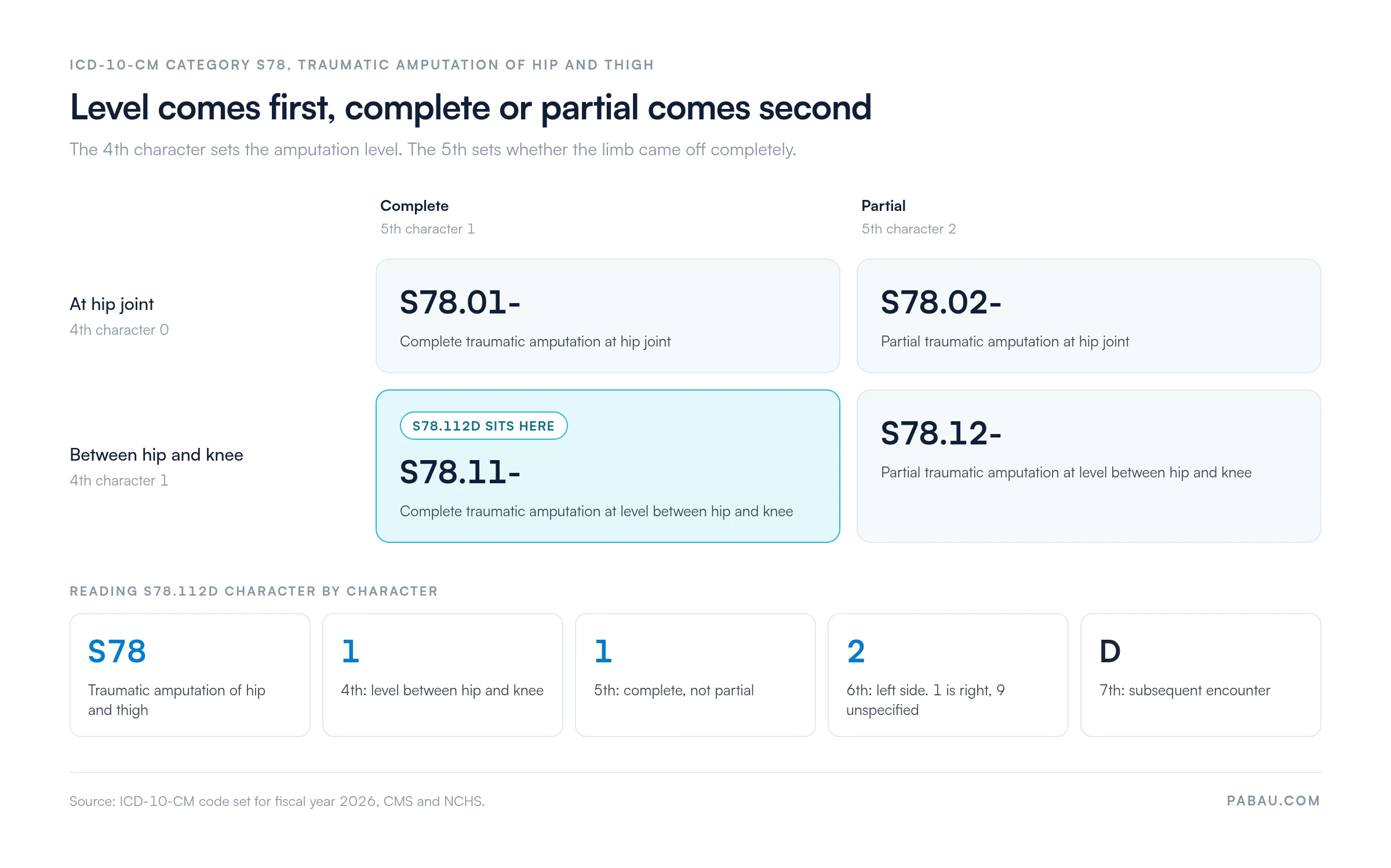
The 7th character D says active treatment is over. Under the ICD-10-CM official guidelines (Section I.C.19), every injury code in the S00-T88 chapter needs a 7th character to name the encounter type. S78.112 takes three of them.
A common misreading treats D as visit number two. The character tracks the phase of care, not the count of visits. A patient at their first outpatient appointment after discharge already warrants D, because the surgical phase is over. Someone returning for revision surgery months later goes back to A.
S78.112S covers the other direction. Use it when the visit treats a direct late consequence of the amputation. A chronic stump infection or phantom limb pain months later fits, once the injury itself has resolved.
Reach for S78.112D when a patient with a prior complete left thigh amputation comes in for care that is not acute surgical management. In practice, that covers five situations:
Outpatient therapy is where this matters most. Payers separate initial from subsequent encounter codes during claim review, so an initial-encounter code on a routine therapy visit is a familiar denial trigger.
Check whether the chart notes document that the original amputation has been surgically treated and the wound is healing. If active intervention on the injury itself is still ongoing, such as an open wound revision, use S78.112A. Once that phase is complete, every subsequent encounter uses D until a sequela condition arises warranting S.
ICD-10-CM asks for laterality on paired anatomical sites, and the 6th character in S78.112D is what encodes left.
Change it and you have a different billable code. It pays to check the operative note rather than the referral. An unspecified code on a documented case is a specificity error payers flag.
Bilateral cases carry both codes. S78.112D and S78.111D can sit on the same claim, and payers and clearinghouses process each line separately. So both have to be fully specified.
Auditors reviewing an S78.112D claim look for four elements in the medical record. A missing one is enough to support a denial or a downcode, because the code is only as defensible as the note behind it.
A note template is the cheapest fix here. Practices treating patients after traumatic limb loss can capture all four elements at every follow-up visit, which removes the audit exposure for this code family.
Build a follow-up note template for post-amputation visits with four fixed fields: laterality, amputation level, amputation type, and encounter context. A coder who finds all four in 30 seconds makes fewer claim errors than one hunting through narrative notes.
Coding is one step in a longer sequence, and knowing where the claim can stall tells you what to check first.
Here is the path a subsequent-encounter amputation claim takes:
Steps three and five are where a wrong 7th character surfaces. Neither one tells you the character was wrong, though, so the fix has to start in the note.
Three errors account for most denials in this code family, and each is visible before the claim goes out. Our guide to denial codes covers the remark codes that come back when one slips through.
This is the most common one. Once the patient is seen in an outpatient setting for follow-up, D applies, however soon after the amputation that visit happens. Payers cross-reference encounter type against facility claim data, so S78.112A on an outpatient rehabilitation claim stands out.
S78.119D exists for records that genuinely do not name a side. ICD-10-CM asks for the most specific code available, so a documented left thigh means S78.112D. Reaching for the unspecified digit invites a payer edit or a request for records.
A partial amputation leaves some tissue continuous, while a complete one severs the segment entirely. Coding S78.122D when the operative report describes a complete transfemoral amputation is a clinical mismatch, and post-payment audits catch it. Read the operative description before you pick the 5th character.
Five questions catch the common problems before the claim leaves. Run them at the point of coding, rather than after the remittance arrives, because a clean claim costs far less than a corrected one.
In many practices, the coder reads a narrative note, retypes the code into a payer portal, and hears about the denial three weeks later. The note, the code, and the claim live in three separate places. Nobody spots the mismatch until the money is late.
Practice management software like Pabau keeps all three against the same appointment. The follow-up note, the diagnosis code, and the claim sit in one record, so nobody is retyping S78.112D from a printout. Pabau’s claims software for practices carries the current ICD-10-CM catalog, so the code is there to select.
For US practices, claims go out electronically through the Claim.MD clearinghouse. Eligibility is checked before the visit, and remittances post back afterwards.
A denied line then shows up next to the visit that caused it. You can correct the documentation while the patient is still in your care.
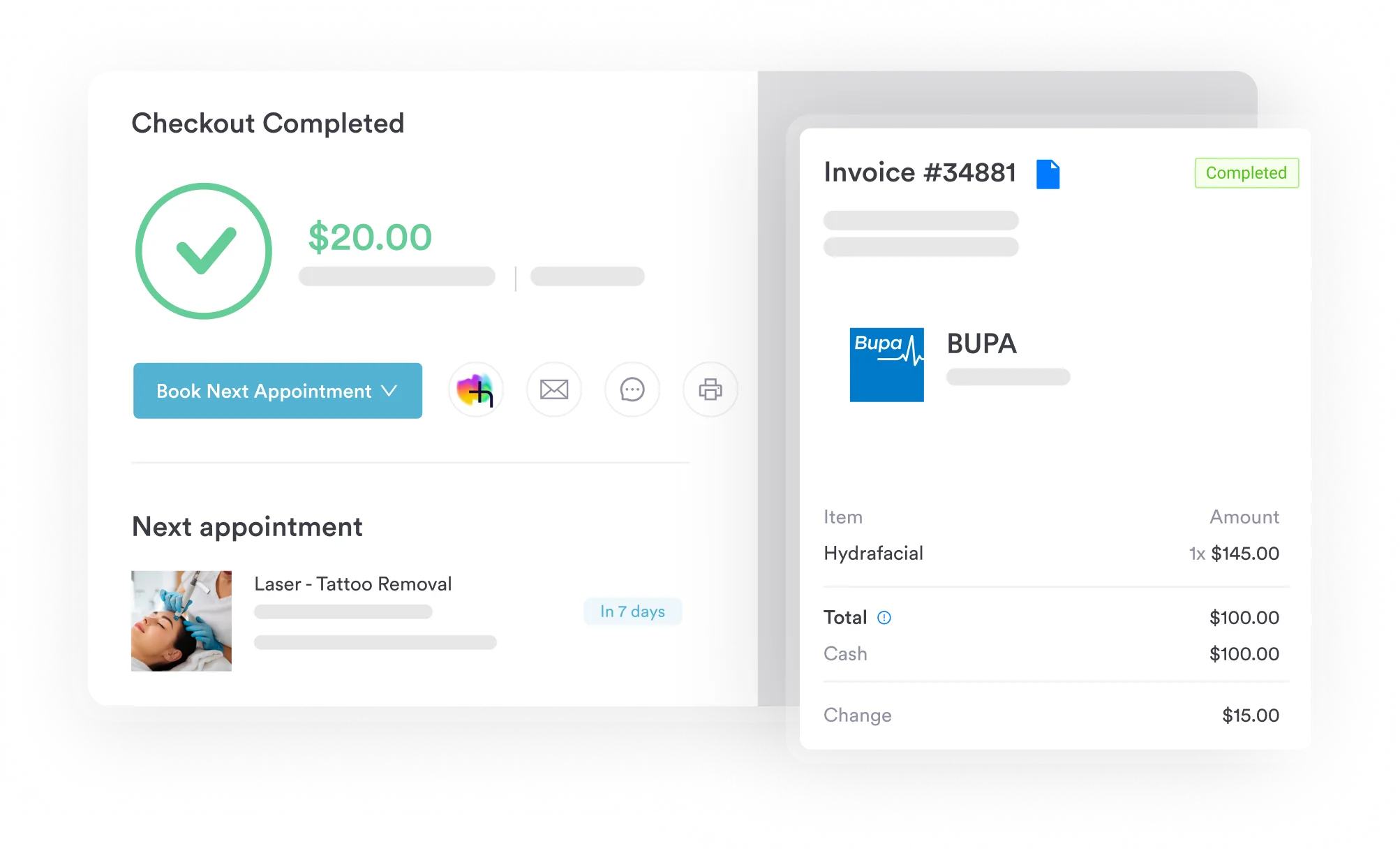

Pabau submits ICD-10 diagnosis codes electronically to 4,000-plus US payers through the Claim.MD clearinghouse. Eligibility is checked before the visit, remittances post back after it, and nobody re-enters the code by hand.

Follow-up amputation coding comes down to one character, and the record either supports it or it does not. If the note reads as follow-up care and names the side, the level, and the complete severance, S78.112D holds up under review. If it does not, no amount of claim scrubbing rescues the line.
So the fix sits upstream of billing. Build the four elements into the post-amputation note template once, and your coder stops hunting for them at every visit.
Book a demo to see how Pabau ties the follow-up note, the diagnosis code, and the claim to one appointment.

Need guidance on denial patterns for injury codes? Denial management in healthcare covers the most common reasons ICD-10 injury claims are denied and how to address them.
Submitting claims through a clearinghouse? Understanding the 837 file explains how electronic claim files are structured and validated before reaching payers.
Want to verify insurance coverage before the appointment? Insurance eligibility verification outlines real-time eligibility checking and how it reduces claim rejections for post-acute care visits.
The immediate parent is S78.11, complete traumatic amputation at level between hip and knee. Above that sits S78.1, which covers the same level for both complete and partial amputations. Neither is billable, so the six-character code plus its 7th character is what you submit.
No. ICD-10-CM guidelines report injury aftercare with the injury code plus a 7th character for subsequent encounter. The aftercare Z codes cover other conditions, so they do not apply to this visit.
ICD-10-CM sets no national requirement for external cause reporting, though many payers and trauma registries expect one. If you report a code from Chapter 20, give it the subsequent-encounter 7th character too, so both codes describe the same visit.
There is no time limit. D applies for as long as the visits are follow-up care for the amputation itself. It ends when treatment addresses a late effect instead, which is the point where S78.112S takes over.
Once treatment is no longer directed at the injury, the limb loss is reported as a status. Z89.612 covers an acquired absence of the left leg above the knee. Use it on visits for unrelated problems.