ICD-10 Code S42.444P: Medial epicondyle fracture, right humerus
ICD-10 Code S42.444P: full descriptor and code validity ICD-10 Code S42.444P car...

Last Updated: Oct 13, 2026
Billable Code Specific Code
S77.21XA is the billable ICD-10-CM code for crushing injury of right hip with thigh, initial encounter.
Let Pabau's smart automation suggest the right codes, reduce claim denials, and keep your practice compliant—effortlessly.
Automate repetitive tasks and focus on what matters most—your patients.
Reduce coding errors and ensure compliance with the latest regulations.
Clean claims, fewer denials, and faster reimbursements.
Powerful insights and reporting to help your practice thrive.
HIPAA compliant SOC 2 certified GDPR-compliant Trusted by 4,000+ clinics worldwide

S77.21XA describes a crushing injury of the right hip with thigh, initial encounter, and is a billable ICD-10-CM code valid for the 2026 edition
The 7th character A covers the whole active treatment phase, not just the first visit; D and S apply to routine healing and sequelae
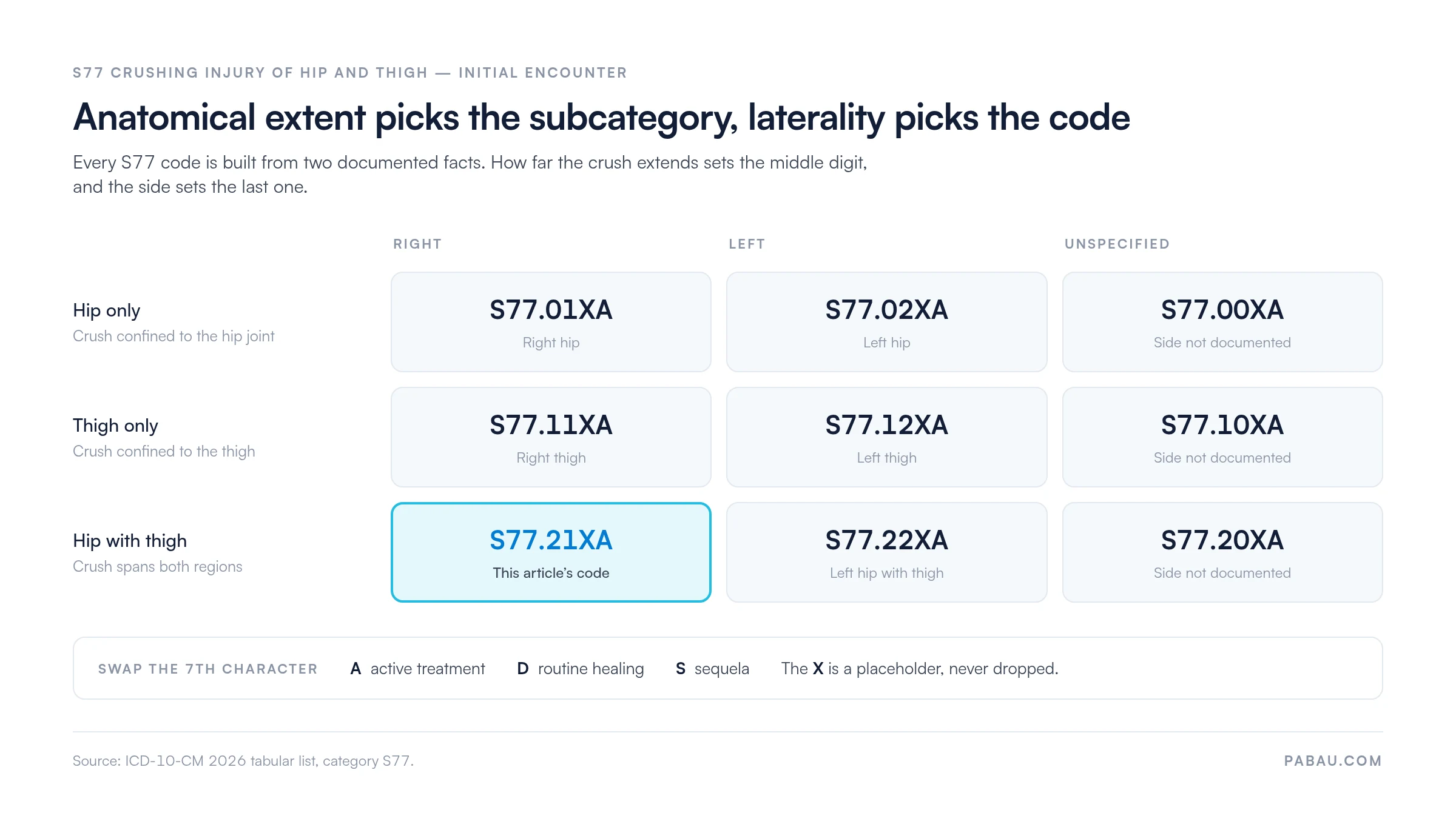
Anatomical extent sets the subcategory: S77.0 is hip only, S77.1 is thigh only, and S77.2 is hip with thigh
Laterality must be documented: right (S77.21XA), left (S77.22XA), and unspecified (S77.20XA) are three distinct billable codes
Traumatic compartment syndrome after a crush injury is coded from category T79.A, not the nontraumatic M79.A family
S77.21XA is billable and specific under ICD-10-CM, so it can be submitted for reimbursement without a more detailed sub-code. The 2026 edition became effective on October 1, 2025. That date comes from the annual ICD-10-CM update cycle. The cycle is maintained by the Centers for Medicare and Medicaid Services (CMS) and the National Center for Health Statistics (NCHS).
A crushing injury differs from a fracture or a contusion. It involves mechanical compression of soft tissue, vascular structures, or bone. The combined hip-with-thigh region is what separates this code from the hip-only and thigh-only crush codes. Selecting it correctly requires confirmation of both laterality and encounter type.
Use this table to confirm the core attributes of S77.21XA before submission. Cross-check against the CDC/NCHS ICD-10-CM web tool for the current fiscal year edition.
Knowing where S77.21XA sits in the hierarchy makes the neighboring codes easier to navigate and the sequencing rules easier to apply. The code belongs to Chapter 19, which covers injuries, poisoning, and other consequences of external causes. Chapter 19 is one of the most documentation-intensive chapters in ICD-10-CM, because every code needs anatomical specificity and an encounter-type character.
The 7th character is the most frequently miscoded element in Chapter 19 trauma codes. For S77.21XA, the character A designates the initial encounter. Per the ICD-10-CM Official Guidelines for Coding and Reporting (Section I.C.19), “initial encounter” covers every encounter while the patient receives active treatment. It is not limited to the first visit to a single provider.
A patient seen in the ED and then transferred to an orthopedic surgeon carries S77.21XA at both visits, as long as active treatment continues.
Document the phase of treatment explicitly in every clinical note. Payers flag claims where the 7th character shifts from A to D with no progress note confirming that active treatment has ended. A short line such as ‘wound fully epithelialized, transitioning to aftercare’ supports the coding change.
Laterality is a non-negotiable documentation requirement here, because S77.21XA identifies the right hip with thigh specifically. Submitting the unspecified code when the note clearly says “right” is a coding error that can trigger a payer audit. Two neighboring codes account for most of the remaining mis-selections, and both turn on how far the crush extends.
S77.11XA covers a crushing injury of the right thigh with the hip uninvolved. S77.01XA covers a crushing injury of the right hip alone. The grid below lays the whole S77 family out on the two axes the coder actually has to decide.
Clinicians and coders use several alternate terms that map to this code. Recognizing them helps when an operative report or an ED note describes the injury without using precise ICD-10 language.
Incomplete documentation is the main driver of denials on S77.21XA claims. The clinical record has to support every element the code encodes: the injury type, the anatomical region, the laterality, and the encounter phase. Payers run automated editing tools that flag claims where the chart note does not substantiate the specificity of the code submitted.
Section I.C.19 of the ICD-10-CM Official Guidelines for Coding and Reporting governs crush injury coding. Three principles apply directly to S77.21XA. First, code the most specific site the documentation supports: a combined hip-and-thigh injury takes an S77.2x code, not S79 (other injuries of hip and thigh).
Second, when a crush injury occurs alongside a fracture of the same bone, the fracture code takes sequencing priority as the principal diagnosis. Third, traumatic compartment syndrome arising from a crush injury is coded from category T79.A as an additional code. The M79.A codes cover nontraumatic compartment syndrome and do not apply to a crush injury.
S77 also carries an instruction to use additional codes for all associated injuries. A traumatic sciatic nerve injury on the right side is coded separately as S74.01XA. The crush code does not capture that nerve damage.
External cause codes from Chapter 20 are recommended rather than mandatory for most payers, though some state Medicaid programs require them. They also strengthen the medical necessity record. Assign the V, W, X, or Y code that describes the mechanism. W23.2XXA covers caught, crushed, or jammed between a stationary and a moving object.
S77.21XA is a diagnosis code, so it needs a CPT procedure code to form a claim. Which CPT codes accompany it depends entirely on the treatment rendered. Below are the pairings seen most often in emergency, orthopedic, and surgical settings.
Since 2023, the ED evaluation and management codes are levelled by medical decision making rather than by history and exam. That makes 99283 low complexity, 99284 moderate, and 99285 high. Debridement is the procedure most often reported first on these claims, and CPT 11042 sets the base unit that the add-on codes build on.
The diagnosis and the procedure travel together on the same claim line, so both have to be recorded at the encounter rather than reconstructed later. Practice management software like Pabau stores them on the encounter record. Its claims management software then carries that record through to a CMS-1500 export or an 837P transaction.
Three scenarios show how the 7th character and laterality interact with the clinical presentation. They are worth reading closely, because an operative report almost never uses the words “initial encounter” that the code depends on.
A crush injury with vascular damage or compartment syndrome needs additional codes, sequenced with the most severe injury first. Assign T79.A21A (traumatic compartment syndrome of right lower extremity, initial encounter) alongside the crush code when compartment syndrome is documented. Omitting it can reduce reimbursement and invite a medical necessity audit.
Crush injury codes in the S77 family generate a predictable set of denials, and heading them off keeps accounts receivable aging down on trauma claims. Each pattern below maps to a specific remittance message, so it helps to read them alongside the denial codes your payers return most often.
A second failure mode is quieter. The code is chosen correctly, then applied to the wrong encounter date or paired with an incompatible CPT. The claim is denied on grounds unrelated to the diagnosis itself. Running the code through the AAPC Codify ICD-10-CM lookup before submission catches most of these.
A laterality error usually surfaces during the billing review, several days after the visit. The coder raises a query, the clinician adds an addendum, and the claim goes out late. On a trauma case that is a week of aging on an account that should have paid on first submission.
Pabau, our all-in-one practice management system, keeps the ICD-10 diagnosis and the CPT procedure on the encounter record itself. Both sit beside the clinical note that supports them. The coder reviewing a crush injury claim reads the mechanism, the laterality, and the treatment phase on one screen, without opening a second system.
From there the claim goes out through the Claim.MD clearinghouse, and the remittance comes back against the same record. When a payer denies on laterality or encounter type, the reason code lands next to the note that has to change. The correction and the resubmission then happen in one place.

Pabau holds the ICD-10 diagnosis and the CPT procedure on the same encounter record, then submits and tracks the claim through the Claim.MD clearinghouse. Your coders read the note and the codes side by side.

Choosing S77.21XA takes seconds. The documentation behind it decides whether the claim pays. Every element the code encodes has to appear in the chart note in the clinician’s own words. No coder can supply a word the clinician never wrote.
So build the check into the encounter rather than the billing review. A query raised three days later already costs a working week, and by then the mechanism of injury is a memory rather than a note. Confirm laterality, extent, and treatment phase while the record is still open.
Pabau ties the diagnosis code to the procedure at the encounter and carries the claim through to the clearinghouse. Book a demo to see how that cuts rework on trauma and injury claims.

Need to understand the claims submission process end to end? What is revenue cycle management covers how diagnosis codes feed into claims, remittance, and collections workflows.
Want to reduce denials before they happen? Clean claim submission guide explains the documentation and coding elements that decide whether a claim pays on first submission.
Working a backlog of rejected trauma claims? Denial management in healthcare sets out how to triage, appeal, and track denials without losing the filing deadline.
New to the diagnosis-to-payment chain? What is medical billing walks through each step from the coded encounter to the posted payment.
Managing insurance eligibility before the visit? Insurance eligibility verification outlines how to confirm coverage for trauma and injury codes before the patient arrives.
S77.21XA is a billable ICD-10-CM code that describes a crushing injury of the right hip with thigh, initial encounter. It falls under Chapter 19 (Injury, poisoning and consequences of external causes), in block S70-S79 (Injuries to the hip and thigh). The code is valid for the 2026 edition, effective October 1, 2025.
Yes, S77.21XA is a billable and specific ICD-10-CM code. It can be submitted directly for reimbursement without additional sub-code specificity. The clinical documentation has to support the right-sided laterality, the hip-with-thigh extent, and the initial encounter designation.
The CPT codes paired with S77.21XA depend on the treatment rendered. Common pairings include CPT 99283-99285 for ED evaluation, CPT 11042 for wound debridement of skin and tissue, and CPT 97110 for therapeutic exercise during rehabilitation. When compartment syndrome is present, CPT 27602 (fasciotomy) may also apply.
The sequela code is S77.21XS. Use it when treating a condition that is a direct late effect of the original crush injury, such as chronic contracture or nerve damage. The sequela condition itself (for example, M62.851 for muscle wasting) should be listed as the first-listed diagnosis, with S77.21XS appended as the cause.