ICD-10 code T32.0: Corrosions involving less than 10% of body surface area
T32.0 is a corrosion code, not a burn code T32.0 reports chemical corrosions tha...

Last Updated: Nov 26, 2026
Billable Code Specific Code
S76.309D is the billable ICD-10-CM code for an unspecified hamstring injury of an unspecified thigh, at a subsequent encounter. Its official descriptor is "Unspecified injury of muscle, fascia and tendon of the posterior muscle group at thigh level, unspecified thigh, subsequent encounter." The D marks routine care after active treatment has ended.
Use S76.309D only when the record names the hamstring group but neither the injury type nor the side. A documented hamstring strain codes to S76.31-, and a thigh strain with no muscle group named codes to S76.91-.
Let Pabau's smart automation suggest the right codes, reduce claim denials, and keep your practice compliant—effortlessly.
Automate repetitive tasks and focus on what matters most—your patients.
Reduce coding errors and ensure compliance with the latest regulations.
Clean claims, fewer denials, and faster reimbursements.
Powerful insights and reporting to help your practice thrive.
HIPAA compliant SOC 2 certified GDPR-compliant Trusted by 4,000+ clinics worldwide

S76.309D is a billable ICD-10-CM code for an unspecified injury of the hamstring (posterior thigh) muscle group, unspecified thigh, at a subsequent encounter.
It is an unspecified-injury code. A documented hamstring strain belongs in S76.31-, and a thigh strain with no muscle group named belongs in S76.91-.
The 7th character D applies once active treatment has ended and the patient is in routine care during healing or recovery.
Use S76.301D or S76.302D whenever any note in the record identifies the right or left thigh.
Practice software such as Pabau keeps the muscle group, injury type and side in one patient record, so the claim matches the note.
ICD-10 code S76.309D is the billable diagnosis code for an unspecified injury of the hamstring muscle group, unspecified thigh, at a subsequent encounter. The CMS FY2027 ICD-10-CM code files list it as valid from October 1, 2026, to September 30, 2027.
The code reports a follow-up visit for a hamstring injury when the record does not say what kind of injury it was. It also leaves the side unspecified. Most hamstring injuries are documented as strains, so S76.309D should be the exception on a claim rather than the default.
Each character in S76.309D narrows the diagnosis one step. Read left to right, it moves from body region to muscle group, then to injury type, side and encounter phase.
The fourth character sets the muscle group. S76.0 covers the hip, S76.1 the quadriceps, S76.2 the adductors and S76.3 the posterior group. S76.8 covers other specified thigh muscles, and S76.9 covers unspecified thigh muscles. An initial visit for a thigh muscle injury with no group, type or side named codes to S76.909A.
The most common error on this code is treating it as a hamstring strain code. Within S76.3, the fifth character names the injury type, and an unspecified injury is only one of four options.
When the note says “hamstring strain” or “pulled hamstring,” code from S76.31-. S76.319D, for example, reads “Strain of muscle, fascia and tendon of the posterior muscle group at thigh level, unspecified thigh, subsequent encounter.”
When the note documents a thigh strain without naming the muscle group, the right subcategory is S76.91-. S76.919D reads “Strain of unspecified muscles, fascia and tendons at thigh level, unspecified thigh, subsequent encounter.”
S76.309D fits when the record confirms a hamstring injury but never says what kind. A follow-up note reading “hamstring injury, improving” with no earlier diagnosis on file is one example. Query the provider before settling on it, because the injury type is usually documented somewhere in the episode.
The 7th character D means the patient has finished active treatment and is receiving routine care while the injury heals. The FY2027 ICD-10-CM Official Guidelines for Coding and Reporting (Section I.C.19.a) use D for encounters after active treatment ends, during “the healing or recovery phase.”
The 7th character tracks the treatment phase, so D can apply at a first visit. A new provider seeing the patient for the first time reports S76.309D if active treatment ended at another practice. The guidelines also rule out aftercare Z codes for injuries, because the injury code with D already reports that care.
Document the move from active treatment to recovery-phase care in the note. A line such as “continues rehabilitation for hamstring injury of 3/14, active treatment completed 3/28” gives payers the encounter narrative they need. Add the side and the injury type whenever they are known.
Category S76 holds several codes that sit close to S76.309D. Matching the right one means confirming the muscle group, the injury type and the side, in that order.
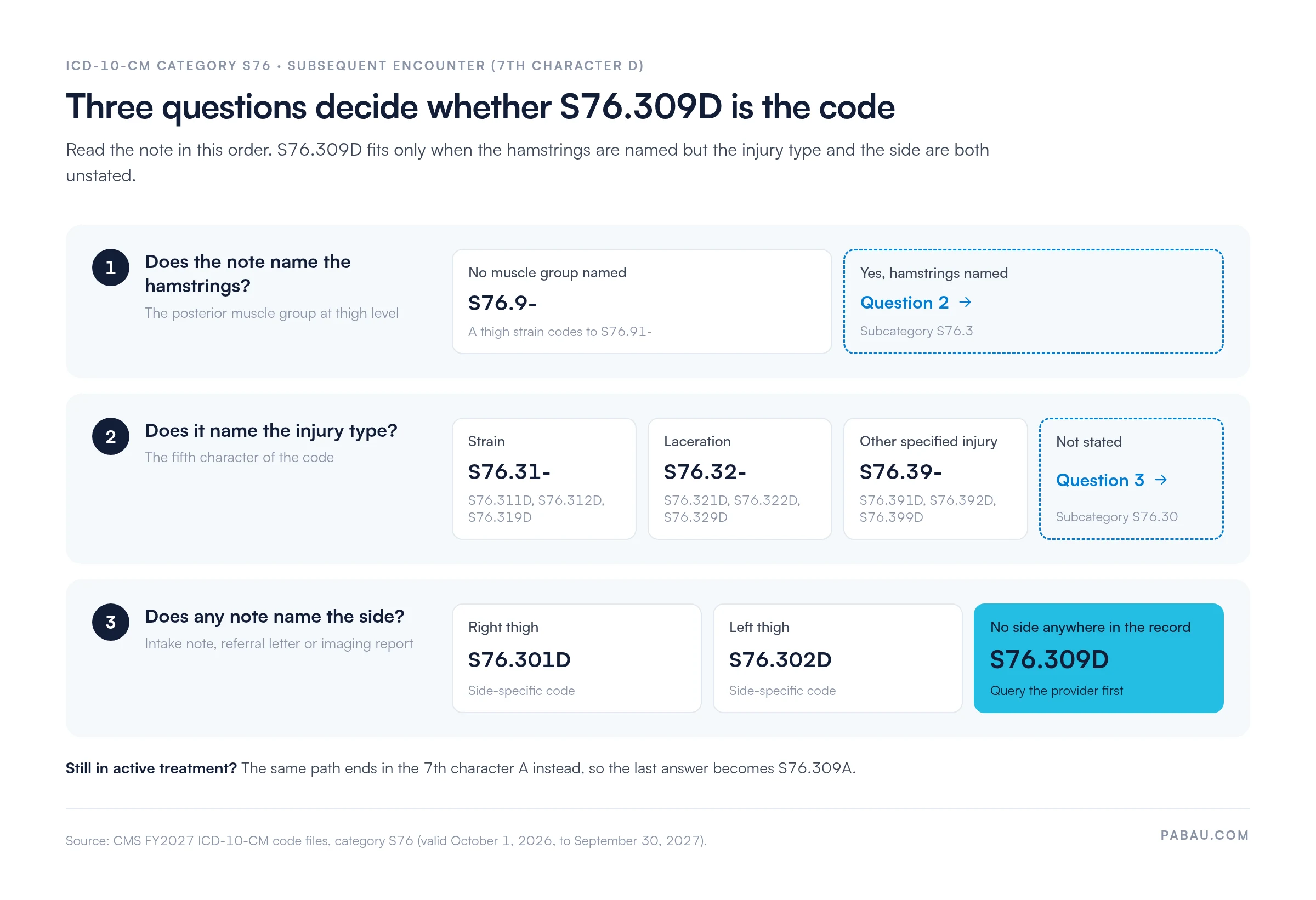
The most consequential choice is between S76.309D and the side-specific S76.301D or S76.302D. If the initial note says “right hamstring injury” and later notes are silent on the side, query the provider before using the unspecified code.
Category S76 carries one code also note and two Excludes2 notes in the FY2027 tabular list. Each one changes what else goes on the claim.
Excludes2 means the excluded condition is not part of S76. Both codes may still appear together when the patient has both conditions.
Supporting S76.309D takes a record that identifies the posterior (hamstring) muscle group, the encounter phase and the reason for continued care. For medical billing compliance, every character of the code has to trace back to the clinical note.
The record should contain each of the following before a claim goes out with this code:
An unspecified injury type and an unspecified side together invite payer queries. Before defaulting to S76.309D, query the provider on both points.
Medicare and most commercial payers accept subsequent encounter injury codes when each visit documents why care continues. Payers look for skilled care with measurable goals, and a note that only repeats the diagnosis rarely satisfies them.
For Medicare outpatient therapy, insurance eligibility verification at the start of the episode is essential. Once the patient’s therapy spending for the year passes the KX modifier threshold, each therapy line needs the KX modifier. The modifier attests that the services remain medically necessary, and higher spending can trigger targeted medical review.
Workers’ compensation carriers add another layer. Many require the claim to reference the original injury report. Some also ask for periodic functional status reports before they authorize more rehabilitation. Requirements vary by state, so check the carrier’s treatment guidelines before the first follow-up claim is filed.
An eligibility check before each visit catches an expired authorization before weeks of follow-up sessions build up unpaid. Our guide to submitting a clean claim covers the other pre-submission checks that prevent clearinghouse rejections.
Most S76.309D denials trace back to the note. The table pairs six common triggers with a documentation fix and an appeal route. Each denial comes back on the remittance as a reason code. This guide to denial codes for billers explains what each one asks you to fix.
Pabau’s claims management software builds claims in the same system that holds the visit note. Your billing team can check the code against the note before submission. Pairing that with denial management workflows means rework is handled systematically rather than case by case.
Run a quarterly audit of S76.30- and S76.31- claims from the previous 90 days. Sort the denials into injury-type errors, 7th-character errors and side queries. The split shows whether the fix is coder training or the documentation workflow.
Physical therapists see many hamstring injuries in the recovery phase, but most arrive with a strain diagnosis. Those claims carry an S76.31- code with the 7th character D. S76.309D applies only when the referral names a hamstring injury without a type.
Therapy claims commonly pair S76.309D with CPT 97110 for therapeutic exercise, 97112 for neuromuscular re-education and 97530 for therapeutic activities. Each CPT line needs its own support in the note. That means the deficit the intervention targets and the patient’s progress toward measurable goals.
A physical therapy practice can record the encounter phase on the intake form, so it carries into the claim. That prevents a common error on this code. A patient finishes active treatment elsewhere and re-presents for physical therapy, and the first session is coded A instead of D.
S76.309D falls under Section I.C.19 of the ICD-10-CM Official Guidelines, which covers injury, poisoning and certain other consequences of external causes. Section I.C.19.b adds that each injury gets its own code unless a combination code exists.
The CDC/NCHS ICD-10-CM web tool lets coders confirm the current tabular entry for S76.309D, including the category notes. The AAPC ICD-10-CM lookup mirrors the same CMS and NCHS data.
CMS publishes the full ICD-10-CM update files each year, and the new code set takes effect on October 1. Check S76.309D against each new file before the fiscal year begins. The FY2027 addenda carry no changes to category S76.
In many practices the injury details make two trips. The provider writes them into a free-text note, and someone at the billing desk reads that note and picks a code. A note that says “thigh injury, improving” leaves the coder guessing at the muscle group, the injury type and the side.
In Pabau, the provider records those details in structured form fields at the visit. The muscle group, injury type, side and encounter phase are captured once and stay in the patient record. US claims then go out through Claim.MD, with eligibility checks before the visit and electronic remittances after it.
The result is a claim that agrees with the note behind it. Your billing team spends less time querying providers, and fewer follow-up claims come back for a strain coded as an unspecified injury.

Pabau keeps the muscle group, injury type and side in one structured record. Claims go out through Claim.MD with eligibility checked first, so follow-up visits are coded right the first time.

Treat S76.309D as the code you reach last. It fits a hamstring injury of unknown type and unknown side, seen after active treatment has ended. A documented hamstring strain belongs in S76.31- instead.
Fix the documentation first and the coding follows. A provider who names the muscle group, the injury type and the side at each visit removes most of the queries this code attracts. Book a demo to see how Pabau keeps hamstring follow-up claims matched to the visit note.

Need a claims submission workflow for physical therapy visits? Claim.MD clearinghouse guide explains how the clearinghouse validates ICD-10 codes against payer rules before submission.
Chasing a corrected claim or an appeal? Timely filing limits by payer lists the deadlines for initial claims, corrected claims and appeals.
Want to understand how remittance advice reveals denial patterns? Electronic remittance advice explained breaks down how to read ERA files and spot the denial codes that keep coming back.
ICD-10 code S76.309D means unspecified injury of muscle, fascia and tendon of the posterior muscle group at thigh level, unspecified thigh, subsequent encounter. The posterior muscle group is the hamstrings. The code applies at a follow-up visit when the record names a hamstring injury but not its type or side.
No. S76.309D reports an unspecified injury of the hamstring muscle group, and strains have their own codes. A documented hamstring strain at a subsequent encounter codes to S76.311D (right), S76.312D (left) or S76.319D (unspecified thigh). A thigh strain with no muscle group named codes to S76.911D, S76.912D or S76.919D.
S76.309A is reported for each encounter where the patient is receiving active treatment for the injury. S76.309D is reported after active treatment ends, while the patient receives routine care during healing or recovery. A first visit with a new provider still takes D when active treatment has already ended.
Yes, when the referral documents a hamstring injury without naming its type or side. Rehabilitation after active treatment is recovery-phase care, so it takes D as the 7th character. Most therapy referrals document a strain, though, and those visits code to S76.31- instead.
The usual cause is a documented strain reported as an unspecified injury. Others are the 7th character A on a recovery-phase visit and an unspecified side when the record names one. Thin functional documentation and lapsed therapy authorizations add more. Each has a documentation fix that supports a corrected claim.
Only when no document in the record, including the intake note, referral letter or imaging report, identifies the side. If any document names the side, use S76.301D for the right thigh or S76.302D for the left. Query the provider before defaulting to the unspecified code.
Yes. S76.309D is a valid, billable ICD-10-CM code in the CMS FY2027 code files, which apply from October 1, 2026, to September 30, 2027. The FY2027 update made no changes to category S76. Check the code again each October, when the next fiscal year’s files take effect.