

ICD-10 Code S53.013D: Anterior subluxation of unspecified radial head
ICD-10 Code S53.013D: Quick reference summary Use the table below as your first ...

Last Updated: Nov 6, 2026
Billable Code Specific Code
S72.8X1R is the billable ICD-10-CM code for other fracture of right femur, subsequent encounter for open fracture type IIIA, IIIB, or IIIC with malunion.
Coders frequently confuse ICD-10 code S72.8X1R with its malunion siblings, S72.8X1P for a closed fracture and S72.8X1Q for an open type I or II fracture. They also confuse it with the other open type III codes, S72.8X1N for nonunion and S72.8X1F for routine healing. Each mix-up triggers a different payer denial.
Imaging confirmation of malunion must be present in the medical record before this code can be assigned. Coding from clinical suspicion alone is a documentation deficiency that auditors flag.
Let Pabau's smart automation suggest the right codes, reduce claim denials, and keep your practice compliant—effortlessly.
Automate repetitive tasks and focus on what matters most—your patients.
Reduce coding errors and ensure compliance with the latest regulations.
Clean claims, fewer denials, and faster reimbursements.
Powerful insights and reporting to help your practice thrive.
HIPAA compliant SOC 2 certified GDPR-compliant Trusted by 4,000+ clinics worldwide

S72.8X1R is a billable ICD-10-CM code for follow-up care of an open type IIIA, IIIB, or IIIC right femur fracture that healed with malunion.
The 7th character R means malunion of an open Gustilo type III fracture. Closed malunion takes P, and open type I or II malunion takes Q.
The record must state the Gustilo type. Under Tabular List convention, an open fracture with no documented type defaults to type I or II, which codes to Q.
Payers deny S72.8X1R claims when imaging that confirms malunion is missing from the chart or the encounter type is wrong.
Pabau’s claims management software checks the encounter type and supporting records before a femur fracture claim reaches the payer.
ICD-10 code S72.8X1R is a valid, billable ICD-10-CM code, effective for discharges and encounters from October 1, 2015 onward. It sits in Chapter 19 (Injury, poisoning and certain other consequences of external causes), within the S70-S79 block for injuries to the hip and thigh. Its category is S72 (fracture of femur), and its subcategory is S72.8 (other fracture of femur).
The official descriptor is: Other fracture of right femur, subsequent encounter for open fracture type IIIA, IIIB, or IIIC with malunion. Each part of that descriptor maps to a character position in the code. Knowing each position is the fastest way to avoid laterality, fracture-type and encounter-type errors.
The placeholder X in position 5 is not optional. Omitting it produces an invalid code that payers reject outright. Confirm the full 7-character string S72.8X1R before every claim. Check its validity for the current fiscal year with the CDC/NCHS ICD-10-CM web tool.
A subsequent encounter is any visit after the patient has completed active treatment for the fracture. The provider is now managing healing, or a complication of healing. Malunion is one of those complications.
An open fracture is one where the broken bone has pierced the skin or communicates with a wound. The Gustilo-Anderson classification grades open fractures by wound size, soft-tissue damage and vascular injury. ICD-10-CM uses that classification for femur fractures, and S72.8X1R covers only the most severe grades:
Types I and II are lower-energy open fractures with smaller wounds, and they take a different code. A right femur malunion after a type I or II open fracture is S72.8X1Q. A malunion after a closed fracture is S72.8X1P.
Malunion means the fracture has united, with callus bridging the gap, but in a position that is not anatomically correct. Typical presentations include angular deformity, shortening or rotational malalignment. The key distinction from nonunion is that the bone has healed. It has just healed badly.
If the follow-up note says ‘malunion of Gustilo type IIIB open fracture, confirmed on imaging dated [date]’, that one sentence supports every element of S72.8X1R. Train providers to put the Gustilo type and the imaging date in the assessment, so payer record requests resolve quickly.
The S72.8X1 subcategory takes 16 valid 7th characters. Each one encodes the encounter type, the healing status and whether the fracture was open or closed. Every full descriptor begins “Other fracture of right femur,” followed by the wording below.
The list is easier to read as a grid. Every healing status has three codes, one for each fracture type. Sequela (S) stands alone, because it no longer tracks the fracture type.
S72.8X1R sits in the bottom-right cell. Moving one column left (Q) or two (P) keeps the malunion but changes the fracture type. Moving one row up (N) keeps the fracture type but changes the healing status.
The codes most often swapped for S72.8X1R share either its healing status or its fracture type. The malunion siblings P and Q are the main mix-ups, because they differ from R only in the original fracture type.
Section I.C.19 of the ICD-10-CM Official Guidelines for Coding and Reporting governs 7th character selection for traumatic fractures. Its rule in Section I.C.19.c settles the first S72.8X1R question. A fracture not documented as open or closed is coded as closed.
The second default comes from coding convention, not from the guidelines. The Tabular List treats an open fracture with no stated Gustilo type as type I or II, and AHA Coding Clinic applies the same reading.
The decision tree below applies both defaults. The diagram after it condenses steps 4 and 5 into the branch that ends at P, Q or R.
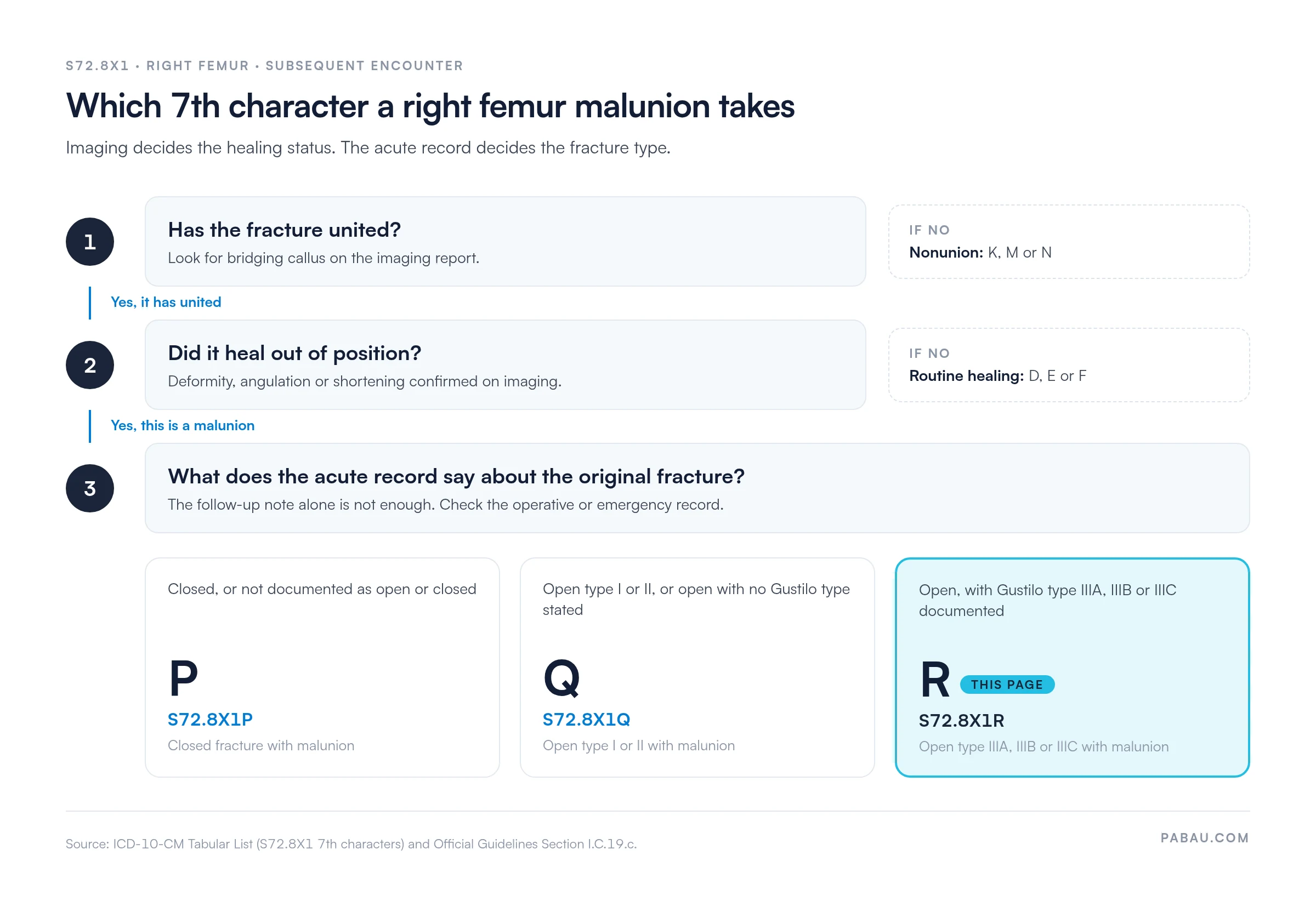
The guidelines also state that care for fracture complications, such as malunion and nonunion, is reported with the subsequent-encounter 7th character. A patient seeking corrective surgery for a type IIIB femur malunion is therefore still at the subsequent-encounter stage. Report S72.8X1R, not S72.8X1S.
Payers reviewing S72.8X1R claims look for five documentation elements. The Gustilo type matters most, because it is the only element that separates R from Q. Missing any one element is enough grounds for denial.
When a follow-up note documents ‘fracture healing with deformity’ but does not use the word malunion, query the provider before assigning S72.8X1R. The imaging report’s explicit language is stronger audit protection than a coder’s inference from vague clinical phrasing.
ICD-10-CM does not make external cause codes (V00-Y99) a national reporting requirement. Some state mandates and payer policies do require them. Where they are reported, they continue for the length of treatment, with a 7th character matching the encounter. At a malunion follow-up, that is the subsequent-encounter character D.
Other codes that may appear alongside ICD-10 code S72.8X1R on the same claim:
The CPT codes on a claim carrying ICD-10 code S72.8X1R depend on the service rendered at the follow-up visit. Orthopedic and rehabilitation practices should confirm medical necessity and any NCCI bundling edits before submitting a combination. AAPC’s ICD-10-CM code lookup gives crosswalk guidance on each pairing.
Malunion repair and corrective osteotomy (CPT 27470, 27472 and 27450) routinely require prior authorization from Medicare Advantage plans and most commercial payers. Confirm payer-specific requirements before scheduling surgery. When imaging billed under CPT 73552 confirms the malunion, file that report in the chart before either claim goes out.
Medicare coverage for fracture follow-up care follows Local Coverage Determinations (LCDs) from the Medicare Administrative Contractor (MAC) for your jurisdiction. No single Medicare rule governs all malunion claims. Requirements vary by MAC and change regularly, so check the current LCD before submitting a claim for surgical correction.
Key payer-side considerations for ICD-10 code S72.8X1R claims:
Clean claim protocols that prevent encounter-type and laterality errors are covered in the guide on clean claim submission. The revenue cycle management overview explains how these claims fit into the wider payment cycle.
Most denials on ICD-10 code S72.8X1R claims are preventable. These six patterns account for most rejections on open fracture follow-up codes. The remittance names each rejection with one of the standard medical billing denial codes.
Systematic denial management starts upstream. Practices that use claims management software with pre-submission edits catch encounter-type and laterality errors before they reach the payer. For appeals and recovery, see the guide on denial management workflows.
Insurance eligibility verification before the follow-up visit is also worth building into the workflow. Coverage often changes between the acute fracture and the malunion follow-up, especially when months separate the two. The guide on insurance eligibility verification covers the practical steps.
Most S72.8X1R denials trace back to records that never meet. The Gustilo type sits in the acute operative note, and the malunion shows up in a later imaging report. The claim is then coded from a third document.
Pabau’s practice management software keeps clinical notes, uploaded reports and billing in one patient record. Coders can check the fracture type and imaging date against the 7th character without chasing files. Claims then go out through Pabau’s integration with the Claim.MD clearinghouse, which runs eligibility checks and payer-specific edits first.
The result is fewer R-versus-Q rejections and fewer record requests on open femur fracture follow-ups.

Pabau’s claims management workflows flag encounter-type mismatches and missing documentation before a claim leaves your practice. See how orthopedic and rehabilitation teams keep open femur fracture follow-up claims clean.

S72.8X1R is a narrow code. It fits one patient: An open Gustilo type IIIA, IIIB, or IIIC right femur fracture that has healed out of alignment. Every other right femur malunion belongs to P or Q.
So code from the acute record, not only the follow-up note. If the Gustilo type is missing, coding convention pushes the claim to Q. A provider query costs far less than a denial and a resubmission.
Pabau keeps the acute-phase notes, imaging reports and claims in one patient record, so the 7th character can be checked before submission. Book a demo to see how Pabau supports cleaner fracture follow-up claims for orthopedic practices.

Need a structured approach to managing fracture-related billing across the care episode? What is medical billing covers the end-to-end process from charge capture through payment posting.
Want to understand how your clearinghouse validates ICD-10 code submissions before they reach the payer? Claim.MD clearinghouse guide explains the edit and routing logic that catches coding errors at submission.
Looking for a reference on how 837 electronic claim files carry diagnosis codes to payers? 837 electronic claim file guide covers the structure of electronic claim submissions including diagnosis code placement.
ICD-10 code S72.8X1R means other fracture of right femur, subsequent encounter for open fracture type IIIA, IIIB, or IIIC with malunion. It applies at a follow-up visit after a severe open right femur fracture has healed in an abnormal position, confirmed by imaging.
Yes. S72.8X1R is a fully specified, billable ICD-10-CM code with a valid 7-character structure. It can be reported as a principal or secondary diagnosis when the record documents the Gustilo type and imaging-confirmed malunion.
Malunion means the fracture has healed, but in an abnormal anatomic position. Nonunion means it has failed to heal, with no bridging callus present. For an open type III right femur fracture, malunion is S72.8X1R and nonunion is S72.8X1N. The two need different imaging findings and are not interchangeable.
Use a subsequent-encounter 7th character (D through R) while the patient still receives care for the fracture, including care for malunion. Use S (sequela) only for a residual condition after the fracture episode has resolved. A patient planning or recovering from corrective surgery for malunion remains at the subsequent-encounter stage.
The most common reason is coding R when the record shows a closed fracture or no Gustilo type. Using C instead of R at a follow-up is another. Missing malunion imaging, laterality errors, the wrong S72 subcategory and outdated code versions complete the list. Each has a prevention step before submission.
Yes. S72.8X1R has been valid since ICD-10-CM took effect on October 1, 2015, and it remains billable. Confirm validity for the specific date of service with the CDC/NCHS ICD-10-CM web tool, because annual updates can change code status.



