

HCPCS code E0198: Water pressure pad billing guide
HCPCS code E0198 is a water pad for a standard mattress HCPCS code E0198 is the ...

Last Updated: Oct 13, 2026
CPT Code 73552 is the billing code for a radiologic examination of the femur, minimum 2 views. It applies whenever two or more projections of the femur are acquired in a single session. A single-view femur study is billed as 73551 instead.
Medicare's 2026 national non-facility rate for the global service is $35.74, before your locality adjustment. Two decisions drive whether that money arrives: the view count in the signed report, and the -26 or -TC modifier that matches the setting. Undercoding to 73551 when two projections were captured is the most common error on femur imaging.
Let Pabau's smart automation suggest the right codes, reduce claim denials, and keep your practice compliant—effortlessly.
Automate repetitive tasks and focus on what matters most—your patients.
Reduce coding errors and ensure compliance with the latest regulations.
Clean claims, fewer denials, and faster reimbursements.
Powerful insights and reporting to help your practice thrive.
HIPAA compliant SOC 2 certified GDPR-compliant Trusted by 4,000+ clinics worldwide

CPT Code 73552 covers a femur radiologic examination with a minimum of two views, and 73551 covers single-view studies.
Medicare’s 2026 national non-facility rate is $35.74, built from 1.07 total RVUs and the $33.4009 conversion factor.
Practice expense RVUs are identical in the facility and non-facility settings for this code, so the setting decides who bills, not how much.
Modifiers -26, -TC, -LT, -RT, and -52 are the ones you will use, and the -26/-TC split causes most denials.
Pabau’s claims management software submits and tracks 73552 claims through the Claim.MD clearinghouse and posts remittances automatically.
CPT Code 73552 describes a radiologic examination of the femur, minimum 2 views, as defined by the American Medical Association’s CPT code set. The code sits within the Radiology section of the CPT manual, under diagnostic radiology procedures for the lower extremities.
Clinically, the code applies whenever two or more projections of the femoral shaft or the distal or proximal femur are acquired in one encounter. Anteroposterior (AP) and lateral views are the usual pair. Oblique and additional spot views also satisfy the minimum 2 views requirement.
Clinical indications that support ordering a femur series include:
The code captures the global service unless it is split-billed with modifiers. When the radiologist personally performs and interprets the study in a private office or a free-standing imaging center, bill 73552 with no modifier. When the facility owns the equipment and the radiologist supplies only the interpretation, apply the -26 and -TC split.
Medicare pays CPT 73552 under the CMS Medicare Physician Fee Schedule (MPFS). Rates are set annually and adjusted by the Geographic Practice Cost Index (GPCI) for each Medicare locality. The national unadjusted figures below use the 2026 conversion factor, so your allowable will differ by MAC jurisdiction.
Important: The global figure is 1.07 total RVUs multiplied by the 2026 nonqualifying APM conversion factor of $33.4009. Practices paid on the qualifying APM conversion factor of $33.5675 see $35.92 for the same study. The component amounts are national approximations, and every figure here moves once your locality’s GPCI values are applied.
Relative value units (RVUs) set the base payment for 73552 before geographic adjustment. Work, practice expense, and malpractice combine into a total, which is then multiplied by the locality GPCI and the annual conversion factor.
The equal practice expense values are the part worth noting. Because the facility and non-facility figures match, the setting decides who bills which component rather than what the components are worth. Use the FastRVU 2026 RVU lookup tool to confirm the values and run your locality calculation. CMS updates the RVU data files each October for the following calendar year.
Modifier selection is the highest-risk step in a femur imaging claim. Applying -26 and -TC incorrectly is a leading driver of rework at imaging centers. The chart below sets out the two decisions behind every clean 73552 claim, and the table after it covers each modifier in turn.
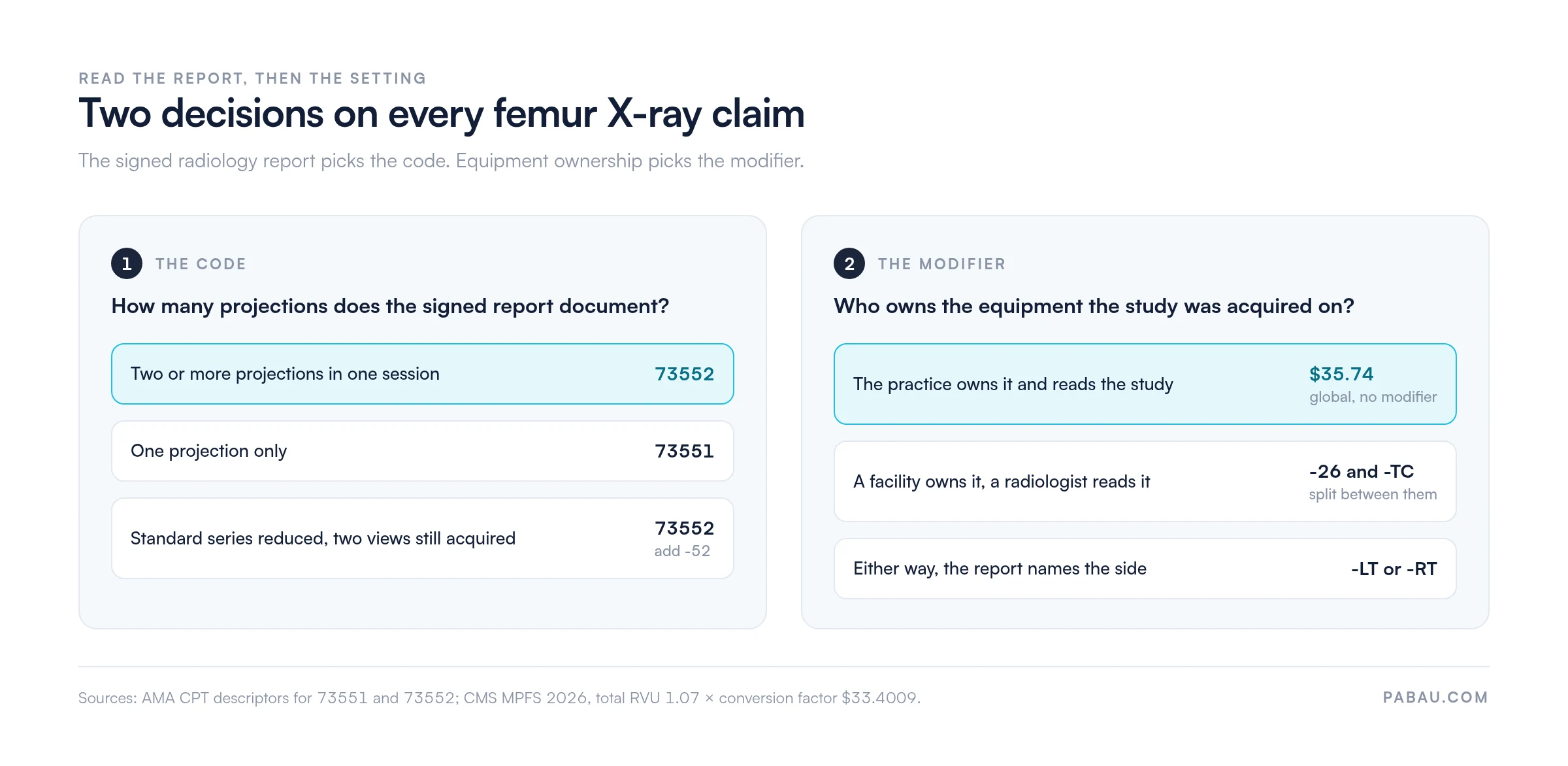
Verify modifier applicability against current NCCI edits before submission. Payer policies on the -26 and -TC split vary. Some commercial payers want the global code even when the radiologist and the facility are separate entities. Read each payer’s provider manual before you set a default.
Before submitting a split-billed 73552 claim, confirm the place of service (POS) code matches the modifier. POS 11 (office) paired with -26 signals a potential inconsistency to Medicare. POS 22 (hospital outpatient) or POS 19 (off-campus hospital outpatient) aligns correctly with facility -TC billing and radiologist -26 professional claims.
Every 73552 claim needs a supporting ICD-10-CM diagnosis code that establishes medical necessity. The diagnosis has to appear in the ordering provider’s notes and match the clinical indication on the radiology order. Our ICD-10-CM code library carries the full descriptor and coding notes for each diagnosis below.
The codes below are the ones most often paired with CPT 73552 in orthopedic and radiology practices. They are examples rather than an exhaustive list.
Two traps sit in this table. The M89.8X subcategory is not subdivided by side, so a coder looking for a right or left thigh option will not find one. The seventh character on a trauma code also has to match the stage of care in the note. A marks an initial encounter, D a subsequent one, and S a sequela. Submitting an A code on a follow-up visit is an audit trigger under payer edit systems.
A clean 73552 claim needs documentation that ties the clinical indication to the imaging order. Medicare and most commercial payers follow the Local Coverage Determinations (LCDs) issued by the applicable MAC. Those LCDs name the ICD-10 codes and clinical scenarios that support coverage.
The radiology report and the referring provider’s order together establish medical necessity. Here is what reviewers look for in a 73552 audit:
Practices that capture view counts by hand often undercode by defaulting to 73551. Automating the charge-capture step, so the view count in the report drives the code selection, removes that error. Most of the work behind a clean claim happens at the point of order, not at billing.
CPT 73551 covers a femur radiologic examination with one view, and CPT 73552 applies when two or more views are acquired. The distinction is simple in principle. Undercoding still happens, usually because the order was placed as “femur X-ray” with no view count and the biller took the lower code.
Decision rule: Read the radiology report, not the order. The order may say “femur X-ray,” but if the report documents an AP and a lateral view, bill 73552. If the report documents a single AP projection because the patient could not tolerate repositioning, bill 73551 and document the clinical reason.
73552 sits within a family of lower-extremity diagnostic radiology codes. When the clinical question involves a different anatomical site, select the sibling code for that site rather than stretching 73552 with documentation workarounds.
Radiology and orthopedic practices billing high volumes of musculoskeletal imaging hit the same three errors. The wrong code goes out when the view count is unclear. A modifier gets left off a split-billed claim. A diagnosis reaches the payer that does not match the indication on the order.
Practice management software like Pabau keeps the code, the modifier, and the diagnosis on one patient record. Pabau’s claims management software then submits that record as a claim, so what the payer receives matches what the radiologist signed off on.

Pabau connects to the Claim.MD clearinghouse, which submits CMS-1500 and 837P claims electronically to thousands of US payers. Validation before submission checks the payer and administrative data on the claim, such as membership numbers and authorization codes. Code and modifier selection stays with your coder. Real-time eligibility verification runs before the appointment, so a coverage problem surfaces then rather than as a denial 30 days later.
Pabau also processes electronic remittance advice, known as ERA. It posts 835 payment files against outstanding claims automatically. Billing staff can then see where every 73552 claim stands without working through a stack of EOBs. Secondary claims, corrected claims, and appeals tied to CARC denial reasons run through the same clearinghouse connection.
Run a quarterly audit of your 73551 vs 73552 billing ratio. If more than 30% of your femur imaging claims are going out as 73551, review a sample of the corresponding radiology reports. Undercoding at this scale typically means the biller is defaulting to the lower code rather than confirming view count. A targeted coding education session, combined with a charge-capture prompt that requires view count entry, typically resolves this within one billing cycle.

Pabau connects your clinical records to claim submission, so a femur imaging claim leaves the practice with its modifiers and diagnosis attached. See how electronic submission, eligibility checks, and remittance posting work in one system.

Three checks decide whether a 73552 claim pays. The report has to document two or more views. The modifier has to match who owns the equipment. The diagnosis has to match the indication on the order.
Work from the report rather than the order and the undercoding problem largely disappears. A quarterly look at your 73551-to-73552 ratio will tell you whether charge capture is doing that job. If the ratio looks wrong, the answer is usually a prompt at the point of charge entry rather than another coder training session.
Book a demo to see how Pabau takes a femur imaging claim from the signed report through to a posted payment.

Want to understand how clearinghouse submissions work for musculoskeletal codes? Medical claims clearinghouse guide covers how 837P electronic claims reach payers and what happens when they don’t.
Dealing with 73552 denials and unsure how to respond? Denial codes in medical billing explains CARC and RARC codes and how to build an effective appeal.
Need to verify insurance coverage before the imaging appointment? Insurance eligibility verification outlines the real-time check process that reduces radiology claim rejections at source.
CPT Code 73552 covers a radiologic examination of the femur with a minimum of two views. Any combination of AP, lateral, or oblique projections acquired in one session qualifies. The code does not apply to single-view femur studies, which are billed under CPT 73551.
Yes, Medicare covers CPT 73552 when medical necessity is established and documented, subject to the applicable MAC’s Local Coverage Determination. The claim must include a supporting ICD-10-CM diagnosis code that aligns with the documented clinical indication in the ordering provider’s notes.
A complete 73552 claim requires four things. First, a signed written order naming the femur, the laterality, and the clinical indication. Second, a clinical note from the referring provider that establishes medical necessity. Third, a radiology report stating the number of views acquired, with a minimum of two. Fourth, an ICD-10 diagnosis code that matches the documented indication. Missing or inconsistent documentation between the order and the report is the leading cause of 73552 denials.
The 2026 RVUs for CPT 73552 are 0.18 work, 0.87 practice expense, and 0.02 malpractice, for a total of 1.07. The practice expense value is the same in the facility and non-facility settings. Multiplying 1.07 by the 2026 conversion factor of $33.4009 gives a national rate of $35.74. Your locality’s GPCI values then adjust that figure.



