ICD-10 code T87.52: Necrosis of amputation stump, left upper extremity
ICD-10 code T87.52 at a glance: Left arm, not left leg ICD-10 code T87.52 is the...

Last Updated: Oct 26, 2026
Billable Code Specific Code
T78.09XA is the billable ICD-10-CM code for anaphylactic reaction due to other food products, initial encounter. It covers confirmed anaphylaxis caused by a food without its own code in T78.01–T78.08, such as soy, wheat, corn, or legumes other than peanuts.
The code sits in category T78 (Adverse effects, not elsewhere classified) in Chapter 19. The 7th character A marks active treatment. Follow-up visits take T78.09XD, and late effects take T78.09XS.
Let Pabau's smart automation suggest the right codes, reduce claim denials, and keep your practice compliant—effortlessly.
Automate repetitive tasks and focus on what matters most—your patients.
Reduce coding errors and ensure compliance with the latest regulations.
Clean claims, fewer denials, and faster reimbursements.
Powerful insights and reporting to help your practice thrive.
HIPAA compliant SOC 2 certified GDPR-compliant Trusted by 4,000+ clinics worldwide

T78.09XA is valid on HIPAA-covered claims as a principal or secondary diagnosis under ICD-10-CM FY2026.
The 7th character A means active treatment. Use D for follow-up visits and S for sequela.
T78.09XA applies only when the food has no dedicated code. Peanuts, shellfish, other fish, fruits and vegetables, tree nuts and seeds, food additives, milk, and eggs take T78.01-T78.08.
A food reaction without documented anaphylaxis takes T78.1XXA, not T78.09XA.
Pabau, the practice management platform we build, scrubs T78.09XA claims for errors and submits them to US payers through Claim.MD.
ICD-10 code T78.09XA is the billable code for anaphylactic reaction due to other food products, initial encounter. Use it when the clinician documents anaphylaxis caused by a food without its own code, such as soy, wheat, or corn.
The patient must still be in active treatment. The code sits in category T78 within Chapter 19 of the CDC/NCHS ICD-10-CM tabular list, which covers codes S00-T88.
Category T78 is residual. It collects adverse effects and anaphylactic reactions that have no more precise home elsewhere in the classification. Under T78.0, anaphylactic reaction due to food, eight common triggers get their own codes, T78.01 through T78.08. T78.09 covers every other named food.
The ICD-10-CM Chapter 19 instructions require a 7th character on all T78.09 codes to define the encounter type. T78.09XA uses the mandatory placeholder “X” at the 6th position (no 6th-character subdivision exists) followed by the 7th character. A wrong encounter character is enough for a payer to reject the claim.
Per the ICD-10-CM Official Guidelines (Section I.C.19.a), “initial encounter” means the patient is still receiving active treatment for this event. It doesn’t mean the first time the patient has ever had anaphylaxis.
A second ED visit two days later for the same reaction still uses character “A” if treatment is ongoing. Switching to “D” is appropriate only when the condition is being managed as a healed or healing issue rather than an acute one.
Document encounter type explicitly in the clinical note. Write ‘Patient presenting for active treatment of anaphylactic reaction’ (character A) or ‘Follow-up for resolved anaphylaxis, prescribing maintenance medication’ (character D). Vague language such as ‘seen for food allergy’ gives the coder no basis to select the correct 7th character and delays billing.
T78.09XA is the catch-all for named foods. The ICD-10-CM tabular list gives eight common food triggers their own codes under T78.0. T78.09XA is valid only when the documented food is none of them.
Two neighbors sit outside this table. When the record names no food at all, T78.00XA (anaphylactic reaction due to unspecified food) applies instead.
T78.1 (other adverse food reactions, not elsewhere classified) covers food reactions that don’t meet anaphylaxis criteria, such as gastrointestinal upset. If the clinician’s note confirms anaphylaxis, T78.1 is wrong whichever food is involved.
T78.09XA is often confused with two other codes: T78.40XA (allergy unspecified, initial encounter) and T78.1XXA (other adverse food reaction, non-anaphylactic). Three questions settle the choice, and the order matters.
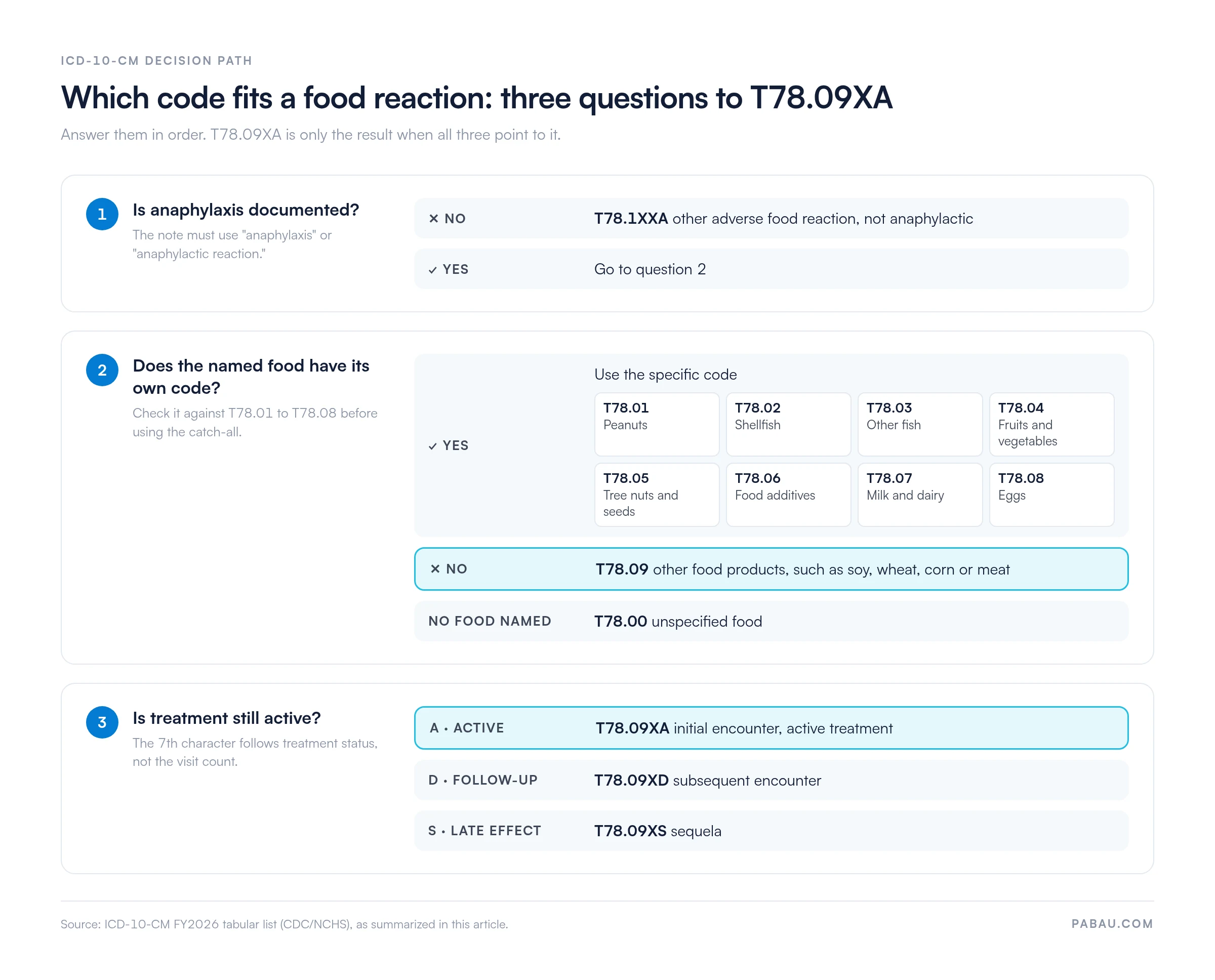
T78.09XA and T78.40XA are easy to mix up. T78.40XA is for allergy, not anaphylaxis, and it does not specify food as the trigger. Using T78.40XA when the documentation clearly states “anaphylactic reaction to soy” is an under-coding error that payers may flag during claims review.
T78.09XA claims are only defensible when the medical record contains specific elements. A vague notation of “food allergy reaction” is not sufficient. Auditors and payers look for four documentation anchors before accepting the code.
For clean claim submission, build a prompt covering all four elements into your anaphylaxis encounter template. A medical billing workflow that checks the note before the claim goes out saves a round of rework and resubmission.
T78.09XA is recognized by Medicare, Medicaid, and most commercial payers as a valid primary or secondary diagnosis code. Payer-specific Local Coverage Determinations (LCDs) vary by Medicare Administrative Contractor (MAC) region, so verify with your specific MAC before submitting. The guidance below reflects general CMS ICD-10-CM coding principles rather than any single payer’s LCD.
When T78.09XA is the reason for an emergency department visit, it typically serves as the principal diagnosis. An allergy workup or desensitization consult after the event may list it as a secondary diagnosis.
The primary reason for that visit goes first. Per CMS ICD-10 coding guidance, sequencing follows the circumstances of the admission. The condition most responsible for the visit becomes the principal code.
Prior authorization is generally not required for emergency anaphylaxis treatment coded under T78.09XA. Follow-up allergy testing, desensitization protocols, or specialty referrals may need prior authorization. That depends on the payer and the CPT codes involved. Check payer portals before scheduling non-emergency services.
T78.09XA denials usually trace back to one of four causes. Each has a clear fix, and front-end documentation checks prevent most of them.
A structured denial management workflow that categorizes T78 denials by denial reason code speeds up the corrective process. Practices handling many anaphylaxis claims should also keep the medical billing denial codes reference handy. It lists the CARC/RARC codes payers use when rejecting T78.09XA claims.
T78.09XA rarely appears alone on a claim. The following codes are frequently submitted alongside it, depending on the clinical encounter and treatment delivered.
When T78.09XA is the main reason for the encounter, it is coded as principal. Companion codes for treatment (J0171, CPT E/M) follow as additional codes. On a later visit for allergy testing, the reason for that visit becomes principal and T78.09XD becomes secondary.
Our electronic remittance advice processing guide shows how payers signal sequencing errors on 835 ERA files. For the wider picture, the revenue cycle management guide covers how these code pairings fit into the full claim lifecycle.
Before submission, check T78 placement against the CDC tabular list or the AAPC ICD-10-CM code lookup. The WHO ICD-10 browser shows the international version. It stops at T78.0, with no T78.09 subcategory and no 7th characters.
When a patient has multiple food triggers confirmed in the same encounter, code each anaphylaxis separately using the most specific available code. T78.09XA may appear alongside T78.01XA on the same claim. That happens when the note confirms a reaction to both peanut and a second food without its own code. Report all conditions that were treated during the visit.
Without a claims tool, a biller checks the food in the note against T78.01-T78.08 by hand, then rekeys the code into a clearinghouse portal. A wrong food code or 7th character only shows up when the denial comes back.
Pabau keeps the encounter note, the diagnosis code, and the claim in one patient record. Its medical billing software scrubs every claim for missing or invalid details before it leaves Pabau. A claim that still comes back rejected is flagged Needs action, with a link to the field to correct.
US practices submit CMS-1500 claims through Claim.MD and settle payments straight from ERA files. Our Claim.MD clearinghouse overview explains how submission, tracking, and reconciliation work.
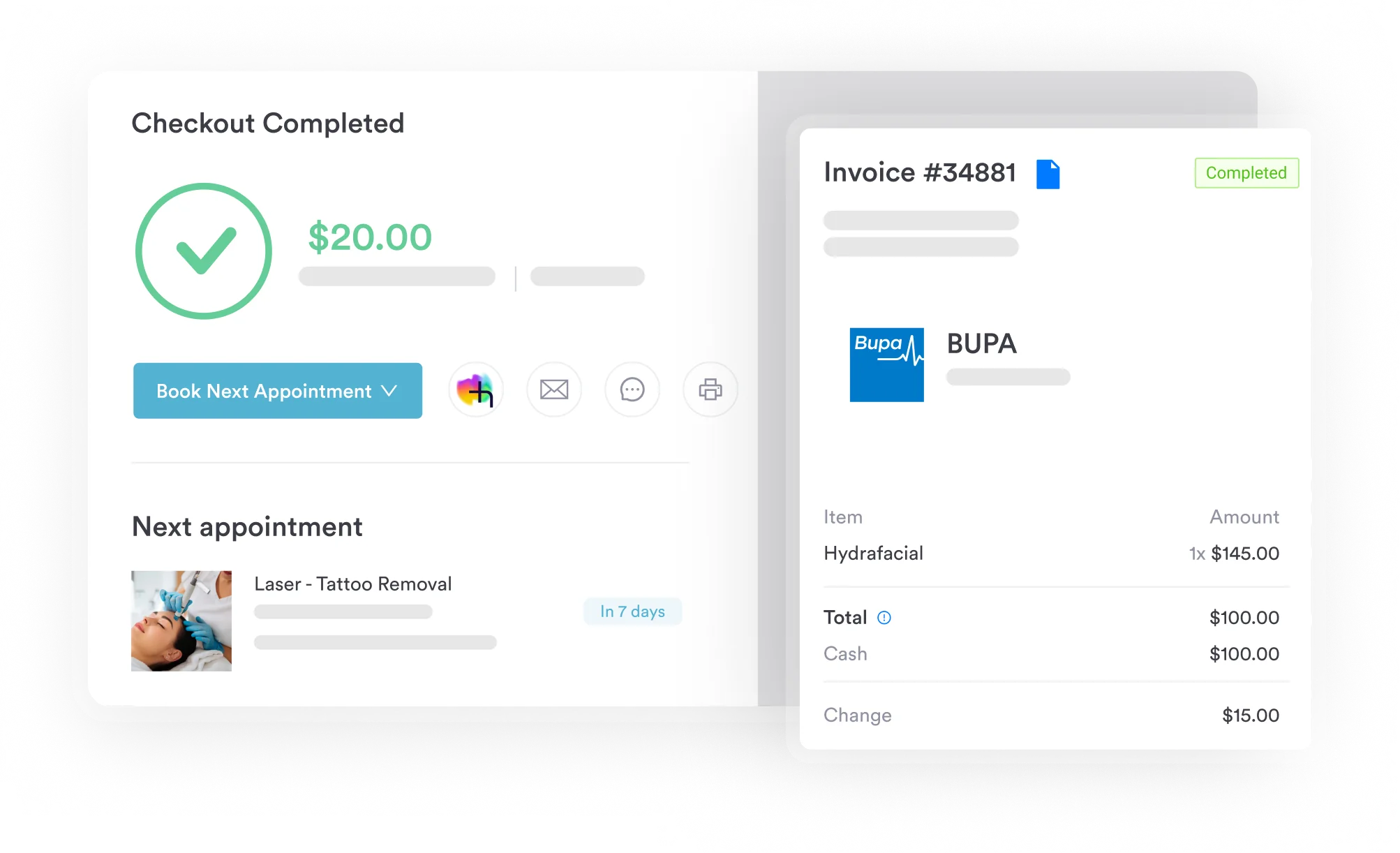

Pabau scrubs each claim for missing or invalid details and submits it to US payers through Claim.MD. Rejections come back flagged with the field to fix.

T78.09XA rewards one habit at the point of care. Name the food, use the word anaphylaxis, and state whether treatment is still active. With those three facts in the note, the code choice takes seconds and holds up on audit.
Without them, coders fall back on T78.40XA or guess the 7th character, and the claim comes back for rework. Check the food against T78.01-T78.08 before you reach for the catch-all, and query the clinician when the note is vague.
Book a demo to see how Pabau checks T78.09XA claims for errors before they leave your practice.

Need to understand how denials are categorized and resolved? Denial management in healthcare covers the full workflow for identifying, appealing, and preventing claim rejections.
ICD-10 code T78.09XA is the billable diagnosis code for anaphylactic reaction due to other food products, initial encounter. It applies to confirmed anaphylaxis caused by a food without its own code in T78.01-T78.08. Common examples include soy, corn, wheat, and legumes other than peanuts.
T78.09XA is for initial encounters, while active treatment for the reaction is ongoing. T78.09XD is for subsequent encounters after active treatment has ended. Treatment status decides it, not timing. A second ED visit two days later still uses “A” if the patient is still being treated for the same reaction.
Use T78.09XA when the documentation confirms anaphylaxis triggered by a food not listed in T78.01-T78.08. Use T78.40XA only when the documented trigger is not food, or the trigger is unknown and anaphylaxis criteria are not met. T78.40XA means “allergy, unspecified,” so using it for documented anaphylaxis is under-coding.
Four causes come up most. The 7th character is wrong, such as “A” on a follow-up visit. A more specific T78.01-T78.08 code existed for the named food. The note never uses the word “anaphylaxis.” Finally, T78.09XA may be sequenced as secondary when it was the main reason for the visit.
The record needs four elements. The clinician must write “anaphylaxis” or “anaphylactic reaction” in the assessment and name the causative food. The coder confirms the food has no T78.01-T78.08 code. The encounter language must support the 7th character. A note reading only “severe allergic reaction to food” won’t defend T78.09XA on audit.
Eight food categories have their own codes and are excluded from T78.09XA. They are peanuts (T78.01), shellfish (T78.02), other fish (T78.03), and fruits and vegetables (T78.04). The rest are tree nuts and seeds (T78.05), food additives (T78.06), milk and dairy (T78.07), and eggs (T78.08). If the documented trigger is any of these, the specific code takes precedence.