ICD-10 Code S92.002G: Unspecified fracture of left calcaneus
ICD-10 code S92.002G: Code definition and clinical meaning ICD-10 code S92.002G ...

Last Updated: Oct 22, 2026
Billable Code Specific Code
S72.454D is the billable ICD-10-CM code for a nondisplaced supracondylar fracture of the lower end of the right femur, without intracondylar extension. It is used at a subsequent encounter for a closed fracture with routine healing.
It applies once the fracture's active treatment is complete, at each visit where the right distal femur is still healing as expected. The code sits in Chapter 19 (S00-T88). Assignment turns on two positions. The 6th character 4 marks a nondisplaced right femur, and the 7th character D marks routine healing.
Let Pabau's smart automation suggest the right codes, reduce claim denials, and keep your practice compliant—effortlessly.
Automate repetitive tasks and focus on what matters most—your patients.
Reduce coding errors and ensure compliance with the latest regulations.
Clean claims, fewer denials, and faster reimbursements.
Powerful insights and reporting to help your practice thrive.
HIPAA compliant SOC 2 certified GDPR-compliant Trusted by 4,000+ clinics worldwide

S72.454D codes a nondisplaced supracondylar fracture of the right femur at a subsequent encounter for a closed fracture with routine healing.
The 7th character D covers the whole routine healing phase after active treatment ends, not just a single follow-up visit.
Common denial triggers are using A when D is correct and leaving displacement status undocumented. Another is billing a left-femur code: S72.455D (nondisplaced left femur) or S72.452D (displaced left femur).
Pabau, the practice management platform we build, scrubs each claim for missing or invalid details before sending it to payers through Claim.MD.
ICD-10 code S72.454D is the billable code for a nondisplaced supracondylar fracture of the right femur during routine healing. It applies at subsequent encounters for a closed fracture without intracondylar extension, once active treatment is complete. The code sits in category S72 (fracture of femur), and the table below sets out its structure.
The supracondylar region is the area of the distal femur just proximal to the femoral condyles, where the shaft widens before articulating with the knee. Fractures in this zone matter biomechanically. The gastrocnemius pulls on the distal fragment and can cause posterior angulation, even when the fracture is nondisplaced.
A nondisplaced fracture means the bone has broken but the fragments have not shifted out of anatomical alignment. In a displaced fracture, the fragments are offset, angulated, or shortened. The distinction matters for coding because ICD-10-CM assigns a different 6th character to displaced and nondisplaced fractures at the same site.
Supracondylar femur fractures occur most often in two groups: older adults with osteoporosis after low-energy falls, and younger patients after high-energy trauma. Physical therapy after initial orthopedic management is one of the most common settings where S72.454D appears on claims.
The 7th character is where most coding errors occur with this code family. The ICD-10-CM Official Guidelines for Coding and Reporting (Section I.C.19.a) define the 7th-character encounter categories below.
In practice, a subsequent encounter covers far more than a second visit. A patient may have dozens of D-suffix encounters across months of physical therapy and follow-up imaging. The D suffix stops when the fracture is confirmed healed. It also stops when the provider documents delayed healing, nonunion, or malunion, which take G, K, and P. A sequela, treated after healing, takes S.
Document the phrase ‘routine healing’ or ‘fracture healing ongoing’ in every note that will bill under a D-suffix code. Payers, Medicare included, audit D-suffix claims for proof that the fracture is still healing rather than a chronic complaint being revisited.
Several codes in the S72.45 subcategory differ from S72.454D by only one character. Getting one character wrong produces a laterality, displacement, or encounter-type error, and each is a common denial reason for this code family. The breakdown below shows which character carries which fact, and what each swap turns the code into.
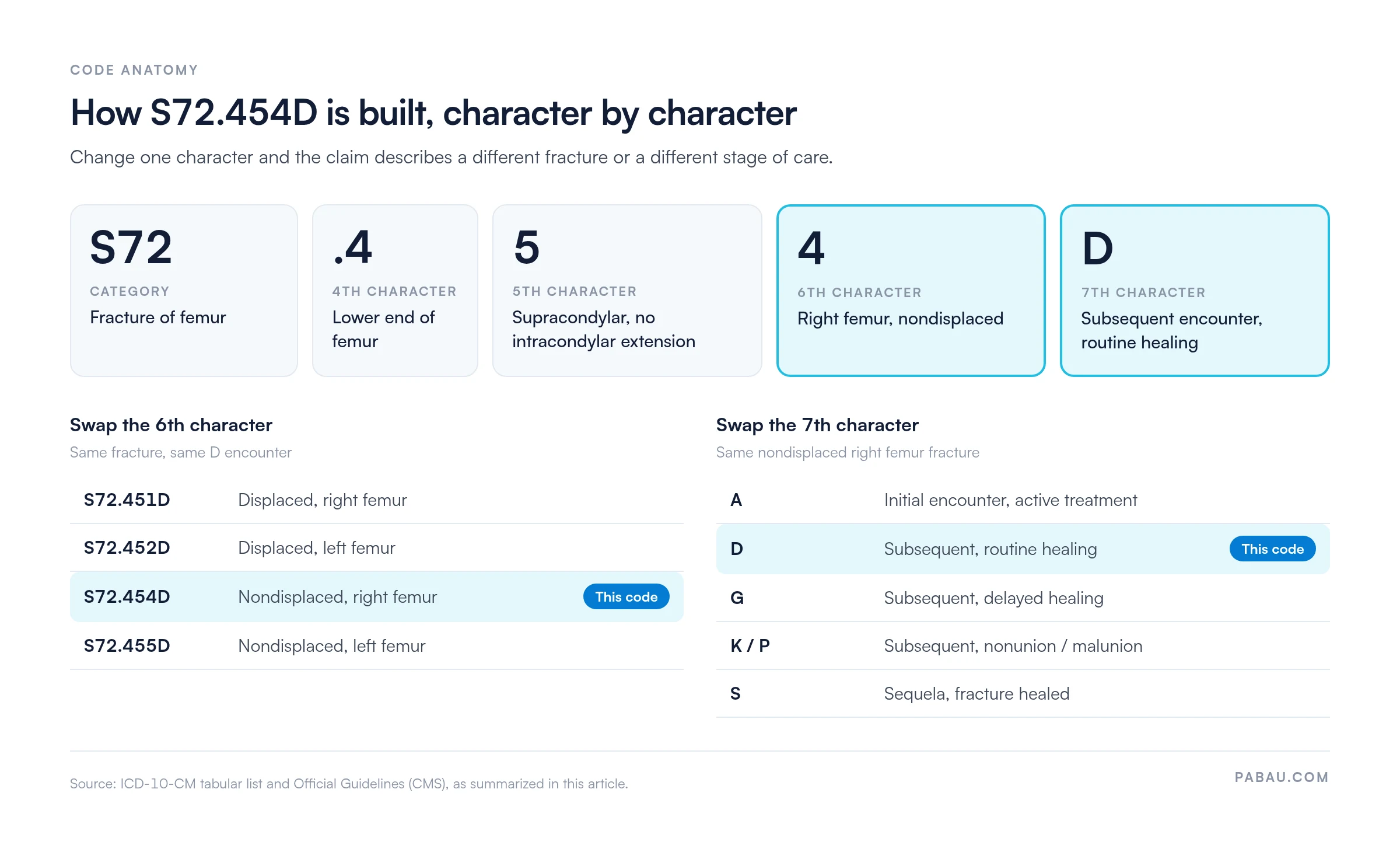
The table lists the nearest neighbors of S72.454D and the single difference that separates each one from it. Check it against the note before you submit a follow-up claim.
The ICD-10-CM tabular list carries notes at three levels above S72.454D: the S72 category, the S72.4 subcategory, and S72.45. According to the CMS ICD-10-CM codes and guidelines, coders must review these notes before finalizing any S72 code.
The S72 category also sets two defaults. A fracture not documented as displaced or nondisplaced is coded as displaced, and one not documented as open or closed is coded as closed. That first default is why a note missing the word “nondisplaced” turns S72.454D into S72.451D.
S72.45 also lists “supracondylar fracture of lower end of femur NOS” as an inclusion term. An unqualified supracondylar fracture therefore still codes here, as long as there is no intracondylar extension.
Every element of the code’s descriptor must be supported by documentation in the medical record. Displacement is the element that slips most often. Under the S72 default note, a fracture not documented as nondisplaced codes as displaced (S72.451D). That code can mismatch the visit and trigger a denial or a payer query.
Laterality consistency across all record elements is particularly important. Pairing a right-femur fracture on the operative note with a left-femur billing code is a common keying error. It triggers automatic payer rejection.
Medicare Part B covers subsequent fracture care encounters billed under orthopedic evaluation and management or fracture care CPT codes. S72.454D serves as the supporting diagnosis. Coverage is subject to payer-specific Local Coverage Determinations (LCDs) and medical-necessity review. Commercial payers follow similar documentation rules but vary on prior authorization for associated physical therapy and imaging.
Key payer considerations when billing with ICD-10 code S72.454D:
S72.454D denials follow predictable patterns. The same five errors appear repeatedly in denial management in healthcare audits for orthopedic fracture codes. Each rejection comes back with a reason code, which our guide to medical billing denial codes decodes.
The D-versus-S distinction trips up even experienced coders because both occur after the fracture has been treated. The rule is clear once the clinical question is framed correctly. Is the fracture still healing, or has it healed and left a lasting problem?
S72.454D is a diagnosis code and must be paired with a procedure code on every claim. The CPT codes below are the ones most commonly billed alongside this diagnosis in outpatient and post-acute settings. Verify each pairing against the current AAPC ICD-10-CM code lookup and the payer’s coverage policy before submission.
Rehab claims are where S72.454D shows up most often. Before billing a therapy episode, check the complexity rules on 97161 and the timed-unit rules on 97110.
Orthopedic and sports medicine practices handle high volumes of fracture follow-up encounters. For them, clean claim submission depends on matching the encounter-type suffix to the documented clinical stage. Catching a wrong suffix before the claim leaves the practice costs far less than appealing it.
When a patient moves from orthopedic surgical care to physical therapy for fracture rehabilitation, make sure both practices use the same ICD-10 code (S72.454D). Both records should also document the fracture as still healing. Inconsistent coding across the care team is a common audit trigger for fracture-related claims.
In many practices, fracture follow-up claims are still checked by hand. A biller reads the progress note and keys the code into a separate billing tool. A wrong suffix only surfaces when the payer rejects the claim.
Pabau’s medical billing software keeps the visit, the note, and the claim in one patient record. Each CMS-1500 claim is scrubbed for missing or invalid details, then sent to payers through Claim.MD. Eligibility is checked before the patient arrives.
When a claim comes back rejected, Pabau flags it as Needs action, so the corrected S72.454D claim goes back out quickly. Payments settle straight from electronic remittance advice (ERA) files, which closes the medical billing loop on each follow-up visit.

Pabau scrubs every claim for missing or invalid details before it goes out through Claim.MD. Rejected claims are flagged for action, so S72.454D follow-ups get paid without a long resubmission loop.

S72.454D rewards discipline more than expertise. Before the claim goes out, confirm four facts in the note: right femur, nondisplaced, past active treatment, and still healing.
When one of those facts is missing, fix the documentation first and the code second. A corrected note supports every later D-suffix visit in the episode, while a corrected code fixes only one claim.
The trade-off to remember is timing. Move off D as soon as the provider documents delayed healing, nonunion, malunion, or a sequela. Book a demo to see how Pabau keeps fracture follow-up claims clean from the first visit to the last.

Want to understand how clearinghouse submission works? Claim.MD clearinghouse guide walks through how Pabau submits claims and checks eligibility through Claim.MD.
Researching denial patterns across your fracture claims? Denial codes in medical billing covers the CARC and RARC codes you will see when S72.454D claims are rejected.
Need a primer on the revenue cycle for orthopedic practices? Revenue cycle management explained covers the end-to-end process from eligibility verification through ERA posting.
ICD-10 code S72.454D is the billable code for a nondisplaced supracondylar fracture of the right femur, at a subsequent encounter with routine healing. It applies to a closed fracture once initial active treatment is complete. It is not used at the first visit, when the fracture was actively treated.
The D suffix applies after active treatment of the fracture is complete, during all routine healing-phase encounters. This includes cast changes, wound checks, physical therapy visits, and follow-up imaging. It is not limited to one visit. Use D throughout the healing phase until the fracture is confirmed healed, or until delayed healing, nonunion, or malunion changes the suffix.
A subsequent encounter (D suffix) means the fracture is still healing. A sequela (S suffix) means the fracture has healed. The patient is now treated for a condition it caused, such as post-traumatic arthritis or chronic pain. The switch from D to S happens when the provider documents that the fracture itself has resolved and the current treatment addresses a residual complication.
The most common denial reasons are using the A suffix (initial encounter) when D applies, and submitting a left-femur code for a right-femur injury. Others are missing documentation of nondisplaced status, or no record of prior active treatment to support the D suffix. Each of these can be corrected and resubmitted with appropriate documentation.
There is no fixed time limit in ICD-10-CM guidelines. The D suffix stays correct while the fracture is actively healing. That period varies with patient age, bone health, fracture severity, and treatment approach. Typical distal femur healing takes 3 to 6 months. Still, keep the D suffix until the treating provider documents union or a complication, however long that takes.
S72.455D (nondisplaced supracondylar left femur, subsequent encounter) is the most common laterality error. S72.454A (same fracture, initial encounter) is the most common encounter-type error. S72.451D (displaced supracondylar right femur, subsequent encounter) is the most common displacement-status error. Verify all three character positions before finalizing the code.