ICD-10 Code Y76.0: Diagnostic obstetric and gynecological devices
ICD-10 Code Y76.0: Definition and billable status ICD-10 Code Y76.0 is a valid, ...

Last Updated: Oct 23, 2026
Billable Code Specific Code
S72.446C is a billable ICD-10-CM code. It describes a nondisplaced fracture of lower epiphysis (separation) of unspecified femur, initial encounter for open fracture type IIIA, IIIB, or IIIC.
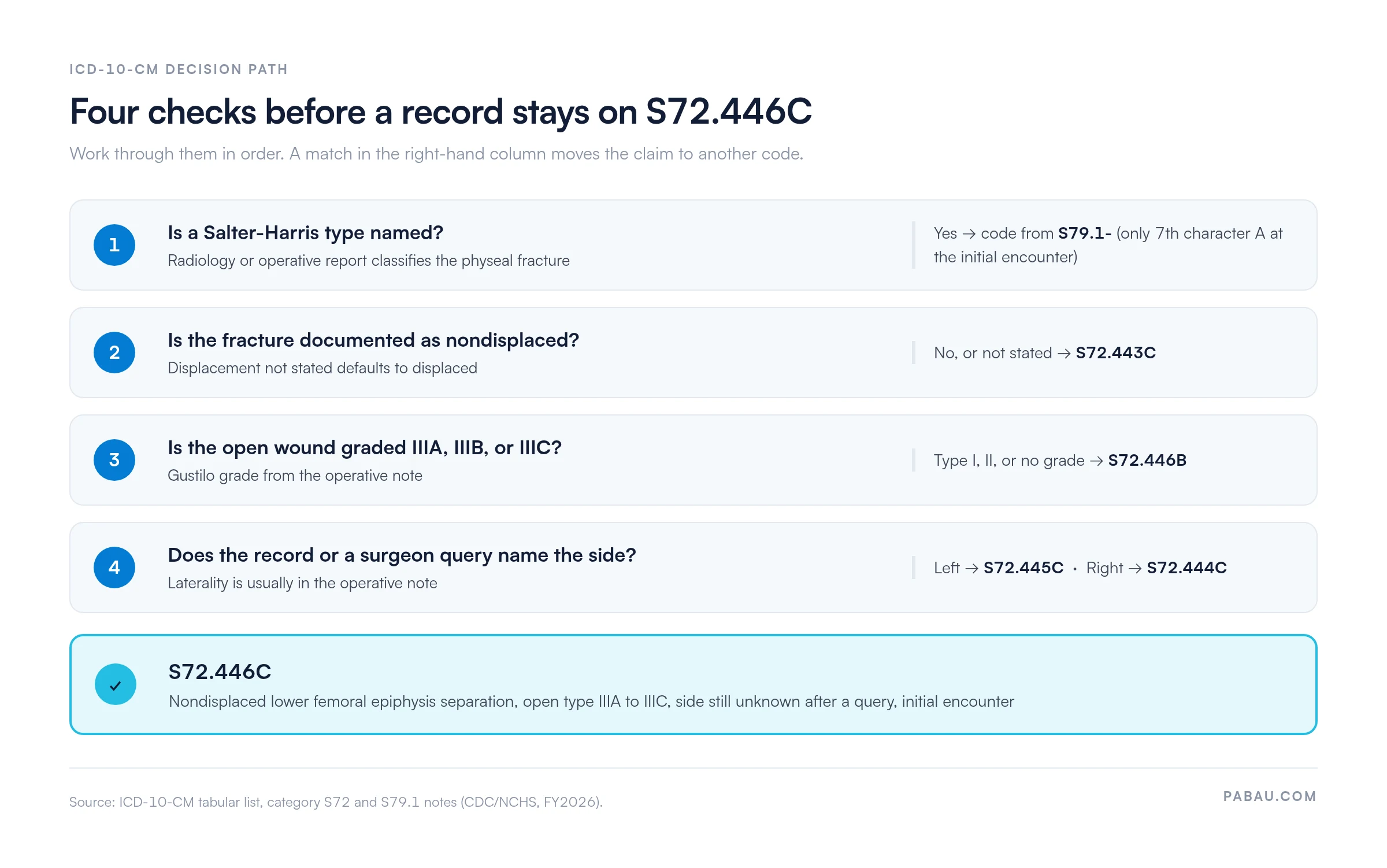
In clinical terms, this is a nondisplaced separation of the distal femoral epiphysis with an open wound graded Gustilo type IIIA, IIIB, or IIIC. It is an injury of skeletally immature patients. Because the side is not recorded, query the surgeon for laterality before the claim goes out. When the record names a Salter-Harris physeal fracture, code it from S79.1- instead.
Let Pabau's smart automation suggest the right codes, reduce claim denials, and keep your practice compliant—effortlessly.
Automate repetitive tasks and focus on what matters most—your patients.
Reduce coding errors and ensure compliance with the latest regulations.
Clean claims, fewer denials, and faster reimbursements.
Powerful insights and reporting to help your practice thrive.
HIPAA compliant SOC 2 certified GDPR-compliant Trusted by 4,000+ clinics worldwide

S72.446C codes a nondisplaced lower femoral epiphysis separation, side unspecified, at the initial encounter for a Gustilo type IIIA, IIIB, or IIIC open fracture.
The 7th character C means an open type IIIA, IIIB, or IIIC fracture. In contrast, types I and II, and open fractures with no documented grade, take B.
The 6th character 6 means nondisplaced with the side unspecified. However, a documented left femur moves the claim to S72.445C, and a right femur to S72.444C.
Physeal fractures classified by Salter-Harris type belong in S79.1-, and S72.44 carries an Excludes1 note for Salter-Harris type I.
Follow-up visits for a type III open fracture use F, J, N, or R. In contrast, D, G, K, and P describe closed fractures.
ICD-10 code S72.446C is the billable ICD-10-CM code for a nondisplaced fracture of the lower epiphysis (separation) of an unspecified femur. In addition, it applies at the initial encounter for an open fracture graded Gustilo-Anderson type IIIA, IIIB, or IIIC.
In fact, the full official descriptor is Nondisplaced fracture of lower epiphysis (separation) of unspecified femur, initial encounter for open fracture type IIIA, IIIB, or IIIC.
Each character in S72.446C narrows the injury. Indeed, misreading the 6th or 7th character produces a valid code for a different injury, and automated edits rarely catch it.
The 6th character records displacement and side together. As a result, the S72.44 group holds six options, listed below.
Two tabular defaults pull claims away from this code. First, a fracture not documented as displaced or nondisplaced is coded as displaced, which gives S72.443C. Second, an open fracture with no documented Gustilo type is coded to B, which gives S72.446B.
The lower epiphysis is the rounded end of the femur that forms the upper half of the knee joint. In children and adolescents, however, the distal femoral physis (growth plate) joins it to the shaft.
An epiphyseal separation is a fracture through or along that growth plate, so the injury belongs to skeletally immature patients. In fact, the distal femoral physis drives most of the femur’s growth in length, which is why surgeons watch closely for later growth disturbance.
Indeed, a type III open wound with a nondisplaced fracture is a rare mix. The energy that opens the soft tissue often displaces the bone too, so confirm both findings in the imaging report and operative note.
First, the 6 in S72.446C records that the documentation never names the injured side. A type IIIA to IIIC open fracture brings surgery, debridement, and imaging, so the operative note almost always states left or right.
When the record names the left femur, use S72.445C. Likewise, when it names the right, use S72.444C. Otherwise, keep S72.446C for the rare record where a query to the surgeon still cannot establish the side.
Many payers apply edits to unspecified-laterality injury codes. In fact, an unspecified side on a surgical fracture claim invites a request for records, which delays payment even when the coding is defensible.
Category S72 uses 16 7th characters that combine encounter type, open or closed status, Gustilo grade, and healing course. However, character C applies only while an open type IIIA, IIIB, or IIIC fracture is under active treatment.
For example, under ICD-10-CM guideline I.C.19.a, active treatment includes surgery, emergency department care, and evaluation and continuing treatment by the same or a different physician.
Once active treatment ends, this injury moves to F for routine healing, J for delayed healing, N for nonunion, or R for malunion. In contrast, D, G, K, and P describe closed fractures and are wrong on any follow-up for an open type III fracture.
Therefore, check the extension list in the CDC/NCHS ICD-10-CM browser rather than a third-party lookup when a code family is unfamiliar.
The category S72 notes state that open fracture designations follow the Gustilo open fracture classification. As a result, the surgeon’s documented grade decides the 7th character, and coders cannot infer it from a wound description alone.
Grading is often confirmed in the operating room at debridement, so the operative note is the document to code from. For example, if the emergency note says type II and the operative note says type IIIA, query the surgeon before choosing between B and C.
Make Gustilo grade and laterality required fields in your open fracture operative note template. In fact, those two fields decide whether this claim goes out as S72.446C, S72.445C, S72.444C, or S72.446B.
The S72.44 group and the S79.1 physeal codes sit side by side in the tabular list. So the table below maps the confusion points that most often change the code. Neighboring injury codes outside this table are indexed in our diagnostic codes guide.
Four documentation checks, read in order, then decide whether a record stays on S72.446C or moves to one of the codes above.
Excludes notes for this code sit at four levels of the tabular list. An Excludes1 note means the two conditions are never coded together. In contrast, an Excludes2 note means the condition is not part of this code, but both may be reported when both are present.
The physeal rule matters most for this code. In short, when the radiology or operative report names a Salter-Harris type, code the physeal fracture from S79.1- rather than S72.44-.
S79.1 offers only A at the initial encounter, with no open fracture or Gustilo characters. Therefore, document the open wound and its grade in the record whichever code applies.
Chapter 19 asks for external cause codes from Chapter 20 to record how the injury happened, such as a V-code for a traffic collision. In addition, add Z18.- for any retained foreign body. A fracture caused by bone disease is coded as a pathological fracture from M84.4- to M84.6- instead.
Every element of the code must be confirmed in the medical record before submission. Thus, the checklist below covers what reviewers and payers look for.
Building clean claim submission habits starts with the operative note template. In addition, for the wider principles of documentation integrity, see our guide to billing compliance requirements.
ICD-10 code S72.446C describes the condition, not the procedure. Instead, the CPT codes below are the procedures most often billed with it. The medical billing link between diagnosis and procedure must reflect documented medical necessity.
Debridement of a contaminated type III wound is billed with 11012, and that code’s own page covers its modifiers and reimbursement. However, lateral condyle codes such as 27514 describe a different injury and should not be paired with an epiphyseal separation diagnosis. Finally, for descriptors, units, and modifiers, reference the AMA’s CPT code set directly.
Pabau, the practice management platform we build, connects to the Claim.MD clearinghouse through a built-in integration. As a result, claims go out online, eligibility is checked in real time, and ERAs come back into the system.
For inpatient stays treated medically, a femur fracture principal diagnosis groups to the femur fracture MS-DRGs, 533 and 534. In contrast, surgical fixation usually moves the stay to the hip and femur procedure MS-DRGs, 480 to 482.
Confirm the assignment with the current grouper, since MS-DRG definitions update every October 1. Because this injury affects skeletally immature patients, Medicaid, CHIP, and commercial plans are the usual payers rather than Medicare.
In addition, prior authorization rules vary by payer and plan year. Emergency surgery for an open fracture rarely waits for approval, but many plans still require notification within a set window after admission.
Denials on ICD-10 code S72.446C cluster around a short list of paperwork and coding errors.
Effective denial management in healthcare treats each denial category as a workflow problem. For example, tracking denial reasons by code shows whether S72.446C denials come from laterality, grading, or physeal errors.
Open fracture claims fail on details spread across several documents. For example, the side sits in the imaging report, the Gustilo grade in the operative note, and the encounter type on the schedule.
Pabau keeps those records in one patient file and submits claims through Claim.MD. So your billing team can check each element before submission. Afterward, Pabau’s claims management tools track the remittance and any denial code on each claim.

Pabau keeps imaging reports, operative notes, and encounter details in the patient record your claims are built from, then submits online through Claim.MD. So your team can confirm side and Gustilo grade before the claim goes out.

S72.446C is a narrow code, and many records that seem to fit it belong somewhere else. A named side moves the claim to S72.445C or S72.444C. Likewise, a Salter-Harris type moves it to S79.1-, and a type I or II wound moves it to S72.446B.
In short, use S72.446C only when the record confirms a nondisplaced distal femoral epiphyseal separation with a type IIIA to IIIC open wound. The side must also remain unknown after a query.
To see how Pabau keeps fracture documentation and claims in one place, book a demo with our team.

Need to understand how claim denials are tracked and resolved? Denial management in healthcare covers the workflow steps from denial identification through appeal and resubmission.
Want to see how clearinghouse submission works end to end? Claim.MD clearinghouse overview explains how electronic claims reach payers and how remittances return.
Want to see where coding fits in the revenue cycle? Revenue cycle management fundamentals covers the documentation and coding standards that prevent rejections before submission.
Billing the debridement that opens most type III cases? CPT code 11012 explains open fracture debridement, its modifiers, and how it is reimbursed.
ICD-10 code S72.446C is the billable ICD-10-CM code for a nondisplaced fracture of the lower epiphysis (separation) of an unspecified femur. It applies at the initial encounter for an open fracture graded Gustilo type IIIA, IIIB, or IIIC. In addition, it sits in subcategory S72.4, fractures of the lower end of the femur.
S72.446C covers the initial encounter, meaning any visit where the open type III fracture is under active treatment. In contrast, S72.446F covers subsequent encounters once the fracture is healing routinely. Use J for delayed healing, N for nonunion, and R for malunion. D and G apply only to closed fractures.
Types I and II take 7th character B at the initial encounter, so the code becomes S72.446B. However, C is reserved for types IIIA, IIIB, and IIIC. An open fracture with no documented Gustilo type also defaults to B under the S72 7th character list.
Only when the record does not state the side and a query to the surgeon cannot establish it. If the left femur is documented, use S72.445C. Likewise, if the right femur is documented, use S72.444C. In fact, most open type III fracture records name the side in the operative note.