Pabau Engage inbox

Pabau Engage is here: every patient conversation in one inbox.

Learn more
ICD-10-CM Code

ICD code S72.25XA – Left nondisplaced subtrochanteric femur fracture

Billable Code Specific Code


Code Definition

S72.25XA is the billable ICD-10-CM code for nondisplaced subtrochanteric fracture of left femur, initial encounter for closed fracture. It applies while the patient is under active treatment for a closed break just below the lesser trochanter of the left femur.

The code already states the left side, so the record has to document it. If the record names no side, query the provider. Only a side that stays unconfirmed moves the code to S72.26XA.

Chapter
S00-T88 Injury, poisoning and certain other consequences of external causes
Category
S72 Fracture of femur
Group
S72.25 Nondisplaced subtrochanteric fracture of left femur
Billable
Yes
Code also known as
subtrochanteric fracture, hip fracture (colloquial), proximal femur fracture, closed femur fracture
Save time. Improve accuracy. Get paid faster.
Automate coding with Pabau

Let Pabau's smart automation suggest the right codes, reduce claim denials, and keep your practice compliant—effortlessly.

  • AI-powered code suggestions
  • Real-time compliance checks
  • Faster claims, fewer denials
Why practices choose Pabau
Save hours every week

Automate repetitive tasks and focus on what matters most—your patients.

Improve accuracy

Reduce coding errors and ensure compliance with the latest regulations.

Get paid faster

Clean claims, fewer denials, and faster reimbursements.

Grow with confidence

Powerful insights and reporting to help your practice thrive.

HIPAA compliant SOC 2 certified GDPR-compliant Trusted by 4,000+ clinics worldwide

Key takeaways

Key takeaways

S72.25XA is a billable FY2027 ICD-10-CM code for a closed, nondisplaced subtrochanteric fracture of the left femur at the initial encounter.

The fifth character 5 encodes both nondisplaced and left, so the code is only correct when the record documents the left femur.

If no side is documented, query the provider before coding. Without a documented side, the correct code would be S72.26XA.

The seventh character A marks active treatment for the fracture, so it covers the ED visit, the admission and any later surgery.

Pair S72.25XA with the LT modifier on side-specific procedures. An RT modifier on the same claim invites a laterality denial.

ICD-10 code S72.25XA: Code details at a glance

ICD-10 code S72.25XA is the billable code for a closed, nondisplaced subtrochanteric fracture of the left femur at the initial encounter. It is valid in the FY2027 code set, per the CMS ICD-10-CM code files. The table below gives coders the quick-reference data they need before building a claim.

FieldValue
CodeS72.25XA
Full descriptorNondisplaced subtrochanteric fracture of left femur, initial encounter for closed fracture
BillableYes
LateralityLeft femur, encoded in the fifth character (5)
Valid date rangeFY2016 to present (billable in the current FY2027 code set)
ICD-10-CM chapterChapter 19: Injury, poisoning and certain other consequences of external causes (S00-T88)
Category / subcategoryS72 (fracture of femur) / S72.2 (subtrochanteric fracture of femur) / S72.25 (nondisplaced, left femur)
Fracture typeClosed. An open fracture takes seventh character B or C at the initial encounter.
Applicable toAll ages; most often older adults after a low-energy fall

Use the CDC/NCHS ICD-10-CM web tool to check effective dates and tabular notes after each annual code update.

Anatomy and clinical context: What is a subtrochanteric fracture?

A subtrochanteric fracture is a break in the femur just below the lesser trochanter, usually within about 5 centimeters of it. The region carries high compressive and tensile forces. That makes these fractures mechanically demanding to repair, and it is why accurate coding matters for medical necessity.

Three clinical details drive code selection at this site:

  • Displacement status: A nondisplaced fracture means the bone fragments have not shifted from their anatomical position. A displaced subtrochanteric fracture of the left femur takes S72.22XA instead.
  • Laterality: The fifth character carries the side. In S72.25XA, the 5 means nondisplaced and left, and the X at position six is a placeholder. The section below covers how to confirm it.
  • Mechanism and patient profile: Nondisplaced subtrochanteric fractures most often follow low-energy falls in older patients with osteoporotic bone. High-energy trauma, such as a motor vehicle collision, tends to produce displaced patterns. The mechanism drives external cause code selection.

The open or closed status is also fixed in S72.25XA: The code describes a closed fracture. A documented open fracture keeps the same first six characters but takes seventh character B or C at the initial encounter.

Laterality: Confirm and document the left side

Laterality is where S72.25XA claims most often go wrong. The code already states the left femur, so the record has to say left too. A coder who assigns it from a note that names no side is reporting a fact the provider never documented.

Work through the record in this order before you assign the code:

  1. Check every source in the encounter: The ED note, the imaging report and the operative report can each document the side. If one of them names the left femur, S72.25XA is supported.
  2. Resolve conflicts: If one note says left and another says right, query the provider. Never pick the side that matches the procedure modifier.
  3. Query when no side is written: Ask the provider for an addendum before the claim goes out. A side is almost always recoverable from imaging.
  4. Fall back only after the query: If the provider cannot confirm a side, the correct code is S72.26XA. It is a legitimate code, but payers see it as low specificity on a surgical claim.
Side documentedNondisplacedDisplaced
Left femurS72.25XAS72.22XA
Right femurS72.24XAS72.21XA
No side documentedS72.26XAS72.23XA

The grid above shows why a one-digit slip matters. S72.24XA, S72.25XA and S72.26XA differ only in the fifth character, yet each one tells the payer a different side.

The seventh character: Why A means active treatment

The seventh character in S72.25XA sets the encounter type, and it is one of the most denial-prone fields in fracture coding. “A” means the patient is receiving active treatment for the fracture at this encounter. That covers the emergency visit, the surgical admission and any later operative session still treating the injury. A first visit to a new provider after treatment has ended takes “D” instead.

Seventh character options for S72.25X

CharacterFull descriptor extensionClinical scenario
AInitial encounter for closed fractureEmergency visit, surgical admission, or any encounter where active treatment of a closed fracture is underway
BInitial encounter for open fracture type I or IIActive treatment of an open fracture classed as Gustilo type I or II
CInitial encounter for open fracture type IIIA, IIIB, or IIICActive treatment of an open fracture classed as Gustilo type IIIA, IIIB or IIIC
DSubsequent encounter for closed fracture with routine healingFollow-up after active treatment is complete; the fracture is healing normally
GSubsequent encounter for closed fracture with delayed healingFollow-up where healing is slower than expected, with no malunion or nonunion confirmed
KSubsequent encounter for closed fracture with nonunionFollow-up where imaging confirms nonunion; may lead to a separate surgical episode
PSubsequent encounter for closed fracture with malunionFollow-up where the fracture has healed in a malposition
SSequelaLate effects of the fracture, such as chronic pain or gait disturbance, after the acute phase has resolved

Subsequent encounters for an open fracture use E, F, H, J, M, N, Q or R instead. D, G, K and P apply only to closed fractures, and S marks a sequela. The ICD-10-CM Official Guidelines, Chapter 19, apply “initial encounter” for as long as the patient receives active treatment. Switch to D, G, K or P once active treatment has ended and the visit is for healing or recovery.

Coding guidelines: How to select S72.25XA correctly

Accurate selection of ICD-10 code S72.25XA rests on five documentation elements. Missing any one of them either points to a different code or creates a denial trigger. The path below shows where each missing element sends the claim.
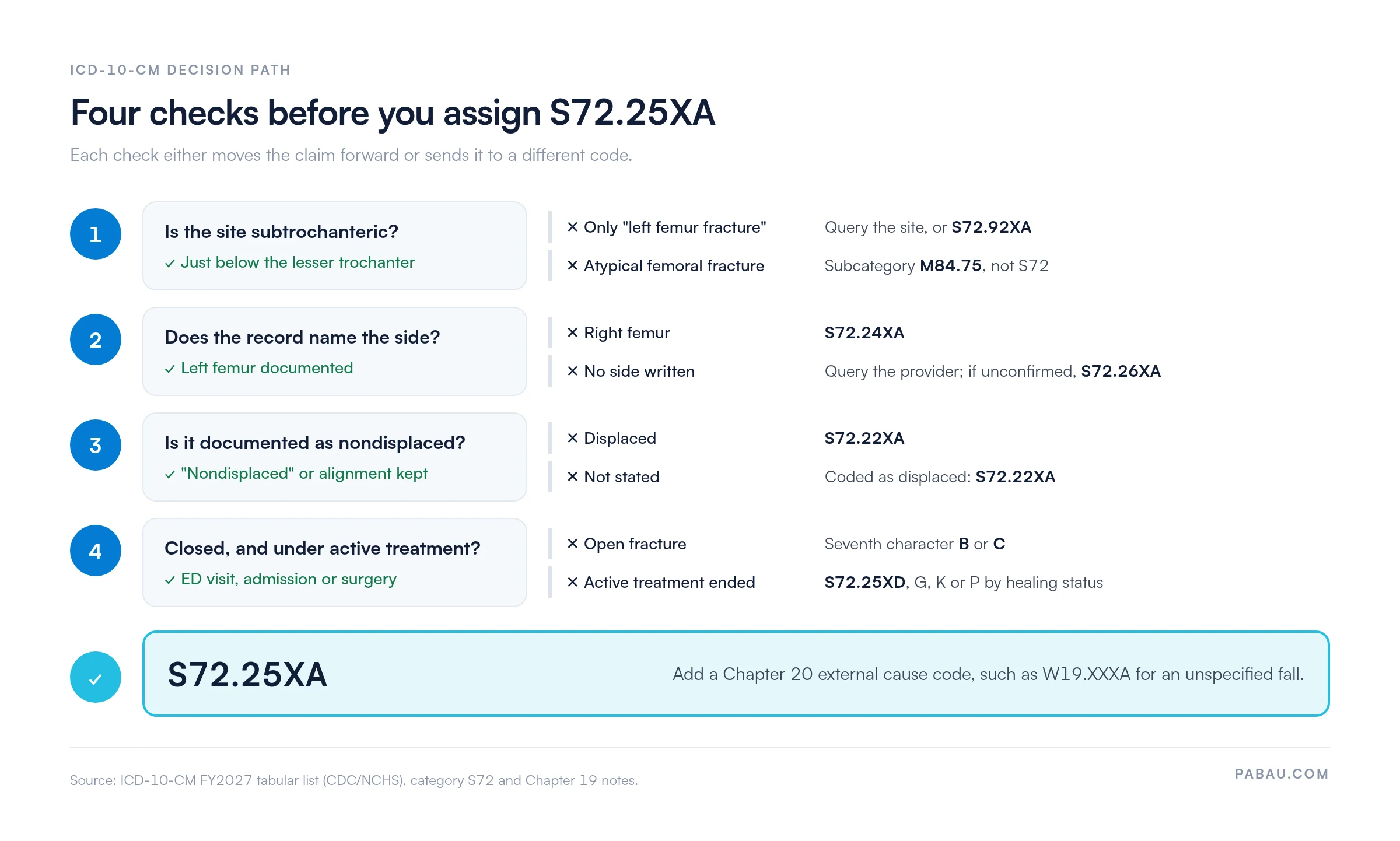
Decision path for ICD-10 code S72.25XA. Check 1, subtrochanteric site: if only left femur fracture is documented, query or use S72.92XA; atypical femoral fracture goes to M84.75. Check 2, side: right femur is S72.24XA; no side means query, then S72.26XA. Check 3, nondisplaced: displaced or not stated is S72.22XA. Check 4, closed and active treatment: open fracture takes B or C; after active treatment, S72.25XD, G, K or P. Then S72.25XA plus an external cause code such as W19.XXXA.
Three of the four checks can send the claim to a sibling S72.2 code, so the side and displacement deserve the closest read. Rules from the FY2027 ICD-10-CM tabular list.

Documentation requirements for a nondisplaced subtrochanteric fracture of the left femur

  1. Fracture site: The provider note must say “subtrochanteric” or describe a break just below the lesser trochanter. “Proximal femur fracture” alone is not enough, because it can also describe the femoral neck or the trochanteric region.
  2. Displacement status: The record must state “nondisplaced” or show alignment maintained on imaging. Under the S72 note, a fracture not documented as displaced or nondisplaced is coded as displaced, which here means S72.22XA.
  3. Laterality: The record must document the left femur. If it does not, follow the query steps in the laterality section above.
  4. Encounter type: Confirm that active treatment is ongoing before assigning “A”. If another facility treated the fracture and your visit is follow-up only, the seventh character is usually “D”.
  5. External cause code: The Chapter 19 note directs coders to add a secondary code from Chapter 20 (V00-Y99) to show the cause of injury. Common choices include W19.XXXA (unspecified fall) and W01.0XXA (fall on same level from slipping, tripping and stumbling).

Building documentation queries around these five elements makes pre-submission audits faster. A coder who flags a missing element at entry lets the provider clarify before the claim leaves the practice. That saves a correction cycle that would otherwise hold up payment.

Pro Tip

Keep the provider’s laterality addendum in the record, with the date it was added. An auditor will look for it whenever the original ED note named no side.

Tabular notes and excludes that apply to S72.25XA

The S72 category and Chapter 19 carry instructional notes that affect how S72.25XA is used and sequenced. Reviewing them before submission catches errors at the category level.

Notation typeDetail
Note (S72)A fracture not indicated as displaced or nondisplaced is coded as displaced. A fracture not indicated as open or closed is coded as closed. Open fracture types follow the Gustilo classification.
Excludes1 (S72)Traumatic amputation of hip and thigh (S78.-)
Excludes2 (S72)Fracture of lower leg and ankle (S82.-); fracture of foot (S92.-); periprosthetic fracture of prosthetic implant of hip (M97.0-)
Note (Chapter 19)Use secondary codes from Chapter 20 to indicate the cause of injury. Use an additional code for any retained foreign body (Z18.-).
Excludes2 (Chapter 19)Birth trauma (P10-P15); obstetric trauma (O70-O71)

Atypical femoral fractures deserve a separate check. They are often linked to long-term bisphosphonate use and can occur in the subtrochanteric region. ICD-10-CM codes them in subcategory M84.75 (atypical femoral fracture), not in S72. If the record mentions bisphosphonate use and a stress or insufficiency pattern, confirm the mechanism before assigning S72.25XA.

Subtrochanteric fracture codes sit within a dense cluster of S72 variants. The table below maps the most frequently confused neighbors and the rule that separates each one from S72.25XA.

CodeDescriptorKey distinction from S72.25XA
S72.24XANondisplaced subtrochanteric fracture of right femur, initial encounter for closed fractureRight femur documented. Use it only when the record names the right side.
S72.26XANondisplaced subtrochanteric fracture of unspecified femur, initial encounter for closed fractureNo side documented anywhere in the encounter. Query the provider first, because the side is usually recoverable.
S72.22XADisplaced subtrochanteric fracture of left femur, initial encounter for closed fractureSame side, but displaced. Also the default when displacement status is not documented.
S72.21XADisplaced subtrochanteric fracture of right femur, initial encounter for closed fractureDiffers on both counts: Displaced, and on the right side.
S72.23XADisplaced subtrochanteric fracture of unspecified femur, initial encounter for closed fractureDisplaced, with no side documented.
S72.25XDNondisplaced subtrochanteric fracture of left femur, subsequent encounter for closed fracture with routine healingActive treatment is complete and the fracture is healing normally.
S72.25XSNondisplaced subtrochanteric fracture of left femur, sequelaThe visit is for a late effect, such as chronic pain, after the fracture has resolved.
S72.92XAUnspecified fracture of left femur, initial encounter for closed fractureLeft side documented but not the fracture site. Query for the site, because payers treat this as a low-specificity code.

CPT codes billed with S72.25XA and Medicare coverage

Subtrochanteric fractures usually need surgical stabilization, so S72.25XA most often pairs with musculoskeletal procedure codes. Each pairing needs medical necessity documentation covering fracture severity, mobility status and implant choice.

CPT codeProcedure descriptionMedical necessity note
27238Closed treatment of intertrochanteric, peritrochanteric, or subtrochanteric femoral fracture; without manipulationUsed when a stable nondisplaced fracture is managed without surgery. Document why nonoperative care was chosen.
27244Treatment of intertrochanteric, peritrochanteric, or subtrochanteric femoral fracture; with plate/screw type implant, with or without cerclageRequires documentation of the fracture pattern, the implant rationale and an operative report confirming plate and screw fixation.
27245Treatment of intertrochanteric, peritrochanteric, or subtrochanteric femoral fracture; with intramedullary implant, with or without interlocking screws and/or cerclageRequires documentation of intramedullary nail selection. Often the preferred approach for subtrochanteric fractures because of the biomechanical load.
99232-99233Subsequent hospital inpatient or observation care (E/M)Visits by the operating surgeon fall inside the 90-day global period. Another physician, such as a hospitalist, may bill them with supporting documentation.

Report the LT modifier on side-specific procedure codes such as 27244 and 27245, so the claim agrees with the left-femur diagnosis. An RT modifier next to S72.25XA is a mismatch that payer edits catch.

These pairings are subject to medical necessity review, so a valid pairing alone does not guarantee coverage. Medicare covers surgical fixation under Part A or Part B, depending on the setting. Check the Local Coverage Determination for your MAC jurisdiction before submission.

Common claim denial reasons for S72.25XA

Claims with S72.25XA are denied more often for administrative and documentation reasons than for coverage reasons. The patterns below are the ones coding communities report most consistently, though no published denial-rate data exists for this code.

  • Wrong seventh character (D or S when A is correct): Assigning “D” to a surgical encounter is the most common error. A patient admitted for intramedullary nailing is under active treatment, so “A” applies even if surgery happens on day two.
  • Missing external cause code: Payers increasingly audit traumatic fracture claims for a V00-Y99 external cause code. Some payer edits reject a claim without one as incomplete.
  • Laterality conflict: A left-femur code such as S72.25XA paired with an RT modifier fails payer edits. So does an unspecified code such as S72.26XA paired with any side modifier.
  • Displaced vs nondisplaced mismatch: If the operative report describes reducing a displaced fracture, a nondisplaced code will not match the clinical picture. Code the displacement status before reduction, not after it.
  • CPT-ICD pairing edit failure: Some payer edit systems flag a diagnosis that does not fit the procedure’s standard indications. Review payer-specific medical policies before submitting high-cost implant claims.

Understanding denial management workflows helps practices track which denial types recur on fracture codes. When a denial does arrive, the denial reason codes on the remittance tell you how to route the appeal.

Pro Tip

Before resubmitting a denied S72.25XA claim, pull the operative report and confirm four details. Check the documented side, the displacement status before reduction, the subtrochanteric site descriptor and the encounter type on each date of service. Correcting all four in one resubmission avoids a second denial cycle.

ICD-9-CM crosswalk for S72.25XA

The approximate ICD-9-CM equivalent for S72.25XA is 820.22 (subtrochanteric fracture of femur, closed). This mapping comes from the CMS General Equivalence Mappings (GEMs). It is approximate because ICD-9-CM did not encode laterality, displacement status or encounter type.

ICD versionCodeDescriptorMapping note
ICD-10-CMS72.25XANondisplaced subtrochanteric fracture of left femur, initial encounter for closed fractureCurrent code for all active US claims
ICD-9-CM820.22Subtrochanteric fracture of femur, closedGEM forward map; approximate only. ICD-9 did not encode side, displacement or encounter type.

The ResDAC guidance on ICD codes in Medicare files explains the GEM method and its limits for longitudinal claims research. Do not treat the crosswalk as a billing equivalent for current submissions.

For quick lookups, the AAPC Codify ICD-10-CM lookup offers a searchable interface alongside the official tabular data. Our medical billing fundamentals guide covers the wider claim lifecycle. It also shows how diagnosis code selection feeds into submitting a clean claim.

How claims management software prevents laterality denials for S72.25XA

In many practices, the clinical note, the diagnosis code and the claim live in different tools. A coder reads the operative report, keys S72.25XA into a billing system and adds a modifier from memory. That handoff is where a left-femur code ends up next to an RT modifier.

Pabau, the practice management and billing platform we build, keeps clinical notes, coding and claims in one workflow. The coder sees the documented side and the encounter details in the same record that builds the claim. Pabau’s claims management software then sends the claim through its Claim.MD clearinghouse integration.

Claim.MD supports real-time eligibility checks for 400+ payers and electronic claims to thousands of US payers, with ERA remittance returned electronically. The outcome is fewer returned claims and fewer correction cycles on high-cost fracture repairs.
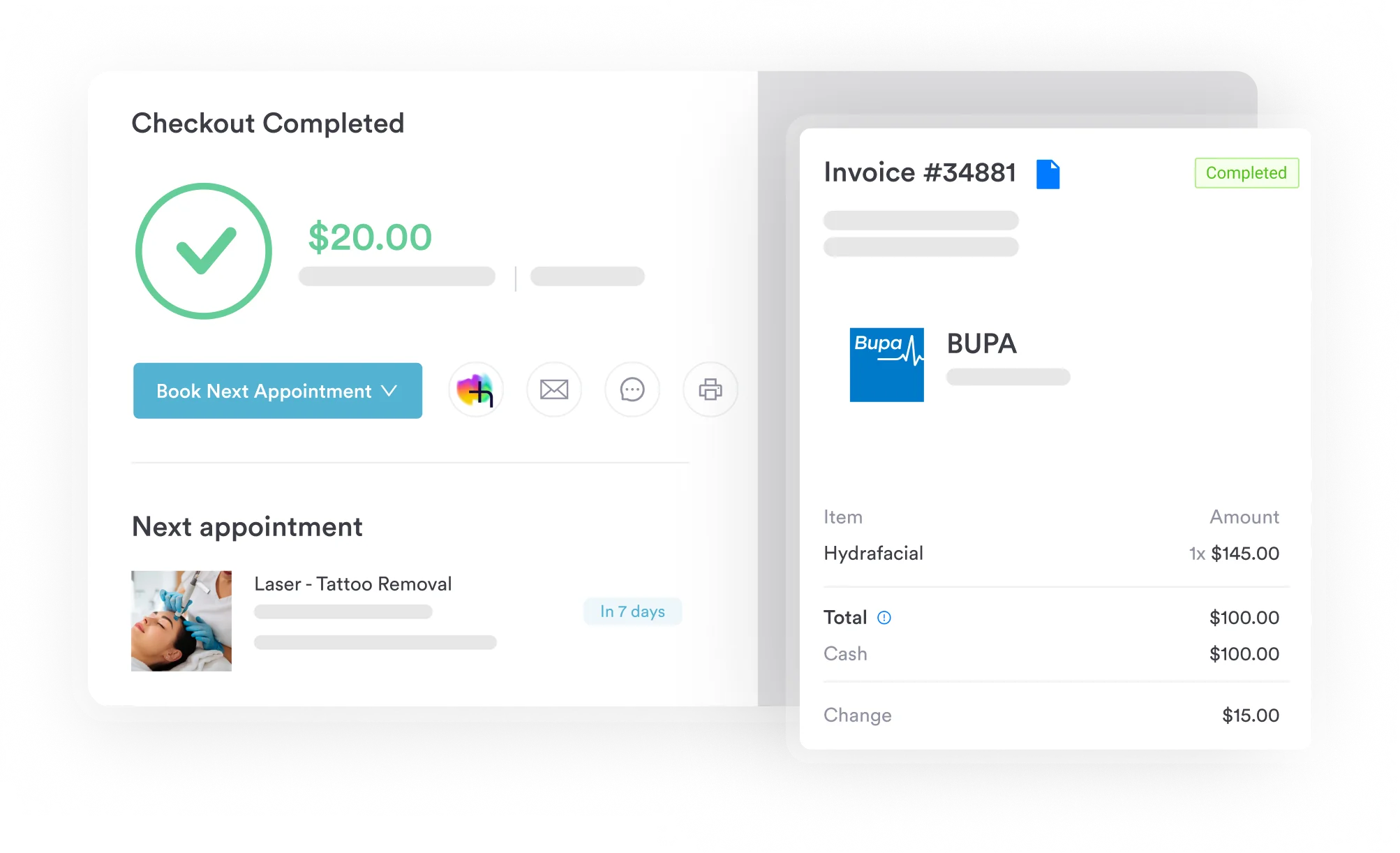
Pabau checkout screen showing a completed payment and an invoice billed to the patient's insurer
Pabau raises the insurer invoice from the same patient record that holds the clinical note, so billing never works from a retyped diagnosis.

Reduce fracture code denials before claims leave your practice

Pabau keeps clinical notes, diagnosis codes and claims in one workflow. Coders can confirm the side, the seventh character and the CPT pairing before a claim reaches the clearinghouse.

Pabau claims management dashboard

Conclusion

S72.25XA is a narrow code, and that is its value. It tells the payer the fracture is subtrochanteric, nondisplaced, closed, on the left femur and under active treatment. Each of those facts has to be in the record before the code goes on a claim.

The side is the fact most worth a second look. Confirm the left femur in the note, match it with an LT modifier, and query the provider when no side is written. A query costs minutes, while a laterality denial costs a full resubmission cycle.

Book a demo to see how Pabau keeps documentation, coding and claims together, so fracture claims go out right the first time.

Continue your research

Continue your research

Need to understand how denied claims are tracked and appealed? Denial management in healthcare covers the CARC/RARC framework and appeals workflows for common fracture code denials.

Submitting claims electronically for the first time? 837 file format guide explains how ICD-10 codes are structured inside an electronic claim and what clearinghouse validation checks.

Want to understand payer eligibility before the procedure? Insurance eligibility verification outlines how real-time eligibility checks reduce claim rejections on high-cost surgical cases.

Frequently asked questions

What does ICD-10 code S72.25XA mean?

ICD-10 code S72.25XA is the diagnosis code for a nondisplaced subtrochanteric fracture of the left femur, initial encounter for closed fracture. It sits in category S72 (fracture of femur) and subcategory S72.2 (subtrochanteric fracture of femur). The code is billable in the FY2027 ICD-10-CM code set, within Chapter 19.

Is S72.25XA a billable ICD-10-CM code?

Yes. S72.25XA is a valid, billable ICD-10-CM diagnosis code in the FY2027 code set. It is a full-specificity, seven-character code for the initial encounter of a closed, nondisplaced subtrochanteric fracture of the left femur.

What is the difference between S72.25XA and S72.25XD?

S72.25XA covers encounters where the patient receives active treatment for the fracture. S72.25XD covers a subsequent encounter after active treatment ends, when the fracture is healing routinely. Assigning S72.25XD to a surgical visit is a common denial trigger. Use S72.25XA for every encounter where active fracture management continues.

When should S72.25XA be used instead of S72.24XA or S72.26XA?

Use S72.25XA when the record documents a nondisplaced subtrochanteric fracture of the left femur. Use S72.24XA when the right femur is documented. S72.26XA applies only when no side is documented, so query the provider first. The side is usually recoverable from imaging or the operative report.

Why would a claim with S72.25XA be denied?

The most common reasons are a D instead of an A on an active surgical encounter and a missing external cause code. A laterality conflict is another, such as S72.25XA paired with an RT modifier. A displacement mismatch also triggers denials when the operative report describes reducing a displaced fracture. Checking these four fields before submission prevents most denials on this code.

What is the ICD-9 equivalent of S72.25XA?

The approximate ICD-9-CM equivalent is 820.22 (subtrochanteric fracture of femur, closed), per the CMS General Equivalence Mappings. The match is approximate because ICD-9-CM did not encode laterality, displacement or encounter type. One broad ICD-9 code therefore covered left, right, displaced and nondisplaced variants.
Avatar photo
Maja Popovska
Content Writer

Maja is a Senior Content Writer at Pabau, where she covers everything from practice management and compliance to medical aesthetics and patient experience. Off the clock: binging true crime docuseries, baking and dreaming about travel.
×