

ICD-10 code S61.201A: Open wound of left index finger without nail damage
ICD-10 code S61.201A covers a left index finger wound of unstated type ICD-10 co...

Last Updated: Oct 16, 2026
Billable Code Specific Code
S72.052S is the billable ICD-10-CM code for unspecified fracture of head of left femur, sequela.
Sequela claims also travel in pairs, with the residual condition coded first and S72.052S second. Send one without the other and the payer bounces it.
Let Pabau's smart automation suggest the right codes, reduce claim denials, and keep your practice compliant—effortlessly.
Automate repetitive tasks and focus on what matters most—your patients.
Reduce coding errors and ensure compliance with the latest regulations.
Clean claims, fewer denials, and faster reimbursements.
Powerful insights and reporting to help your practice thrive.
HIPAA compliant SOC 2 certified GDPR-compliant Trusted by 4,000+ clinics worldwide

ICD-10 code S72.052S means unspecified fracture of head of left femur, sequela, and it is billable
Unspecified describes the fracture pattern, not the site or the side, because subcategory S72.05 carries no displacement detail
A documented nondisplaced articular fracture of the left femoral head is a different code: S72.065S
The 7th character S marks a sequela encounter, and it is one of 16 valid 7th characters for the stem code S72.052
Code the residual condition first and sequence S72.052S after it, per ICD-10-CM guideline Section I.B.10
Practice management software like Pabau pre-fills claim forms from the patient record and checks required fields before submission
ICD-10 code S72.052S is a billable ICD-10-CM diagnosis code, valid for reimbursement submission. The full clinical description is: Unspecified fracture of head of left femur, sequela.
The code sits in chapter S00-T88, injury, poisoning and certain other consequences of external causes. It belongs to the S70-S79 block for injuries to the hip and thigh.
The CMS ICD-10 codes page publishes the annual files that confirm billable status. Once the residual condition code leads, S72.052S goes out on a CMS-1500 form or an 837P electronic claim.
Both formats carry the pair in the same order, and tools built for faster claims management assemble it straight from the record.
S72.052S covers a healed fracture of the left femoral head that the record never took any further. The operative note or imaging report named the site and the side.
It did not call the fracture articular, and it did not say whether the fragments were displaced. ICD-10-CM has a subcategory for exactly that situation, and S72.05 is it.
The femoral head is the ball-shaped top of the femur that fits into the acetabulum to form the hip joint. A fracture there is anatomically distinct from femoral neck and intertrochanteric fractures, which sit lower on the proximal femur.
Sequelae of femoral head fractures commonly include post-traumatic arthritis, avascular necrosis, chronic pain, and reduced range of motion.
Each residual condition needs its own diagnosis code, sequenced before S72.052S on the claim. Which one the physician is treating decides the first line of the claim.
Displacement changes the subcategory, not the 7th character. Femoral head fractures split across two neighboring subcategories, and the wording in the note decides which one you use.
S72.05 holds the unspecified fractures. S72.06 holds the articular fractures and their displaced and nondisplaced options.
Two defaults are worth keeping straight. The S72 tabular note codes a fracture as displaced when the record does not say displaced or nondisplaced. It codes a fracture as closed when the record is silent on open or closed.
Neither default sends you to S72.05. That subcategory is reserved for a femoral head fracture the record never described as articular.
When the detail probably exists somewhere, query the physician rather than defaulting. An operative report or a CT read usually states the fracture pattern, and a one-line clarification moves the claim to a more specific code.
The stem code S72.052 is not billable on its own. A 7th character is required. It records the encounter type, the healing status, and whether the fracture was open or closed.
Sixteen valid characters apply, because S72 splits its subsequent encounters by Gustilo open fracture type as well as by healing stage.
Laid out as a grid, those 16 characters form five stages of three, plus sequela on its own.
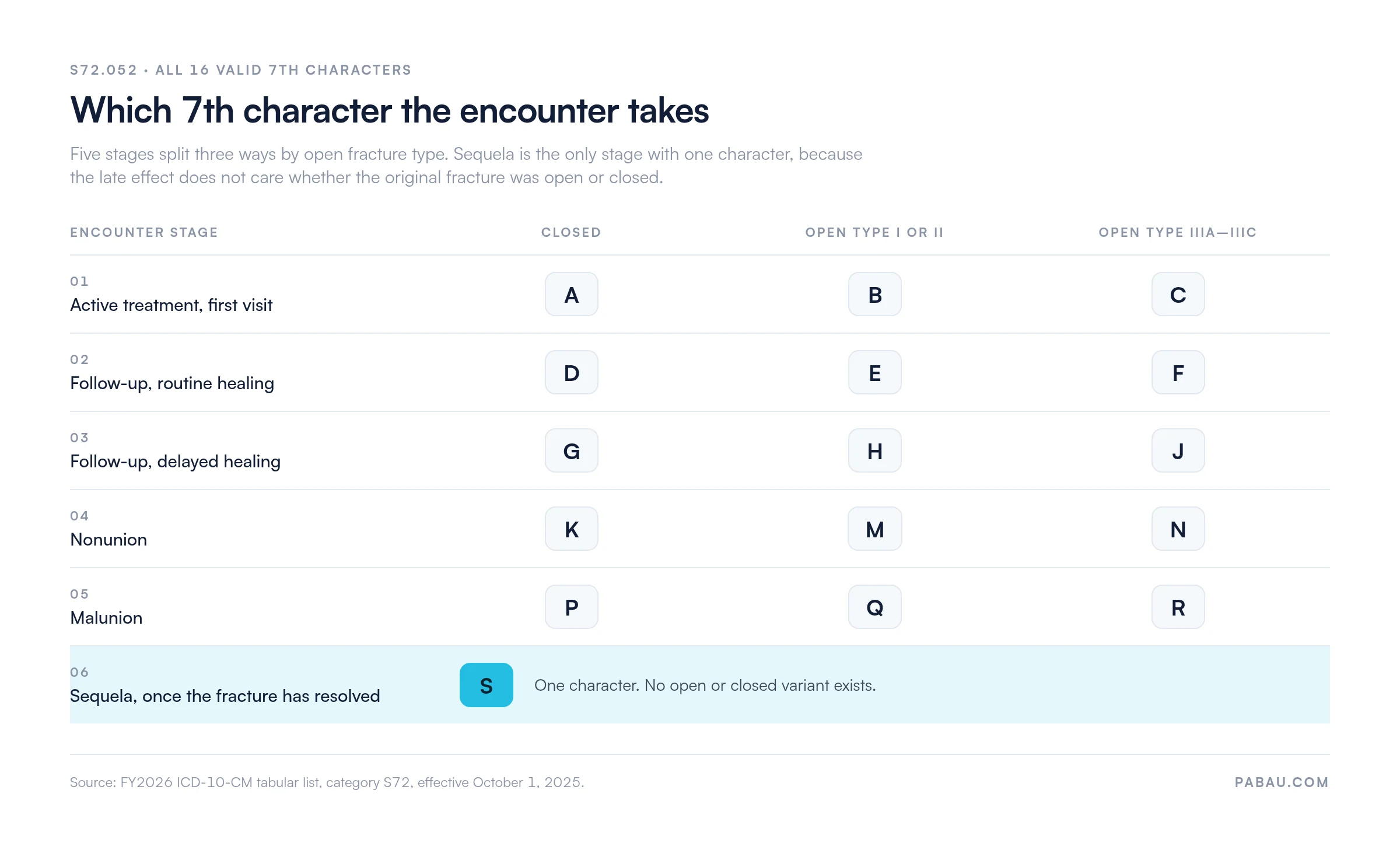
The six characters below cover closed fractures. They handle most femoral head sequela work, since a fracture not documented as open is coded as closed.
The remaining ten characters apply when the fracture was documented as open. Gustilo type I and II injuries take one character, and types IIIA, IIIB, and IIIC share another at each healing stage.
Sequela has no open or closed variant. The late-effect encounter takes S whatever the original fracture looked like. Verify current assignments against the CDC/NCHS ICD-10-CM web tool, which mirrors the official tabular list each fiscal year.
S72.052S sits at the most granular level of the S72 fracture-of-femur category. Reading the lineage from the top shows exactly where the fracture detail stops.
Notice what the 7th character does not do. It adds no fracture detail, since S only records that the encounter treats a late effect. The stem code already fixes every piece of clinical specificity. That is why the displaced and nondisplaced options sit one subcategory across, in S72.06.
This is where most billing errors start. Coders frequently submit S72.052D, subsequent encounter with routine healing, when the fracture has already healed. By then the patient is presenting for a residual condition, which is a different situation and a different code.
Work through this checklist before assigning any S72.052 encounter code.
The distinction is simple. Sequela (S) means the original fracture has resolved and the patient is being treated for something it left behind. A subsequent encounter (D, G, K, or P) means the fracture is still the clinical problem being managed.
Check the physician’s note for the phrase ‘history of fracture’ or ‘prior fracture.’ That language often sits alongside a new diagnosis of post-traumatic arthritis or avascular necrosis of the femoral head. When it does, code sequela rather than a subsequent encounter. The residual condition code leads; S72.052S follows.
S72.052S needs documentation that supports every element of the code description. Auditors reviewing hip fracture claims check four things before they accept a sequela encounter.
Sequela coding takes two codes: one for the residual condition and one for the cause, S72.052S. The sequela code is never listed first. Missing the residual condition code is the most common reason these claims fail an audit review.
External cause reporting carries no national mandate, though some states and payers require it. A Chapter 20 external cause code such as W00.1XXS then records how the original fracture happened. It covers a sequela of a fall from stairs due to ice and snow. External cause codes are sequenced after the residual condition and S72.052S.
A motorcycle crash fills the same slot. When an unspecified motorcycle rider hit a nonmotor vehicle away from a public road, the external cause code is V26.29XS.
S72.052S sits inside a family of femoral head fracture codes. Coders working hip fracture claims need the sibling and adjacent codes to pick the right level of specificity.
Two rows deserve a second look. S72.059S exists for genuinely unknown laterality, and it is the row to avoid whenever the operative note names a side. S72.052A and S72.052D share the stem but belong to the active phase, so neither one ever appears alongside S72.052S on the same claim.
S72.052S sits within a large category covering the full range of femur fractures. Knowing where femoral head fractures fall inside S72 keeps claims out of adjacent subcategories.
Femoral head fractures are the least common hip fracture type in older patients. They show up more often after high-energy trauma and posterior hip dislocations in younger patients. That is one reason the documentation tends to be surgical rather than clinical.
On the inpatient side, S72.052S groups to the aftercare DRGs rather than an acute fracture DRG. That grouping follows what the encounter treats, which is the late effect rather than the fracture itself.
DRG assignment shifts with each annual grouper release, so confirm the current mapping before you rely on it for reimbursement modeling. CMS publishes the MS-DRG classifications and software files each fiscal year.
Femoral head fracture sequela claims attract a predictable set of errors. Each one comes back carrying a denial code, and reading that code is faster than rereading the note. Almost all of them are catchable at the point of coding.
Take a patient who returns 14 months after a left femoral head fracture, now with post-traumatic arthritis of the left hip. Two diagnosis codes go on the claim. M16.52 is the residual condition, so it takes position A in box 21 of the CMS-1500. S72.052S follows in position B as the cause.
The diagnosis pointer on the service line, box 24E, then leads with A, the residual condition. On an 837P electronic claim the same pair rides in the HI segment, in the same order. Reverse the two and the payer sees a sequela code in the primary position, which is where the clinical edit fires. That edit is not fracture-specific. The same rule applies across chapter S00-T88, where a toxic effect sequela such as T59.3X2S also sits behind its residual condition code.
A superficial injury sequela follows the same order. ICD-10 code S00.36XS, the sequela of a nonvenomous insect bite of the nose, is reported after the code for the residual condition.
Four checks catch most of what a payer would send back.
Run those four before you hit send and the claim usually clears on the first pass. The wider routine, the one that applies across every code family, sits in our guide to clean claim submission.
In most practices, a sequela claim gets built twice. The coder reads the note in the record, then retypes the diagnosis codes into a separate billing tool. A missing authorization number comes back as a rejection days later.
Practice management software like Pabau keeps that work in one place. The claim form is pre-filled from the patient record. The procedure code attached to the service lands on the charge line, and the diagnosis slots are seeded from the recorded problem list.
Built-in ICD-10-CM and CPT/HCPCS lookup libraries cover more than 20,000 codes, refreshed with every official release. You can confirm S72.052S without leaving the claim screen.
S72.052S tells the payer why the patient came back after a left femoral head fracture that already healed. Unspecified in this code describes the fracture pattern, since the record never called it articular. It never describes the site or the side, and it never applies while the fracture is still being treated.
Practice management software like Pabau keeps the sequela pair on one claim screen. The claim form pre-fills from the patient record, and built-in ICD-10-CM and CPT/HCPCS lookup libraries confirm S72.052S and its residual-condition partner before the claim goes out.
Book a demo to see how orthopedic sequela claims move from note to submission.

Need the fuller billing picture behind this sequela pair? What is revenue cycle management walks through how diagnosis coding connects to claim submission and payment reconciliation.
Coding a different stage of the same femoral head fracture? ICD-10 code S72.059P covers the malunion 7th character on the unspecified-laterality version of this subcategory.
Want the documentation checklist that keeps sequela claims from bouncing? What makes a clean claim outlines the sequencing and evidence requirements that prevent denials before they happen.
S72.052S is a billable ICD-10-CM diagnosis code for an unspecified fracture of the head of the left femur, sequela. It reports a residual condition caused by a left femoral head fracture that has already healed. The code is valid for FY2026 and accepted on CMS-1500 and 837P claims.
No. S72.05, the subcategory S72.052S belongs to, carries no displacement detail at all. A nondisplaced articular fracture of the left femoral head is coded S72.065S, and a displaced articular fracture is S72.062S.
Yes. S72.052S has been valid since October 1, 2015, and it is unchanged for FY2026, effective October 1, 2025. The parent codes S72, S72.0, S72.05, and the stem S72.052 are not billable alone; claims need the full seven-character code.
S72.052A covers the initial encounter, while the patient is receiving active treatment for the fracture. S72.052S covers a later visit, after the fracture has healed, for a residual condition such as post-traumatic arthritis or avascular necrosis caused by it.
S designates a sequela, meaning the original fracture has resolved and the encounter treats a late effect it left behind. It differs from D, G, K, and P, which all describe a fracture still in an active healing or complication stage.
Confirm the record names the left femoral head and does not describe the fracture as articular, confirm the encounter is for a residual condition rather than ongoing healing, then code the residual condition first, such as M16.52 for post-traumatic osteoarthritis of the left hip, followed by S72.052S.
No. S72.052S appears on the CMS present-on-admission exempt list, so acute care hospitals do not report a POA indicator for it. Confirm your payer’s companion guide, since some leave the field blank rather than omitting it.



