ICD-10 code V43.42XS: Car boarding injury, sequela
ICD-10 code V43.42XS covers the late effects of a car boarding injury ICD-10 cod...

Last Updated: Oct 7, 2026
Billable Code Specific Code
S00.36XS is the billable ICD-10-CM code for insect bite (nonvenomous) of nose, sequela. It applies once a nonvenomous bite on the external nose has healed. The visit treats a condition the bite left behind, such as a scar or persistent itch.
Code the residual condition first and list S00.36XS after it. A bite elsewhere on the head without its own subcategory takes S00.86XS, insect bite (nonvenomous) of other part of head, sequela. Venomous stings are coded to T63 instead.
Let Pabau's smart automation suggest the right codes, reduce claim denials, and keep your practice compliant—effortlessly.
Automate repetitive tasks and focus on what matters most—your patients.
Reduce coding errors and ensure compliance with the latest regulations.
Clean claims, fewer denials, and faster reimbursements.
Powerful insights and reporting to help your practice thrive.
HIPAA compliant SOC 2 certified GDPR-compliant Trusted by 4,000+ clinics worldwide

S00.36XS is a billable ICD-10-CM code for a nonvenomous insect bite of the nose, reported as a sequela.
The S seventh character applies only once the bite wound has fully healed, never while it still needs wound care.
The residual condition, such as a scar or pruritus, is listed first, and S00.36XS follows as the additional code.
The note must tie the current condition to the earlier bite and confirm that the acute phase has ended.
Bites on head sites without their own subcategory use S00.86XS, and venomous stings are coded to T63.
ICD-10 Code S00.36XS is the billable ICD-10-CM code for insect bite (nonvenomous) of nose, sequela. You use it when a healed bite on the external nose has left a condition that needs treatment, such as a scar or persistent itch.
That residual condition is coded first, and S00.36XS follows as the additional diagnosis. Once the codes are set, Pabau’s claims management software sends the claim and tracks its status from one dashboard.
Use the table below to check billable status, chapter placement and encounter type before you code.
S00.36XS covers a nonvenomous insect bite of the external nose, meaning the skin and soft tissue of the nasal surface, documented as a sequela. Bites from mosquitoes, gnats, fleas, bedbugs and similar insects fall here. Venomous insect bites are excluded by the ICD-10-CM tabular list and coded to the T63 block instead.
The code doesn’t describe the bite wound itself. It describes an encounter for a condition caused by a bite that has since healed. That residual condition, such as a hypertrophic scar, persistent itch or skin discoloration, brings the patient in. It gets its own code, sequenced before S00.36XS.
The seventh character S in ICD-10-CM injury codes marks a sequela encounter. The patient is being treated for a condition caused by an earlier injury, and that injury is no longer in an acute or healing phase. Per the CMS ICD-10-CM Official Guidelines Section I.C.19, the sequela character applies once the acute phase has ended.
Three seventh characters govern the S00.36 family. Each maps to a distinct clinical scenario and a distinct documentation requirement.
The most common coding error is using S00.36XD after the wound has fully healed, when the patient returns for scar or skin-tone management. At that point the correct code is S00.36XS. Payers treat the two differently, because a subsequent encounter code implies active healing and triggers different medical necessity thresholds.
The choice between these three codes turns on how far the bite has healed at the visit. The time since the bite doesn’t decide it. A wound check three weeks after a bite can still be S00.36XD if the tissue is actively healing. A scar management visit six weeks after the bite should be S00.36XS if the wound has closed.
The diagram below maps each healing status to its code and shows the order the codes take on a sequela claim.
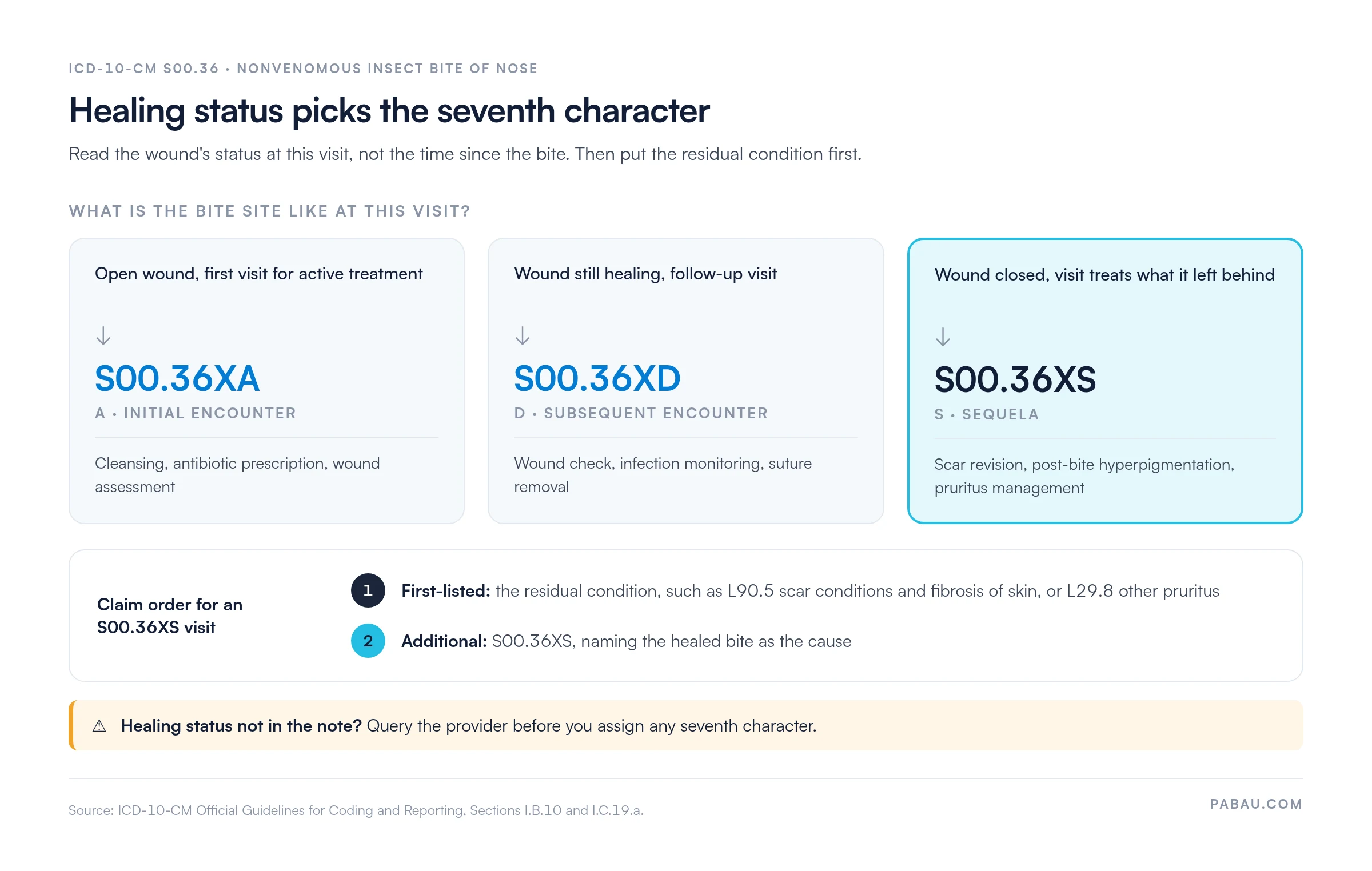
A note that simply says “follow-up for insect bite,” with no healing status, makes the correct seventh character impossible to assign. Structured clinical note templates that ask for healing status remove this guesswork.
Two sets of codes create confusion around S00.36XS: the body-site variants within the S00 block, and the venomous bite codes in the T63 block.
The ICD-10-CM tabular list excludes venomous insect bites from the S00 block. They are coded to T63.4 (venom of other arthropods) or the appropriate T63 subcategory. If the record documents a bee sting, wasp sting or fire ant bite, S00.36XS doesn’t apply. That holds even for a sequela visit on the nose.
Payers audit sequela claims more often than initial-encounter claims, because they need a documented causal chain. Strong medical billing compliance starts with what the provider writes in the note, long before the claim reaches billing.
The clinical record must include each of the following to support S00.36XS:
Build a sequela checklist into your clinical note template. A checkbox confirming the acute phase has resolved, plus a field describing the residual condition, takes providers seconds. Those two entries give the payer the causal chain it looks for on every sequela claim.
CMS ICD-10-CM Official Guidelines Section I.B.10 states that the condition or nature of the sequela is generally sequenced first. The injury code carrying the S seventh character follows as an additional diagnosis. Reversing that order is one of the most frequent errors on these claims.
The exception applies when the sequela code itself gives the most complete description and no separate nature-of-sequela code exists. A residual skin condition almost always has its own ICD-10-CM code, so S00.36XS will routinely appear as a secondary diagnosis. Submitting it as the sole diagnosis is a common denial pattern, covered in the payer section below.
Some payers and state reporting rules also ask for the cause of the injury, which takes the external cause code W57.XXXS at a sequela visit. Our W57.XXXA page explains how that code family works.
Payers reject S00.36XS claims for a small set of predictable reasons, and most of them trace back to the clinical note. Knowing the pattern lets you prevent most denials at the documentation stage.
Effective denial management workflows treat these patterns as predictable rather than random. Track denial reasons by code family to see whether S00.36XS claims fail at documentation, coding or medical necessity. The fix is different for each.
Submitting a clean claim for a sequela encounter takes three elements: the causal-link statement, the nature-of-sequela code listed first, and documented medical necessity. Each one can be confirmed before the claim leaves the practice.
The following guideline sections govern S00.36XS use. Reference them during internal audits or when a payer asks for additional documentation. The CDC/NCHS ICD-10-CM web tool provides the current tabular list with every exclusion note and coding instruction.
The same Chapter 19 rules apply to every injury code with an S character. Our library of ICD-10-CM codes covers the A, D and S variants for neighboring sites.
Today, many practices code the sequela visit in one tool, raise the invoice in another and chase the claim by phone. A missing detail often surfaces only when the rejection arrives, weeks after the provider has moved on.
Pabau, the practice management platform we build, keeps the treatment note, the invoice and the claim in one place. The invoice is raised against the patient’s linked insurer at checkout. Before each claim goes out, Pabau checks that required details such as membership numbers and authorization codes are filled in.
US practices send claims electronically through Claim.MD from inside Pabau, run eligibility checks and post ERA remittances. Every claim then shows a live status, from pending to paid, so a rejected S00.36XS claim gets fixed while the visit is still fresh.

Pabau checks each claim for missing details before it goes out, then tracks it to payment in one dashboard. Rejections surface early, while the note is still easy to fix.

Most S00.36XS denials are decided in the exam room, long before anyone opens the claim. If the note confirms the bite has healed and names the residual condition, the claim nearly codes itself. If it doesn’t, no amount of billing skill will rescue it.
So start with the template. Add the healing-status question and the residual-condition field, and make S00.36XS the second code by habit. The trade-off is a few seconds per note against a resubmission weeks later.
Book a demo to see how Pabau carries a sequela visit from the treatment note to a paid claim.

Need to understand how clearinghouse validation works? Medical claims clearinghouse guide explains how electronic claim scrubbing catches code errors before submission.
Tracking sequela denials across your practice? Denial codes in medical billing covers the CARC and RARC codes payers use when rejecting sequela claims.
Want to streamline the full billing cycle? Revenue cycle management overview outlines how coding accuracy connects to collections and practice cash flow.
Treating a bite on a neighboring site? ICD-10 code S00.469D walks through an insect bite of the ear at the follow-up stage.
ICD-10 Code S00.36XS is the billable ICD-10-CM code for a nonvenomous insect bite of the nose, reported as a sequela. It applies when the bite wound has healed but left a condition that needs treatment, such as a scar, pruritus or hyperpigmentation. The S seventh character marks the visit as a sequela encounter.
Yes. S00.36XS is a valid, billable ICD-10-CM code for FY2027, which runs from October 1, 2026, to September 30, 2027, with no change from FY2026. It usually appears as an additional diagnosis. The residual condition, such as a scar or pruritus, is listed first.
S00.36XA covers the initial encounter while the bite is in active treatment. S00.36XD covers follow-up visits while the wound is still healing. S00.36XS applies once the wound has fully healed and the visit treats a residual condition. Healing status at the visit decides the choice, not the time since the bite.
Use the S seventh character when the original injury has resolved and the patient is treated for a condition it caused. Typical examples are a scar, chronic pain or skin discoloration. The note must confirm that the acute phase has ended. It must also describe the residual condition being treated.
Yes. Under the ICD-10-CM Official Guidelines, the nature of the sequela is generally sequenced first, and S00.36XS follows as an additional code. Submitting S00.36XS as the only diagnosis, with no code for the residual condition, is a common cause of claim denials.
Payers most often deny S00.36XS claims for four reasons. The note doesn’t link the condition to the original bite, the seventh character is D instead of S, or no nature-of-sequela code is listed. The fourth is thin medical necessity documentation. Structured note templates and a pre-submission claim check prevent each one.