ICD-10 Code S42.444P: Medial epicondyle fracture, right humerus
ICD-10 Code S42.444P: full descriptor and code validity ICD-10 Code S42.444P car...

Last Updated: Oct 13, 2026
Billable Code Specific Code
S72.043B is the billable ICD-10-CM code for displaced fracture of base of neck of unspecified femur, initial encounter for open fracture type I or II.
Let Pabau's smart automation suggest the right codes, reduce claim denials, and keep your practice compliant—effortlessly.
Automate repetitive tasks and focus on what matters most—your patients.
Reduce coding errors and ensure compliance with the latest regulations.
Clean claims, fewer denials, and faster reimbursements.
Powerful insights and reporting to help your practice thrive.
HIPAA compliant SOC 2 certified GDPR-compliant Trusted by 4,000+ clinics worldwide

ICD-10 Code S72.043B describes a displaced fracture at the base of the neck of the unspecified femur. Unspecified means the record never states which femur was fractured.
The sixth character is the laterality character here. S72.041 is the right femur, S72.042 the left femur, and S72.043 the femur that documentation does not identify.
This is a billable, specific ICD-10-CM code valid for FY2026 (effective October 1, 2025) and eligible for HIPAA-covered transaction submission.
The 7th character B confirms: initial encounter, open fracture, Gustilo classification type I or II only. Type IIIA/B/C requires code S72.043C instead.
S72.043B maps to HCC 402 (Hip Fracture/Dislocation) under CMS-HCC Model V28, which CMS phased in to full weight for payment year 2026.
ICD-10 Code S72.043B is a billable ICD-10-CM diagnosis code for a displaced fracture at the base of the neck of the unspecified femur. It applies at the initial encounter for an open fracture of Gustilo type I or type II. The sixth character, 3, is the unspecified-laterality option.
So this is the code for a base-of-neck fracture where the record never names a side. It is valid for fiscal year 2026, became effective on October 1, 2025, and is eligible for HIPAA-covered transactions. It sits inside the S72 category, which covers fractures of the femur.
Laterality is where femoral fracture claims fail most often. S72.043B is correct only when the chart genuinely names no side. It is the wrong code whenever left or right appears anywhere in the record.
In practice, every character in the code has to be earned by the record. A coder who cannot point to documentation for displacement, subsite, open status and Gustilo type has to query the physician first.
The 7th character is the most consequential character in S72.043B for billing purposes. In fact, getting it wrong triggers an automatic claim edit. The character B carries three facts at once. This is an initial encounter, the fracture is open rather than closed, and the open fracture is Gustilo type I or type II.
Under ICD-10-CM guidelines, “initial encounter” covers the whole active treatment period rather than the first office visit alone. A patient seen in the emergency department, then in surgery, then in follow-up for wound management still carries the B character throughout active treatment. The S72 category offers sixteen 7th-character options, and the table below lists all of them.
Per CMS ICD-10-CM coding guidelines, coders must not assume open fracture type from clinical context. The treating physician must document “open fracture type I” or “open fracture type II” in the note, or use equivalent Gustilo terminology. Absent that documentation, the coder queries the surgeon rather than assuming type I or II.
S72.043B covers both Gustilo type I and type II fractures under a single code. Coders therefore do not need to distinguish between them for reporting purposes. The clinical difference still matters when auditing documentation, because it flags the cases that belong under S72.043C for Gustilo type IIIA/B/C.
Ultimately, the classification must come from the surgeon’s operative report or clinical note. A rehabilitation note describing the wound weeks later does not establish the Gustilo type, and neither does a nursing entry.
Check the operative note specifically for wound size measurement and soft tissue coverage language. Surgeons documenting “adequate coverage” with a wound under 10 cm point to type II. Language like “periosteal stripping” or “flap required” signals type IIIB, which needs S72.043C instead.
The femoral neck connects the femoral head (the ball of the hip joint) to the femoral shaft. Accordingly, fractures here are classified within S72.0, fracture of head and neck of femur. That subcategory then splits by anatomical subsite and by fracture characteristics.
Specifically, the base of the femoral neck sits at the junction between the neck and the intertrochanteric region. Clinicians often call a fracture here basicervical, while the tabular list indexes the same subsite as cervicotrochanteric. Either way, the base-of-neck subsite is captured under S72.04.
By contrast, these fractures differ clinically from subcapital fractures, which sit near the femoral head and code to S72.01. They also differ from midcervical or transcervical fractures in the mid-neck, which code to S72.03.
Within S72.04, the sixth character records displacement status and laterality together, which is why the six codes below differ by a single digit. S72.041 is the displaced fracture of the right femur and S72.042 the displaced fracture of the left. S72.043 is the displaced fracture reported when the record identifies no side at all.
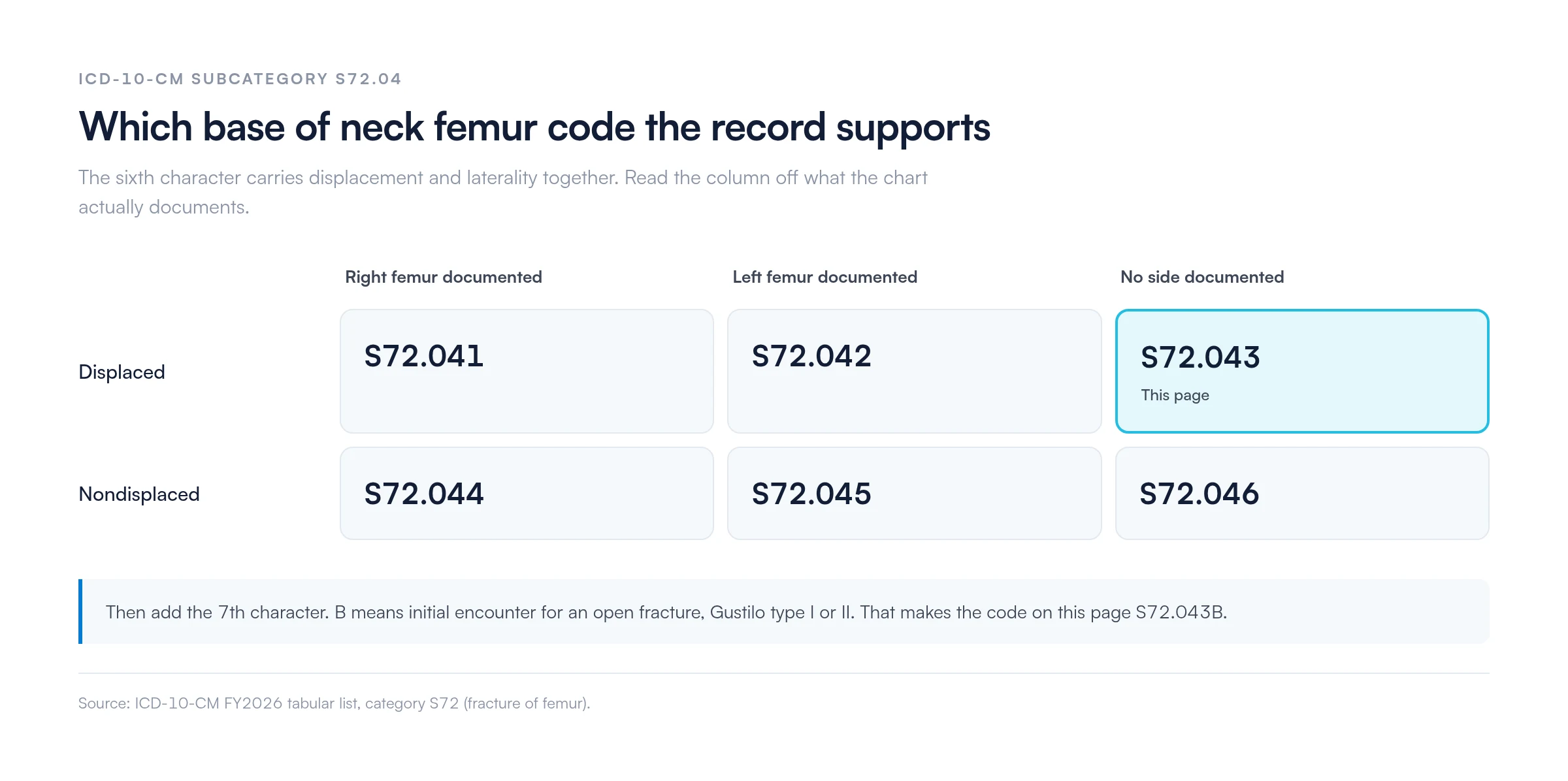
S72.043B sits within a tightly clustered group of sibling codes that differ by one character. As a result, selecting the wrong sibling is one of the most common audit findings in hip fracture billing, and laterality is where it happens most. The table below covers the S72.043 variant group and the neighbors a coder is most likely to confuse with it.
A displaced base-of-neck fracture is usually treated surgically, so this diagnosis travels with a hip procedure code on the same claim. Where the surgeon performs a total hip replacement, that procedure line is CPT 27130.
For confirmation, coders can verify current S72 code validity using the CDC/NCHS ICD-10-CM web tool or the AAPC ICD-10-CM code lookup.
S72.043B maps to HCC 402, Hip Fracture/Dislocation, under CMS-HCC Model V28. Notably, this matters most for Medicare Advantage plans, where diagnosis coding drives the risk adjustment factor (RAF) score assigned to each patient.
Consequently, an omitted or inaccurate hip fracture code leaves the plan underestimating patient complexity. That reduces plan reimbursement and can surface later as a RADV audit finding.
Under Model V28, HCC 402 captures hip fracture and dislocation diagnoses that signal patient frailty and injury severity. CMS did not switch to V28 in one step. It blended the two models across three payment years instead.
Verify the RAF value and the HCC assignment each year against the current CMS risk adjustment files, because the mappings are updated annually.
Laterality does not change the mapping, so S72.041B, S72.042B and S72.043B all land in HCC 402. It does, however, change audit exposure. A reviewer who finds left or right in the chart will expect the specific code on the claim, not the unspecified one.
For practices billing Medicare Advantage, hip fracture coding carries compliance weight as well as revenue weight. For instance, a RADV reviewer can pull the chart and ask how HCC 402 was supported. An unspecified code sitting beside a documented side is the finding they write up.
Every character in S72.043B requires explicit physician documentation, with one deliberate exception. Laterality is the element this code reports as unspecified. The record must therefore support the other five elements below and must genuinely lack a documented side. Consequently, missing any of them gives a payer grounds to downcode the claim or to request a refund.
The elements above have to be captured at the point of care, not reconstructed weeks later from a closed chart. A practice running claims management software can hold that check at submission. A missing Gustilo type or an absent laterality then surfaces before the claim goes out.
Hip fracture codes generate a disproportionate share of claim edits, because five specificity elements have to line up at once. Overall, most errors fall into a small number of predictable patterns.
Typically, a pre-submission audit step catches most of these. It checks each fracture code for laterality, encounter type, and open or closed status before the claim leaves the practice. The surgical side of the same claim runs through the CPT codes reference, so both lines get reviewed together.
Run a quarterly audit of all S72.043B claims. Flag any claim billed with B that belonged in a subsequent encounter character. For an open type I/II fracture the right characters are E, H or M instead. Then flag every S72.043B claim whose chart names a side, because that claim needed S72.041B or S72.042B. Those two patterns are the first checks a RAC auditor runs on femoral neck fracture codes.
The ICD-10-CM tabular list includes several instructional notes that apply to S72.043B through its parent categories. Therefore, coders must read these notes at every level of the hierarchy before assigning the code.
Applicable To: The S72 category includes the term “fracture of femur.” At S72.04 the inclusion term is “cervicotrochanteric fracture of femur,” which is the only synonym the classification lists for this subsite. Surgeons often write “basicervical” for the same fracture, but that word is clinical shorthand rather than a coded inclusion term.
Excludes1 (from S72): One condition alone is Excludes1 at S72. That is traumatic amputation of hip and thigh (S78.-), which can never be reported alongside a femur fracture code. Three neighboring groups carry Excludes2 notes at S72 instead.
Practically speaking, the difference shows up at the claim level. An Excludes1 note means the two conditions cannot occur together, so a payer edit fires when both codes appear. An Excludes2 note means the condition simply is not part of S72, so both codes may be reported when the patient has both injuries.
Hip fracture NOS: A chart that records only “hip fracture” is not excluded from S72. “Hip fracture NOS” is an Applicable To inclusion term at S72.00- and at S72.01-, so it codes to the unspecified-part-of-neck subcategory.
Notably, it does not code to S72.9. That subcategory carries its own Excludes1 note for fracture of hip NOS, which steers the coder away from S72.9 rather than toward it.
A note that locates the fracture below the lesser trochanter leaves S72.0 altogether and codes to the subtrochanteric group, S72.2-. Side, displacement and encounter then set the rest of the code. A later visit for a displaced closed left femur fracture with delayed healing, for example, takes S72.22XG. Where that left femur fracture is open type I or II and healing routinely, the later visit takes S72.22XE.
Non-traumatic fractures: Pathological and stress fractures are not traumatic injuries, so they belong in Chapter 13 rather than S72. Use M84.4- or M84.5- for a pathological fracture and M84.3- for a stress fracture. A femoral neck fracture caused by metastatic bone disease, for example, is a pathological fracture and never takes an S72 code.
Alphabetic index path: To locate S72.043B in the alphabetic index, start with “Fracture, traumatic,” then read down to “femur, femoral,” then “neck,” then “base.” The index sends the coder to S72.04-.
The tabular list then supplies the sixth character for displacement and laterality, plus the 7th character for encounter and open fracture type. Because the record names no side, the sixth character is 3 and the completed code is S72.043B.
The CMS ICD-10-CM Official Guidelines for Coding and Reporting govern how these instructional notes are read. They take precedence over any commercial coding reference.
Often, most practices find a laterality problem only after the remittance arrives. The claim goes out with S72.043B, the payer sees an unspecified code where a specific one exists, and the denial lands weeks later. By then the operative note is closed and the query is a chase.
Practice management software like Pabau keeps the clinical record and the claim in one system. As a result, the coder reads the operative note, the imaging report and the diagnosis line on the same screen. Coding queries stay attached to the encounter instead of living in an email thread.
Overall, the outcome is fewer unspecified codes leaving the practice, and a shorter paper trail when a reviewer asks how HCC 402 was supported. Every subscription includes the full claims workflow, so none of this waits on an upgrade.

Pabau’s claims management tools help orthopedic and trauma practices submit ICD-10-CM codes accurately, track claim status, and reduce denial rates across payer types.

S72.043B is a correct code and a weak one at the same time. Indeed, it is billable, it maps to HCC 402, and it will usually pay. It also tells the payer that nobody wrote down which femur was broken.
So treat the code as a prompt rather than an answer. Where the record genuinely names no side, S72.043B is what you report and the chart supports it. Where a side sits unread in an imaging report, the query costs minutes and the denial costs weeks.
Pabau validates ICD-10-CM code completeness before submission, so a missing laterality surfaces while the encounter is still open. Book a demo to see how Pabau handles claims for traumatic fracture encounters.

Need to send a clean claim for an orthopedic code? Clean claim best practices covers the documentation and formatting that stop automatic edits on trauma codes.
Unsure how billing works for hospital-based fracture care? Medical billing fundamentals walks the claim lifecycle from code assignment through to remittance.
Reading ERA responses on orthopedic claims? Electronic remittance advice (ERA) guide explains how to read 835 files and answer denial reason codes.
Want the wider view of how a claim earns its money? Revenue cycle management maps every stage from patient registration to final payment posting.
Building coding checks your auditors will accept? Medical billing compliance sets out the review steps that keep specificity errors out of submitted claims.
ICD-10 Code S72.043B is a billable ICD-10-CM diagnosis code for a displaced fracture of the base of the neck of the unspecified femur. It applies at the initial encounter for an open fracture classified as Gustilo type I or type II. Unspecified means the record does not identify which femur was fractured. The code is valid for FY2026 and maps to HCC 402 under CMS-HCC Model V28.
Neither one specifically. S72.043B is the unspecified-laterality code in the S72.04 group, so it is used when documentation never states a side. The right femur takes S72.041B and the left femur takes S72.042B. If the chart names a side, one of those two codes is required instead.
Yes, S72.043B is a billable, specific ICD-10-CM code effective October 1, 2025, for fiscal year 2026. It is valid for HIPAA-covered transaction submission and can be used as a principal or secondary diagnosis code. Being billable is not the same as being the best available code, so query the physician when laterality is missing.
S72.043A covers a closed fracture at the same site. That is a displaced base-of-neck fracture of the unspecified femur at the initial encounter. S72.043B covers the same fracture when it is open with a Gustilo type I or type II classification. Using A when an open fracture is documented is the most common coding error in this group.
A Gustilo type I open fracture has a wound under 1 cm with minimal soft tissue damage and no contamination. A type II fracture has a wound between 1 and 10 cm with minimal contamination and adequate remaining soft tissue coverage. Both are captured by the 7th character B for initial encounters in the S72 code series.
Yes, S72.043B maps to HCC 402, Hip Fracture/Dislocation, under CMS-HCC Model V28. CMS blended V28 with V24 across payment years 2024 and 2025, and V28 carries full weight from payment year 2026. Laterality does not change the mapping, so the right, left and unspecified codes all group to HCC 402.
Physicians must document a displaced fracture, the base-of-neck anatomical subsite, open fracture status, a Gustilo type I or type II classification, and an initial encounter. Laterality is the one element this code leaves unspecified, so the record must genuinely lack a documented side. Coders may not infer any of these elements from context.