

ICD-10 code S61.201A: Open wound of left index finger without nail damage
ICD-10 code S61.201A covers a left index finger wound of unstated type ICD-10 co...

Last Updated: Oct 16, 2026
Billable Code Specific Code
S66.599A is the billable ICD-10-CM code for other injury of intrinsic muscle, fascia and tendon of unspecified finger at wrist and hand level, initial encounter.
The trouble sits in the sixth character. That 9 says nobody named the finger, and payers look hard at unspecified injury codes. When the record does name the finger, a sibling code moves through the payer with far less friction.
Let Pabau's smart automation suggest the right codes, reduce claim denials, and keep your practice compliant—effortlessly.
Automate repetitive tasks and focus on what matters most—your patients.
Reduce coding errors and ensure compliance with the latest regulations.
Clean claims, fewer denials, and faster reimbursements.
Powerful insights and reporting to help your practice thrive.
HIPAA compliant SOC 2 certified GDPR-compliant Trusted by 4,000+ clinics worldwide

ICD-10 code S66.599A covers other injury of intrinsic muscle, fascia and tendon of an unspecified finger, initial encounter.
The code is billable and valid for HIPAA-covered electronic transactions in FY 2026.
Sixth-character digits 0 through 8 name the finger and the side. Use one of those whenever the record identifies the finger.
Thumb codes under S66.4- carry an Excludes2 note, not an Excludes1. Both can appear on one claim when both injuries are documented.
The seventh character A covers the whole active treatment phase, not just the first visit. It becomes D once active care ends.
S66.599A is a billable, HIPAA-valid ICD-10-CM code for FY 2026, and it is complete as written. Nothing else needs to be appended to it. The table below is the field-by-field reference.
Per CMS ICD-10-CM guidance, every billable ICD-10-CM code is valid on HIPAA-covered electronic transactions. Codes are reviewed each year, so check the current tabular list before you submit.
Read S66.599A from left to right and it answers five separate questions. Every answer has to be earned by a line in the note, or the code is wrong.
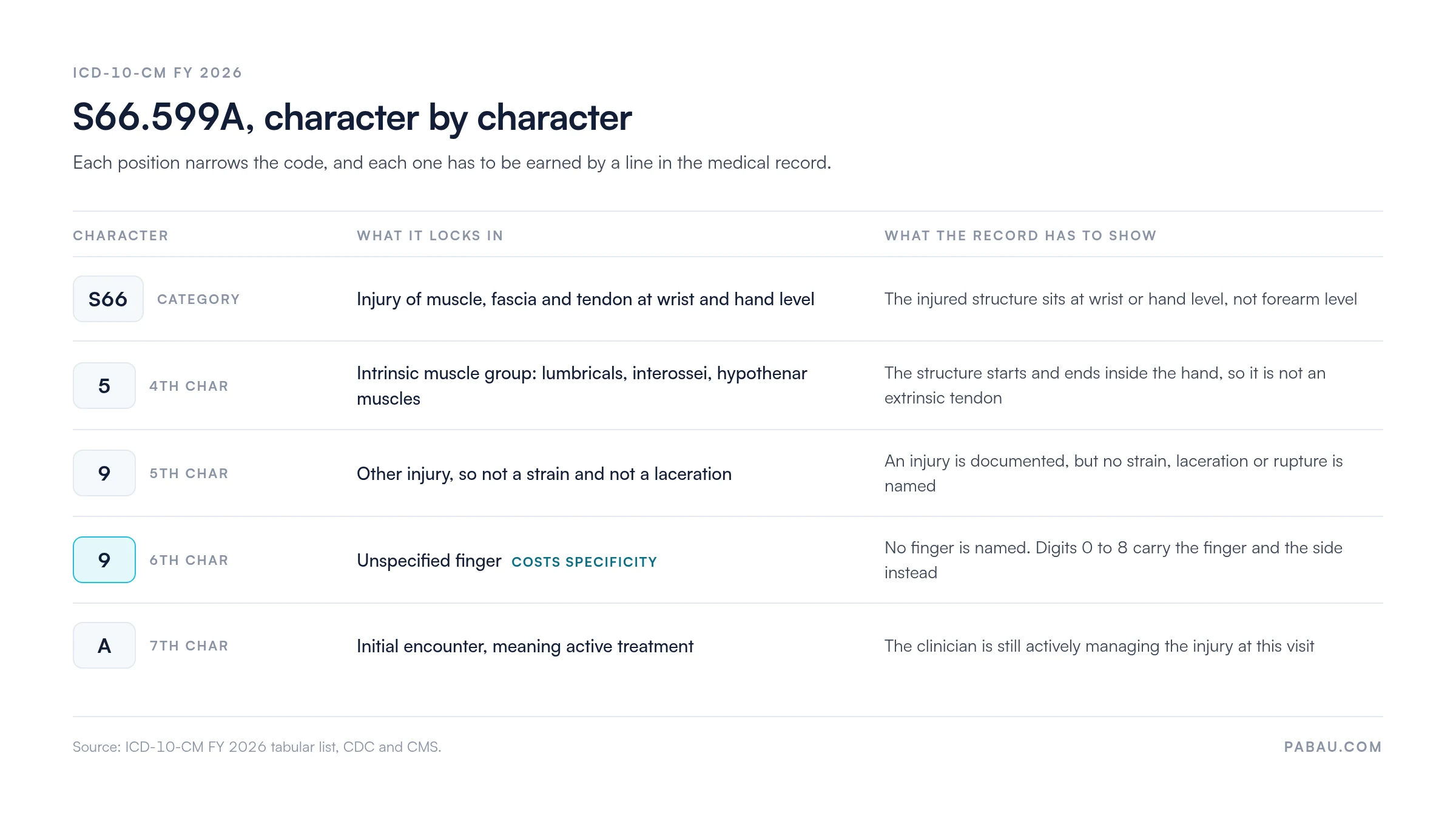
The intrinsic group is where coders slip most often. Lumbricals, interossei and hypothenar muscles begin and end inside the hand.
Extrinsic flexors and extensors begin in the forearm, so their injuries belong to other S66 subcategories. Mislabeling an extensor tendon injury as an intrinsic one changes the diagnosis, and payer edits usually catch it. Other injury of the left index finger extensor, for example, codes to S66.391A at initial encounter. A right little finger extensor injury seen at a follow-up visit codes to S66.396D.
The full ladder from chapter down to billable code runs like this:
Step down that ladder as far as the documentation allows. Where the note names the finger, S66.599A is not the bottom rung.
The seventh character is required, and A means active treatment rather than first visit. Codes in the injury chapters are incomplete without it, so a claim missing that character comes straight back.
Choosing the wrong one is a common reason hand injury claims get returned for correction.
According to the CDC/NCHS ICD-10-CM tool, initial encounter describes the phase of care and not the visit count. A patient can have four visits and still sit in the A phase. The code moves to D once the clinician documents that active management has ended.
When the note names the finger, one of nine sibling codes replaces S66.599A. The sixth character carries the finger and the side together, which is why the list below is worth reading digit by digit.
The sixth character is also where a keystroke does the most damage, because S66.594A and S66.595A differ only by the side. Pull the descriptor from our ICD-10-CM code library rather than from memory, then read it back against the note.
Document the specific finger whenever it can be identified. Coding S66.599A for a right index finger injury leaves S66.590A, a more specific code, unused. Specificity reduces payer scrutiny and gives medical necessity something concrete to rest on.
Thumb injuries sit under S66.4- as an Excludes2, not an Excludes1. That distinction decides whether you can report both codes together, and the FY 2026 tabular list is clear on it.
Use S66.599A when the intrinsic structures of a non-thumb finger are injured at wrist and hand level. It applies where neither the injury type nor the finger is pinned down. These four presentations come up most:
Once imaging or a specialist note identifies the finger, move to the sibling code at the next encounter. Staying inside the initial encounter phase does not stop you from adding specificity, and S66.590A through S66.598A remain available for the rest of the episode.
Sprain, strain and laceration each send the claim somewhere other than S66.599A. Three of those detours account for most of the miscoding in this range.
Other phrasing does map here. Operative notes, referral letters and therapy assessments describe this code in several ways:
Where the note gives a structure and a mechanism but no injury type, S66.599A is the honest choice. Do not reach for it to paper over an injury the surgeon already described precisely.
Picking the code takes seconds. Payment is decided by what happens either side of it, so it helps to see the whole path.
Most S66.599A problems surface at step four, which is the cheapest place to find them. A rejection there costs a correction. A denial after adjudication costs an appeal, and the clock on timely filing keeps running while you write it.
Five things account for most returns on this code. Work down them before the claim leaves your system.
Those five checks are most of the distance between a coded encounter and a clean claim that pays on the first pass. Run them while the note is still open, because chasing the clinician a week later rarely works.
Add the external cause code even where the payer does not insist on it. Commercial payers often flag musculoskeletal injury claims with no mechanism code for extra review, which stretches the reimbursement timeline by weeks.
Plenty of practices code in one system and submit from another. The diagnosis gets entered twice, and the second copy is where the transposed sixth character lands. Nobody sees it until the rejection arrives.
Practice management software like Pabau keeps that entry in one place.
The ICD-10 code sits on the encounter inside the patient record. Pabau’s medical claims management then links it to the procedure lines that go out on the claim. Coders search for S66.599A in the built-in ICD-10 and CPT catalogues instead of switching to a separate lookup tool.
Pabau also integrates with Claim.MD, our US clearinghouse partner, which reaches thousands of US insurance payers. Claims leave as CMS-1500 forms generated from the invoice, and claim status plus electronic remittance advice comes back into the Pabau claims dashboard.
Billing staff see a rejected diagnosis code in the same place they submitted it.
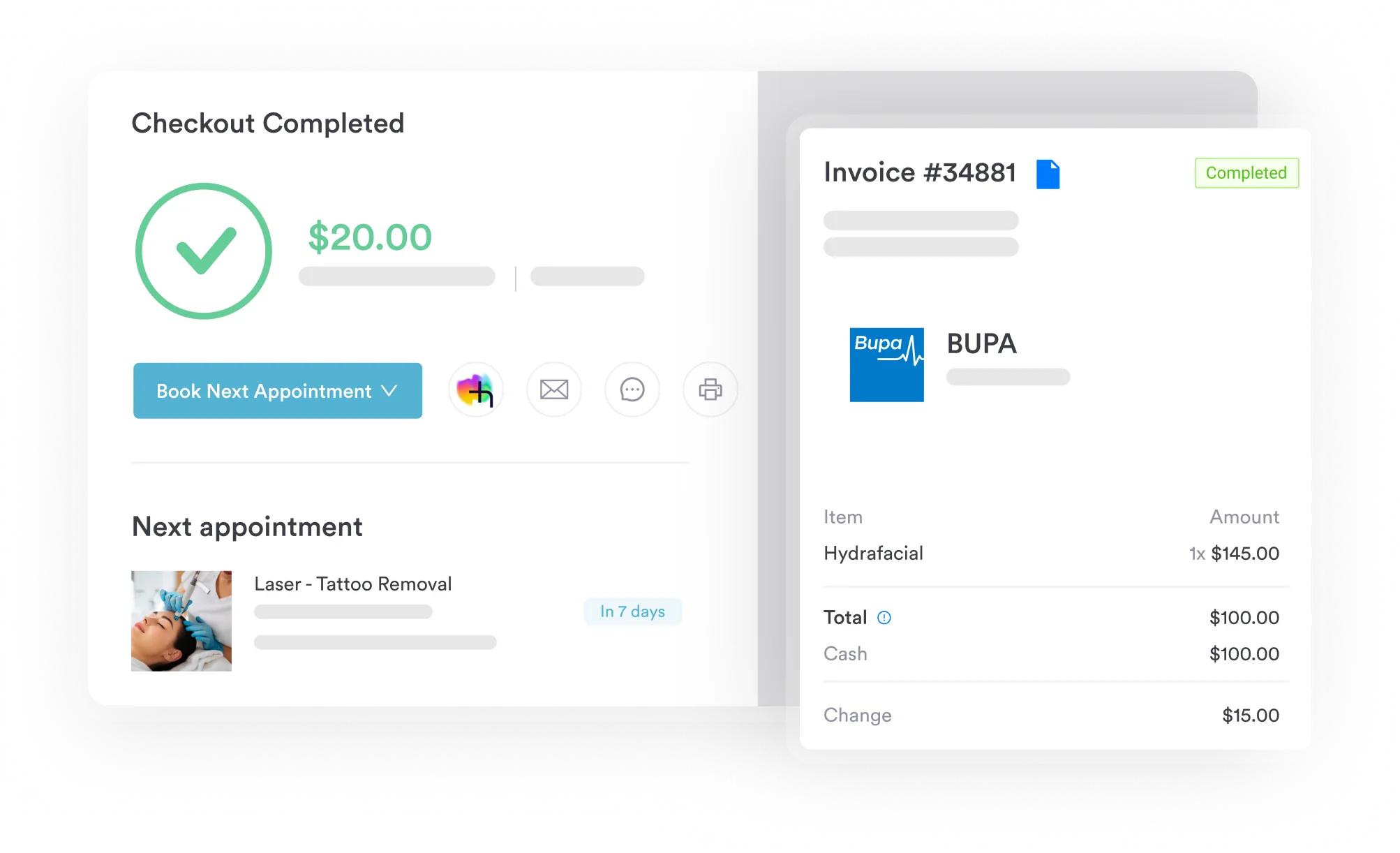

Pabau holds the ICD-10 code on the encounter, generates the CMS-1500 from the invoice, and brings claim status and remittance back into one dashboard. Your coders and billers stop retyping the same diagnosis.

S66.599A is a clean code to report and an easy one to over-use. The sixth character is where the money sits, because an unspecified finger invites the review that a named finger avoids.
So push for the finger in the documentation before the encounter closes. That single habit moves most of these claims onto a sibling code, shortens the payment cycle, and gives an auditor less to ask about later.
If your coders and your billers work in separate systems, that diagnosis is being retyped somewhere. Book a demo to see how Pabau keeps ICD-10 entry, claim submission and remittance on a single patient record.

Need the whole claim lifecycle in view? What is revenue cycle management covers how accurate diagnosis coding connects to every later step in the claim.
Chasing a denial on a musculoskeletal claim? Denial codes in medical billing explains the common denial reasons and how to answer them before you resubmit.
Wondering where payer edits catch a bad code? Medical claims clearinghouse shows what a clearinghouse checks before your claim reaches the payer.
Building a superbill for a hand injury visit? Superbill walks through the fields that have to be right before it becomes a claim.
New to the billing side of diagnosis coding? What is medical billing sets out each step between the encounter and the payment.
Yes. On an outpatient claim the injury code is first-listed, and S66.599A qualifies. The external cause code naming the mechanism is always secondary, so it can never take the first position. Sequence the injury first, then the mechanism, then place and activity.
No. The sixth character 9 already means the finger is unspecified, so there is nothing to lateralize. Laterality only appears once a finger is named, in the codes ending 0 through 7. Those digits carry the finger and the side together.
A mechanism code from the W or X range comes first, such as a struck-by or crushing injury. Add Y92 for the place of occurrence and Y93 for the activity. Y99 records the external cause status, for example work-related or leisure.
Yes, on acute care inpatient hospital claims. POA reporting applies there, and an injury present before admission is reported as Y. Outpatient and physician office claims carry no POA indicator at all.
It can be, but it is weak on its own. An unspecified finger tells a reviewer little about function, so pair it with documented deficits and goals. Where the finger is known, a sibling code supports medical necessity far better.



