ICD-10 Code S66.308A: Extensor muscle injury, other finger
ICD-10 Code S66.308A: Definition and code hierarchy ICD-10 Code S66.308A is the ...

Last Updated: Oct 14, 2026
Billable Code Specific Code
S66.598A is the billable ICD-10-CM code for other injury of intrinsic muscle, fascia and tendon of other finger at wrist and hand level, initial encounter. It applies when the note documents the injury but no finger-specific code from S66.590A to S66.597A fits.
Denials on this code usually trace back to the note rather than the claim form. The physician has to name the injured structure, state the side, and confirm the visit is active treatment. That last point is what the 7th character "A" reports.
Let Pabau's smart automation suggest the right codes, reduce claim denials, and keep your practice compliant—effortlessly.
Automate repetitive tasks and focus on what matters most—your patients.
Reduce coding errors and ensure compliance with the latest regulations.
Clean claims, fewer denials, and faster reimbursements.
Powerful insights and reporting to help your practice thrive.
HIPAA compliant SOC 2 certified GDPR-compliant Trusted by 4,000+ clinics worldwide

S66.598A covers an intrinsic muscle, fascia, or tendon injury at finger level that no named-finger code fits.
The 7th character ‘A’ is valid only during active treatment. Switch to ‘D’ at follow-up and ‘S’ for sequela visits.
‘Other’ (NEC) requires documented injury details, while ‘unspecified’ (S66.599A) applies only when those details are absent.
Claims fail most often on a wrong 7th character, missing laterality, or absent external cause codes.
Pabau checks that insurance details are complete before submission, then sends the claim electronically through Claim.MD.
ICD-10 Code S66.598A is a valid, billable ICD-10-CM diagnosis code for fiscal year 2026, confirmed by the CDC/NCHS ICD-10-CM web tool. It belongs to the S66.5 subcategory, “Injury of intrinsic muscle, fascia and tendon of other and unspecified finger at wrist and hand level”. That subcategory sits in the S60-S69 block, “Injuries to the wrist, hand and fingers”. The full descriptor is: Other injury of intrinsic muscle, fascia and tendon of other finger at wrist and hand level, initial encounter.
Hand surgery teams and therapy practices reach for this code often, so it helps to see where it sits before choosing it. The table below maps its position in the hierarchy.
The intrinsic muscles of the finger originate and insert entirely within the hand. That is what separates them from the extrinsic muscles, which originate in the forearm. S66.598A covers injury to these structures at finger level. Injuries to the extrinsic extensor tendons at the same level take an S66.3 code, such as S66.391A. At a follow-up visit for that same extensor injury on the right little finger, the code is S66.396D.
The structures within the code’s anatomical scope include:
The “other finger” qualifier is what decides this code. S66.590A through S66.597A assign the injury to a named finger and a side, from the right index finger to the left little finger. S66.598A applies when the injured finger cannot be coded to one of those eight positions. If the note clearly identifies the ring finger, use S66.594A for the right hand or S66.595A for the left.
Laterality is not encoded within S66.598A itself, so the code does not distinguish right from left hand. Coders capture the side through the medical record instead. Payers increasingly require the treating hand to be noted in the physician’s assessment, and a record that omits it invites a medical-necessity denial.
The 7th character “A” in S66.598A designates an initial encounter. It means the patient is receiving active treatment for the injury, whether that is evaluation, surgical repair, or conservative management like splinting.
According to CMS ICD-10-CM Official Guidelines Section I.C.19, the three 7th character extensions for injury codes carry distinct meanings. Coders must apply them consistently across every visit. Carrying “A” into a follow-up visit after healing has begun is the most common 7th character error on S66.598A claims. The table below clarifies each option.
One distinction is worth spelling out. A patient seen by a hand therapist for an initial PT evaluation still takes “A”. The therapy is part of active treatment after the surgeon’s repair. Once the injury has clinically healed and the patient attends routine maintenance visits, switch to “D”. Mixing the two is a payer audit trigger, and the same logic runs through every injury code in the S00-T88 chapter.
Every code from S66.590A to S66.599A sits in the “other injury” branch of S66.5. The first eight name a finger and a side, so one of them usually applies before S66.598A does. The grid below is the fastest way to check.
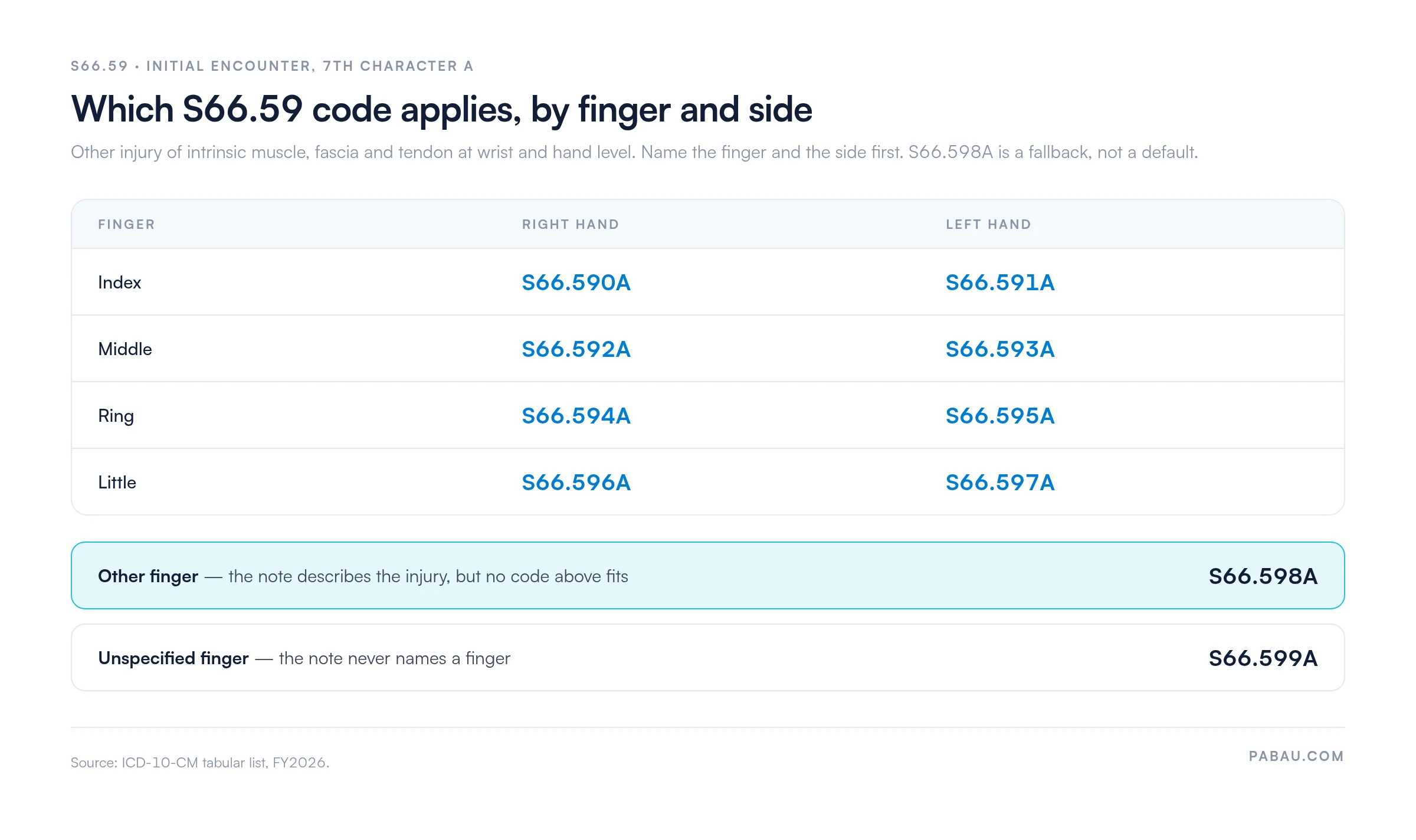
The same series is set out below with the documentation that supports each choice.
The AAPC ICD-10-CM code lookup provides additional crosswalk detail for the full S66.5 series. For complete ICD-10 code family searches, the ICD List lookup tool mirrors official CMS data.
S66.598A (“other”) and S66.599A (“unspecified”) look nearly identical on the claim form. They describe two different documentation situations.
In ICD-10-CM, “other” (NEC, not elsewhere classified) means the provider has documented the injury and no specific code matches it. “Unspecified” (NOS, not otherwise specified) means the documentation does not carry enough information to code more precisely. Payers treat the two differently, which is why the distinction is worth guarding.
Common mistake: coders reach for S66.598A when the note opens with “finger injury” and stop reading there. If the next sentence identifies the ring finger, the correct code is S66.594A on the right hand or S66.595A on the left. Query the provider before defaulting to “other” or “unspecified”.
Before assigning S66.598A, read the full physician note for any finger-specific language. Phrases like ‘ring finger lumbrical’ or ‘right middle finger interosseous’ push you to a finger-specific code. Reserve S66.598A for genuine multi-finger or anatomically ambiguous presentations where no specific code fits.
To support ICD-10 Code S66.598A on a claim, the treating clinician’s note must contain a minimum set of elements. Sound medical billing compliance means auditing notes against this checklist before the code is assigned.
External cause codes (Chapter 20, V00-Y99) are required alongside S66.598A wherever the mechanism is known, per CMS ICD-10-CM official guidelines Section I.C.20. That includes a place-of-occurrence code (Y92) and an activity code (Y93) where applicable. Omitting them on a workers’ compensation claim is a common denial trigger.
Payer requirements for S66.598A vary by plan and by year, so always verify the specific payer’s current policy before submitting. The general framework across major payer types is consistent enough to guide preparation.
Medicare: requires that the diagnosis is clinically supported by the documented encounter. External cause codes are expected for trauma-related claims. Medicare does not typically require prior authorization for evaluation visits. Surgical repair paired with S66.598A may still trigger prior auth under specific Local Coverage Determinations.
Medicaid: state plans vary. Most require that intrinsic muscle injury claims be accompanied by documentation of conservative treatment failure before authorizing surgical intervention. Some states flag “other” category codes for additional review.
Commercial insurers: many require prior authorization for hand surgery CPT codes such as 26002 or 26356 when the paired diagnosis is an “other” NEC code. A clean clinical note reduces the likelihood of a medical necessity review.
Workers’ compensation: state jurisdiction rules vary significantly. Most require the injury to have occurred in the course of employment, documented with a formal incident report and employer confirmation. The external cause code and the place-of-occurrence code are non-negotiable on these claims.
For practices submitting electronically, a clearinghouse connection shortens the loop between submission and payer response. Pabau, our practice management software, connects to Claim.MD. US practices can run real-time eligibility checks, track claim status, and post ERA remittances from one dashboard. That will not catch a wrong 7th character, so the coding review still happens before the claim is queued.
CPT code pairing depends on the clinical scenario and on payer policy, and there are no universal pairing rules. The table below reflects CPT codes commonly associated with S66.598A claims, by type of service rendered. Verify compatibility with each payer’s current fee schedule.
An accurate superbill listing both the diagnosis and the procedure code, with the correct modifier, is the foundation of a clean claim. Check the pairing before submission rather than after the remittance comes back.
Most S66.598A denials trace back to one of five root causes. Each has a corrective action that can be applied at the documentation or submission stage.
For denials already in the pipeline, the billing denial codes reference helps staff read the CARC reason code and route the appeal correctly. Sorting denials by root cause is what makes the pattern visible. Five S66.598A rejections for one missing external cause code call for a documentation fix rather than five appeals.
Run a monthly audit of all S66.598A claims submitted in the prior 90 days. Filter for 7th character ‘A’ on claims where the date of service is more than 30 days after the documented injury date. Those encounters are almost certainly due a 7th character correction to ‘D’ and represent a refiling opportunity.
Choosing S66.598A correctly is the coder’s job. What happens next is where the time goes. Someone rekeys the invoice into a payer portal and chases an authorization number nobody recorded. Weeks later the rejection comes back for a missing membership number.
Pabau builds the claim from the invoice the practice already raised at checkout. It runs background checks on the insurance details a payer needs, including membership numbers and authorization codes. The send button stays disabled until the missing ones are filled in. Every claim then sits in one dashboard as pending, submitted, processing, paid, or in error.
US practices connect through Claim.MD for electronic submission, real-time eligibility checks, and ERA remittance posting. Those checks cover the administrative side of the claim rather than ICD-10 logic. The 7th character and the finger-specific decision stay with your coding review. Practices that want cleaner claims management pair that review with a submission process that refuses to send an incomplete claim.

Pabau checks that membership numbers and authorization codes are present before a claim can be sent, then submits it through Claim.MD. You get real-time eligibility checks and live claim status in one dashboard.

S66.598A is a narrow code doing a narrow job. It belongs on the claim when the note describes an intrinsic muscle, fascia, or tendon injury at finger level that no finger-and-side code covers. Reach for it because the documentation rules the others out, never because reading the note to the end took too long.
Two habits carry most of the value here. Check the 7th character against the phase of care on every visit, not only the first. Ask the provider for the side and the structure while the encounter is still fresh. An amended note written six weeks later rarely survives an audit as well.
The coding decision stays with your team, and the administrative half of the claim does not have to. Book a demo to see how Pabau checks insurance details and submits hand injury claims electronically.

Need guidance on denial codes that accompany rejected S66.598A claims? Denial codes in medical billing explains how to read CARC codes and route appeals for common injury code rejections.
Looking for a structured overview of how electronic claims move from practice to payer? Medical claims clearinghouse guide covers how clearinghouses validate, route, and report on claims including those with injury diagnosis codes.
Want to understand how 837 EDI files carry your ICD-10 codes to payers? 837 file guide explains the transaction format that transmits S66.598A and paired CPT codes in electronic submissions.
ICD-10 Code S66.598A is the billable diagnosis code for an intrinsic muscle, fascia, or tendon injury of another finger, initial encounter. Its full descriptor reads: other injury of intrinsic muscle, fascia and tendon of other finger at wrist and hand level, initial encounter. It sits in the S66.5 subcategory, inside the S60-S69 block for injuries to the wrist, hand and fingers. The 7th character “A” confirms active treatment, and the code is valid for FY2026 per the NCHS ICD-10-CM tabular list.
Yes, S66.598A is a fully billable ICD-10-CM code, valid for submission on claims for fiscal year 2026. It is a complete 7-character code and does not require any additional characters.
S66.598A is the “other” (NEC) code, used when the injury is documented but doesn’t fit a more specific code. S66.599A is the “unspecified” (NOS) code, used only when documentation lacks enough detail to code more precisely. If the physician note names the injury type, S66.598A is appropriate; if the note is silent on specifics, S66.599A applies.
Use “D” (S66.598D) for follow-up visits once the injury is in the healing phase. The 7th character “A” is reserved for active treatment only. If the patient presents with a late complication or residual condition from a healed injury, use “S” (S66.598S) for sequela.
Yes, wherever the mechanism of injury is known, CMS ICD-10-CM Official Guidelines Section I.C.20 require an external cause code alongside injury codes like S66.598A. This includes a mechanism code (e.g. W20.8XXA), a place-of-occurrence code, and an activity code where applicable. Workers’ compensation claims in particular are routinely denied when external cause codes are missing.
The most common reasons are a 7th character “A” carried into a follow-up visit, missing external cause codes, and undocumented laterality. Documentation too thin to support the intrinsic muscle injury descriptor is a fourth. Each of these has a corrective action: query the provider, amend the documentation, or refile with the correct code.