ICD-10 Code S82.242H: Displaced spiral tibial shaft fracture, delayed healing
ICD-10 Code S82.242H: Definition and code details ICD-10 Code S82.242H designate...

Last Updated: Oct 15, 2026
Billable Code Specific Code
S66.192D is the billable ICD-10-CM code for other injury of flexor muscle, fascia and tendon of right middle finger at wrist and hand level, subsequent encounter.
Let Pabau's smart automation suggest the right codes, reduce claim denials, and keep your practice compliant—effortlessly.
Automate repetitive tasks and focus on what matters most—your patients.
Reduce coding errors and ensure compliance with the latest regulations.
Clean claims, fewer denials, and faster reimbursements.
Powerful insights and reporting to help your practice thrive.
HIPAA compliant SOC 2 certified GDPR-compliant Trusted by 4,000+ clinics worldwide

S66.192D is a billable ICD-10-CM code for other injury of the flexor muscle, fascia and tendon of the right middle finger.
The 7th character D marks a subsequent encounter, meaning routine care during healing after active treatment has already been given.
The code has been in ICD-10-CM since the original FY2016 release, so it is not a new FY2026 addition.
Even sixth digits sit on the right hand and odd digits on the left, which is where most sibling mix-ups start.
Practice management software like Pabau keeps the note, the code and the claim in one record, so follow-up claims go out complete.
The code is valid, billable and accepted on HIPAA-covered transactions, so it can go on a claim as it stands. It has been part of ICD-10-CM since the original FY2016 release on October 1, 2015, and the FY2026 edition simply carries it forward. CMS publishes the current edition in its ICD-10 code files.
The official description reads: Other injury of flexor muscle, fascia and tendon of right middle finger at wrist and hand level, subsequent encounter. Every phrase in it does a job.
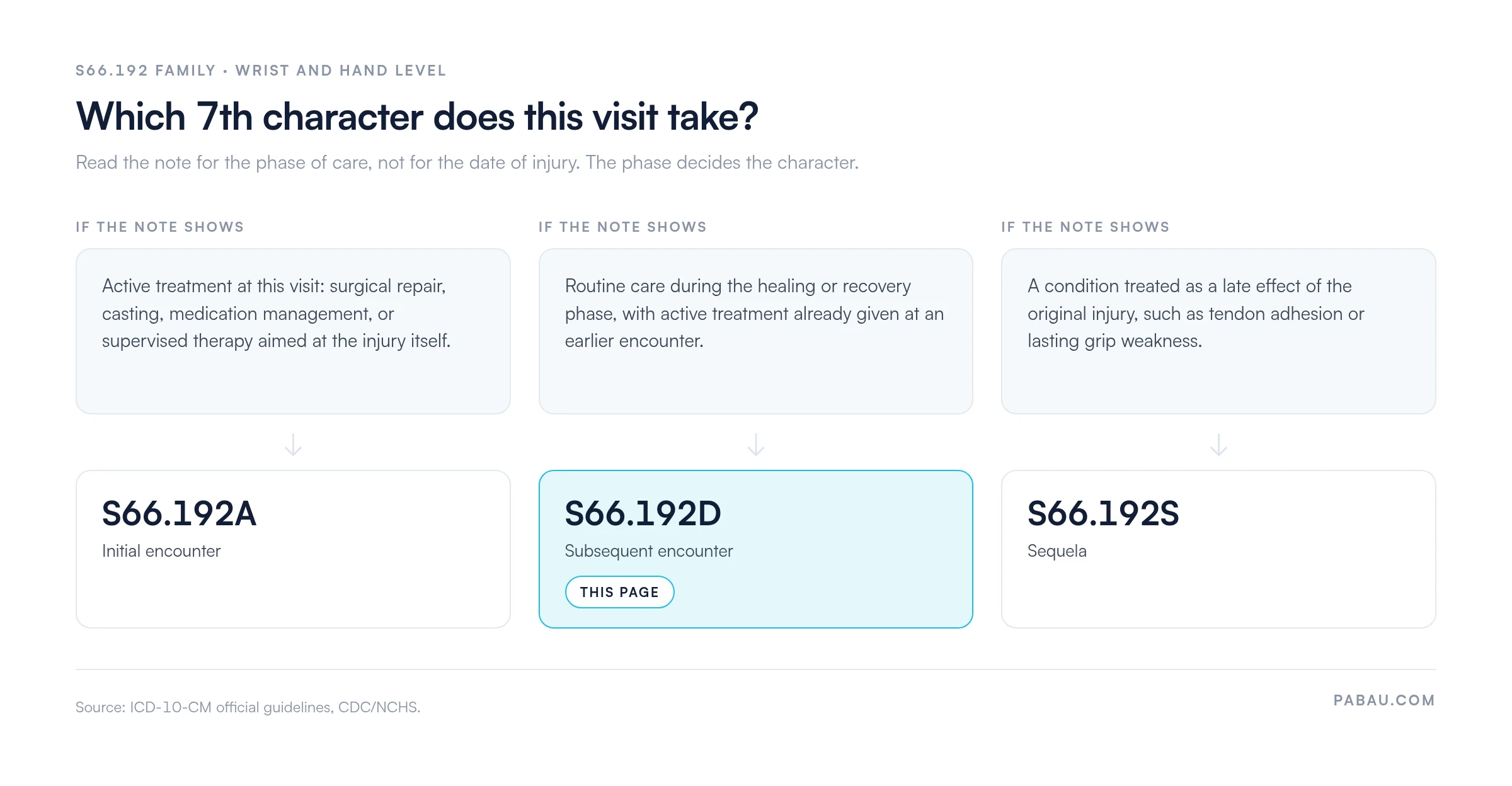
D tells the payer that active treatment is over and that the patient is now in the healing phase. According to the CDC/NCHS ICD-10-CM official guidelines, that phase begins once the provider has delivered active treatment for the injury.
Active treatment covers surgical repair, casting, medication management and supervised physical therapy aimed at the injury itself.
A worked example makes the boundary clear. A patient has flexor tendon repair on the right middle finger, then returns two weeks later for a wound check and suture removal. That visit is S66.192D.
If the same patient comes back a year on with tendon adhesion and reduced grip, the visit takes S66.192S instead. The injury code stays on the record throughout. Only the 7th character moves, and the chart below turns that choice into one question you can ask of any note.
S66.192D is the seven-character billable form of base code S66.192, which sits three levels under category S66. Reading the hierarchy downward is the fastest way to confirm that no more specific code exists for what the note describes.
S66.192 on its own is not billable. Every claim carries the full seven characters, and a stripped six-character code will bounce at the front door.
Practices that submit high volumes of injury claims usually handle this inside their claims management software. The code, the note and the claim line then live in one place.
Only the sixth digit changes across the S66.19 siblings, and it carries both the finger and the side. Even digits are the right hand and odd digits the left, running outward from the index finger.
Learn that pattern once and the whole subcategory becomes readable without a lookup.
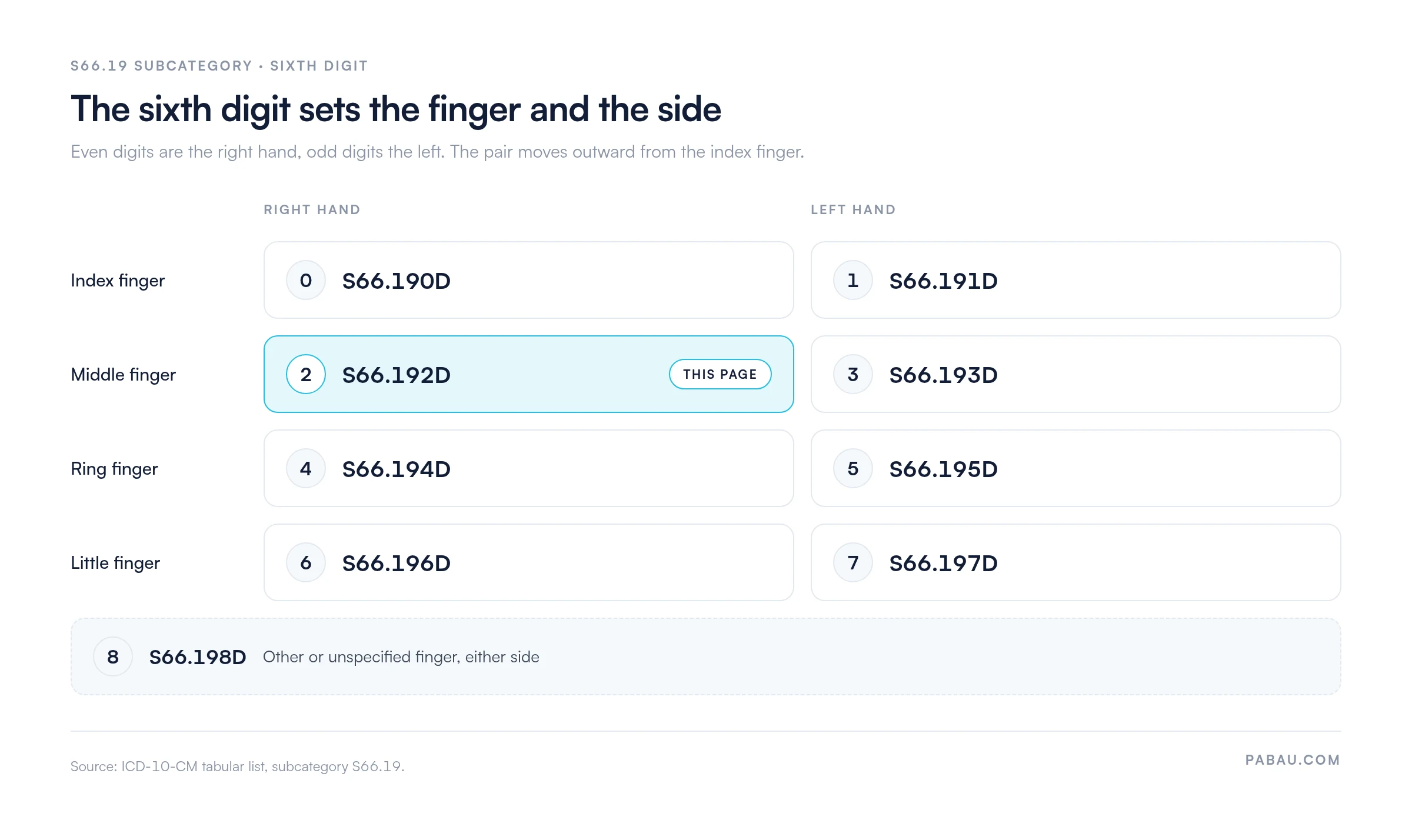
Each code below carries the same wording as S66.192D, with only the finger and the side changing. The full ICD-10-CM code index covers the neighboring subcategories if the note points somewhere else in S66.
S66 codes stop at wrist and hand level. A flexor injury documented above the wrist belongs in the S56 family instead, and the forearm-level equivalent for an unspecified finger is S56.109A. Checking the level before the digit saves a rework cycle.
Four elements have to be in the record before this code is defensible. They are the side, the digit, the structure, and evidence of earlier active treatment.
Build a follow-up note template for hand and wrist flexor injuries. Give it required fields for side and digit, plus a checkbox confirming prior active treatment. That removes the two entries most often copied forward from an earlier visit.
Denials on this code cluster around four repeatable mistakes. Each one is visible in the chart before the claim leaves the practice, which is the cheapest place to catch it.
Submitting the initial-encounter code at a follow-up appointment is the most common error on this family. Payers expect a logical progression from A to D across the encounter history. A repeated A reads as active treatment that never ended, which invites a medical necessity review and slows payment.
S66.192D covers the flexor surface only. Extensor tendon injuries at the same level sit in a separate subcategory, S66.3-, whose initial-encounter other-injury code for the left index finger is S66.391A. At a follow-up visit that subcategory takes the D character too, as in S66.396D for the right little finger. A coder who reaches for S66.192D without checking which surface the clinician named is introducing an error that may only show up at audit.
Intrinsic hand muscle is a third structure to rule out before a flexor code is used. Those injuries sit in S66.5-, where S66.598A covers other injury of another finger at the initial encounter.
S66.192D is the right side and the middle finger. Choosing S66.193D or S66.190D instead misstates the injury, and both are one keystroke away. This error usually comes from a note copied forward from an earlier visit. The side and digit fields deserve a second read at every follow-up.
Sequela applies when the visit treats a late effect of the injury, such as tendon adhesion or lasting grip weakness. Time since the injury is not the test. Switching to S66.192S while the patient is still in routine healing care puts the code and the note in contradiction.
These phrases in a note, a referral letter or an operative report should send you to S66.192D. None of them is the official wording, which is why the mapping has to be deliberate.
For a second check on the descriptor or the hierarchy, the AAPC Codify ICD-10-CM lookup supports synonym search across the chapter. Whatever tool you use, read it against the note in front of you.
Run these five checks before the claim leaves the practice. Each one maps to a mistake above, so the list is short by design.
In most practices the encounter note lives in one system and the claim gets rekeyed into another. Staff then pick the 7th character away from the note that justifies it. That is how an A survives onto a follow-up claim.
Practice management software like Pabau keeps both in one record. The clinical note, the diagnosis code and the claim line all sit against the same appointment. A coder can read the prior operative note while picking the character, and code lookup libraries put the descriptor a search away.
On the claim itself, Pabau checks that the payer’s required fields are filled in, including membership numbers and authorization codes. US practices submit through the Claim.MD integration, which handles the CMS-1500 and 837P formats.
Coding judgment stays with your coder, which is why having the note and the code side by side matters. Pabau tracks submission status and remittances after that, so a queried follow-up surfaces while it is still easy to fix.

Pabau keeps the clinical note, the diagnosis code and the claim line on one record. It also checks that a payer’s required fields are filled before submission. Status and remittance tracking then show which claims need a second look.

The judgment on this code is small and it is made in one keystroke. Read the phase of care off today’s note, confirm the side and digit in words, then append the character that matches. Skip either check and the denial queue grows on a code that was never in doubt.
Practices that build those two checks into the follow-up template stop paying for them later in reworked claims. Book a demo to see how Pabau keeps the note, the code and the claim on one record.

Need help understanding your clearinghouse options? Medical claims clearinghouse guide covers how electronic claim submission works and what to look for in a clearinghouse partner.
Want to reduce claim denials systematically? Denial codes in medical billing breaks down the most common denial reason codes and how to address each one.
Chasing a claim that came back short-paid? Denial management in healthcare sets out a process for working denials by reason code instead of case by case.
Want fewer claims returned on the first pass? Clean claim explains what a payer accepts without a query and how to hit that standard consistently.
Building out your billing compliance process? How to get credentialed with insurance companies covers the credentialing steps that support accurate ICD-10 claim submission across payer networks.
No. ICD-10-CM directs you to use the acute injury code with the 7th character for subsequent encounter instead of an aftercare Z code. S66.192D already tells the payer this is healing-phase care.
No. The S66.19 subcategory covers other and unspecified fingers, which excludes the thumb. Thumb flexor injuries at wrist and hand level belong in S66.0-.
There is no fixed limit in visits or days. D applies for as long as the patient receives routine care during healing, which is a clinical judgment recorded in the note.
Code each finger separately. The sixth digit is finger-specific, so one S66.19 code cannot describe an injury to two digits. A right middle and right ring finger injury takes S66.192D and S66.194D.
Yes, when the reason for the visit is follow-up care for that injury. If the patient is seen mainly for an unrelated problem, the injury code moves to a secondary position.