ICD-10 Code S82.242H: Displaced spiral tibial shaft fracture, delayed healing
ICD-10 Code S82.242H: Definition and code details ICD-10 Code S82.242H designate...

Last Updated: Oct 15, 2026
Billable Code Specific Code
S56.109A is the billable ICD-10-CM code for unspecified injury of flexor muscle, fascia and tendon of unspecified finger at forearm level, initial encounter.
Used where the digit genuinely cannot be identified, S56.109A is the correct choice. Used as a default, it costs the practice specificity that one documentation query would have recovered.
Let Pabau's smart automation suggest the right codes, reduce claim denials, and keep your practice compliant—effortlessly.
Automate repetitive tasks and focus on what matters most—your patients.
Reduce coding errors and ensure compliance with the latest regulations.
Clean claims, fewer denials, and faster reimbursements.
Powerful insights and reporting to help your practice thrive.
HIPAA compliant SOC 2 certified GDPR-compliant Trusted by 4,000+ clinics worldwide

ICD-10 Code S56.109A covers an unspecified injury of the flexor muscle, fascia, and tendon of an unspecified finger at forearm level, initial encounter.
S56.109A became valid on October 1, 2025 for FY2026, and it is billable when documentation does not name the finger.
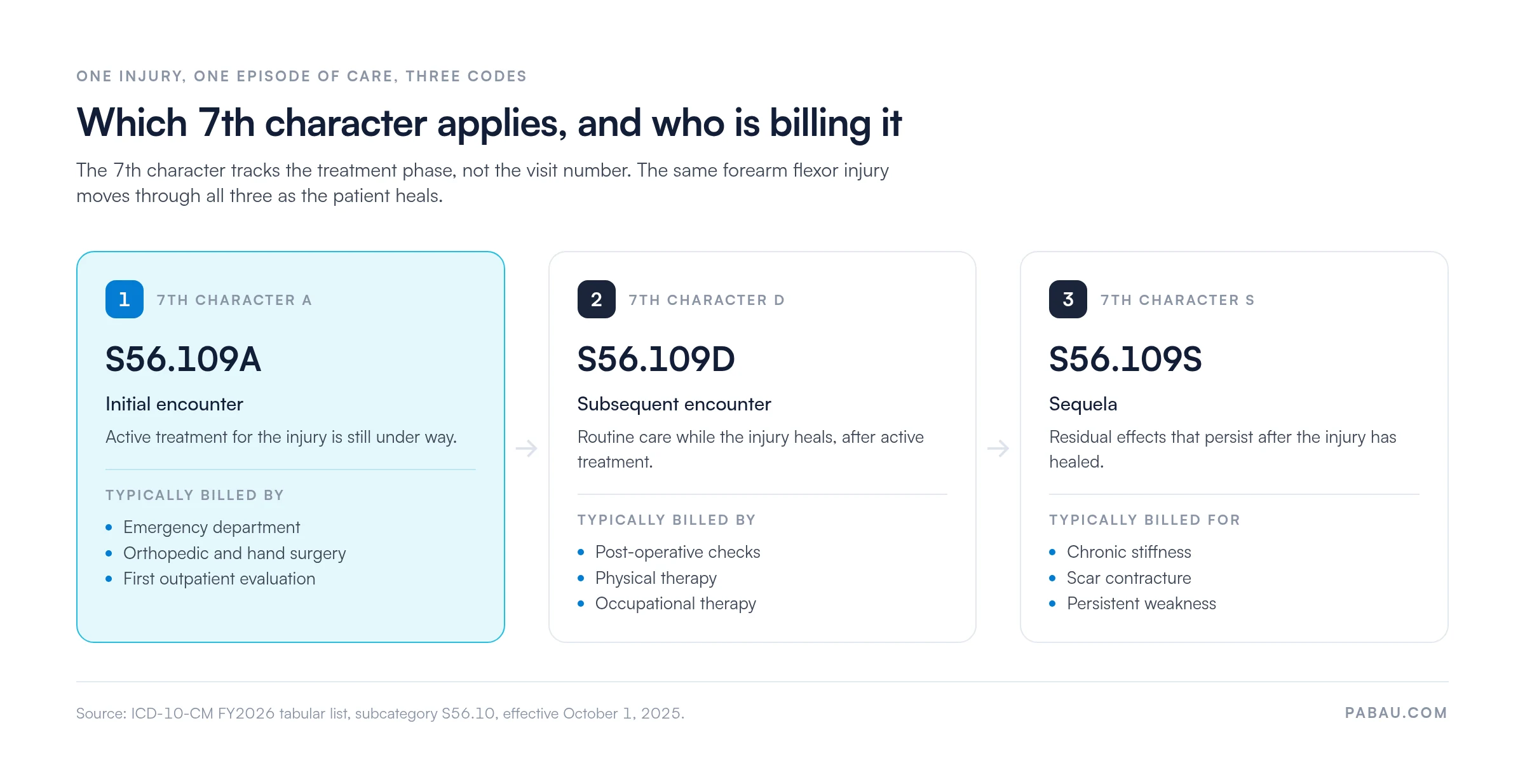
S56.109A, S56.109D, and S56.109S share the same clinical description, and only the 7th character changes with the encounter phase.
Repeated use of S56.109A points at incomplete documentation, so treat the pattern as a query trigger for the clinical team.
Practice management software like Pabau submits claims through Claim.MD, its US clearinghouse partner, and tracks status and remittance in one place.
The word “unspecified” applies twice in this code. Once to the injury type, because it draws no distinction between a laceration, a rupture, and a strain. Once to the finger, because the specific digit is not documented.
The code sits within the S56 category, which covers injury of muscle, fascia, and tendon at the forearm level. Three anatomical structures are grouped together: the flexor muscle belly, the fascial sheath around it, and the tendon proper. An injury to any one of them, or any combination, maps to S56.109A when the finger is unspecified. The CDC/NCHS ICD-10-CM web tool publishes the authoritative annual tabular list.
The table below summarizes the core attributes of S56.109A as published in the FY2026 ICD-10-CM edition, which became effective October 1, 2025.
Knowing where S56.109A sits in the ICD-10-CM hierarchy helps coders navigate to more specific alternatives when the documentation supports them. The chain runs from the chapter level down to the billable code.
The CMS publishes the full ICD-10-CM tabular list and its annual update files. Coders can cross-reference the current hierarchy and any mid-year corrections through the CMS ICD-10 codes page. The same hierarchy holds for every category: chapter, block, category, subcategory, then billable code.
The 7th character is mandatory for all S56 codes. Choosing the wrong one is among the most common coding errors in trauma and musculoskeletal claims. The parent code S56.109 generates three billable codes, one per encounter phase.
A common misapplication is using S56.109A for physical therapy visits that happen weeks after the injury. Once active treatment ends and the patient moves to routine rehabilitation, S56.109D is the correct choice. The ICD-10-CM Official Guidelines for Coding and Reporting are maintained by the National Center for Health Statistics. They tie “initial encounter” to the treatment phase, not to the first time a patient is seen. The flow below maps each character to its phase, and to the setting most likely to bill it.
S56.109A is correct when the clinical note does not identify the finger involved. That happens legitimately in a minority of cases. A patient arriving unconscious after a crush injury is one example, and a wound evaluation where swelling prevents individual digit assessment is another. In most presentations the finger can be documented.
The table below lists the digit-specific siblings inside the S56.1 subcategory. Each covers the same unspecified injury type, but for a named finger on a named side. Choosing one over S56.109A takes a single extra documentation element.
The sixth character carries both facts at once. Odd values are the right side and even values are the left, running from the index finger up to the little finger. Only S56.109A drops the side, which is the same reason it drops the digit.
Treat S56.109A as a documentation improvement trigger. When it appears repeatedly in a practice’s claims data, the pattern says the coder-to-clinician query workflow needs strengthening. The AAPC ICD-10-CM lookup gives coders a searchable reference for every S56.1 sibling and its description.
Encoder tools and clinical documentation systems may surface S56.109A under several alternate descriptions. Recognizing them helps coders match free-text documentation to the correct code without a manual lookup every time.
Approximate synonyms are a convention of commercial coding lookup tools. The ICD-10-CM Official Guidelines for Coding and Reporting do not define them, and neither does the Tabular List. None of them changes the code selection, and all map to S56.109A when the finger is unspecified and the encounter is initial.
Payers reviewing a claim coded with S56.109A expect the note to support both the injury type and the unspecified finger designation. Missing documentation elements are the leading driver of denials and audits on this code, so managing claim denials starts before the claim is built.
The same principle holds across the rest of the ICD-10-CM code index. Document what you know, query what is missing, and reach for the unspecified code only when the clinical picture genuinely prevents more detail.
Two musculoskeletal codes sit in the same position. M42.9 stays correct only while the record names neither the age group nor the vertebral level. M87.9 holds until the note gives the affected site and the cause.
S56.109A sits inside a larger family of S56 codes covering forearm-level muscle, fascia, and tendon injuries. The table below maps the adjacent codes coders reach for most, so you can tell quickly whether a different subcategory applies.
For the full tabular listing across the S56 subcategories, the US-specific ICD-10-CM edition is the one to use, through the CDC/NCHS tool linked above. The WHO ICD-10 browser adds international reference context, but its code titles are not the billable US ones.
The flexor mechanism at the forearm includes the flexor digitorum superficialis, the flexor digitorum profundus, and the flexor pollicis longus. These muscles originate at or near the medial epicondyle and the proximal radius and ulna. They travel through the forearm and insert into the phalanges by way of long tendons.
An injury at the forearm level means the damage affects the muscle belly or the proximal tendon. Damage to the same tendon at the finger or palm falls under S66 instead. The level described in the operative note decides the category.
Common scenarios generating S56.109A include volar forearm lacerations from glass or sharp objects, crush injuries from industrial accidents, and sports-related blunt trauma. In each case the coding question is the same: has the clinician documented which flexor tendon and which finger are involved? When the answer is yes, a more specific code is available.
Review records coded with S56.109A at 30-day intervals. Look for later visits coded with a digit-specific sibling, such as S56.103A for the right middle finger. Where you find one, the earlier unspecified code was probably a documentation problem rather than a genuine unknown. That pattern is worth flagging to your clinical documentation improvement team.
Flexor tendon injuries at the forearm level cross several care settings. The code appears at initial presentation and again at therapy visits. That makes it one of the few ICD-10-CM codes that flows through a whole episode of care under different 7th characters.
Encounter-type prompts at the point of code selection are what cut 7th character errors, wherever the practice keeps its notes. Physical therapy and occupational therapy teams need them most, because one injury can generate visits for months.
On the procedure side, forearm-level flexor repair maps to the CPT 25260 to 25265 range. Those codes cover flexor tendon and muscle repair at the forearm and wrist. The 26350 series covers repairs at the hand and digits, so read the operative note for the level before pairing. Payer-specific local coverage determinations still decide which pairings are accepted.
Coding errors for S56.109A fall into two predictable categories. One is the wrong 7th character, using A when the encounter is a follow-up. The other is missing specificity, using the unspecified code when a digit-specific sibling was available. Both come down to what the workflow asks the clinician to confirm.
Practice management software like Pabau keeps the clinical note, the diagnosis code, and the claim in one patient record. Nobody is reconciling three systems to check one character. Pabau submits claims electronically through Claim.MD, its US clearinghouse partner, and handles eligibility checks, claim status tracking, and electronic remittance advice from the same place.
That matters most for codes that travel across an episode of care. Pabau’s claims management software holds every submitted claim, its status, and its remittance against the patient record. You can see which 7th character went out on which date without opening a separate clearinghouse portal.
Volume is what makes the 7th character risky. One forearm flexor injury can generate dozens of physical therapy and occupational therapy visits across several months. Each visit needs the character that matches its phase. Checking the code on the previous claim is the cheapest way to get the next one right.

Pabau submits claims electronically through Claim.MD, checks eligibility, tracks claim status, and returns electronic remittance advice in one place. Your coders and clinicians work from the same patient record, so a 7th character gets corrected before the claim goes out.

S56.109A bills cleanly, and it survives an audit when the note explains why the digit could not be identified. Treat it as a temporary state rather than a resting place. Confirm the encounter is genuinely initial, confirm the injury sits at the forearm level, and confirm the note cannot name the digit.
If the code turns up twice in the same patient’s chart, the second one is a query waiting to be sent. Catching that upstream costs less than reworking a denial. Book a demo to see how Pabau keeps the note, the code, and the claim in one workflow for musculoskeletal injury billing.

Need to understand the full ICD-10 claims lifecycle? Medical claims clearinghouse guide covers how electronic claims are validated and processed before they reach payers.
Handling frequent denials on musculoskeletal codes? Superbill best practices explains how to structure the superbill to capture the correct ICD-10 and CPT pairings from the start.
Working in physical therapy or occupational therapy? Electronic remittance advice (ERA) explained shows how to read ERA files and spot ICD-10 edit rejections quickly.
ICD-10 Code S56.109A is a billable ICD-10-CM diagnosis code. It covers an unspecified injury of the flexor muscle, fascia, and tendon of an unspecified finger at the forearm level, initial encounter. The “unspecified” qualifier applies to both the injury type and the finger. The 7th character A confirms the visit is an active treatment phase.
Yes. S56.109A is a valid, billable ICD-10-CM code as of the FY2026 edition (effective October 1, 2025). You can use it to indicate a diagnosis for reimbursement purposes. The clinical documentation has to support an unspecified injury of the flexor muscle, fascia, or tendon of an unspecified finger at forearm level.
All three describe the same anatomical injury; only the encounter phase differs. S56.109A is for the initial encounter, meaning active treatment. S56.109D covers subsequent encounters, meaning routine care during healing. S56.109S covers sequela, the residual effects that persist after the injury has healed.
Use S56.109A only when the clinical note genuinely cannot identify the specific finger involved. If the note names the digit and the side, use the matching sibling code. Those run from S56.101A for the right index finger to S56.108A for the left little finger. Using S56.109A when a specific code is available may trigger payer queries or denials.
Forearm-level flexor repair maps to the CPT 25260 to 25265 range, which covers flexor tendon and muscle repair at the forearm and wrist. The 26350 series covers the hand and digits instead. Payer-specific local coverage determinations still decide which pairings are accepted, so verify against current payer policy.
The parent code is S56.109, which describes the same unspecified injury without the 7th character extension. S56.109 is not billable on its own. The 7th character (A, D, or S) is mandatory for every S56 code, and it tells the payer which encounter type applies.