ICD-10 code S61.201A: Open wound of left index finger without nail damage
ICD-10 code S61.201A covers a left index finger wound of unstated type ICD-10 co...

Last Updated: Oct 16, 2026
Billable Code Specific Code
S65.503S is the billable ICD-10-CM code for unspecified injury of blood vessel of left middle finger, sequela.
That one letter is what payers check first. Choose D instead and the claim describes a patient still in treatment, which rarely matches the note behind it.
Let Pabau's smart automation suggest the right codes, reduce claim denials, and keep your practice compliant—effortlessly.
Automate repetitive tasks and focus on what matters most—your patients.
Reduce coding errors and ensure compliance with the latest regulations.
Clean claims, fewer denials, and faster reimbursements.
Powerful insights and reporting to help your practice thrive.
HIPAA compliant SOC 2 certified GDPR-compliant Trusted by 4,000+ clinics worldwide

S65.503S is a billable ICD-10-CM code for an unspecified blood vessel injury of the left middle finger, reported as a sequela.
The ‘S’ 7th character applies only after active treatment ends and the patient returns with a lasting effect of that injury.
A sequela claim carries two codes, and the residual condition is listed first, with S65.503S second.
Choosing ‘D’ when active treatment has already finished is the error that sends these claims back.
Pabau’s claims management software offers ICD-10 code lookup and checks that required claim fields are complete before you submit.
Yes, S65.503S is a billable, specific ICD-10-CM code. You can report it for reimbursement on HIPAA-covered transactions.
Per the CMS ICD-10 codes page, the FY2026 edition took effect on October 1, 2025 and runs through September 30, 2026. You can check the code’s current status at any point with the CDC/NCHS ICD-10-CM web tool.
S65.503S is a complete seven-character code, so it needs no placeholder characters. You can submit it as it stands on a CMS-1500 or an 837P claim. The only condition is that the record supports a sequela encounter. Shorter base codes are different, and ICD-10 code S03.00XS carries a mandatory X in the fifth position before its sequela character.
Four elements sit inside that description. The chart has to support each one before you assign the code.
“Unspecified” is about the documentation rather than the diagnosis. It means the note does not separate a laceration from a puncture or a contusion.
Query the provider whenever a more specific injury type is available. When the record genuinely does not say, S65.503S stands, and you should not upgrade it without clinical support.
The base code S65.503 is not billable on its own. It needs a 7th character, and each option describes a different phase of care. Section I.C.19 of the ICD-10-CM Official Guidelines sets the rules for how they are applied.
The practical point is that the 7th character reflects the nature of the encounter, not the time since the injury. A patient seen six months later still takes D if the provider is actively treating the wound.
A patient seen three weeks out with chronic digital vascular insufficiency takes the S suffix. In practice, the choice comes down to one question about the visit in front of you.
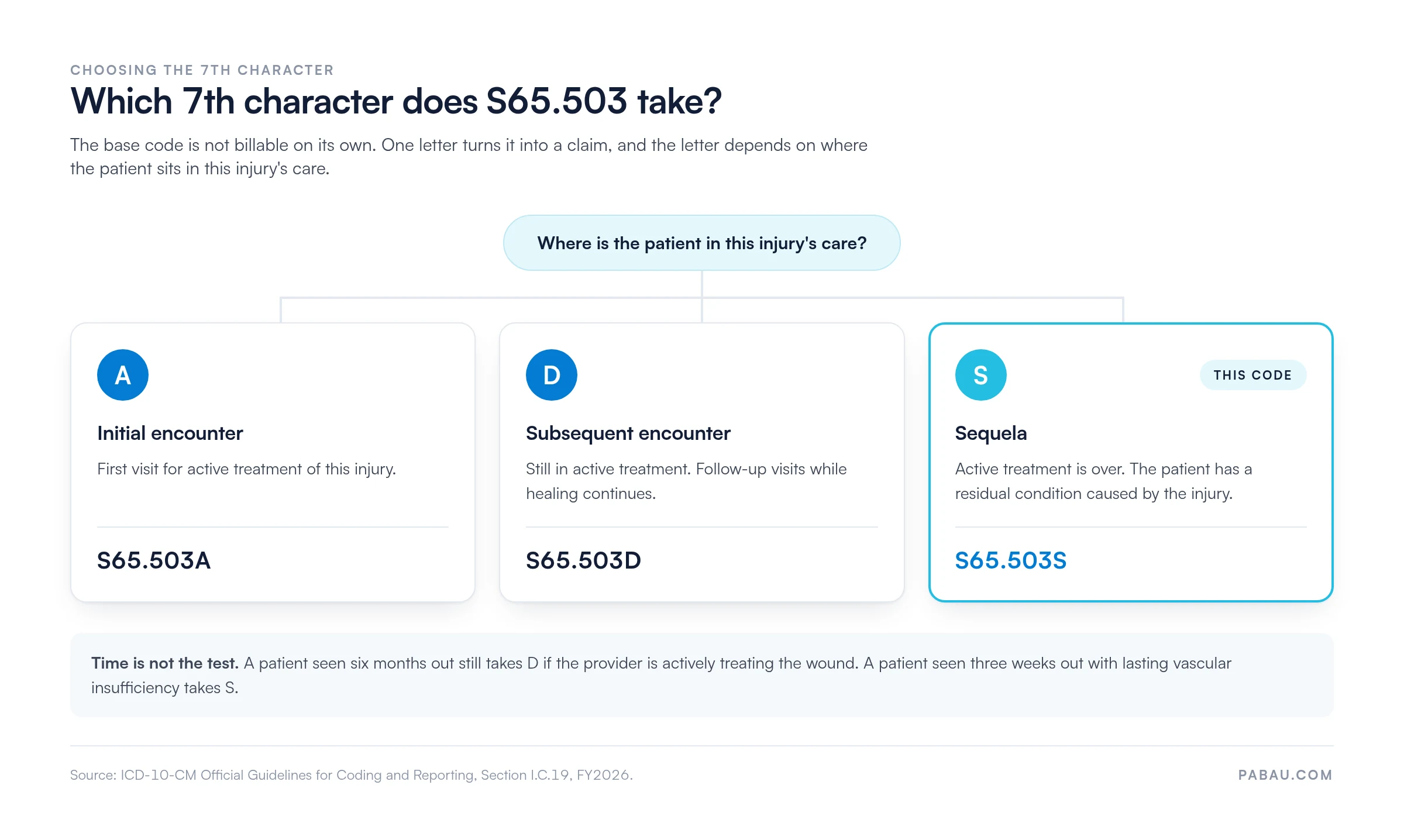
Before you assign S65.503S, confirm two things in the chart. First, that active treatment of the original blood vessel injury has ended. Second, that the current visit documents a condition caused by that earlier injury. If the provider is still managing the wound, or running vascular assessments as part of ongoing treatment, S65.503D applies instead.
A sequela encounter takes two codes, and the order matters. Section I.B.10 of the ICD-10-CM Official Guidelines puts the residual condition first and the sequela code second. So the late effect being treated leads the claim, and S65.503S follows it.
The same order governs sequela codes elsewhere in the chapter, such as ICD-10 code T45.626S for underdosing of hemostatic drugs. The residual condition still leads the claim.
Common residuals after a finger vessel injury include vascular insufficiency, digital ischemia, cold sensitivity, and scarring that restricts circulation.
Each of those needs its own code alongside S65.503S. Payer policy can add its own sequencing requirements, so check it before you submit.
Reading the hierarchy from the top down is the quickest way to land on the right code in the tabular list. It also shows you which neighbors to rule out.
S65.5 runs across both hands and all four fingers. Only the digit and the side separate these codes, which makes them easy to transpose on a busy day.
Check any sibling description you rarely use before the claim goes out. The AAPC ICD-10-CM code lookup and the ICD List reference tool both carry the full wording.
Injuries rarely arrive one digit at a time either. When a second finger or a different structure is involved, our ICD-10-CM code directory is the faster route to the matching code.
Notes rarely use the tabular list’s phrasing. All of the descriptions below map to S65.503S. The one condition is that the encounter is a sequela of an unspecified vessel injury in the left middle finger.
If the note uses one of these phrases and active treatment has ended, S65.503S is your code. If the wording names a specific injury type instead, look for a more specific code first.
Every element of S65.503S has to be supported in the record. Miss one and the claim tends to come back.
When the provider writes only ‘left finger injury’ with no digit, do not reach for S65.503S. Code S65.509S for the unspecified finger and send a query for laterality and digit. Upgrading to a more specific code without clinical support is a compliance risk, and it is the kind of pattern an audit picks up quickly.
Paper charting is where these details tend to go missing. A structured note template that asks for the digit and the encounter type heads off the query before it starts.
Once the code is settled, the claim’s path is short. Diagnosis codes go in box 21 of the CMS-1500, keyed without the decimal point, so S65.503S is entered as S65503S. Box 24E then points each service line to the diagnosis that supports it.
In box 21, the residual condition takes pointer A and S65.503S takes pointer B, in that order. The service line usually points to the residual condition, since that is what the provider treated.
Where a payer asks for an external cause code, it follows the diagnosis codes and never leads the claim. ICD-10 code W44.G1XS is one example, reported when a sequela visit follows an audio device entering a natural orifice.
From there the claim moves to the clearinghouse, which screens it for format and eligibility problems before the payer ever sees it.
Five checks catch almost every avoidable rejection on a sequela claim:
Two mistakes account for most of the rejections here. The first is D on a chart that describes a healed injury. The second is S65.503S sent on its own, with no code for the residual condition. Both are far cheaper to catch before submission, so build the check into your clean claim routine.
S65.503S has no one-to-one ICD-9-CM equivalent. ICD-9 handled finger vessel injuries without laterality, digit detail, or encounter suffixes, so the mapping below is a rough one.
ICD-10-CM added laterality, digit specificity, and the encounter suffix that ICD-9 never had. For historical billing research, work from the General Equivalence Mappings published by CMS rather than a manual crosswalk.
The S65.503 family has been valid since ICD-10-CM took effect, and it is unchanged for FY2026.
Do outpatient claims need a present on admission indicator? No. POA reporting covers diagnoses on inpatient hospital claims under Medicare and many Medicaid programs.
Three short questions settle which value to report:
Requirements still vary by payer and by setting. Confirm them before you send an inpatient claim carrying S65.503S.
Coding errors on injury codes usually start upstream, in the note. When a template never asks for the digit, the side, or the encounter type, even a strong coder has to raise a query. That query adds days to the billing cycle, and it happens on the same codes over and over.
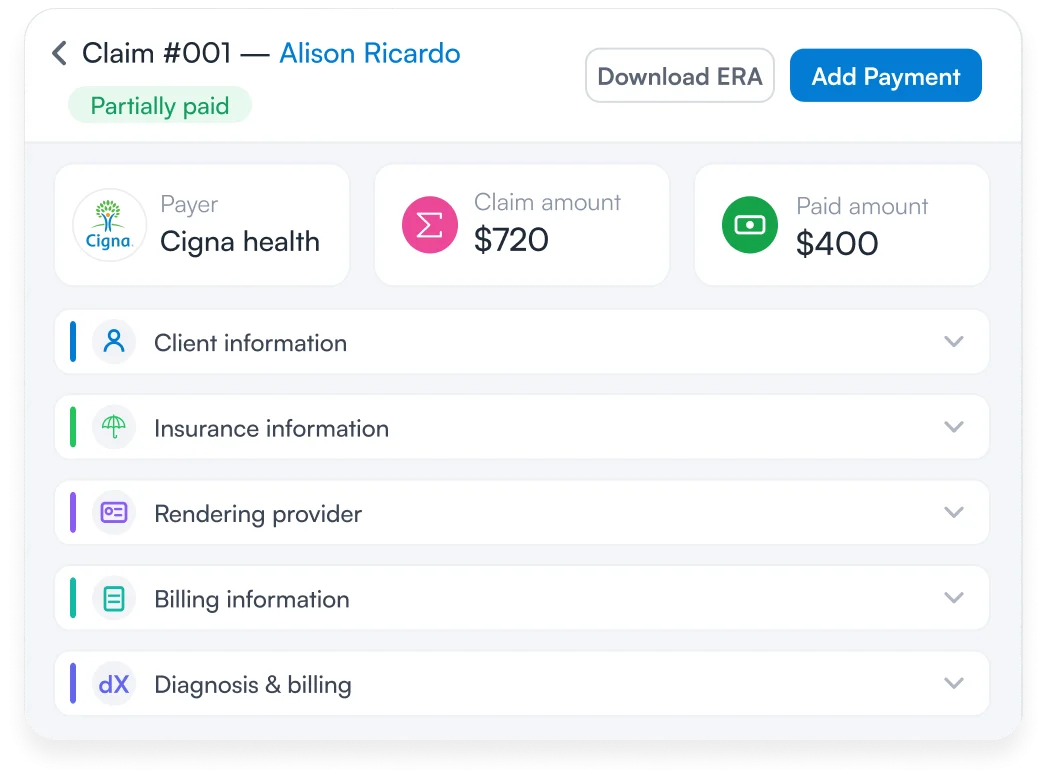
Practice management software like Pabau pre-fills the claim form from the client record. The codes already attached to the service land on the charge line.
Its claims management software also carries full ICD-10-CM and CPT lookup libraries, refreshed with each official release. You can search a sibling code without leaving the claim you are working on.
Before the send button unlocks, Pabau checks that the claim’s required fields are complete, such as membership and authorization numbers.
On the US pipeline through Claim.MD, you also get eligibility checks, claim status tracking, and ERA remittance posting across thousands of US payers. The coding judgment stays with you, but the paperwork around it stops slowing you down.
Digital intake forms and note templates close the loop at the other end. When the template asks the provider for the digit and the encounter context, the coder gets what they need on the first pass.

Pabau pre-fills the claim from the client record, carries ICD-10-CM and CPT lookup libraries, and confirms the required fields are complete before you submit. Injury codes like S65.503S go out whole the first time.

Sequela coding for finger vessel injuries is low volume and high scrutiny. The letter on the end of the code does the heavy lifting. Get it wrong and the claim describes a patient who is not the one in the chart.
So there is one question to settle before you code. Has active treatment of the original injury ended? If it has, S65.503S is right, paired with a code for the residual condition and sequenced behind it. If it has not, S65.503D is the code you want.
Most of the effort here is documentation, not judgment. Book a demo to see how Pabau pulls codes and required claim fields straight from the client record.

Need to decode a rejection on an injury claim? Denial codes in medical billing covers the most common denial reason codes and how to answer each one.
Wondering how a claim gets from your desk to the payer? Medical claims clearinghouse walks through the submission path from the practice to the payer.
Working on your first-pass acceptance rate? Clean claim sets out what a payer accepts without a single edit.
New to the billing side of coding? What is medical billing follows the cycle from patient registration through to payment.
Worried about how your coding would hold up in an audit? Medical billing compliance covers the rules and checks that sit behind code selection.
No. Blood vessel injuries of the thumb sit in S65.4, a separate subcategory. S65.5 covers the index, middle, ring and little fingers, plus other and unspecified digits.
Only where your payer or state asks for one. ICD-10-CM sets no national mandate for external cause reporting. When you do report it, the external cause code takes the ‘S’ 7th character as well.
A fresh injury starts a new episode of care, so code it with an ‘A’ 7th character. You can still report S65.503S alongside it when the earlier late effect is also being treated.
No. A sequela encounter needs a code for the residual condition being treated, and that code is sequenced first. On its own, S65.503S does not tell the payer what was treated.
Then S65.503S is the wrong pick. S65.5 has separate subcategories for a documented laceration and for other specified injuries. Unspecified applies only when the note does not name the injury type.