ICD-10 code S61.201A: Open wound of left index finger without nail damage
ICD-10 code S61.201A covers a left index finger wound of unstated type ICD-10 co...

Last Updated: Oct 16, 2026
Billable Code Specific Code
W44.G1XS is the billable ICD-10-CM code for audio device entering into or through a natural orifice, sequela. It covers earbuds, earphones and hearing aid parts that entered the ear canal or another natural orifice in an incident that has since resolved.
The seventh character S marks a sequela encounter. The patient is being treated for a late effect, such as ear canal scarring or lasting hearing loss. W44.G1XS is reported after that late-effect diagnosis, never as the first-listed code.
Let Pabau's smart automation suggest the right codes, reduce claim denials, and keep your practice compliant—effortlessly.
Automate repetitive tasks and focus on what matters most—your patients.
Reduce coding errors and ensure compliance with the latest regulations.
Clean claims, fewer denials, and faster reimbursements.
Powerful insights and reporting to help your practice thrive.
HIPAA compliant SOC 2 certified GDPR-compliant Trusted by 4,000+ clinics worldwide

W44.G1XS is a billable ICD-10-CM external cause code for an audio device foreign body, reported at a sequela encounter.
The S seventh character applies only when the original incident has resolved and the visit treats a late-effect condition.
W44.G1XS is sequenced after the principal diagnosis and is never the first-listed code on a claim.
Claims are often denied when the record doesn’t link the current condition to the prior audio device incident.
ICD-10 Code W44.G1XS is the billable ICD-10-CM external cause code for an audio device entering into or through a natural orifice, sequela. It applies when an earbud, earphone or hearing aid part caused an injury that has since resolved. The patient is now being treated for a late effect of that injury.
W44.G1XS is always a secondary code, listed after the late-effect diagnosis. The table below sums up the billing facts.
W44.G1XS is a leaf-node code in Chapter XX of ICD-10-CM, the chapter dedicated to external causes of morbidity (V00-Y99). Only the full seven-character code is valid on a claim, so W44 or W44.G1 on its own will fail.
The W44 subcategories, including W44.G1, came in with a recent ICD-10-CM update that gave foreign body incidents more detail than the older non-specific codes. The CMS ICD-10 codes page publishes the annual tabular list updates that confirm their effective dates.
The seventh character tells the payer which phase of care the visit belongs to. Of the three options, S has the narrowest criteria.
Per the ICD-10-CM Official Guidelines (Section I.C.19.a), sequela coding requires that the original condition no longer exists in its acute form. If a device is still present or the canal injury is still under active treatment, W44.G1XD is correct. The diagram below maps each character to the visit it describes and shows where W44.G1XS sits on the claim.
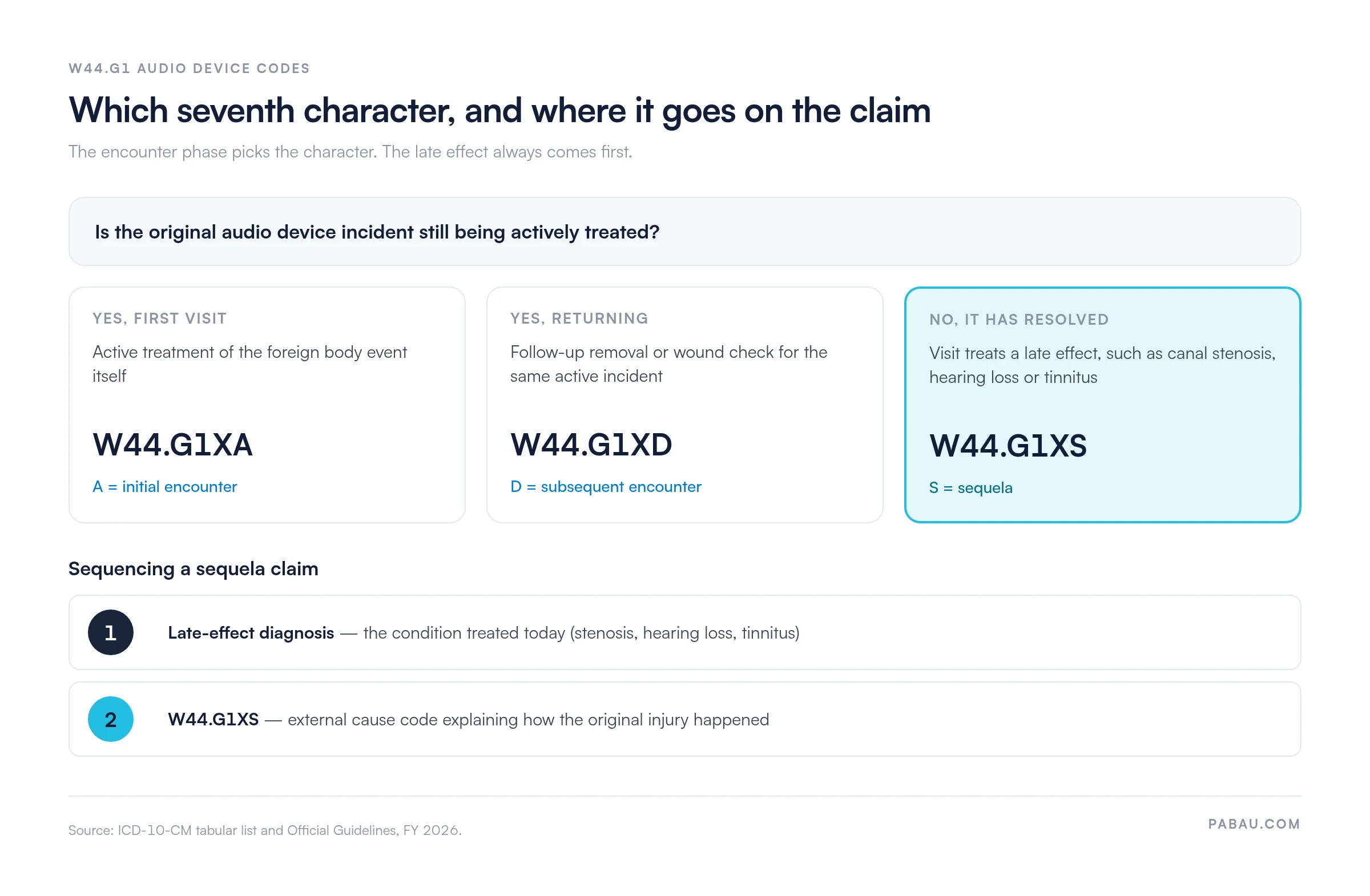
The W44.G1 subcategory captures any audio device that enters the ear canal or another natural orifice. It reaches beyond earbuds to parts of hearing aids and earphones. Other object types sit in their own W44 subcategories, such as ICD-10 code W44.B0XA for an unspecified plastic object at the initial encounter.
W44.G1XS applies when that incident is in the past and the visit treats what it left behind. Take a patient with fibrotic scarring of the ear canal six months after a lodged earbud was surgically removed. The scarring is the condition treated today, and W44.G1XS records its external cause.
If the audio device is still physically present or the ear canal has not yet been cleared, the encounter is active treatment. Use W44.G1XD, not W44.G1XS. Reserve the S character for visits where the patient’s chief complaint is a residual effect of an already-resolved foreign body incident.
Three clinical presentations commonly qualify for the sequela designation on this code family.
In each scenario, the late-effect condition (stenosis, hearing loss, tinnitus) is coded as the principal diagnosis. W44.G1XS follows as the supplementary external cause code. Section I.C.20 of the Official Guidelines keeps external cause codes out of the first-listed position, so a claim that leads with W44.G1XS gets rejected.
The W44 category carries specific official notes that affect how the code interacts with other ICD-10-CM sections. Review these before submitting any W44.G1XS claim.
The codes below are the ones most often mixed up with W44.G1XS. They differ by encounter phase, by chapter, or by the type of object involved.
T16 codes (foreign body in ear) live in the injury chapter and can serve as the principal diagnosis. W44.G1XS stays a supplementary external cause code, even on a claim that also carries a T16 code.
Because W44.G1XS designates a sequela encounter, the associated procedures reflect treatment of residual conditions rather than active removal. The CPT codes below are the most frequent companions.
If active foreign body removal is still in progress, pair W44.G1XD with a removal code such as 69200 or 69205 instead. For a sequela visit that documents residual hearing loss, comprehensive audiometry under 92557 is the usual starting point.
Claims using W44.G1XS are audited more often than most external cause codes because the sequela designation requires a verifiable causal chain. The medical record must support four specific documentation elements.
A record missing any one of these four elements can be enough for a denial on its own. Build all four into your sequela note template so the provider covers each one during the visit.
W44.G1XS follows the standard payer rules that apply to supplementary external cause codes. No Medicare National Coverage Determination (NCD) specifically governs this code. Local Coverage Determinations (LCDs) for audiological services and ear procedures may still apply, depending on the CPT code and MAC jurisdiction.
Four denial patterns come up again and again on W44.G1XS claims. Each one can be caught before the claim leaves the practice.
When one of these denials does come back, the remittance carries a claim adjustment reason code (CARC) naming the problem. This guide to medical billing denial codes explains the CARCs most often returned on external cause code claims.
Without a check before submission, sequencing and seventh-character errors surface only when a denial lands. Someone then pulls the old incident notes, reorders the diagnoses and resubmits the claim by hand.
Practice management software like Pabau runs that check before the claim goes out. Its error-catching claims management tools validate ICD-10 and CPT pairings and flag sequencing issues at submission. Claims then reach the payer through the Claim.MD clearinghouse connection, which checks the seven-character code structure at file level.
The result is fewer returned claims on complex external cause codes, and less of your billing team’s week spent reworking sequela denials.

Pabau’s integrated claims management and Claim.MD clearinghouse connection validates ICD-10 codes, flags sequencing issues, and tracks denials in one workflow. See how practices reduce claim rework on complex external cause codes.

W44.G1XS is simple to assign once the encounter clearly qualifies as sequela. The whole decision rests on one question: has the audio device incident resolved, with today’s visit treating what it left behind?
If the note answers that in writing and the late effect sits in the first position, the claim should hold up. If it doesn’t, code W44.G1XD or ask the provider to clarify before you submit.
Book a demo to see how Pabau checks sequencing and seventh characters before your external cause claims reach the payer.

Want sequela claims accepted on first submission? What is a clean claim sets out the data and documentation a payer expects before it will process a claim.
Want to reduce denied claims on external cause codes? Denial management in healthcare covers the root-cause analysis process and corrective action steps for recurring denial patterns.
Ready to streamline ICD-10 claim submission end to end? Revenue cycle management explains how to connect diagnosis coding, claim filing, and payment posting into a single workflow.
Clearing a scarred ear canal at a sequela visit? CPT code 69210 covers cerumen removal with instrumentation and how to bill it per ear.
ICD-10 Code W44.G1XS is the billable ICD-10-CM external cause code for an audio device entering into or through a natural orifice, sequela. It is assigned when a patient presents with a late-effect condition, such as hearing loss or ear canal stenosis. That condition must result from an audio device foreign body incident that has already resolved. W44.G1XS is always sequenced after the principal diagnosis, never first-listed.
W44.G1XA (A = initial encounter) is used when the patient is in active treatment for the audio device foreign body event. W44.G1XD (D = subsequent encounter) applies when the patient returns for continued care of the same active condition. W44.G1XS (S = sequela) is used only when the original incident is resolved and the current visit treats a residual late-effect complication.
Use S when the original audio device foreign body condition has healed or been resolved and the patient now presents for a late-effect complication. Use D when the patient is still being treated for the same active condition. That includes follow-up removal visits and wound care for the original incident.
Yes, W44.G1XS is a valid, billable ICD-10-CM leaf-node code confirmed in the FY 2026 tabular list. It cannot, however, be listed as the principal or first-listed diagnosis. It must always follow the principal diagnosis code that describes the actual late-effect condition being treated.
The most common reason is listing W44.G1XS as the principal diagnosis instead of the late-effect condition. Claims are also denied when the record doesn’t link the current condition to the prior audio device incident. Using W44.G1XS during active treatment, where W44.G1XD applies, or submitting an incomplete seven-character code also triggers denials.