ICD-10 Code S42.444P: Medial epicondyle fracture, right humerus
ICD-10 Code S42.444P: full descriptor and code validity ICD-10 Code S42.444P car...

Last Updated: Oct 13, 2026
Billable Code Specific Code
S64.498S is the billable ICD-10-CM code for injury of digital nerve of other finger, sequela.
That character follows the documented state of the original injury, not the time since it happened. A patient still in recovery is coded D, even a year later. Practice management software like Pabau stores both encounters in one client record, and its claims management tools validate the required claim fields before submission.
Let Pabau's smart automation suggest the right codes, reduce claim denials, and keep your practice compliant—effortlessly.
Automate repetitive tasks and focus on what matters most—your patients.
Reduce coding errors and ensure compliance with the latest regulations.
Clean claims, fewer denials, and faster reimbursements.
Powerful insights and reporting to help your practice thrive.
HIPAA compliant SOC 2 certified GDPR-compliant Trusted by 4,000+ clinics worldwide

S64.498S is the billable ICD-10-CM code for injury of digital nerve of other finger, sequela.
The seventh character S applies only to a late effect of an injury that has finished active treatment.
Thumb injuries belong to S64.3, and the index, middle, ring, and little fingers have their own subcodes.
Documentation has to show the original injury, the current condition, and a clinician statement linking the two.
Pabau keeps the original injury note in the same client record as the sequela visit, then validates claim fields before submission.
S64.498S describes injury of digital nerve of other finger, sequela. It is billable and specific, and it has been in ICD-10-CM since the first US release on October 1, 2015. October 1, 2025 only marks the start of the current annual edition, FY2026. The code is valid in HIPAA-covered claim transactions, so it fits standard HIPAA-compliant billing workflows. The clearinghouse validates structure before the payer validates content, which is why an electronic claim can fail twice. Practices still filing on paper carry this code on the CMS-1500 form, in the service lines.
The official ICD-10-CM description is injury of digital nerve of other finger, sequela. Thumb injuries sit outside this family altogether. They belong to the separate S64.3 category, coded as S64.31XS for a right thumb sequela.
Under S64.49, the index, middle, ring, and little fingers each carry dedicated subcodes, S64.490 through S64.497, one per side. S64.498 is the residual option, for a finger that none of those subcodes covers. The CDC ICD-10-CM web tool lists the current subcodes for the series.
So treat S64.498S as a flag rather than a default. If the note names the middle, ring, or little finger, a more specific subcode exists, and the residual code invites a request for records.
Approximate synonyms mapped to S64.498S include:
The code’s hierarchical position within ICD-10-CM runs as follows:
ICD-10-CM appends a 7th character to traumatic injury codes to show which phase of care the encounter represents. S64.498 has three options. Payers check that character against the documented phase of treatment, so the wrong one is a direct route to a denial.
A patient still in active healing takes the D character. A patient whose original injury has resolved, and who now presents with a causally linked condition, takes S instead. Persistent neuropathic pain, grip weakness, and cold intolerance all qualify. The same logic runs through the other hand injury codes, including S66.520S.
In ICD-10-CM terms, a sequela is a condition caused directly by a prior injury. It appears once the acute and recovery phases have ended. The original injury (the cause) and the current presenting condition (the effect) must both be documented and linked. For a digital nerve injury, sequelae commonly include:
The ICD-10-CM Official Guidelines set the order. Report the current condition first, then the injury code carrying the S character. Payers adjudicate on the principal diagnosis, so reversing that pair can trigger an edit or a denial.
Healed injuries to other hand structures follow the same pattern, including S65.919S. Each one needs its own sequela code at the follow-up visit, sequenced after the condition it caused.
When a patient’s coding moves from S64.498D to S64.498S, record that switch in the chart. One line works: the original injury has clinically resolved, and the patient now presents with the named sequela. That gives a payer the language it needs to accept the encounter-type change without asking for records.
A payer needs to see the causal chain from the prior injury to the current presentation. Meeting medical office documentation standards for injury sequelae means covering every element below.
Digital patient records that tie every encounter note to one history make this straightforward. You attach the original injury note to the sequela claim without hunting through paper files.
Several ICD-10-CM tabular instructions apply at the S64 category level and affect how S64.498S is coded in practice. Coders should verify these against the current edition via the AAPC Codify ICD-10-CM lookup or the official CMS files.
Records that support a sequela claim have to stay retrievable for an audit. That is where patient data security and coding compliance meet.
S64.498S sits inside a wider family of nerve injury codes at wrist and hand level. Knowing the siblings is what keeps a claim off the residual code when a dedicated subcode exists.
Fractures and ligament injuries in the same finger sit in their own families, such as S62.630K. Check the structure before assuming one code covers the whole injury.
S64.498S is a diagnosis code. The work done at the visit is billed from the CPT set alongside it, and the codes below are the usual pairings. Validate each one against current AMA CPT guidance and your payer policies before submission. These pairings show up constantly in physical therapy practice management and hand rehabilitation.
Match every CPT code to a documented procedure, and never bill one for work that was not performed. For sports medicine practices treating traumatic digital nerve injuries in athletes, the therapy codes 97110 and 97012 appear most often alongside S64.498S.
At a sequela visit, much of the work is proving something that happened months ago. Someone has to find the original injury note, confirm that active treatment ended, and copy the payer details onto the claim. When those records live in three places, that hunt is where the encounter type gets guessed.
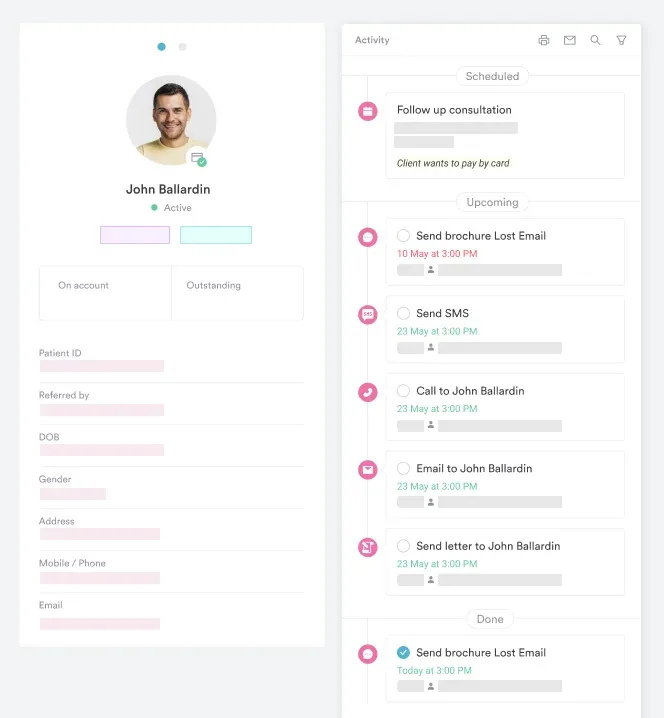
Pabau, an all-in-one practice management system, holds the whole history in one client record. The first encounter note, the discharge from active treatment, and today’s visit sit on the same timeline, with photos and forms attached. Nothing has to be re-keyed from a second system to support the claim.
Claims then go out through Pabau’s billing integration, which checks the required claim fields first. A missing membership number or authorization code gets caught there, instead of coming back as a rejection next week. The coding judgment stays with your team, and Pabau tracks what happens to each claim after it leaves.

Pabau keeps the original injury note and today’s sequela visit in one client record, then validates the required claim fields before submission. Your team spends less time rebuilding history for a payer.

The deciding question at a sequela visit is whether the original injury is still being treated. Answer that in the note, and the seventh character follows from it. Leave it implicit, and an auditor gets to decide for you.
Check the finger as well. If the record names the middle, ring, or little finger, a dedicated subcode fits better than the residual code. The claim then carries more weight with the payer.
Pabau keeps that injury history in one client record and validates claim fields before submission, so fewer nerve injury claims come back. Book a demo to see it against your own billing workflow.

Coding a sequela for a finger sprain? S63.615S walks through the same seventh-character decision for a ring finger sprain.
Still treating the injury at follow-up? S63.501D shows how a subsequent-encounter claim should read while recovery continues.
Documenting a fresh ligament rupture in the same hand? S63.491A covers the initial-encounter record for an index finger ligament.
Billing an injection alongside the diagnosis? 20526 explains the documentation a hand injection claim needs.
Billing a device placed during spinal fusion? Interbody device insertion billing guide covers the CPT code for inserting a biomechanical device into a disc space.
S64.498S is a billable ICD-10-CM code for injury of digital nerve of other finger, sequela. The seventh character S marks a late effect of an earlier digital nerve injury. Numbness, neuropathic pain, and grip weakness are typical presentations. The original injury has already finished its active treatment and recovery. The code has been in ICD-10-CM since the first US release and remains valid in the FY2026 edition.
Yes. S64.498S is a billable, specific ICD-10-CM code valid for reimbursement in HIPAA-covered transactions. It is at the highest level of specificity within the S64.498 sub-code series and can be submitted on claims without further breakdown.
S64.498S applies to a finger that has no dedicated subcode of its own. Thumb injuries are coded from S64.3 instead. The index, middle, ring, and little fingers each have subcodes S64.490 through S64.497, split by right and left. Use S64.498S only when the record does not support one of those, and check the current tabular list before you submit.
Common pairings include 64831 for suture of a digital nerve and 64774 for excision of a neuroma. Chronic pain management may use 64640, and rehabilitation visits use codes such as 97110. Validate every pairing against current AMA CPT guidance and your payer policies before submission.
The immediate parent is S64.498, which cannot be billed on its own because a seventh character is required. Above it sit S64.49 and S64.4 for digital nerve injury of the other fingers. Those roll up to S64 for nerve injury at wrist and hand level, then the S60-S69 block, then the S00-T88 chapter.