

ICD-10 Code S42.444P: Medial epicondyle fracture, right humerus
ICD-10 Code S42.444P: full descriptor and code validity ICD-10 Code S42.444P car...

Last Updated: Oct 13, 2026
Billable Code Specific Code
S63.689S is the billable ICD-10-CM code for other sprain of unspecified thumb, sequela.
The 7th character is the only part of the code that moves across the life of the injury. It is also where sequela claims come apart.
The ICD-10-CM Official Guidelines for Coding and Reporting govern how sequela codes are assigned. They are maintained jointly by the Centers for Medicare and Medicaid Services (CMS) and the National Center for Health Statistics (NCHS).
Let Pabau's smart automation suggest the right codes, reduce claim denials, and keep your practice compliant—effortlessly.
Automate repetitive tasks and focus on what matters most—your patients.
Reduce coding errors and ensure compliance with the latest regulations.
Clean claims, fewer denials, and faster reimbursements.
Powerful insights and reporting to help your practice thrive.
HIPAA compliant SOC 2 certified GDPR-compliant Trusted by 4,000+ clinics worldwide

ICD-10 Code S63.689S describes other sprain of unspecified thumb, sequela. It is billable and valid for HIPAA-covered transactions in the 2026 code year.
The S suffix means the patient has a late effect of a prior thumb sprain, not an active or healing injury. Confusing S with D is a common denial trigger.
Sequela coding needs documented causal linkage between the original thumb sprain and the current late effect. Vague chart notes are the top reason these claims fail audit.
Pabau supports electronic claim submission and claim status tracking for US practices through its Claim.MD integration.
ICD-10 Code S63.689S is a valid, billable ICD-10-CM diagnosis code for the 2026 code year. It is accepted for submission on HIPAA-covered transactions. The full clinical description is: Other sprain of unspecified thumb, sequela.
The base code S63.689 is not billable on its own. A 7th character is required before it can go on a claim, and S63.689S is the sequela variant. The two siblings covering the same base injury are S63.689A for the initial encounter and S63.689D for the subsequent encounter.
ICD-10-CM requires a 7th character on all injury codes in the S60-S69 chapter. For S63.689, three options exist, and each one describes a different clinical situation to the payer. Two questions about the chart settle which one belongs on the claim.
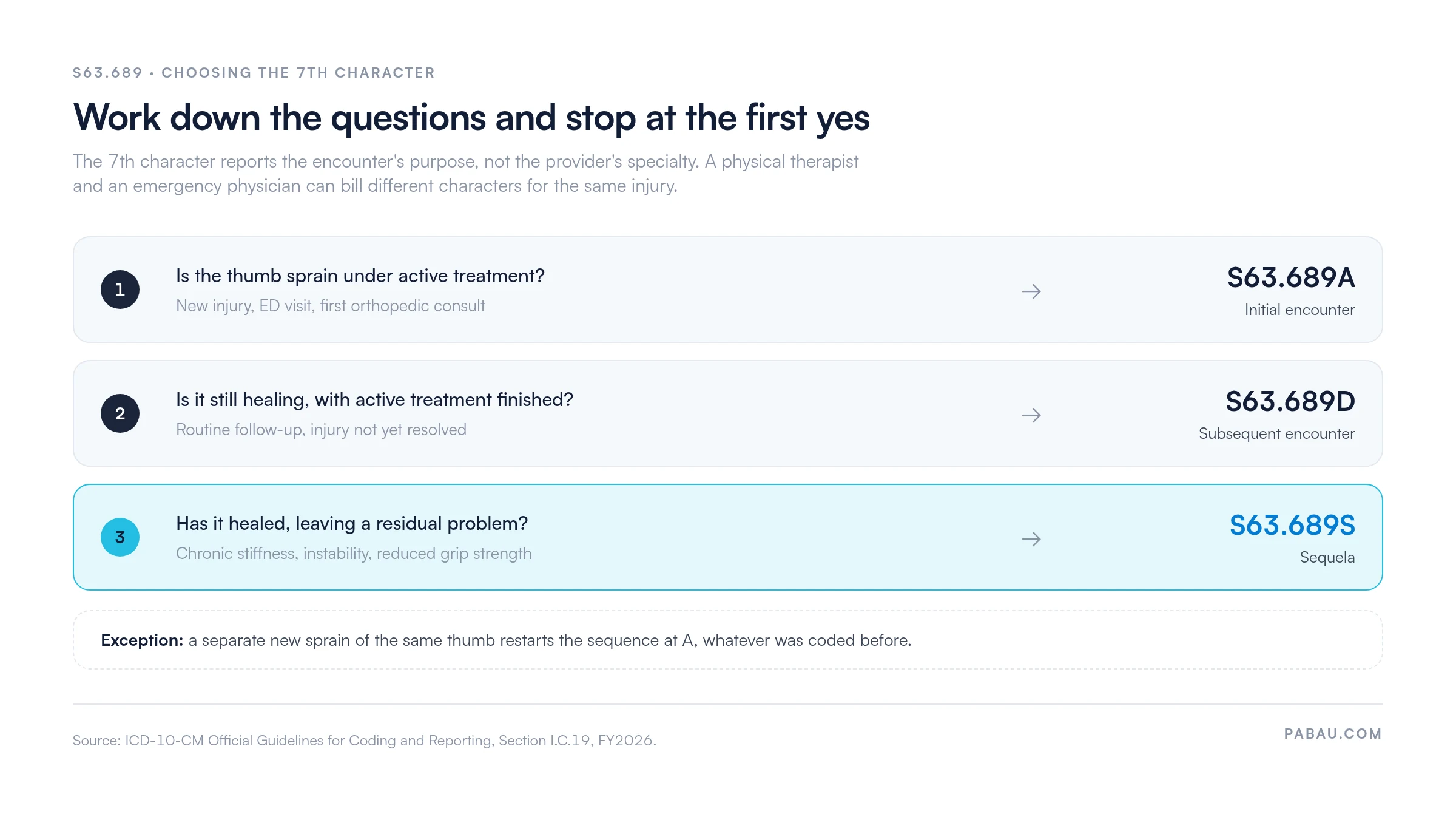
The 7th character reflects the encounter’s purpose, not the provider’s specialty. A physical therapist treating residual thumb stiffness after a healed sprain uses S63.689S, even though an ED physician coded the original injury as S63.689A.
The ICD-10-CM code reference at ICD List confirms this encounter-type logic holds across the S60-S69 range. The same A/D/S framework runs through the rest of the ICD-10-CM injury codes.
Coders most often confuse D and S. Both appear after the acute phase, and they describe different clinical situations. The distinction matters for claim processing. Using D when S is correct, or the reverse, can trigger a medical necessity denial or an audit flag.
The AAPC’s ICD-10-CM code reference reinforces this. The S suffix applies only when “a condition results from a previous injury.” The original condition must be documented as healed or resolved, with the visit addressing only the residual late effect.
Check the chart notes before assigning S63.689S. The documentation has to state that the original thumb sprain is resolved. It also has to link the current complaint, such as stiffness or reduced range of motion, to that prior injury. If the notes say ‘ongoing sprain’ or ‘thumb sprain, follow-up,’ reach for D instead.
A sequela is a late effect – a condition that persists after the acute phase of an illness or injury has fully resolved. Under ICD-10-CM Official Guidelines Section I.C.19, sequela coding for injuries follows a consistent two-code pattern.
The sequela code (S63.689S here) identifies the original injury and encounter type. A second code, drawn from elsewhere in ICD-10-CM, identifies the nature of the specific late-effect condition. For a thumb sprain sequela, that second code might describe joint stiffness, ligamentous laxity, or chronic pain. Both codes appear on the claim.
CMS and NCHS co-publish annual ICD-10-CM update files. The CDC/NCHS ICD-10-CM web tool carries the code definitions and tabular lists for each fiscal year. They confirm the sequela framework as a fixed convention across every injury code.
S63.689S sits inside a defined hierarchy. Knowing the parent and sibling codes shows when a more specific code applies, and keeps laterality and encounter type on the claim. The same chapter-to-billable-code nesting runs through the whole S00-T88 trauma section.
Coding guidance strongly prefers laterality where it is known. S63.689S is reserved for situations where the documentation genuinely does not specify left or right thumb. If the chart notes identify the affected side, use S63.681S (right) or S63.682S (left) instead.
The documented joint matters as much as the side. When the notes name the thumb’s interphalangeal joint, the S63.62 series applies instead, such as S63.621D for a right thumb at a subsequent encounter.
Sequela claims carry a higher documentation burden than standard injury encounter codes. Payers reviewing S63.689S claims look for two things. The first is evidence that the original thumb sprain occurred and was treated. The second is that the current condition follows directly from it.
Sending the claim electronically does not lift any of that burden off the chart. Pabau, a practice management platform, connects to the Claim.MD clearinghouse so US practices can reach thousands of US payers. Real-time eligibility checks confirm coverage before the visit, and claim status and ERA tracking show where each submitted claim stands.
Neither of those checks reads a diagnosis code, so the A, D, and S decision stays with the coder. Pabau’s cleaner claims management flags missing insurer and authorization details before a claim leaves the practice. Denials that do come back are quicker to work once the reason codes are grouped, which is where denial management starts.
The same documentation framework carries across injury code types. Whether the code is an S-suffix sequela or a screening code, the causal chain has to be explicit in the record.
Physical and occupational therapists are the providers most likely to meet sequela coding in practice. A patient finishes acute and recovery-phase treatment for a thumb sprain, and the injury episode closes. If they are then referred for rehabilitation of residual deficits, the treating PT or OT uses S63.689S as the primary diagnosis.
Key points for PT and OT billing with ICD-10 Code S63.689S:
Therapy notes have to carry that causal relationship at every visit, not only at the initial evaluation. A progress note listing exercises and repetitions, with no reference to the healed sprain, leaves a reviewer with no basis for the S suffix. Naming the original injury in each note is the cheapest defense against a retrospective review.
Payer coverage for rehabilitation claims using sequela codes varies. Some commercial payers require pre-authorization for therapy aimed at a sequela. Confirming coverage before the first visit prevents a denial mid-episode, when the patient is already several sessions in.
In most therapy practices the sequela decision lives in two systems at once. The therapist writes the note in the clinical record, and someone else types the diagnosis code into a billing tool. Nobody checks that the two agree until a payer sends the claim back.
Pabau, practice management software for therapy and musculoskeletal practices, holds the note, the diagnosis codes, and the claim on one patient record. Whoever codes the visit reads the note naming the original sprain and its residual effect. The claim then goes out from the same screen through the Claim.MD integration.
Claim status and ERA responses come back to that record. A rejected sequela claim therefore sits next to the note that supports it. Whoever reworks it does not have to go hunting for the documentation first.

Pabau brings scheduling, clinical documentation, and claim submission onto one patient record for therapy and musculoskeletal practices. See how it works for your team.

S63.689S is straightforward when the clinical picture is clear. A prior thumb sprain has resolved, and the patient is being treated for what it left behind. Practices come unstuck on the documentation side. They either fail to link the late effect to the original injury, or reach for D after the sprain has healed.
The fix sits upstream of billing. If the note names the original sprain and the residual effect it left, the suffix choice writes itself and the claim survives review. Book a demo to see how Pabau keeps that note and the claim on one record.

Need to reduce sequela claim denials? Denial management in healthcare explains the coding errors that drive rejections and how to work the reason codes.
Coding another sequela injury? S01.129S applies the same late-effect rules to an eyelid laceration with a foreign body.
Need the subsequent-encounter side of the rule? S76.202D walks through a D-suffix injury claim while the injury is still healing.
Submitting claims through a clearinghouse? Claim.MD clearinghouse review covers how submission, claim status, and ERA responses work in practice.
ICD-10 Code S63.689S is a billable ICD-10-CM diagnosis code for other sprain of unspecified thumb, sequela. It applies when a patient has a late-effect condition caused by a prior thumb sprain that has fully healed. That covers chronic stiffness, instability, and residual pain. It is valid for HIPAA-covered claim submissions in the 2026 code year.
Yes. S63.689S is a valid, billable ICD-10-CM code accepted for HIPAA-covered transactions in the 2026 code year. The base code S63.689 is not billable on its own. It needs a 7th character of A, D, or S to be complete.
Yes. S63.689S suits physical therapy and occupational therapy claims when therapy addresses a late-effect condition from a thumb sprain that has healed. Payer local coverage determinations vary, so verify authorization requirements with the specific payer before submitting. A second code identifying the nature of the sequela condition should accompany S63.689S on the claim.
Documentation should establish three things. The original thumb sprain occurred, it has since resolved, and the current condition follows directly from it. Chart notes need causal language linking the current complaint to the original sprain. Add a separate code for the late effect being treated, such as joint stiffness or ligamentous instability.




