ICD-10 Code S42.444P: Medial epicondyle fracture, right humerus
ICD-10 Code S42.444P: full descriptor and code validity ICD-10 Code S42.444P car...

Last Updated: Oct 13, 2026
Billable Code Specific Code
S63.621D is the billable ICD-10-CM code for sprain of interphalangeal joint of right thumb, subsequent encounter.
It sits in the S63 category for dislocations and sprains at wrist and hand level. The code applies once initial treatment has begun, covering follow-up visits, physical therapy, and splint checks. Using A instead of D on a follow-up visit is the most common error in this code family.
Let Pabau's smart automation suggest the right codes, reduce claim denials, and keep your practice compliant—effortlessly.
Automate repetitive tasks and focus on what matters most—your patients.
Reduce coding errors and ensure compliance with the latest regulations.
Clean claims, fewer denials, and faster reimbursements.
Powerful insights and reporting to help your practice thrive.
HIPAA compliant SOC 2 certified GDPR-compliant Trusted by 4,000+ clinics worldwide

S63.621D describes a sprain of the interphalangeal joint of the right thumb at a follow-up encounter, not the initial visit and not a sequela.
The 7th character D applies when the patient is receiving active or routine care during the healing phase, including physical therapy and follow-up imaging.
Using 7th character A on a follow-up visit is the most common denial trigger for this code family, so document the encounter context explicitly.
Pabau’s claims management software flags 7th-character mismatches before submission, which lowers denial rates on injury codes across the S63 category.
ICD-10 Code S63.621D carries the official descriptor “Sprain of interphalangeal joint of right thumb, subsequent encounter.”
It became effective under ICD-10-CM and remains a valid, billable code for the current fiscal year per the CMS ICD-10-CM tabular list. The code is specific to the right thumb and to the IP joint. Both details must be confirmed in the clinical note before the code is used.
The interphalangeal joint of the thumb is the single hinge joint between the proximal and distal phalanges of the thumb. Unlike the fingers, the thumb has only one IP joint rather than two. A sprain at this location involves injury to the ligaments supporting that joint, most commonly from forced hyperextension or lateral deviation.
Accurate documentation must confirm three things. Name the injury type (sprain, not fracture or dislocation), the specific joint (IP joint, not the metacarpophalangeal or carpometacarpal joint), and the laterality (right). All three are encoded in S63.621D. Missing any one of them in the clinical note makes the code vulnerable on audit.
The ICD-10-CM Official Guidelines for Coding and Reporting set the rule in Section I.C.19.a. The 7th character D is assigned when the patient is receiving active treatment during the healing or recovery phase of an injury. D says nothing about how well the recovery is going. It marks a visit where the injury is still under management and the initial treatment phase has already passed.
Applying this correctly for S63.621D comes down to one question. Has the patient already been seen and treated for this sprain? If they have, and they are back for ongoing care, D is the right character. Ongoing care covers a follow-up visit, a physical therapy referral, and a cast or splint check. If the injury is receiving medical attention for the first time, A applies instead.
The provider treating the patient on a subsequent visit does not have to be the one who saw them initially. What decides the character is the clinical context of this visit. If the visit manages an injury that was already identified, D applies regardless of setting or provider.
The three sibling codes share an anatomical site but describe entirely different clinical moments. Choosing between them means reading the encounter documentation, not the injury description. The path below shows how that reading resolves to one of the three codes.
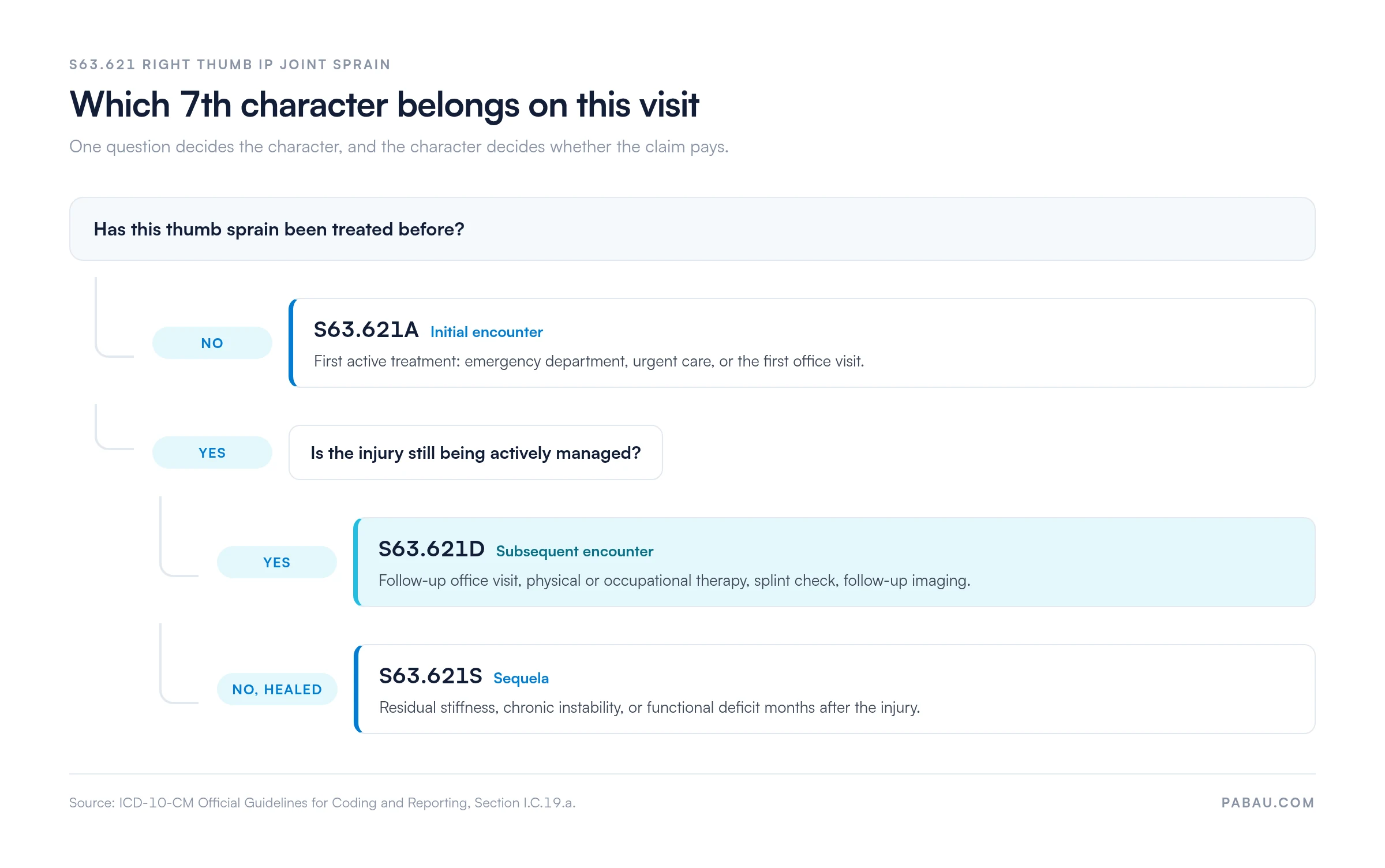
Reading the injury description alone leaves the character to guesswork, and that guess is what payers audit.
The most common error is using S63.621A across every visit, a habit sometimes called “A for always.” Auditors flag the pattern because a patient cannot sit at an initial encounter for the same injury indefinitely. Repeated visits carrying 7th character A for one diagnosis point to either loose documentation habits or systematic miscoding.
The S63 category covers an entire region of the hand, and several adjacent codes describe structures that are close anatomically but clinically distinct. Coders working from incomplete documentation frequently select the wrong joint or wrong laterality. The table below covers the most common substitution errors.
The fix for most of these errors is documentation specificity. When a provider writes “thumb sprain” without naming the joint, coders default to unspecified codes. A query to the treating clinician confirming IP vs. MCP involvement takes less than a minute and protects every downstream claim.
Coders meet the same IP versus MTP distinction in the foot. A sprain of the metatarsophalangeal joint of the left great toe at a follow-up visit takes S93.522D.
The S63 tabular list includes sprains and dislocations of the wrist and hand joints and ligaments. It excludes fractures of the wrist and hand, which sit in S62. It also excludes traumatic joint dislocations classified elsewhere and injuries to tendons at wrist and hand level (S66).
Those boundaries matter for S63.621D claims because combined injuries need separate codes. A thumb sprain alongside a proximal phalanx fracture draws one code from S63 and one from S62.
ICD-10-CM uses two exclusion note types, and they carry different instructions. An Excludes1 note means the two codes cannot be used together on the same claim. An Excludes2 note signals that the excluded condition sits outside this code’s description but may co-exist. Both codes may be reported when both conditions are documented.
Exclusion notes are updated annually, so verify the current-year tabular notes in the CDC/NCHS ICD-10-CM web tool before submitting.
The ICD-10-CM Official Guidelines encourage external cause codes alongside injury diagnosis codes, and many payers require them. For S63.621D, the companions fall into three groups: mechanism of injury, activity, and place of occurrence. Local coverage determinations vary by payer, so confirm the requirement against that payer’s policy before submission.
On subsequent encounters, external cause codes normally carry the D 7th character so they match the primary diagnosis. Place-of-occurrence and activity codes are the exception, since the Y92 and Y93 series take no 7th character at all. Submitting an A-coded mechanism code on a follow-up visit creates a mismatch that triggers automated claim edits at several commercial payers.
Subsequent-encounter visits for a right thumb IP joint sprain produce different procedure code combinations depending on the visit’s clinical purpose. Knowing the common pairings prevents the diagnosis-to-procedure mismatches that trigger claim edits.
In physical therapy practices treating this injury, the 97110 and 97530 pairing with S63.621D is the most common billing pattern. Payers may apply visit frequency limits on it. Some also require functional outcome documentation to support therapy claims beyond a set number of sessions.
Medicare and most commercial payers require medical necessity documentation for each subsequent encounter visit. A claim for S63.621D needs a note showing the injury is still actively managed, and a history of right thumb sprain will not carry it. “History of” language shifts the justification from active treatment to chronic condition management, which changes the coverage criteria.
Submitting through a clearinghouse that validates diagnosis-to-encounter matching catches the most common errors before the payer ever sees them. The electronic remittance advice returned after adjudication closes the loop. It carries CARC reason codes that name exactly which field triggered a rejection. That makes the same mistake easy to trace across a batch of claims.
S63.621D claims deny for a narrow set of predictable reasons, and each one has a documentation fix. The table below covers the five that come up most often on this code family.
Reading the denial codes returned after each remittance cycle is the fastest way to catch systematic patterns. One coder submitting S63.621A on every encounter in an injury episode produces a visible cluster on the denial report. A single workflow correction clears the whole pattern.
Run a monthly pull of all S63-series claims denied in the prior 90 days. Filter by denial reason code CO-4 (inconsistent modifier) and CO-97 (benefit included in primary code). These two CARCs catch most 7th-character and bundling errors on subsequent encounter injury claims before they age into write-offs.
An injury code is only as defensible as the note behind it. For S63.621D, the clinical note has to support the four elements the code encodes, plus the treatment plan that justifies the visit.
A structured clean claim workflow links documentation fields to coding fields at the point of care, so these omissions rarely reach billing. The note also has to stand alone. A coder or auditor reading it cold should be able to confirm every element above without asking the clinician.
In most billing workflows, a wrong 7th character surfaces only when the payer sends the claim back. The coder corrects the character, resubmits, and payment lands weeks later than it should have. Nothing about the note was wrong, but the encounter context never reached the claim.
Pabau is practice management software that holds the appointment, the clinical note, and the claim in one patient record. When a patient comes back for a splint check, the earlier treatment for that thumb sprain is on the same screen as the diagnosis field. The coder can see that treatment already started before choosing between S63.621A and S63.621D.
Claims then go out through an integrated clearinghouse that validates diagnosis-to-procedure pairing before submission. Fewer S63-series claims come back for a character mismatch. The ones that do arrive with a reason code your biller can act on the same day.

Pabau’s claims management software validates 7th-character encounter types and diagnosis-to-procedure pairings at the point of submission, catching S63-series errors before they reach the payer.

S63.621D is a straightforward code when the clinical note names four things: right thumb, IP joint, sprain, and a follow-up visit. Most denials on it trace back to one point of failure. The 7th character gets chosen without anyone confirming whether the encounter was initial or subsequent. Checking that context at every injury-code visit removes the most common audit trigger in the S63 family.
Pabau’s claims management software validates encounter type characters and diagnosis-to-procedure pairings before claims leave the practice, so S63.621D errors never become denials. Book a demo to see how injury coding runs across a multi-provider practice.

Need to understand how denials are classified and resolved? Denial management in healthcare covers the full denial lifecycle from initial rejection to appeal resolution.
Want to see how clearinghouse submissions work end-to-end? Claim.MD clearinghouse guide explains how electronic claims are validated, transmitted, and tracked through to remittance.
Looking for a reference on superbill structure for injury visits? Superbill guide outlines what billing elements are required for compliant injury code claims.
ICD-10 code S63.621D is the billable ICD-10-CM diagnosis code for a subsequent encounter for sprain of the interphalangeal joint of the right thumb. It belongs to the S63 category for dislocation and sprain of joints and ligaments at wrist and hand level. It applies when the patient is returning for active or routine care after the initial treatment has begun.
Use S63.621A for the first encounter where treatment begins (emergency department, urgent care, or first office visit). Use S63.621D for all follow-up visits during the healing phase, including physical therapy, splint checks, and follow-up imaging. The determining question is whether the patient has received any treatment for this injury before the current visit.
The 7th character D designates a subsequent encounter, per ICD-10-CM Official Guidelines Section I.C.19.a. It covers a visit where the patient is receiving active or routine care during the healing phase. It applies regardless of the provider or setting, as long as the visit is for ongoing management of a previously identified injury.
No. Emergency department visits for a first presentation of this injury use S63.621A (initial encounter). S63.621D applies only when the patient has already received treatment for this specific injury and is returning for ongoing management. An ED visit where the patient discloses prior treatment elsewhere could qualify for D, but that context must be explicitly documented in the note.
Four triggers account for most denials. Coders use 7th character A instead of D on a follow-up visit, or get laterality wrong. Others omit external cause codes the payer’s LCD requires, or document medical necessity too thinly. A structured pre-submission checklist that validates all four elements reduces denial rates on this code family significantly.
Common pairings include 99213 or 99214 for established office visits. Therapy visits use 97110 (therapeutic exercises) and 97530 (therapeutic activities). Imaging uses 73130 for follow-up hand X-rays, and 29280 covers splint or strapping reapplication. Payer-specific pairing rules apply and should be verified against the relevant LCD before submission.