ICD-10 code S56.415S: Right ring finger extensor strain sequela
ICD-10 code S56.415S, decoded ICD-10 code S56.415S reports the lasting effects o...

Last Updated: Oct 16, 2026
Billable Code Specific Code
S63.111D is the billable ICD-10-CM code for subluxation of metacarpophalangeal joint of right thumb, subsequent encounter. The D marks a healing-phase visit after active treatment, such as a follow-up check or a physical therapy session.
Coders most often slip on the 7th character, using A (initial encounter) when the patient is already recovering. Thumb codes sit under S63.1, so S63.211D codes the left index finger instead. Check the side too, because S63.112D codes the left thumb.
Let Pabau's smart automation suggest the right codes, reduce claim denials, and keep your practice compliant—effortlessly.
Automate repetitive tasks and focus on what matters most—your patients.
Reduce coding errors and ensure compliance with the latest regulations.
Clean claims, fewer denials, and faster reimbursements.
Powerful insights and reporting to help your practice thrive.
HIPAA compliant SOC 2 certified GDPR-compliant Trusted by 4,000+ clinics worldwide

S63.111D is billable and applies to right thumb MCP joint subluxation at a subsequent (routine-healing) encounter, not the first active-treatment visit.
The thumb has its own subcategory, S63.1. S63.2 covers the other fingers, so S63.211D codes the left index finger, not the thumb.
The 7th character D separates follow-up visits from initial encounters (A) and sequela encounters (S). Misapplying it is a frequent denial trigger.
Laterality is required: S63.111 = right thumb, S63.112 = left thumb, S63.113 = unspecified thumb. Unspecified laterality draws payer scrutiny.
Pabau’s claims management software links ICD-10 codes directly to encounter documentation, reducing 7th-character mismatches before submission.
ICD-10 Code S63.111D is the billable code for a partial dislocation of the right thumb’s metacarpophalangeal (MCP) joint. It is reported at a healing-phase visit after active treatment.
It sits in Chapter 19 of ICD-10-CM (Injury, poisoning and certain other consequences of external causes). Its block is S60-S69, injuries to the wrist, hand and fingers.
For the authoritative tabular listing, the CDC/NCHS ICD-10-CM web tool provides the official annual release with full instructional notes and effective dates. To compare S63.111D with neighboring hand and wrist codes, browse our ICD-10-CM diagnostic codes library.
A subluxation is a partial dislocation. The articular surfaces lose their normal relationship but keep some contact, while in a complete dislocation they separate entirely.
In the metacarpophalangeal (MCP) joint of the right thumb, this typically results from forced hyperextension or radial deviation. Common causes are ball-sport injuries, falls on an outstretched hand, and repetitive occupational stress.
The MCP joint connects the first metacarpal bone to the proximal phalanx of the thumb. Its stability depends on the volar plate, the ulnar and radial collateral ligaments, and the adductor pollicis. A subluxation at this joint strains or partially tears those structures without full articular separation.
Clinically, the patient presents with pain, swelling, and limited pinch-grip strength, though they retain some joint continuity on imaging.
The “subsequent encounter” component means this code applies after the patient has received definitive/active treatment and is now returning for routine healing monitoring. That encounter could be a follow-up visit, physical therapy assessment, cast check, or wound review. The clinical note must confirm the injury is still healing, not resolved.
The 7th character D applies whenever the patient receives routine care during the healing or recovery phase of an injury, after active treatment. Per ICD-10-CM Official Coding Guidelines Section I.C.19.a, three 7th-character options exist for most injury codes.
The D suffix tracks the patient’s phase of care, so a change of provider or visit type leaves it unchanged. A patient can switch from A to D on their very next visit if active treatment was completed at the first encounter. Several A-suffix visits fit when active treatment spans more than one session, such as repeated guided reductions.
The coder switches from D to S once the acute injury has fully healed. The issue being treated is then a late effect, such as persistent joint instability or post-injury arthritis. Per the official guidelines, the code for that late effect is listed first, and S63.111S follows it.
Knowing where S63.111D sits in the code tree prevents laterality errors. It also helps coders find the right sibling when the encounter type or injured side changes. The full hierarchy from block level to the specific billable code follows CMS ICD-10-CM coding guidance.
The 6th character in S63.11- carries two facts at once. Values 1 to 3 code a subluxation (right, left, unspecified), and 4 to 6 code a full dislocation in the same order. The breakdown below reads S63.111D one character at a time.
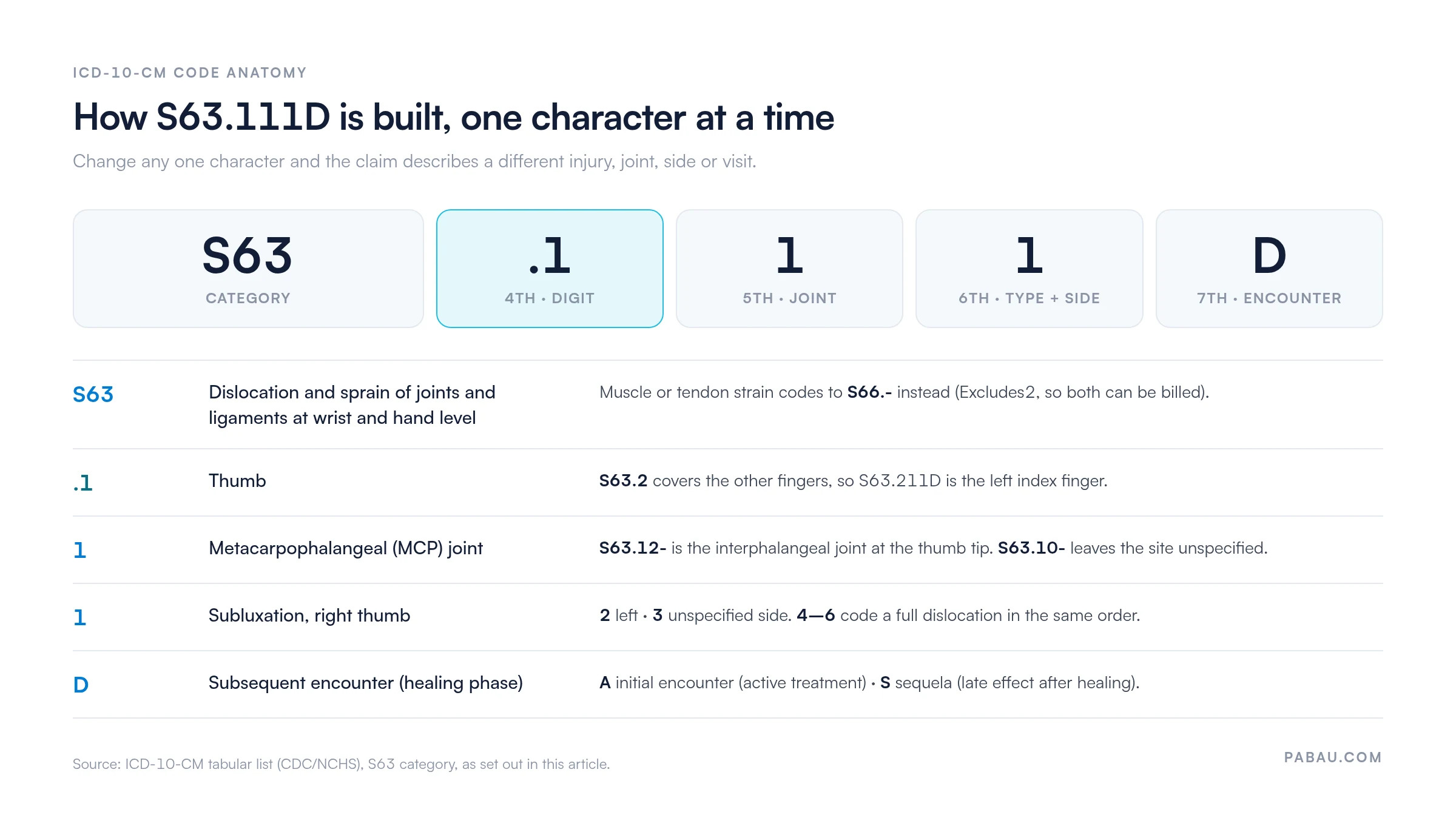
S63.113D (unspecified thumb) is billable but draws payer scrutiny, since the provider’s note almost always names the hand. Use the unspecified code only when the documentation does not identify the side, which should be rare.
Mapping your medical billing workflows from encounter to claim shows coders where a missing side first enters the record.
Several codes share anatomy or injury type with S63.111D. Picking the wrong one creates denials, appeals, or audit flags. The decision table below covers the most frequent mix-ups.
The sprain-versus-subluxation distinction is where clinical documentation matters most. A sprain involves ligament fiber disruption without joint displacement. A subluxation involves partial displacement of the articular surfaces. The treating provider’s notes must explicitly support whichever code is assigned.
“Partial dislocation” and “incomplete dislocation” both map to subluxation, while “ligament strain” or “UCL tear” maps to a sprain code. Check the joint as well, because an IP joint subluxation seen for the first time codes to S63.121A. When documentation is ambiguous, query the provider before coding.
The S63 category carries instructional notes that decide what can be coded alongside S63.111D on the same claim. These are inherited from the parent category and apply to all codes within S63.
The most common pairing is a physical therapy CPT code, such as 97110 or 97530, when the subsequent encounter is a rehabilitation visit. The ICD-10 Code S63.111D then serves as the supporting diagnosis on the PT claim, linking the therapeutic procedure to the healing injury.
Check for associated CPT codes before finalizing the claim. A subsequent-encounter ICD-10 code billed without a matching procedure code is a common trigger for medical necessity denials. So is a CPT that doesn’t pair logically with musculoskeletal injury management. Confirm the CPT reflects what was performed at the healing-phase visit.
Chapter 19 carries a note asking for secondary codes from Chapter 20 (External causes of morbidity) to show how the injury happened. Those codes take their own 7th character, which should match the encounter phase of S63.111D.
At a subsequent encounter, the external cause code itself may still be reported with D. Examples include a fall or a ball-sport strike. Place of occurrence (Y92), activity (Y93), and status (Y99) codes work differently. Per the official guidelines, they are reported once, at the initial encounter, and not repeated on follow-up claims.
The clinical note must support every element of the code. That means the injury type (subluxation, not full dislocation or sprain) and the site (metacarpophalangeal joint). It also means the laterality (right thumb) and the encounter phase (subsequent).
Physical therapy practices often build encounter templates that capture all four. Orthopedic and urgent care settings sometimes leave laterality implicit in the narrative instead of in a structured field.
Required documentation elements for a clean S63.111D claim:
Airtight documentation before coding is also the key to submitting a clean claim on the first pass. It cuts the time coders spend on rework and appeals.
S63.111D is accepted by Medicare and most commercial payers as a valid subsequent-encounter musculoskeletal injury code. There is no national coverage determination (NCD) specific to thumb MCP subluxation.
Coverage follows local coverage determinations (LCDs) and the contractor’s medical necessity criteria. Confirm the applicable LCD through the CMS Coverage Database before billing high-cost associated services.
Medicare claims sent from Pabau’s medical claims management software route through the Claim.MD clearinghouse. It validates ICD-10 and CPT code combinations against the 837P standard before payer transmission.
The electronic remittance advice (ERA/835) returned by the payer maps directly to the original claim line. That shows which encounter and which code triggered a denial or adjustment.
Most denials on ICD-10 Code S63.111D trace back to a small set of correctable errors. The table below maps each denial type to its root cause and fix, based on standard payer remittance denial patterns.
For practices managing high denial volumes, dedicated denial management workflows are the most reliable way to catch these errors systematically rather than case by case.
For any denial received, the CARC (Claim Adjustment Reason Code) on the ERA identifies the specific payer rationale. Cross-referencing CARC codes against the denial types above streamlines the appeal process and identifies patterns that warrant a coding or documentation workflow change.
S63.111D denials usually start in the chart. A follow-up note leaves the side implicit, or a coder picks a finger code from S63.2 because the joint name matches. The claim then fails a remittance cycle later.
Pabau, the practice management and billing platform we build, keeps the diagnosis code attached to the encounter note it came from. Coders see the documented side and encounter phase next to the code before the claim leaves. Claims then pass through the Claim.MD clearinghouse, which checks required fields before payer transmission.
The result is fewer amended claims for laterality and 7th-character errors, and less coder time spent on rework and appeals.

Pabau links ICD-10 diagnosis codes to encounter documentation and validates claims before they reach payers. 7th-character errors and laterality mismatches get caught before they cost you a remittance cycle.

S63.111D is only correct when four facts line up: a subluxation, at the MCP joint, of the right thumb, at a healing-phase visit. Check the subcategory first. A thumb code always starts S63.1, and a code that starts S63.2 belongs to another finger.
If your team codes thumb injuries often, add a laterality and encounter-phase check to the follow-up note template. It catches suffix and laterality errors at the source, before they reach a claim. Book a demo to see how Pabau links each diagnosis code to its encounter note before the claim goes out.

Need a framework for reducing denied claims across your practice? Medical billing compliance covers the documentation and audit practices that prevent systematic coding errors before they reach a payer.
Want to understand how clearinghouse validation works? Claim.MD clearinghouse overview explains how electronic claim validation catches ICD-10 errors before payer submission.
Seeing the same denial codes come back on injury claims? Denial codes in medical billing explains the common codes payers send and how to resolve them.
Coding a subluxation at the thumb tip instead? ICD-10 code S63.121A covers a right thumb IP joint subluxation at the initial encounter.
ICD-10 Code S63.111D is the billable diagnosis code for subluxation of the metacarpophalangeal joint of the right thumb, subsequent encounter. It covers a partial dislocation of the right thumb’s knuckle joint, managed at a routine healing-phase visit after active treatment.
The 7th character D applies when the patient receives routine care during the healing or recovery phase, after initial active treatment is complete. Common D-suffix encounters include follow-up visits, physical therapy sessions, cast changes, wound checks, and splint adjustments.
S63.111A is for the initial encounter, the first visit where active treatment is provided for the subluxation. S63.111D covers subsequent encounters, meaning follow-up visits during the healing phase after active treatment. Using A when the patient is already in the recovery phase is a common cause of encounter-suffix denials on this code.
Medicare accepts S63.111D as a valid subsequent-encounter musculoskeletal injury code. There is no national coverage determination specific to this code. Coverage depends on the applicable local coverage determination (LCD) and whether the encounter documentation supports medical necessity. Confirm the relevant LCD through the CMS Coverage Database for the specific jurisdiction and service type.
It is a partial dislocation of the knuckle joint between the first metacarpal bone and the proximal phalanx of the right thumb. The joint surfaces lose normal alignment but keep some contact. It is typically caused by forced hyperextension or a radial deviation injury.
The most common reasons are the wrong encounter suffix (A instead of D) and a laterality mismatch with prior claims. Thin documentation of ongoing medical necessity is another. So is a CPT code that does not pair logically with a subsequent-encounter musculoskeletal diagnosis. Each can be resolved through documentation review and, where necessary, an amended claim submission.