ICD-10 Code Z74.8: Other problems related to care provider dependency
ICD-10 Code Z74.8: Definition and code details ICD-10 Code Z74.8 is the billable...

Last Updated: Oct 19, 2026
Billable Code Specific Code
S61.311A is the billable ICD-10-CM code for laceration without foreign body of left index finger with damage to nail, initial encounter.
S61.311A sits inside the ICD-10-CM injury chapter (S00-T88) under open wounds of the wrist, hand, and fingers (S61). The code became effective on October 1, 2025 under the FY2026 edition maintained jointly by CMS and the National Center for Health Statistics (NCHS). As a result, every claim submitted against this code must carry all seven characters.
Let Pabau's smart automation suggest the right codes, reduce claim denials, and keep your practice compliant—effortlessly.
Automate repetitive tasks and focus on what matters most—your patients.
Reduce coding errors and ensure compliance with the latest regulations.
Clean claims, fewer denials, and faster reimbursements.
Powerful insights and reporting to help your practice thrive.
HIPAA compliant SOC 2 certified GDPR-compliant Trusted by 4,000+ clinics worldwide

ICD-10 Code S61.311A describes a laceration without foreign body of the left index finger with damage to the nail. Specifically, the 7th character A marks the initial encounter.
S61.311A is a billable, specific ICD-10-CM code valid for FY2026 submission (effective October 1, 2025). As a result, it cannot be submitted without the full 7-character code.
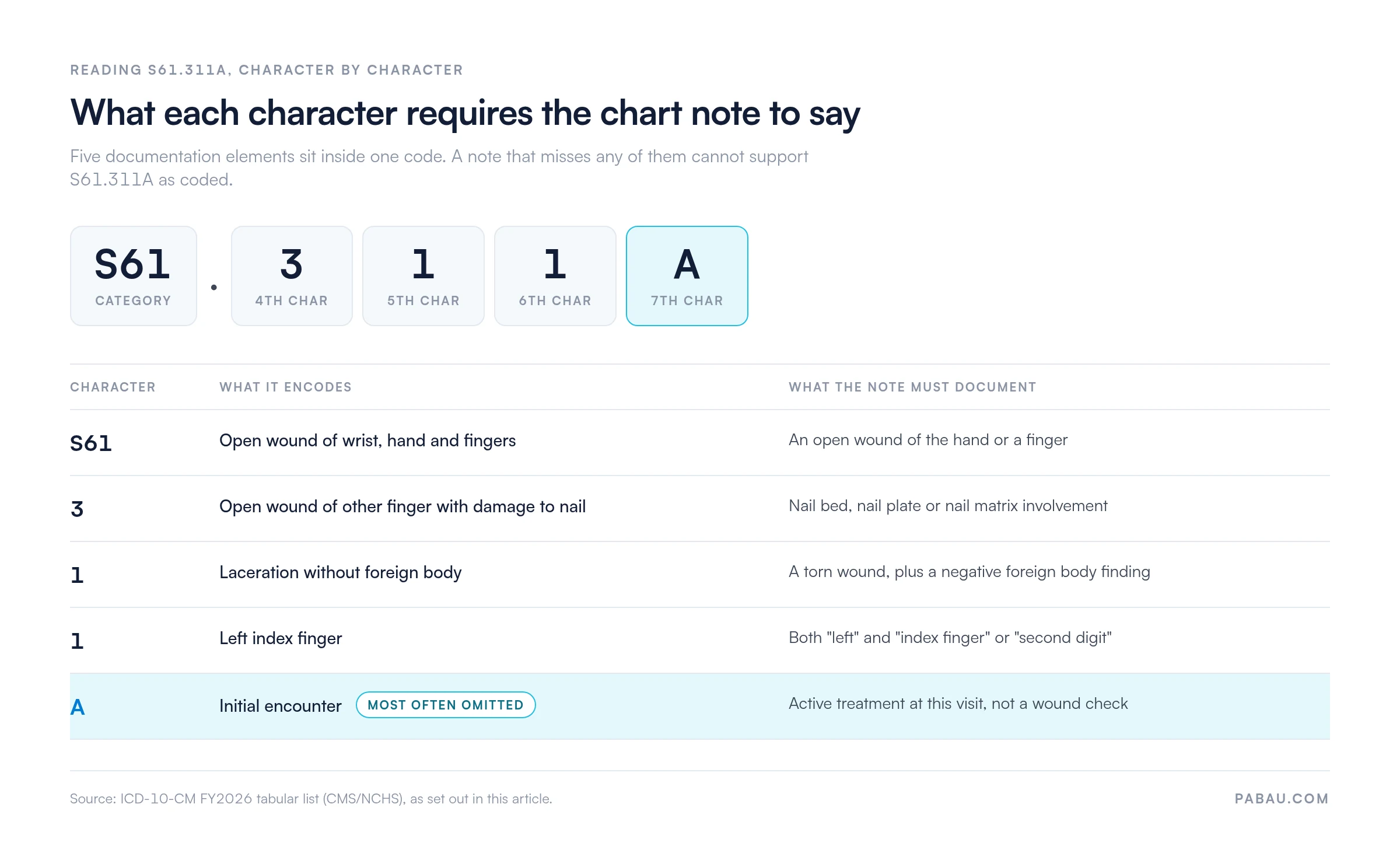
Documentation must confirm five elements: left laterality, index finger, nail damage, absence of foreign body, and initial encounter type. In short, missing any one risks denial.
In addition, practice management software like Pabau integrates with Claim.MD to submit ICD-10 claims electronically and track denials for wound care encounters.
The table below captures the attributes coders verify before billing. Indeed, confirming billable status first prevents rejected submissions before they reach the payer.
Each word in the official description carries a coding function. In fact, removing any element changes which code applies.
Read the code from left to right and each character adds one documentation requirement to the note.
The CDC/NCHS ICD-10-CM web tool confirms the full description and code hierarchy for S61.311A in the current tabular list.
Reading the hierarchy from the chapter down to the billable code shows where each layer of specificity is added. Specifically, the parent hierarchy for S61.311A runs as follows:
The 7th character is the most frequently omitted element in finger laceration coding. As a result, submitting S61.311 without the encounter suffix makes the code invalid for claim submission. In addition, using the wrong character codes the wrong clinical situation.
Key rule: a patient can have multiple initial encounter visits (A) while they are still receiving active treatment for the same wound. The encounter type shifts to D only when the provider is managing the healing process rather than delivering active wound care. In fact, coding A for a suture removal visit when the wound is healing normally is a common audit finding.
Selecting the wrong sibling code is the second most common error in this subcategory. Specifically, the table below maps the distinctions across laterality, nail involvement, and foreign body status. For codes outside this subcategory, start from the ICD-10-CM code index.
The AAPC ICD-10-CM code lookup provides the full S61.3 subcategory listing for cross-referencing all sibling codes by laterality and digit.
This is the distinction most likely to trigger a payer audit. Indeed, both codes cover a left index finger laceration with nail damage. The only difference is whether foreign material is documented in the wound.
When wound exploration is performed but no foreign material is found, document the negative finding explicitly. Therefore, “Wound explored, no foreign body identified” supports S61.311A and protects the claim in audit review.
Run a pre-submission check on every S61.311A claim. In addition, confirm the chart note contains ‘left’, ‘index finger’, ‘nail’, and a negative foreign body statement. In fact, claims missing any of those four anchors are the most common denials in this subcategory.
The clinical record must support each specificity element the code describes. As a result, a note that carries less detail than the code claims exposes the encounter to downcoding or rejection during audit review.
Required documentation elements for a valid S61.311A assignment:
A clean claim for S61.311A depends on all five elements appearing in the source documentation before coding begins. Otherwise, correcting documentation after the claim goes out carries compliance risk.
Finger laceration codes in the S61.3 subcategory generate avoidable denials. Therefore, catching the four errors below at the coding step is cheaper than appealing them after the payer responds.
A single queue for coding, submission, and remittance review keeps these four errors from repeating. In short, that is the practical case for cleaner claims submission.
S61.311A is the diagnosis code supporting a laceration repair CPT claim, not a standalone billable procedure. In other words, the ICD-10 code justifies medical necessity for the repair service. Practices submit these claims electronically in the standard 837P format, usually through a US claims clearinghouse.
Key billing considerations for S61.311A claims:
Verifying eligibility before the patient is seen surfaces coverage limits early. As a result, catching them before treatment reduces post-service billing disputes.
The ICD-9-CM system was retired in the US on October 1, 2015. Nevertheless, crosswalk lookups still matter for legacy data analysis and for audits of historical claims that reference pre-2015 encounters.
ICD-9-CM did not capture laterality, digit specificity, or nail involvement at the granularity ICD-10-CM now requires. Therefore, any crosswalk between S61.311A and an ICD-9 code is an approximation. The ICD List crosswalk tool provides bidirectional lookups for historical claim analysis.
Clinical staff and the coders abstracting from their notes often use different words for the same injury. Specifically, the list below maps common chart expressions to S61.311A.
No synonym is interchangeable with another until the documentation confirms all five specificity elements. Ultimately, synonym recognition flags candidate codes, and the chart note settles which one applies.
A wound care encounter usually crosses three systems. The note sits in the chart, the code goes into a billing tool, and the payer response lands in a separate inbox. Reconciling an S61.311A denial then means opening all three.
Practice management software like Pabau keeps the encounter in one record instead. The clinical note, the charge, and the claim status stay attached to the same visit. A coder can read the documentation behind the code without leaving the chart.
Submission runs through our Claim.MD integration, which sends the 837P and returns remittance advice against the same encounter. Denials arrive with their CARC codes tied to the visit they came from. An S61.311A rejection is then traceable to the note that supported it.
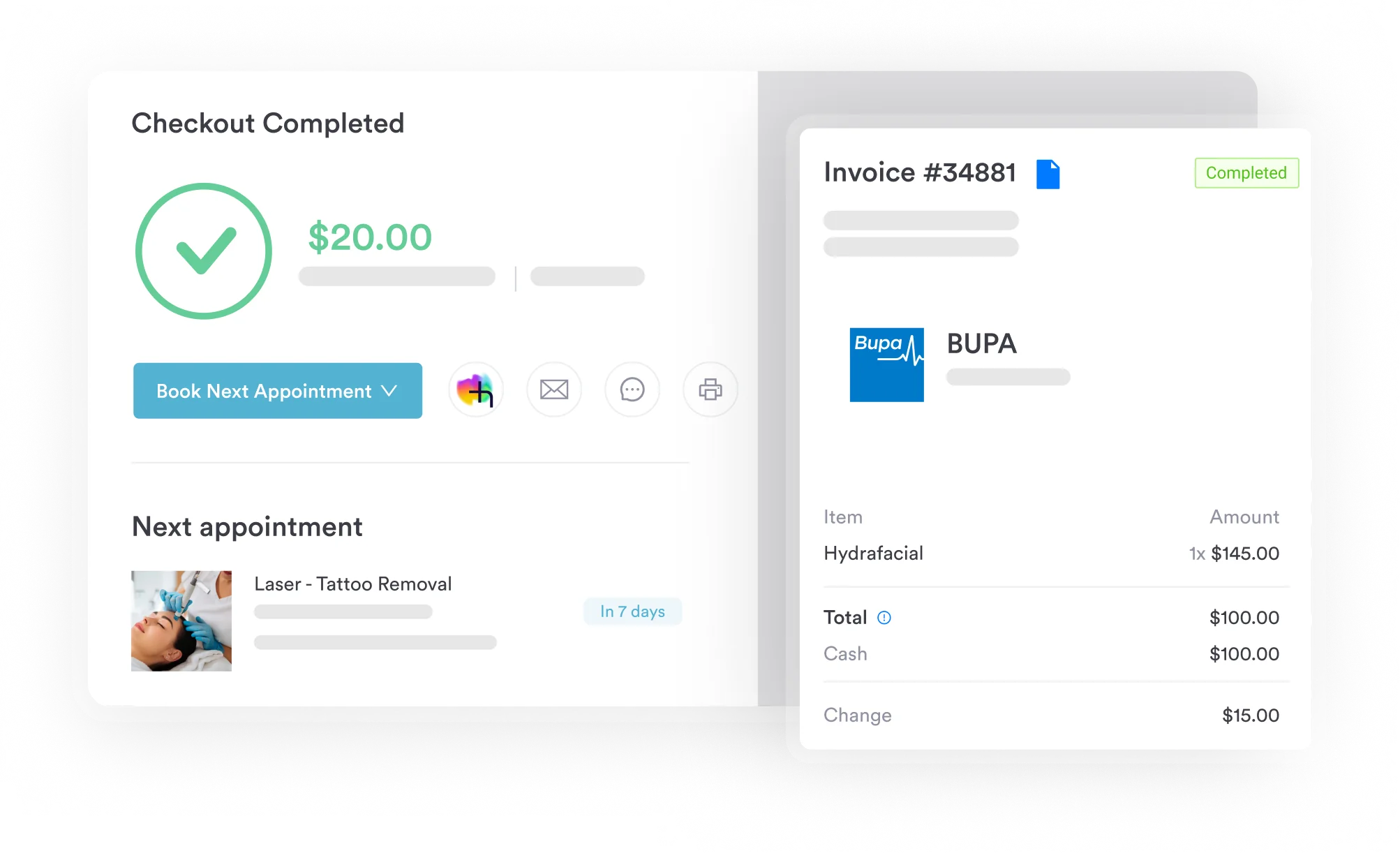

Pabau submits ICD-10-coded claims electronically through Claim.MD and returns remittance advice against the same encounter. Wound care visits, charges, and claim status stay in one record.

S61.311A rewards a documentation habit more than a coding one. In fact, a provider who writes “left index finger, nail bed laceration, no foreign body identified” hands the coder a finished decision.
So the cheapest fix sits upstream of the billing queue. Build the four documentation anchors into the wound care note template, and the 7th character rule into the pre-submission check. As a result, the denials this code generates mostly stop there.
Pabau keeps the note, the charge, and the claim response on the same encounter. An S61.311A denial then points back at the documentation that produced it. Book a demo to see how injury and wound care billing runs end to end.

Managing claim denials for injury codes? Denial management in healthcare covers the workflows practices use to track, appeal, and reduce CARC-coded rejections.
Need a reference on clean claim submission standards? Submitting a clean claim explains what payers require before processing, including ICD-10 code completeness checks.
Exploring US clearinghouse options for ICD-10 claim routing? Claim.MD clearinghouse overview explains how Pabau’s clearinghouse partner handles 837P submissions and ERA returns.
S61.311A is a billable ICD-10-CM diagnosis code. Specifically, it describes a laceration without foreign body of the left index finger with damage to the nail. The 7th character A confirms this is the first active treatment visit for the injury.
Yes. S61.311A is a billable, specific ICD-10-CM code valid for FY2026 claim submission, effective October 1, 2025. It is a 7-character specific code rather than a header, so it can go straight onto a claim. In contrast, the 6-character version S61.311 is not billable on its own.
All three describe the same left index finger laceration with nail damage and no foreign body. Specifically, the difference sits in the 7th character. A covers the initial active treatment encounter. In contrast, D covers follow-up visits such as wound checks or suture removal. Finally, S covers sequela coding for a late effect after the wound has healed.
The note must document five elements: left laterality, index finger or second digit, nail involvement, absence of foreign body, and initial active treatment. Specifically, a negative wound exploration finding satisfies the foreign body element. As a result, missing any one element leaves the code unsupported by the chart.
The approximate ICD-9-CM equivalents are 883.0, open wound of finger without mention of complication, and 883.1, open wound of finger complicated. In fact, both are approximations only. ICD-9-CM did not capture laterality, digit specificity, or nail involvement, so no exact one-to-one crosswalk exists.
S61.311A applies when no foreign body is present in the left index finger wound. In contrast, S61.321A applies when foreign material such as glass, metal, or debris is identified and documented. Therefore, if wound exploration finds no foreign material, record that negative finding explicitly to support S61.311A.