ICD-10 code S61.201A: Open wound of left index finger without nail damage
ICD-10 code S61.201A covers a left index finger wound of unstated type ICD-10 co...

Last Updated: Oct 16, 2026
Billable Code Specific Code
S59.031S is the billable ICD-10-CM code for salter-Harris Type III physeal fracture of lower end of ulna, right arm, sequela.
The code applies once active treatment of that fracture has finished and the visit addresses a residual effect. The parent code S59.031 carries no 7th character, so a claim submitted with it is rejected before a payer reviews it.
Salter-Harris fractures are primarily a pediatric coding concern. These injuries occur at the growth plate (physis) of developing bones. The sequela stage captures long-term consequences such as growth arrest, angular deformity, or restricted range of motion. These can present months or years after the original fracture was treated.
Let Pabau's smart automation suggest the right codes, reduce claim denials, and keep your practice compliant—effortlessly.
Automate repetitive tasks and focus on what matters most—your patients.
Reduce coding errors and ensure compliance with the latest regulations.
Clean claims, fewer denials, and faster reimbursements.
Powerful insights and reporting to help your practice thrive.
HIPAA compliant SOC 2 certified GDPR-compliant Trusted by 4,000+ clinics worldwide

S59.031S is the billable ICD-10-CM code for sequela of a Salter-Harris Type III physeal fracture of the lower end of the right ulna
The parent code S59.031 is not billable. A claim needs one of its six 7th characters: A, D, G, K, P, or S
Use S59.031S only when the patient presents with a late effect of a prior fracture, not during active treatment or a subsequent healing visit
Pabau’s claims management software integrates with Claim.MD to check eligibility and submit clean claims for orthopedic and musculoskeletal encounters
ICD-10 Code S59.031S is a billable ICD-10-CM diagnosis code, effective in the 2026 edition, confirmed by the CDC/NCHS ICD-10-CM web tool. The full clinical description is: Salter-Harris Type III physeal fracture of lower end of ulna, right arm, sequela.
The parent code S59.031 is non-billable on its own. A payer will reject any claim submitted without a valid 7th character extension. S59.031S is one of six valid child codes, each representing a different episode of care. Only the 7th-character versions are accepted for billing.
In ICD-10-CM, the 7th character defines the episode of care, and the ‘S’ suffix carries a specific clinical meaning: sequela. Sequela refers to a late effect that remains after the acute phase of an injury or illness has resolved. There is no minimum time threshold in the CMS ICD-10-CM Official Guidelines for Coding and Reporting. The determining factor is clinical status, not calendar time.
The sequela code is used when the patient’s current visit is for a condition that is the direct consequence of a prior injury. For S59.031S, the patient presents with a complication or residual effect of a previously sustained Salter-Harris Type III fracture of the right distal ulna.
A common documentation error is using the sequela code during ongoing fracture management. If treatment is still directed at the fracture itself, S is the wrong character, and D, G, K, or P applies instead. The flow below maps each character to the phase of care it belongs to.
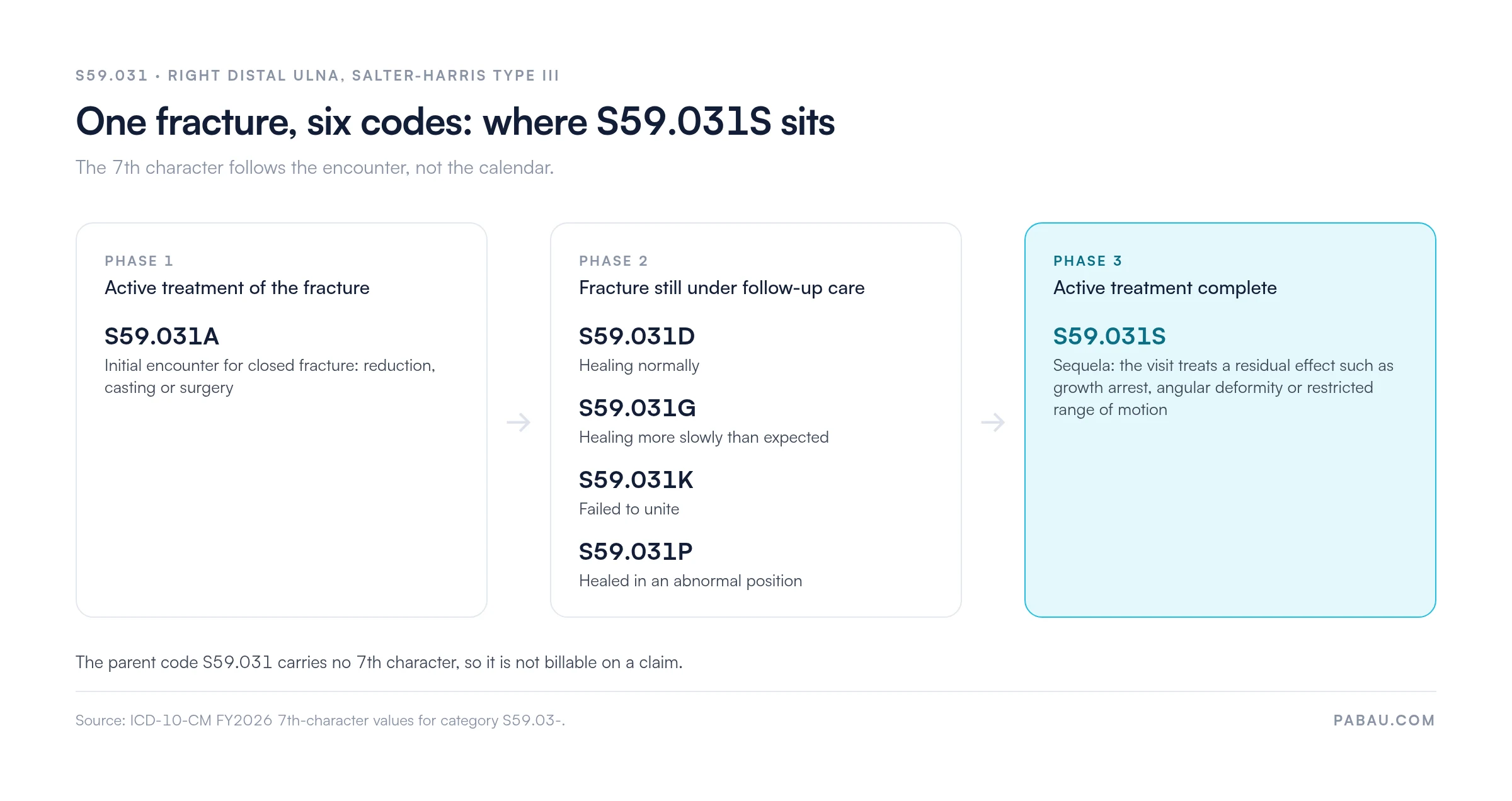
S59.031 has six billable child codes. Each is valid for submission only with its 7th character appended. To look up any of them directly, use the AAPC ICD-10-CM code lookup.
Note that S59.031 without a 7th character is non-billable and will be rejected by payers. Always append the correct episode-of-care character before claim submission. A missing character is cheapest to catch pre-submission, which is where cleaner claims management pays for itself.
Salter-Harris fractures are classified by the relationship between the fracture line and the growth plate (physis). A Type III fracture extends from the physis through the epiphysis, reaching the articular surface. Because the fracture crosses into the joint, anatomical reduction is critical. Displacement at the articular surface increases the risk of growth disturbance and long-term deformity.
These injuries predominantly occur in children and adolescents whose growth plates have not yet fused. The distal ulna physis is a recognized site for this fracture pattern, typically after a fall or sports-related wrist trauma.
Late complications such as premature physeal closure, angular deformity of the forearm, or residual joint incongruence are the conditions documented under the sequela code S59.031S.
Document the specific late effect in the clinical note, not just the sequela code. Payers and auditors expect to see the residual condition being treated, such as growth arrest, angular deformity, or restricted range of motion. That detail supports medical necessity for ongoing therapy or surgical correction.
Understanding the hierarchy helps coders navigate quickly and avoid selecting a non-billable parent code by mistake. S59.031S sits within the ICD-10-CM injury chapter as follows:
Left arm laterality follows the same hierarchy under S59.032, with S59.032S as the corresponding billable sequela code. The same left-arm group also carries S59.032G, the delayed-healing code for a subsequent encounter. Never use the right-arm code for a left-arm injury. Laterality errors are a leading cause of claim rejection on fracture codes.
Submitting S59.031S requires documentation that establishes three things. The record has to show a prior fracture of the right distal ulna consistent with a Salter-Harris Type III injury. It also has to show active treatment of a condition caused by that fracture, and name the late effect being managed.
Practices that submit sequela claims through a clearinghouse benefit from pre-submission editing. Those edits flag laterality mismatches and missing episode-of-care characters before the claim reaches the payer. For a broader view of the claims lifecycle, the submitting a clean claim guide explains the checks that matter most.
Coders working with S59.031S frequently need adjacent codes within the S59 category. The table below covers the ones referenced most often, and our ICD-10-CM code library covers the categories beyond it.
When the Salter-Harris type was not specified in the original medical record, S59.091S (other physeal fracture) is the appropriate fallback for a right arm sequela. Avoid assigning a specific type code without supporting documentation from the original treating clinician.
These three scenarios cover the encounter types that come up most often in pediatric distal ulna physeal fracture cases. Each one follows the ICD-10-CM Official Guidelines published by CDC/NCHS and CMS.
When not to use S59.031S: Do not apply the sequela code while the patient is still being treated for the fracture itself. The same holds while the fracture is still healing, where D, G, K, or P fit instead. A presenting condition unrelated to the prior fracture takes its own code. The wrong episode-of-care suffix is one of the most audited errors in fracture coding.
A sequela claim usually fails for a small reason. The 7th character gets carried over from the initial encounter, or the laterality is typed from memory. The rejection then arrives weeks later, by which point the encounter is cold and the note is harder to reconstruct.
Practice management software like Pabau keeps the diagnosis code, the clinical note, and the claim on the same record. Pabau’s integration with Claim.MD checks patient eligibility in real time and submits the claim electronically. Payer responses come back against that encounter, so the coder sees exactly which character or laterality was refused.
For a practice managing post-fracture cases across years of follow-up, that history sits in one client record. The coder can see the initial encounter code, the treatment dates, and the note linking the residual condition to the original injury.

Pabau integrates with Claim.MD to check patient eligibility in real time, submit claims electronically, and return each payer response against the encounter. Fewer rejections. Faster reimbursement.

Sequela coding on physeal fracture cases turns on one judgment. Has active treatment of the fracture finished? Once it has, S59.031S is straightforward, since the descriptor, the laterality, and the billable status are all fixed.
That judgment is worth documenting in the note itself, not only in the code. A payer reading the record should see the original fracture, the current residual condition, and the causal line between them.
Pabau returns each payer response against the encounter that produced it, so a rejected sequela claim surfaces in days rather than at month end. Book a demo to see how Pabau handles diagnosis code submission for orthopedic caseloads.

Need a structured claims submission workflow? Submitting a clean claim covers the pre-submission checks that prevent rejections on complex diagnosis codes.
Managing denials on musculoskeletal codes? Denial codes in medical billing explains the most common CARC denial reasons and how to respond.
Reworking rejected fracture claims? Denial management in healthcare sets out a process for tracking, appealing, and preventing repeat denials.
New to the billing process behind a code? What is medical billing walks through each step from patient registration to payment posting.
Want to understand the full billing cycle behind a claim? Revenue cycle management walks through every financial touchpoint from coding to reimbursement.
S59.031S is a billable ICD-10-CM diagnosis code. It covers the sequela, or late effect, of a Salter-Harris Type III physeal fracture of the lower end of the right ulna. It is used when a patient presents with a residual condition resulting from a prior fracture after active treatment has ended.
Yes. S59.031S is a fully billable ICD-10-CM code valid for the 2026 FY edition. The parent code S59.031 (without a 7th character) is non-billable and will be rejected on claim submission.
The ‘S’ suffix designates sequela in ICD-10-CM, meaning the encounter is for a late effect of a prior injury rather than the injury itself. There is no minimum time requirement. What matters is that active treatment of the original fracture is complete.
S59.031A is used for the initial encounter, when the patient is first receiving active treatment for the Salter-Harris Type III fracture. S59.031S is used for sequela encounters, after active treatment has ended. The visit addresses a residual late effect such as growth arrest or angular deformity.
The left arm equivalent is S59.032S (Salter-Harris Type III physeal fracture of lower end of ulna, left arm, sequela). S59.031S specifies the right arm only. Using it for a left-arm injury is a laterality error, and a common cause of claim denial.
CPT codes paired with S59.031S depend on the service rendered. Outpatient evaluation and management visits commonly use CPT 99213 or 99214. Corrective osteotomy procedures would use the relevant musculoskeletal CPT codes, and physical therapy visits use timed therapeutic codes such as 97110 or 97530.