ICD-10 code S72.454D: Nondisplaced supracondylar femur fracture, subsequent encounter
ICD-10 code S72.454D: Code details at a glance ICD-10 code S72.454D is the billa...

Last Updated: Oct 22, 2026
Billable Code Specific Code
S58.919S is the billable ICD-10-CM code for complete traumatic amputation of unspecified forearm, level unspecified, sequela. It applies when a patient is treated for a late effect of a past traumatic forearm amputation, such as phantom limb pain.
The 7th character S marks the visit as sequela care, and the late-effect condition is coded first, with S58.919S after it. Using A or D for a sequela encounter is a frequent source of denials, because payers read those characters as active or healing-phase care.
Let Pabau's smart automation suggest the right codes, reduce claim denials, and keep your practice compliant—effortlessly.
Automate repetitive tasks and focus on what matters most—your patients.
Reduce coding errors and ensure compliance with the latest regulations.
Clean claims, fewer denials, and faster reimbursements.
Powerful insights and reporting to help your practice thrive.
HIPAA compliant SOC 2 certified GDPR-compliant Trusted by 4,000+ clinics worldwide

S58.919S is a billable ICD-10-CM code, valid since October 1, 2015, for sequela encounters after a complete traumatic forearm amputation.
The 7th character S marks a sequela encounter, where the visit treats a late effect of the amputation rather than the injury itself.
Under ICD-10-CM Guideline I.C.19.a, the late-effect condition is coded first and S58.919S follows it, so S58.919S is never the primary diagnosis.
Use Z89.2x (acquired absence of upper limb above wrist) for background amputation status, and S58.919S when the visit treats a sequela of the trauma.
Pabau, the practice management and billing platform we build, sends S58.919S claims through the Claim.MD clearinghouse and tracks sequela-related denials before they age.
ICD-10 Code S58.919S is a valid, billable ICD-10-CM diagnosis code for complete traumatic amputation of an unspecified forearm at an unspecified level, sequela. It sits in category S58 (traumatic amputation of elbow and forearm), in chapter 19 (injury, poisoning and certain other consequences of external causes). Per the CMS ICD-10-CM code files, S58.919S became valid on October 1, 2015 and remains active in the current fiscal year.
The code is specific to sequela encounters. The patient’s current visit treats a late effect of the original traumatic amputation, not the acute injury or routine follow-up during healing. On the claim, S58.919S follows the code for that late effect rather than leading it. This matters because payers treat A, D, and S encounters differently for medical necessity and coverage.
Each position in S58.919S carries a specific billing signal. A mismatch between what the operative report documents and what any of these characters conveys is a common cause of denials on this code. The CDC/NCHS ICD-10-CM lookup tool confirms the official descriptor for each segment.
Two characters draw the most scrutiny from payers. The 5th character 1 (complete) signals that the limb segment was fully severed. If the operative report documents a partial amputation, S58.929S applies instead.
The 6th character 9 (laterality unspecified) should only stand when the record does not specify right or left. ICD-10-CM guidelines require the highest specificity the documentation supports. Unspecified laterality on a record that clearly states a side will prompt a query.
The 7th character S designates a sequela encounter. The patient is presenting for a direct late effect of the original traumatic amputation, not for active treatment of the injury or routine healing care. Under ICD-10-CM Official Guidelines Section I.C.19.a, 7th character S covers complications or conditions that arise as a direct result of an injury.
The three 7th character options for S58.919 map to three distinct clinical situations:
A common coder mistake is using D when S is appropriate. Phantom limb pain management and stump revision tied to the original traumatic amputation take the S extension. Using D instead signals routine healing, which misrepresents the stage of care to the payer.
Per Section I.C.19.a, the specific sequela is coded first, and the injury code with its 7th character comes second. For a neuroma on the amputation stump, that first code is T87.30, or the right or left upper-extremity code when the side is documented.
Document the causal chain explicitly. The clinical note should state that the current encounter is being conducted because of the sequela of the traumatic amputation dated [original injury date]. Without that linkage in the record, a reviewer has no basis to approve the S extension over D, and a denial follows.
S58.919S sits at the center of a group of closely related codes. Confusing the laterality or completeness characters is the fastest route to an incorrect code. Use the AAPC ICD-10-CM code lookup to verify adjacent codes when the record specifies a side or a partial amputation.
When the record specifies right or left, code that side rather than defaulting to unspecified. When the side is unclear, query the physician before you submit. ICD-10-CM guidelines require the highest level of specificity the documentation supports. Submitting S58.919S when the record clearly states the right arm leaves specificity on the table and may prompt a documentation improvement request from the payer.
Z89.2x (acquired absence of upper limb above wrist) and S58.919S can both apply to a patient without a forearm. They do different jobs in ICD-10-CM. Z89.2x records that the limb is absent. S58.919S records that the visit treats a consequence of the original injury, and it is never sequenced first.
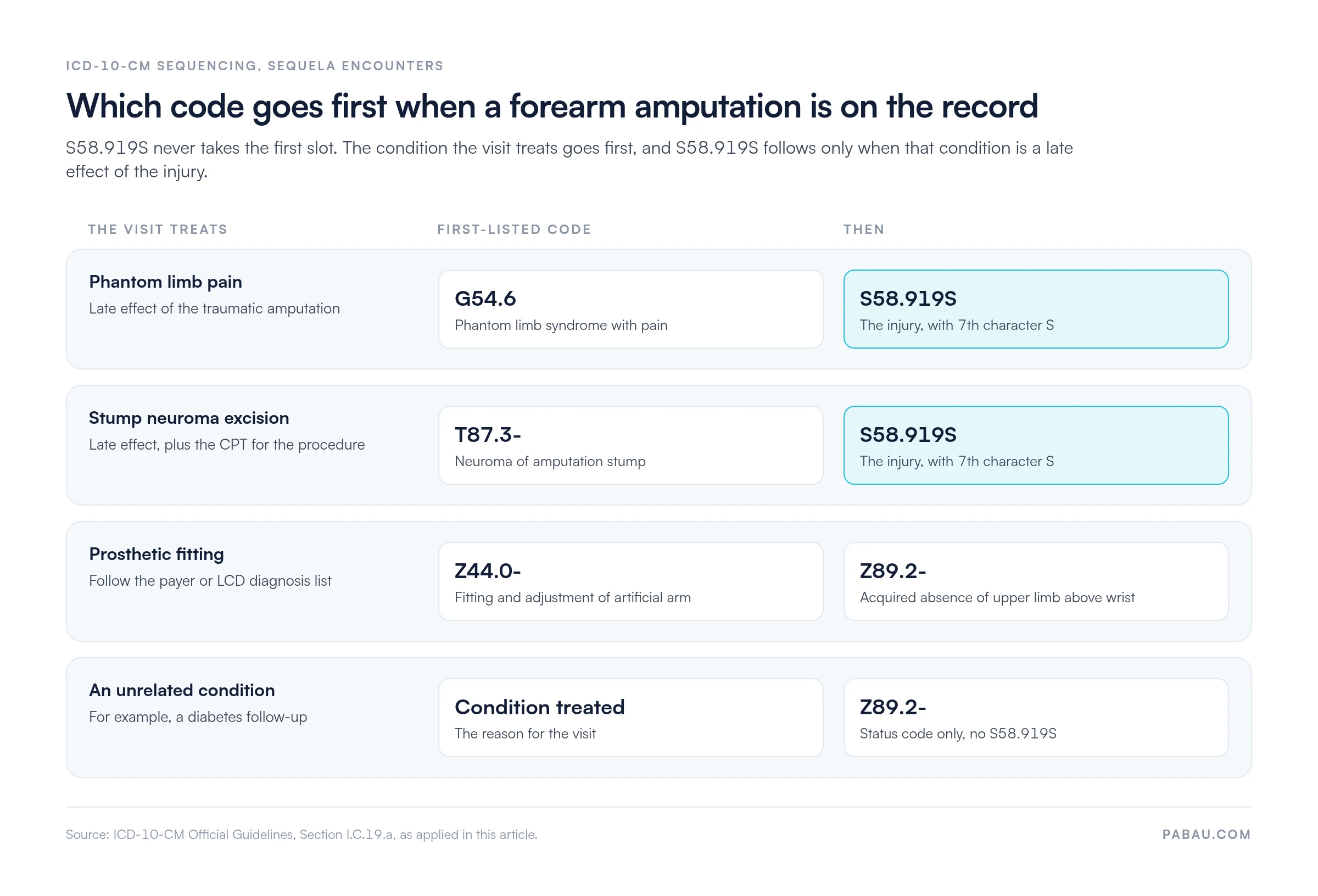
If the clinician is treating a late effect of the amputation, code that condition first and add S58.919S after it. If the clinician is treating something else, use Z89.2x (acquired absence of upper limb above wrist) as a secondary status code. The chart below sets out the code order for each encounter type in the table.
Meeting medical billing compliance standards for S58.919S requires documentation that goes beyond noting the amputation. Payers reviewing sequela encounters want to see a clear chain from the original traumatic event to the current condition being treated.
The medical record should address each of the following:
The laterality point deserves extra attention. If the physical examination documents “the patient’s right stump” and the coder submits S58.919S, an audit will flag the discrepancy. Query before submitting, not after a denial lands.
Medicare’s Local Coverage Determination framework applies to many services billed alongside S58.919S. For upper-extremity prosthetics, follow your Medicare Administrative Contractor’s (MAC’s) policy and the diagnosis codes it accepts, rather than assuming one injury code fits every payer. Payers may also require functional outcome documentation to show that prosthetic services are medically necessary for this patient.
Submitting S58.919S claims through a clearinghouse that runs real-time eligibility checks and claim edits reduces the risk of missing payer-specific coverage criteria. Pabau integrates with the Claim.MD clearinghouse. Claim.MD supports CMS-1500 claims to thousands of US payers, real-time eligibility checks, and ERA tracking, so coders can follow denial patterns on sequela codes.
Common CPT codes billed alongside S58.919S in sequela encounters include:
Verify current payer policy for each CPT pairing before billing. LCD and NCD policies change, and MAC-specific requirements for prosthetics can differ from general Medicare guidelines. For the OT evaluation, the complexity the therapist documents sets the code, from CPT 97165 for low complexity up to 97167 for high. The CMS ICD-10 resource page publishes each fiscal year’s code updates.
S58.919S denial patterns follow a predictable set of root causes. Tracking denial management at the code level shows which of these errors is driving rejections in a given practice. Coders should recognize the patterns below whatever tools the practice uses.
Each denial reason below has its own root cause, and each has a fix you can apply before resubmitting.
Practices that run pre-submission edits on S58.919S claims catch 7th character and laterality errors before they reach the payer. That check is what turns a coded encounter into a clean claim. It surfaces errors at submission rather than after a denial arrives weeks later.
When a denial does come back, its claim denial codes show whether the payer rejected the diagnosis, the 7th character, or medical necessity.
Many sequela denials start in the note, long before the claim. The clinician records phantom limb pain but not the injury date, or names a side the coder never sees. The claim then goes out with S58.919S in the wrong slot or the wrong laterality.
In Pabau, the clinical note, the invoice, and the claim sit on the same patient record. The coder works from the note the clinician signed. The late-effect condition, the injury date, and the side are in front of them when they sequence the codes.
Pabau’s claims management tools then send the claim through Claim.MD and match the ERA when the payer responds. Claim validation checks each claim for missing or invalid details before it leaves Pabau, so your team spends less time reworking denied sequela claims.

Pabau’s claims management tools connect clinical documentation to billing. Your team can submit clean S58.919S claims, track denial trends, and stay audit-ready without switching between systems.

S58.919S always plays a supporting role on the claim. The first code names what the patient came in for today, and S58.919S explains why that problem exists.
When the note names the late effect, the injury date, and the side, the code choice follows from the record. When it doesn’t, a quick query to the clinician costs far less than a denied claim and a resubmission.
Pabau keeps the note, the codes, and the claim on one patient record, so sequela errors surface before submission. Book a demo to see how Pabau handles coding and claims for injury sequela encounters.

Need to understand how claims flow from code to clearinghouse? Medical billing explained covers the end-to-end process from diagnosis coding through payment posting.
Tracking denial patterns across ICD-10 sequela codes? Denial management in healthcare outlines systematic approaches to identifying and resolving recurring denial triggers.
Coding a neuroma on the amputation stump? ICD-10 code T87.30 covers neuroma of amputation stump when the extremity is unspecified.
Want the most-used codes in one place? Medical coding cheat sheet gives your team a quick reference to keep beside the claim queue.
ICD-10 Code S58.919S is the billable ICD-10-CM diagnosis code for complete traumatic amputation of an unspecified forearm at an unspecified level, sequela. It is used when the encounter addresses a late effect of a prior traumatic forearm amputation, such as phantom limb pain or stump complications.
Yes, S58.919S is a fully billable ICD-10-CM code. It has been valid for encounter reporting since October 1, 2015, and remains active in the current ICD-10-CM fiscal year edition.
The 7th character S designates a sequela encounter. The current visit treats a late effect of the original traumatic amputation. It differs from A (active treatment of the acute injury) and D (routine healing care), which cover earlier stages of the same injury’s clinical course.
S58.919S represents a complete traumatic amputation of the unspecified forearm, sequela, while S58.929S represents a partial traumatic amputation of the unspecified forearm, sequela. The 5th character distinguishes them. A 1 means the limb was fully severed, and a 2 means it was only partially severed. Code selection depends on what the operative report from the original amputation documents.
Use S58.919S when the encounter treats a sequela of the traumatic amputation, such as phantom limb pain, and code that condition first. Use Z89.2x (acquired absence of upper limb above wrist) as a secondary status code when the amputation is background to an unrelated visit. Mixing these codes is a common audit finding.
S58 carries an Excludes1 note for traumatic amputation of wrist and hand (S68.-). Elbow-level amputation is coded to S58.0-, between elbow and wrist to S58.1-. Verify in the CDC/NCHS ICD-10-CM tabular list.