

ICD-10 code S61.201A: Open wound of left index finger without nail damage
ICD-10 code S61.201A covers a left index finger wound of unstated type ICD-10 co...

Last Updated: Oct 16, 2026
Billable Code Specific Code
ICD-10 code S56.415S is the billable ICD-10-CM code for strain of extensor muscle, fascia and tendon of right ring finger at forearm level, sequela. It reports what a healed forearm strain left behind, such as a ring finger that won't fully straighten.
The code sits in category S56, which covers muscle and tendon injuries above the wrist. Strains at or below the wrist move to S66 codes instead. The 7th character S means the strain itself has healed. On the claim, the residual condition code goes first and S56.415S follows it. Check the finger digit and the injury level against the note, because one wrong character changes the injury you bill.
Let Pabau's smart automation suggest the right codes, reduce claim denials, and keep your practice compliant—effortlessly.
Automate repetitive tasks and focus on what matters most—your patients.
Reduce coding errors and ensure compliance with the latest regulations.
Clean claims, fewer denials, and faster reimbursements.
Powerful insights and reporting to help your practice thrive.
HIPAA compliant SOC 2 certified GDPR-compliant Trusted by 4,000+ clinics worldwide

S56.415S reports a healed extensor strain of the right ring finger at forearm level, in the sequela phase.
List the residual condition first, such as M20.011 for mallet finger, then add S56.415S after it.
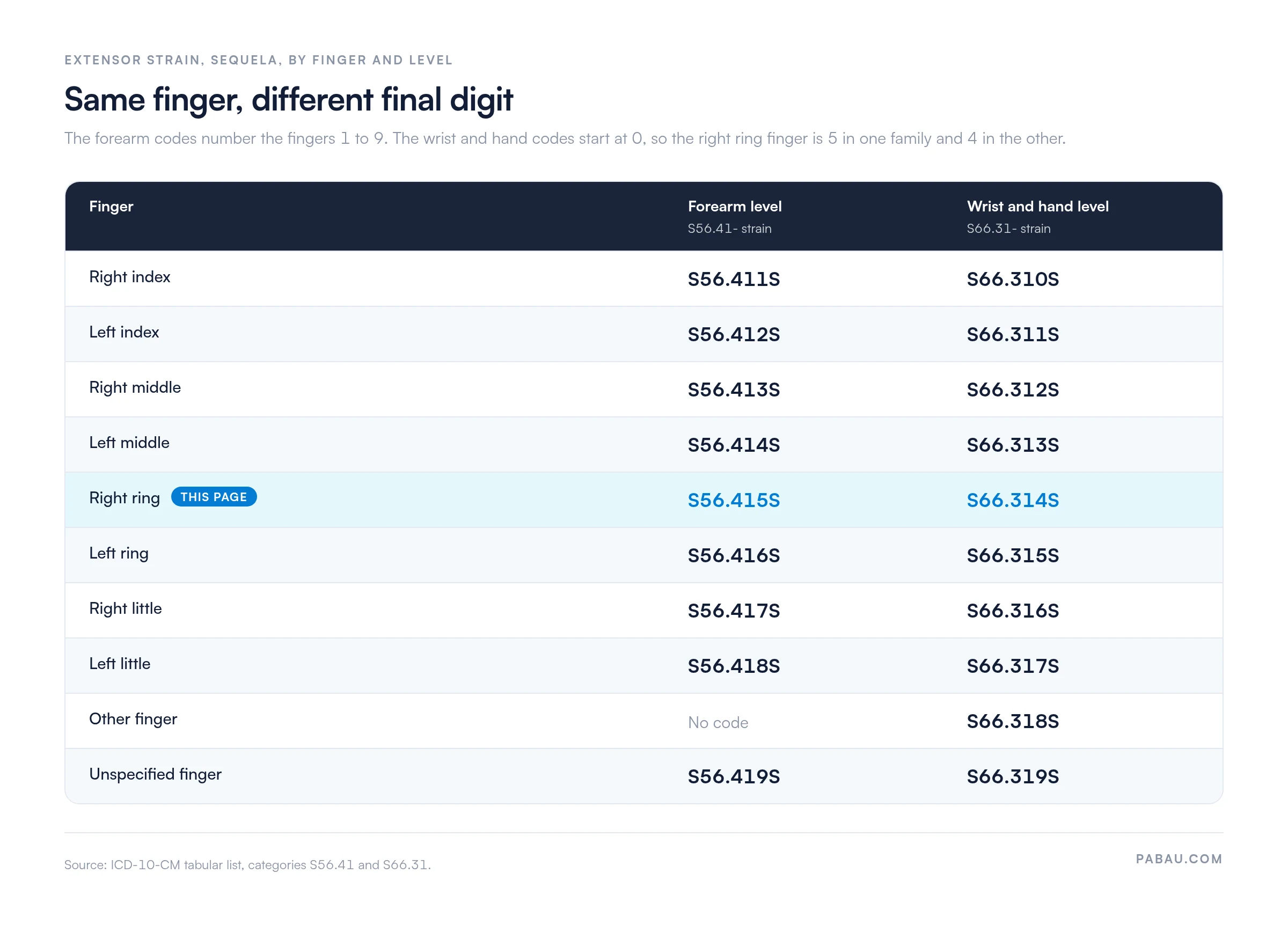
The wrist and hand counterpart is S66.314S, because S66.31- numbers the right ring finger 4, not 5.
Routine follow-up while the strain still heals takes S56.415D, never the Z47.89 aftercare code.
The note must name the side, the finger, the forearm level, the original strain and the causal link.
ICD-10 code S56.415S reports the lasting effects of a healed extensor strain in the right ring finger. The strain happened at forearm level, in the muscle or tendon above the wrist.
Each character in the code narrows its meaning, as the table shows. The official descriptor reads “Strain of extensor muscle, fascia and tendon of right ring finger at forearm level, sequela.”
Category S56 stops at the wrist. Its Excludes2 note sends injuries at or below the wrist to category S66. That category covers muscle, fascia and tendon at wrist and hand level. At that level, the same ring finger strain is S66.314S.
S56.415S is a billable code in the CMS ICD-10-CM code set. It never travels alone, though. A sequela claim also needs a code for the residual problem, which we cover below.
One muscle does most of the work here. Extensor digitorum starts at the lateral epicondyle of the humerus and runs down the back of the forearm.
It splits into four tendons, one each for the index, middle, ring and little fingers. Unlike the index and little fingers, the ring finger has no extensor of its own.
Near the finger, each tendon spreads into an extensor hood with three working parts:
On the back of the hand, small bands called juncturae tendinum link the ring finger tendon to its neighbors. They can pull the ring finger straight along with the middle finger.
A quick exam may then miss weak extension. That is why a note recording isolated ring finger extension carries more weight.
The posterior interosseous nerve, a branch of the radial nerve, supplies the muscle. A radial nerve injury at forearm level codes to S54.2-, separately from S56.415S.
Laterality and finger share the sixth character. Get either one wrong, and the claim describes a different hand.
In S56.41-, odd digits mark the right hand and even digits the left. They run from the index finger (1 and 2) to the little finger (7 and 8). S56.419S covers an unspecified finger.
The wrist and hand codes follow a different pattern. Category S66.31- starts counting at 0, so the right ring finger becomes S66.314S. The grid below lines up both families.
These codes differ from S56.415S by one character or one word. A single slip bills a different injury, so check each one against the note.
Unsure about a neighbor? Confirm it in the CDC/NCHS ICD-10-CM browser before you swap codes.
S56.415S fits when the strain has healed but the finger hasn’t fully recovered. Today’s visit treats what the strain left behind.
Typical presentations include:
One caution on those deformities. Mallet and boutonniere patterns usually follow an injury on the finger itself. If the original strain sat at hand or finger level, the sequela code comes from S66.3- instead.
So read the first encounter note before coding the residual problem. It tells you where the strain happened.
ICD-10-CM guideline I.C.19.a sets the rule. A sequela claim needs the code for the residual condition and the injury code that caused it.
The residual condition goes first, and S56.415S follows. The S attaches to the injury code only. Common residual codes for this finger include:
Match the residual code to the clinician’s own words. A note that says “stiff ring finger” supports M25.641, not a contracture code.
Pain codes need extra care with site. M79.644 covers the right finger, M79.631 the right forearm and M79.621 the right upper arm.
The 7th character tracks the phase of care. How long ago the strain happened doesn’t decide it.
Aftercare Z codes don’t apply to injuries. Guideline I.C.21.c.7 points coders to the injury code with 7th character D instead.
That means Z47.89, encounter for other orthopedic aftercare, never stands in for S56.415D. The switch to S comes once the clinician documents that the strain itself has healed.
Auditors check four points in the record before they accept a sequela claim:
Measurements matter most once therapy starts. Record the extensor lag in degrees and grip strength on both hands.
Structured fields in the therapy note make both easy to capture at every visit.
A sequela claim passes several checkpoints after the visit. If you’re new to the cycle, what is medical billing covers it end to end.
Therapy adds one more checkpoint. Past Medicare’s annual therapy threshold, services need the KX modifier and documented medical necessity.
When a claim does come back, the reason code points to the fix:
For a broader playbook, see denial management in healthcare and this guide to denial codes in medical billing.
Five minutes here can save a resubmission later. Before the claim goes out, confirm:
Pass every check and you have what billers call a clean claim. The payer can process it on the first try.
Read the first visit’s note before any S claim goes out. If it describes a cut, the code is S56.425S. If the strain sat below the wrist, switch to S66.314S.
Sequela claims often stall over a missing residual code or an empty required field. By the time the denial lands, the visit is weeks old.
Pabau, the practice management platform we build, keeps the claim inside the same patient record as the clinical note. Our claims management software pre-fills the claim from the invoice and the insurer details on the client card.
Pabau checks each claim for missing or invalid details, such as membership numbers, before it goes out. Submission then runs through Claim.MD, our US claims integration. Eligibility checks, claim status and remittance posting sit in the same place, so your team spends less time chasing returns.

Pabau pre-fills claims from the invoice and checks them for missing or invalid details. Claim.MD, our US claims integration, sends them on. Spend less time chasing returned S56.415S claims.

S56.415S rewards a careful read of the chart. Three details decide it: extensor, forearm level and right ring finger.
Treat the first visit’s note as your anchor, since it fixes the injury type and level. Today’s note then supplies the residual condition that goes first on the claim. With both in order, the claim tells the payer one consistent story.
Book a demo to see how Pabau keeps sequela claims complete, from the clinical note to the remittance.

Want to see how a sequela claim travels after you hit send? Claim.MD clearinghouse overview explains how electronic claims are checked and passed on to payers.
Trying to read a denial on a returned claim? Electronic remittance advice (ERA) guide shows how to read 835 files and find the reason code.
Building audit-ready documentation habits? Medical billing compliance guide covers the documentation standards that keep injury claims defensible.
Checking coverage before therapy starts? Insurance eligibility verification walks through confirming benefits before the first visit.
Usually not. Coding guidelines sequence the residual condition first, such as M20.011 for a mallet finger. S56.415S follows to show where that condition came from.
There’s no national requirement to report external cause codes. If your state or payer asks for one, give it the same S character. An earlier fall, for example, becomes W18.30XS.
No. One strain can’t be healing and healed at the same visit. Use D while treatment of the strain continues, and S once a healed strain leaves a residual problem.
Then S56.415S doesn’t apply, because S56 codes need trauma. A spontaneous rupture of the extensor tendons in the right forearm codes to M66.231.
No. The S applies for as long as the residual condition is treated. That could be months or years after the strain.



