Pabau Engage inbox

Pabau Engage is here: every patient conversation in one inbox.

Learn more
Book a demo Book a demo
☰
ICD-10-CM Code

ICD code S52.342C – Displaced spiral fracture of radius shaft, left arm, open type III

Billable Code Specific Code


Code Definition

S52.342C is the billable ICD-10-CM code for an open spiral fracture of the left radial shaft. The official descriptor reads: displaced spiral fracture of shaft of radius, left arm, initial encounter for open fracture type IIIA, IIIB, or IIIC.

Use it at the first active-treatment visit, when the wound breaks the skin and carries a Gustilo grade of III. The fracture must sit in the shaft, not the lower end of the radius. A type I or II wound takes S52.342B instead.

Chapter
S00-T88 Injury, poisoning and certain other consequences of external causes
Category
S52 Fracture of forearm
Group
S52.342 Displaced spiral fracture of shaft of radius, left arm
Billable
Yes
Code also known as
Left radial shaft spiral fracture, open spiral fracture of left radius, Gustilo type III radial shaft fracture
Save time. Improve accuracy. Get paid faster.
Automate coding with Pabau

Let Pabau's smart automation suggest the right codes, reduce claim denials, and keep your practice compliant—effortlessly.

  • AI-powered code suggestions
  • Real-time compliance checks
  • Faster claims, fewer denials
Why practices choose Pabau
Save hours every week

Automate repetitive tasks and focus on what matters most—your patients.

Improve accuracy

Reduce coding errors and ensure compliance with the latest regulations.

Get paid faster

Clean claims, fewer denials, and faster reimbursements.

Grow with confidence

Powerful insights and reporting to help your practice thrive.

HIPAA compliant SOC 2 certified GDPR-compliant Trusted by 4,000+ clinics worldwide

Key takeaways

Key takeaways

S52.342C is billable and covers a displaced spiral fracture of the left radial shaft at the initial encounter for an open type III injury.

The 7th character C covers Gustilo type IIIA, IIIB, and IIIC only. Open type I or II takes character B, and a closed fracture takes character A.

The 4th character places this code in the radial shaft branch, so a Colles fracture or another lower-end wrist injury never maps here.

Pabau’s claim validation scrubs claims for missing or invalid details before submission, so fixes happen before a rejection.

ICD-10 code S52.342C: Quick reference

ICD-10 code S52.342C is the billable diagnosis code for a displaced spiral fracture of the left radial shaft. It applies at the initial encounter, and only when the open wound is graded Gustilo type III. Every field below comes from the CDC/NCHS ICD-10-CM web tool, the authoritative U.S. lookup source.

Field Value
Code S52.342C
Full descriptor Displaced spiral fracture of shaft of radius, left arm, initial encounter for open fracture type IIIA, IIIB, or IIIC
Billable Yes
Code category S52 – Fracture of forearm
Subcategory S52.34 – Spiral fracture of shaft of radius
Chapter Chapter 19 – Injury, poisoning, and certain other consequences of external causes (S00-T88)
Valid 7th character C (initial encounter, open fracture type IIIA, IIIB, or IIIC)
Laterality and displacement Displaced, left arm (6th character = 2)

What does S52.342C mean? Breaking down the code structure

S52.342C is a seven-character alphanumeric string, and each position carries a specific clinical meaning. Misreading any position leads to the wrong code.

Position Character(s) Meaning
1-3 S52 Fracture of forearm (category)
4th .3 Fracture of shaft of radius
5th 4 Spiral fracture pattern
6th 2 Displaced, left arm
7th C Initial encounter, open fracture type IIIA, IIIB, or IIIC

Two positions trip coders up here. The 5th character 4 names the fracture pattern as spiral, not the displacement status. Displacement and laterality are both bundled into the single 6th character, so changing the side also changes the digit that proves displacement.

The 4th character is just as decisive. A 3 in that slot means the fracture sits in the shaft of the radius, roughly the middle third of the bone. Lower-end injuries near the wrist belong to S52.5- instead. The phrase “distal end of radius” appears in the S52.5 tabular entry as an inclusion term, and never under S52.3.

Open fracture classification and the 7th character C

The 7th character C maps only to Gustilo-Anderson type IIIA, IIIB, and IIIC open fractures. The S52 tabular entry states plainly that open fracture designations follow the Gustilo classification. Per the CMS ICD-10-CM Official Guidelines, the coder uses whichever Gustilo type the treating surgeon documents.

Gustilo type Wound characteristics ICD-10-CM 7th character (initial)
Type I Clean wound under 1 cm with minimal contamination B
Type II Laceration over 1 cm, moderate soft-tissue damage B
Open fracture NOS Note records an open fracture but states no Gustilo grade B
Type IIIA Extensive soft-tissue laceration, bone still adequately covered C
Type IIIB Extensive soft-tissue loss with periosteal stripping and bone exposure C
Type IIIC Open fracture with arterial injury requiring repair C

The Gustilo grade is the line in the operative note that decides this code. If the surgeon grades the wound IIIA, IIIB, or IIIC, character C applies. If the note says type I, type II, or simply “open fracture” with no grade, the correct code is S52.342B instead.

The coder cannot upgrade a wound to type III from the description alone. Phrases such as “large laceration” or “heavily contaminated” are suggestive, but they are not a Gustilo grade. Query the surgeon rather than assume.

7th character rules for S52.342: Complete reference table

Category S52 carries a 7th character note instructing that the character be added to every code in the category. It controls encounter type, wound status, and healing status together. All sixteen valid characters for the S52.342 base code are listed below.

7th character Meaning When used
A Initial encounter for closed fracture Active treatment, skin intact over the fracture
B Initial encounter for open fracture type I or II Active treatment, Gustilo I, II, or open NOS
C Initial encounter for open fracture type IIIA, IIIB, or IIIC Active treatment, Gustilo grade III wound
D Subsequent encounter for closed fracture with routine healing Follow-up after active treatment, closed fracture
E Subsequent encounter for open fracture type I or II with routine healing Follow-up, Gustilo I or II, healing on schedule
F Subsequent encounter for open fracture type IIIA, IIIB, or IIIC with routine healing Follow-up to this injury, healing on schedule
G Subsequent encounter for closed fracture with delayed healing Follow-up, closed fracture behind schedule
H Subsequent encounter for open fracture type I or II with delayed healing Follow-up, Gustilo I or II, behind schedule
J Subsequent encounter for open fracture type IIIA, IIIB, or IIIC with delayed healing Follow-up to this injury, behind schedule
K Subsequent encounter for closed fracture with nonunion Closed fracture failed to unite
M Subsequent encounter for open fracture type I or II with nonunion Gustilo I or II fracture failed to unite
N Subsequent encounter for open fracture type IIIA, IIIB, or IIIC with nonunion This injury failed to unite
P Subsequent encounter for closed fracture with malunion Closed fracture united in poor alignment
Q Subsequent encounter for open fracture type I or II with malunion Gustilo I or II fracture united in poor alignment
R Subsequent encounter for open fracture type IIIA, IIIB, or IIIC with malunion This injury united in poor alignment
S Sequela Treating a late effect, such as chronic pain, not the fracture itself

Notice how the open-fracture grade travels with the patient. An injury coded C at the first encounter moves to F, J, N, or R at later visits. It never moves to D or E, which are reserved for closed wounds and for Gustilo type I and II wounds.

Dropping to a type I or II character on follow-up contradicts the original record and invites a payer review. The grid below lays the same 16 characters out as wound grade against encounter type. That makes the path this injury takes easier to follow.
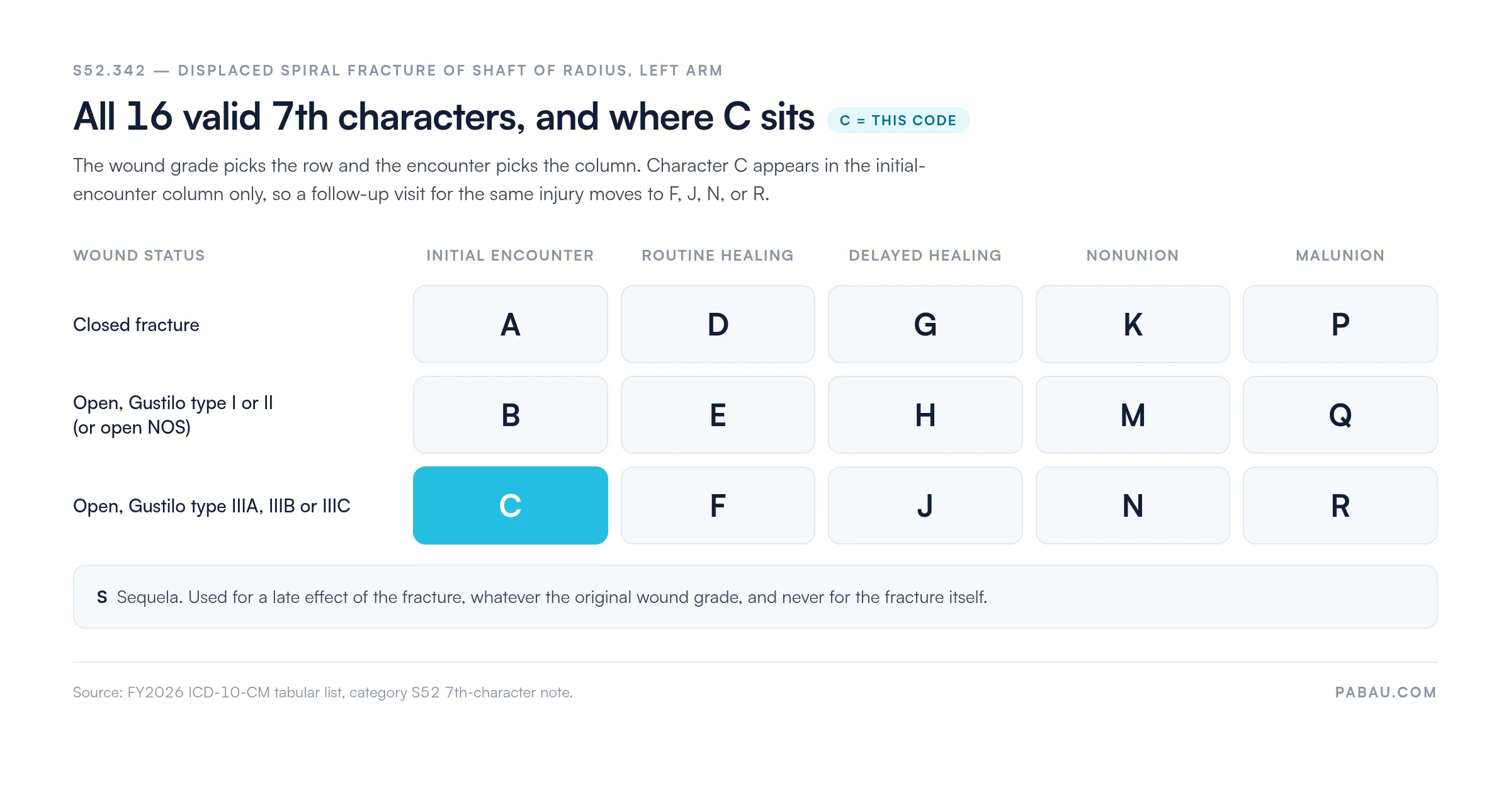
Grid of all 16 valid 7th characters for ICD-10-CM code S52.342: a closed fracture takes A, D, G, K or P; an open Gustilo type I or II wound takes B, E, H, M or Q; an open Gustilo type IIIA, IIIB or IIIC wound takes C, F, J, N or R; S is sequela.
Character C exists only in the initial-encounter column, so every later visit for the same type III wound moves right. Source: FY2026 ICD-10-CM tabular list.

Displacement and laterality: Reading the 6th character in the S52.34 family

The S52.34 subcategory covers spiral fractures of the radial shaft. Its 6th character does double duty, encoding displacement status and side in a single digit. There are six valid values, and no unspecified-side digit 9 exists in this family.

Code Displacement and side When to use
S52.341 Displaced, right arm Record confirms a displaced right radial shaft spiral fracture
S52.342 Displaced, left arm Record confirms a displaced left radial shaft spiral fracture
S52.343 Displaced, unspecified arm Displacement documented, side missing from the record
S52.344 Nondisplaced, right arm Imaging reports no displacement, right side
S52.345 Nondisplaced, left arm Imaging reports no displacement, left side
S52.346 Nondisplaced, unspecified arm No displacement, side missing from the record

Because the digit 9 is not valid here, a construction such as S52.349C does not exist. Software that silently builds it will fail a clearinghouse edit. When the side is genuinely undocumented, S52.343C is the correct unspecified option.

The S52 tabular entry also sets a default: a fracture not described as displaced or nondisplaced is coded to displaced. That rule is why an incomplete radiology report still lands on S52.342 rather than S52.345. Laterality carries no such default, so the side must come from the chart, imaging report, or operative note.

Commonly confused codes and how to choose correctly

Several codes sit adjacent to S52.342C in the tabular list and are frequently misassigned. The table below maps the most common look-alikes and the single documentation detail that separates each one.

Code Descriptor Key distinction
S52.342A Displaced spiral fracture of shaft of radius, left arm, initial encounter for closed fracture Skin intact; no wound communicating with the fracture
S52.342B Displaced spiral fracture of shaft of radius, left arm, initial encounter for open fracture type I or II Open wound graded Gustilo I or II, or recorded as open NOS
S52.345C Nondisplaced spiral fracture of shaft of radius, left arm, initial encounter for open fracture type IIIA, IIIB, or IIIC Imaging explicitly reports no displacement
S52.341C Displaced spiral fracture of shaft of radius, right arm, initial encounter for open fracture type IIIA, IIIB, or IIIC Identical injury on the right arm
S52.352C Displaced comminuted fracture of shaft of radius, left arm, initial encounter for open fracture type IIIA, IIIB, or IIIC Comminuted rather than spiral fracture pattern
S52.372C Galeazzi’s fracture of left radius, initial encounter for open fracture type IIIA, IIIB, or IIIC Radial shaft fracture plus distal radioulnar joint dislocation
S52.302C Unspecified fracture of shaft of left radius, initial encounter for open fracture type IIIA, IIIB, or IIIC Fracture pattern never named in the record
S52.502C Unspecified fracture of the lower end of left radius, initial encounter for open fracture type IIIA, IIIB, or IIIC Injury sits at the wrist end, not the shaft
M84.434A Pathological fracture, left radius, initial encounter for fracture Fracture through diseased bone rather than trauma

The Galeazzi row deserves a second look. The S52.37 tabular entry carries an inclusion term: fracture of lower shaft of radius with radioulnar joint dislocation. A spiral shaft fracture with a dislocated distal radioulnar joint therefore routes to S52.372C, not S52.342C. The dislocation is what moves the code.

Traumatic vs pathological fractures: Routing to the right code

Traumatic fractures belong in S52. Pathological fractures belong in M84 or M80, depending on the underlying disease, and stress fractures in M84.3. The documentation trigger is the physician’s description of mechanism.

  • Routes to S52 (traumatic): “fell on outstretched hand,” “arm caught and twisted,” “direct blow,” “motor vehicle accident,” “fall from height”
  • Routes to M84.4 (pathological, NEC): “pathologic fracture” or “chronic fracture” with no underlying disease named in the record
  • Routes elsewhere in M84 or M80: a fracture through a lytic lesion takes M84.5-, another named disease takes M84.6-, and osteoporosis takes M80.-
  • Routes to M84.3 (stress): “fatigue fracture,” “march fracture,” “stress reaction progressing to fracture”
  • Ambiguous language that causes audits: “spontaneous fracture,” “fracture with minimal trauma,” “fracture with trivial injury” – query the physician before coding

A spiral pattern is itself a clue to mechanism. Spiral fractures come from a twisting force applied along the length of the bone, so the note should describe a rotational injury. If it instead describes bone disease, the claim may belong in M84 or M80 instead.

One Excludes1 note is worth memorizing. M84.4 excludes traumatic fracture and names S52 explicitly, so the two are never reported together for the same site at one encounter.

Pro Tip

Run a documentation query whenever the chart carries an S52 fracture code alongside an active diagnosis of osteoporosis or bone malignancy at the same site. These cases are prime targets for post-payment audit. A one-line physician attestation confirming a traumatic, rotational mechanism lowers the audit risk before the claim is submitted.

CPT procedure codes that pair with S52.342C

S52.342C is a radial shaft fracture, so it pairs with the 25500 series rather than the distal radius codes in the 25600 series. Pairing a 25600-series CPT with this diagnosis is an outright site mismatch. According to the AAPC Codify ICD-10-CM lookup, the codes below are the realistic pairings.

CPT code Description When used
25500 Closed treatment of radial shaft fracture; without manipulation Rare with this diagnosis, since an open type III wound almost always reaches the operating room
25505 Closed treatment of radial shaft fracture; with manipulation Closed reduction only, with no surgical exposure of the fracture
25515 Open treatment of radial shaft fracture, includes internal fixation, when performed The usual pairing: plate or intramedullary fixation of the radial shaft
25574 Open treatment of radial AND ulnar shaft fractures, with internal fixation, when performed; of radius OR ulna Both forearm bones fractured, only one fixed operatively
25575 Open treatment of radial AND ulnar shaft fractures, with internal fixation, when performed; of radius AND ulna Both shafts fixed operatively; add the matching S52.2- ulna code
11010 Debridement at the site of an open fracture; skin and subcutaneous tissues Superficial debridement of the open wound
11011 Debridement at the site of an open fracture; skin, subcutaneous tissue, muscle fascia, and muscle Debridement carried down to muscle
11012 Debridement at the site of an open fracture; skin, subcutaneous tissue, muscle fascia, muscle, and bone Debridement carried to bone, common in Gustilo IIIA to IIIC injuries

The 11010 to 11012 family exists specifically for open fractures, which makes it the natural companion to a character C diagnosis. Choose the code by depth of tissue debrided, not by wound size. Documenting bone debridement supports 11012, while documenting only skin supports 11010.

Closed treatment is uncommon here, but it is not impossible. If both forearm bones break and the surgeon reduces them without opening the fracture, 25565 is the code for that session.

One more routing rule. If the operative note also describes a distal radioulnar joint dislocation, the Galeazzi CPT codes 25520, 25525, and 25526 come into play. The diagnosis moves to S52.372C at the same time. NCCI edits bundle wound care into the fracture CPT when both occur at the same session, so review the edit pair before submitting.

Documentation requirements to support S52.342C

Medicare and most commercial payers expect the elements below before accepting S52.342C on a claim. Missing any one of them invites a denial.

  • Explicit laterality: the record must state the left arm. “Forearm fracture” with no side cannot support S52.342C.
  • Fracture site: the note or imaging must place the fracture in the shaft or middle third of the radius. A wrist-end injury routes to S52.5-.
  • Fracture pattern: the radiologist or surgeon must describe the fracture as spiral. Transverse, comminuted, segmental, and greenstick patterns each have their own subcategory.
  • Displacement status: displaced, or silent on the point. The S52 default codes an undescribed fracture to displaced, but an explicit statement survives audit far better.
  • Gustilo grade from the treating surgeon: the operative note must say type IIIA, IIIB, or IIIC. A grade of I or II, or no grade at all, moves the code to S52.342B.
  • Traumatic mechanism: a documented injuring event, ideally a rotational or twisting force consistent with a spiral pattern.
  • Encounter context: emergency department record, operating room note, or first fracture visit confirming active treatment rather than follow-up.
  • External cause code: Chapter 19 instructs you to add a secondary code from Chapter 20 identifying how the injury happened.

Post-payment audits of open fracture claims focus hardest on the Gustilo grade, because it is the one element that separates two otherwise identical codes. A note that records the grade, the wound size, and the state of soft-tissue coverage answers the reviewer before the question is asked.

Connecting to the denial management workflow early keeps these records audit-ready. Pabau, the practice management platform we build, links to the Claim.MD clearinghouse. That connection checks patient eligibility before the visit and tracks claim status and remittances.

Top reasons S52.342C claims are denied and how to prevent them

Wrong 7th-character assignment is a common cause of S52 rejections. The five most preventable causes are listed below with concrete corrective steps.

  1. Character C assigned to a type I or II wound. C is reserved for Gustilo IIIA, IIIB, and IIIC. A note describing a clean 1 cm laceration supports S52.342B instead. Prevention: require the Gustilo grade as a discrete field in the operative note template.
  2. Character C used on a follow-up visit. C is initial-encounter only. Wound checks, dressing changes, and later fixation reviews take F, J, N, or R depending on healing. Prevention: add an encounter-type check at charge entry that flags C on any visit after the first.
  3. Shaft and lower-end codes swapped. Coders reach for S52.3- when the chart says “distal radius,” which belongs in S52.5-. Prevention: confirm the anatomical third named in the radiology report before choosing the 4th character.
  4. CPT and ICD-10 site mismatch. Billing 25600 or 25609, both distal radius procedures, against a shaft diagnosis triggers an edit. Prevention: validate pairings with the AAPC CPT-to-ICD-10 crosswalk before submission.
  5. Traumatic vs pathological routing error. Billing S52.342C when the record hints at bone disease or minimal trauma. Prevention: query the physician whenever a forearm fracture appears alongside osteoporosis or malignancy.

A clearinghouse that validates ICD-10 character logic before transmission catches the first two causes outright. Pabau’s claim validation scrubs every claim for missing or invalid details before it leaves Pabau.

Automated claims and billing inside Pabau
Pabau’s automated claim submission sends the S52.342C diagnosis and its fracture CPT to the clearinghouse, so nobody rekeys the claim.

Official notes and Excludes rules governing S52.342C

The S52 tabular entry carries several official notes that govern how S52.342C behaves on a claim. These come straight from the FY2026 ICD-10-CM tabular list and the Chapter 19 injury coding rules.

  • 7th character requirement: the note under S52 instructs that a 7th character be added to every code in the category. Submitting the base code S52.342 is invalid and will be rejected at clearinghouse edits.
  • Displacement default: a fracture not described as displaced or nondisplaced is coded to displaced.
  • Open or closed default: a fracture not described as open or closed is coded to closed. S52.342C therefore requires an affirmative open-wound description in the record.
  • Gustilo basis: the note states that open fracture designations are based on the Gustilo open fracture classification. That is why characters B and C hinge on the surgeon’s grade.
  • Excludes1 under S52: traumatic amputation of forearm (S58.-). An amputation is coded there instead, never alongside an S52 fracture of the same limb.
  • Excludes2 under S52: fracture at wrist and hand level (S62.-) and periprosthetic fracture around an internal prosthetic elbow joint (M97.4). Excludes2 permits both codes when both injuries are genuinely present.
  • Excludes1 under M84.4: traumatic fracture, with S52 named in the list. A traumatic and a pathological fracture of the same bone never share an encounter.
  • Chapter 19 instruction: use a secondary code from Chapter 20 to identify the external cause of the injury.

The CMS ICD-10-CM Official Guidelines are republished each fiscal year and govern every one of these notes. Check the current edition before relying on a default rule in an appeal. The rest of the ICD-10-CM code set follows the same note structure, so these habits carry across to other injury categories.

How Pabau keeps S52.342C fracture claims clean

Fracture coding errors usually surface after the remittance arrives. A coder assigns C to a type II wound, the claim is denied, and someone rebuilds it from the operative note. Across a busy orthopedic list, that rework becomes a standing cost.

Pabau moves that check forward. Its claims software for practices scrubs each claim for missing or invalid details before submission. Errors come back on screen while the coder is still in the record.

Electronic remittance advice posts automatically, so the claims that do bounce surface the same day. Your billing team sees which fracture claims need a correction while the operative note is still fresh.

Reduce fracture claim denials before they reach the payer

Pabau’s claim validation scrubs claims for missing or invalid details before they leave Pabau. See it in action.

Pabau claims management dashboard

Conclusion

S52.342C only fits one injury: a displaced spiral fracture of the left radial shaft, first encounter, with a Gustilo type III open wound. Change the side, the fracture pattern, the anatomical third, or the wound grade, and a different code applies.

Three habits keep these claims clean. Read the 4th character as a site decision. Read the 6th as displacement and side together. Take the 7th straight from the surgeon’s Gustilo grade.

Build those checks into charge entry and the denial pattern largely disappears. To see how fracture claim validation works inside a single system, book a demo of Pabau.

Continue your research

Continue your research

Need to understand how claims move from code to payment? What is medical billing walks through the end-to-end claims workflow from charge capture to ERA posting.

Want to reduce denials across your orthopedic claims? Denial management in healthcare covers systematic approaches to tracking, appealing, and preventing payer rejections.

Looking for the denial reason codes that come back on S52 claims? Denial codes in medical billing explains CARC and RARC codes and how to act on them.

Frequently asked questions

What does ICD-10 Code S52.342C mean?

ICD-10 Code S52.342C is the billable diagnosis code for a displaced spiral fracture of the shaft of the left radius. It applies at the initial encounter, and only when the open wound is graded Gustilo type IIIA, IIIB, or IIIC. It covers the active-treatment phase, not follow-up or wound-care visits after that first encounter.

What is the difference between S52.342B and S52.342C?

Both describe the same displaced spiral fracture of the left radial shaft at the initial encounter. The difference is the Gustilo grade of the open wound. Character B covers type I, type II, and open fracture NOS, while character C covers type IIIA, IIIB, and IIIC.

Is S52.342C a distal radius or wrist fracture code?

No. The 4th character 3 places this code in the shaft of the radius. Fractures of the lower or distal end of the radius, including Colles and Smith fractures, belong to subcategory S52.5-. The phrase “distal end of radius” appears as an inclusion term under S52.5, never under S52.3.

Which Gustilo types map to the 7th character C?

Only type IIIA, type IIIB, and type IIIC map to the 7th character C in this code. Type I, type II, and open fracture NOS all map to character B instead. The coder takes the grade from the treating surgeon’s note, and cannot assign it from the wound description alone.

Is S52.342C used for the initial encounter only?

Yes. Character C is restricted to the initial encounter for active treatment. Later visits for the same open type III fracture use F for routine healing, J for delayed healing, N for nonunion, or R for malunion.

Why would a claim for S52.342C be denied?

Five causes dominate. The operative note grades the wound type I or II, which calls for S52.342B. Character C appears on a follow-up visit instead of F, J, N, or R. A lower-end radius injury is miscoded into the shaft branch. A CPT from the 25600 distal radius series is billed against this shaft diagnosis. Or the record points to bone disease, which routes the claim to M84 or M80 instead.
×