

Pabau Engage inbox

Pabau Engage is here: every patient conversation in one inbox.

Learn more
ICD-10-CM Code

ICD code S52.232E – Displaced oblique fracture of left ulna shaft

Billable Code Specific Code


Code Definition

S52.232E is the billable ICD-10-CM code for displaced oblique fracture of shaft of left ulna. It covers the subsequent encounter for an open fracture, type I or II, with routine healing.

It applies at follow-up visits after active treatment of an open left ulna shaft fracture has ended. The surgeon must have documented Gustilo type I or II, and the record must confirm normal healing. If healing is delayed, or the fracture fails to unite or heals out of alignment, the code moves to H, M, or Q.

Chapter
S00-T88 Injury, poisoning and certain other consequences of external causes
Category
S52 Fracture of forearm
Group
S52.232 Displaced oblique fracture of shaft of left ulna
Billable
Yes
Code also known as
oblique ulna fracture, left forearm fracture, open left ulna fracture
Save time. Improve accuracy. Get paid faster.
Automate coding with Pabau

Let Pabau's smart automation suggest the right codes, reduce claim denials, and keep your practice compliant—effortlessly.

  • AI-powered code suggestions
  • Real-time compliance checks
  • Faster claims, fewer denials
Why practices choose Pabau
Save hours every week

Automate repetitive tasks and focus on what matters most—your patients.

Improve accuracy

Reduce coding errors and ensure compliance with the latest regulations.

Get paid faster

Clean claims, fewer denials, and faster reimbursements.

Grow with confidence

Powerful insights and reporting to help your practice thrive.

HIPAA compliant SOC 2 certified GDPR-compliant Trusted by 4,000+ clinics worldwide

Key takeaways

Key takeaways

S52.232E is a billable ICD-10-CM code, active in FY2026 and FY2027, for a displaced oblique fracture of the left ulna shaft. It applies at follow-up visits for an open type I or II fracture that is healing on schedule.

The 7th character E records three facts at once: a subsequent (aftercare) encounter, a Gustilo type I or II open fracture, and routine healing.

A or B on a follow-up visit is a common denial trigger. Correct it to D (closed) or E (open type I or II) before you resubmit.

Inside the surgeon’s 90-day global period after open repair, routine follow-up visits are reported with CPT 99024 instead of a separately paid office visit code.

Pabau, the practice management platform we build, turns each checkout invoice into a claim and flags denied claims for rework.

ICD-10 Code S52.232E: Quick reference

ICD-10 Code S52.232E is the billable code for a displaced oblique fracture of the left ulna shaft at a follow-up visit. The fracture was open, Gustilo type I or II, and is healing on schedule.

The code sits in category S52 (fracture of forearm), inside the injury chapter of ICD-10-CM. The table below gives each field a coder needs before opening the chart.

FieldValue
CodeS52.232E
Official descriptorDisplaced oblique fracture of shaft of left ulna, subsequent encounter for open fracture type I or II with routine healing
Billable / specificYes, billable ICD-10-CM code (active in FY2026 and FY2027)
Code systemICD-10-CM (US Clinical Modification)
Parent subcategoryS52.232: Displaced oblique fracture of shaft of left ulna
Parent categoryS52.2: Fracture of shaft of ulna
ChapterS00-T88: Injury, poisoning and certain other consequences of external causes
7th character meaningE = subsequent encounter, open fracture type I or II, routine healing
LateralityLeft ulna (use S52.231E for right ulna)

Verify current billable status against the CDC/NCHS ICD-10-CM web tool before each fiscal year, because addenda can activate or retire codes mid-cycle.

What S52.232E covers

S52.232E encodes six distinct clinical facts. Each word in the descriptor changes the code if it is wrong or missing from the medical record.

  • Displaced: The fracture fragments are not in anatomical alignment. If the surgeon documents “nondisplaced,” the correct base code shifts to S52.235 (nondisplaced oblique, left ulna).
  • Oblique: The fracture line runs at an angle across the shaft. Transverse fractures use S52.222, spiral fractures S52.242, and comminuted fractures S52.252.
  • Shaft: The midportion of the ulna, not the proximal end (olecranon) or distal end (styloid). Fractures of the upper end code to S52.0-, and fractures of the lower end code to S52.6-.
  • Left ulna: Laterality is hardcoded into the code. A right-side fracture requires S52.231E. When the record does not state the side, query the physician before coding.
  • Subsequent encounter: The patient has completed active treatment and is receiving routine care while the fracture heals. The emergency visit, the surgery date, and visits where the surgeon is still managing the injury stay on an initial-encounter character.
  • Open fracture type I or II: The skin was breached at the time of fracture, classified by the treating surgeon using the Gustilo-Anderson system. Type IIIA, IIIB, and IIIC fractures take F instead of E.

What the 7th character E means

The 7th character E records three clinical facts at once. If the record fails to support any one of them, E is the wrong character.

ElementDefinitionDocumentation source
Subsequent encounterPatient is receiving routine aftercare following the active treatment phase. Active treatment includes surgery, cast application, and early post-op visits while the provider is actively managing the injury.Provider note characterizing the visit as follow-up or aftercare; date of service relative to surgery date
Open fracture type I or IIThe skin was broken and the fracture was graded by the surgeon using Gustilo-Anderson criteria. Type I: wound less than 1 cm, minimal contamination. Type II: wound 1-10 cm, moderate soft tissue damage.Operative report or ED note explicitly stating Gustilo type I or II
Routine healingThe fracture is progressing toward union on the expected clinical timeline, with no radiographic or clinical evidence of delayed healing, nonunion, or malunion.Progress note and X-ray interpretation confirming healing on schedule; absence of delayed healing or nonunion language

Section I.C.19.a of the ICD-10-CM Official Guidelines reserves the initial-encounter characters for active treatment. Once treatment is complete and the patient is in the healing or recovery phase, the subsequent-encounter characters take over.

A move from fracture care to a scheduled orthopedic follow-up plan is the clearest signal of that change. When the provider documents “healing well” or “progressing as expected,” E is the correct character.

All S52.232 code variants and how to pick the 7th character

The S52.232 subcategory carries 16 valid 7th characters. The grid below maps each one to its encounter type, fracture openness, and healing status, so the neighbors of S52.232E are easy to rule out.
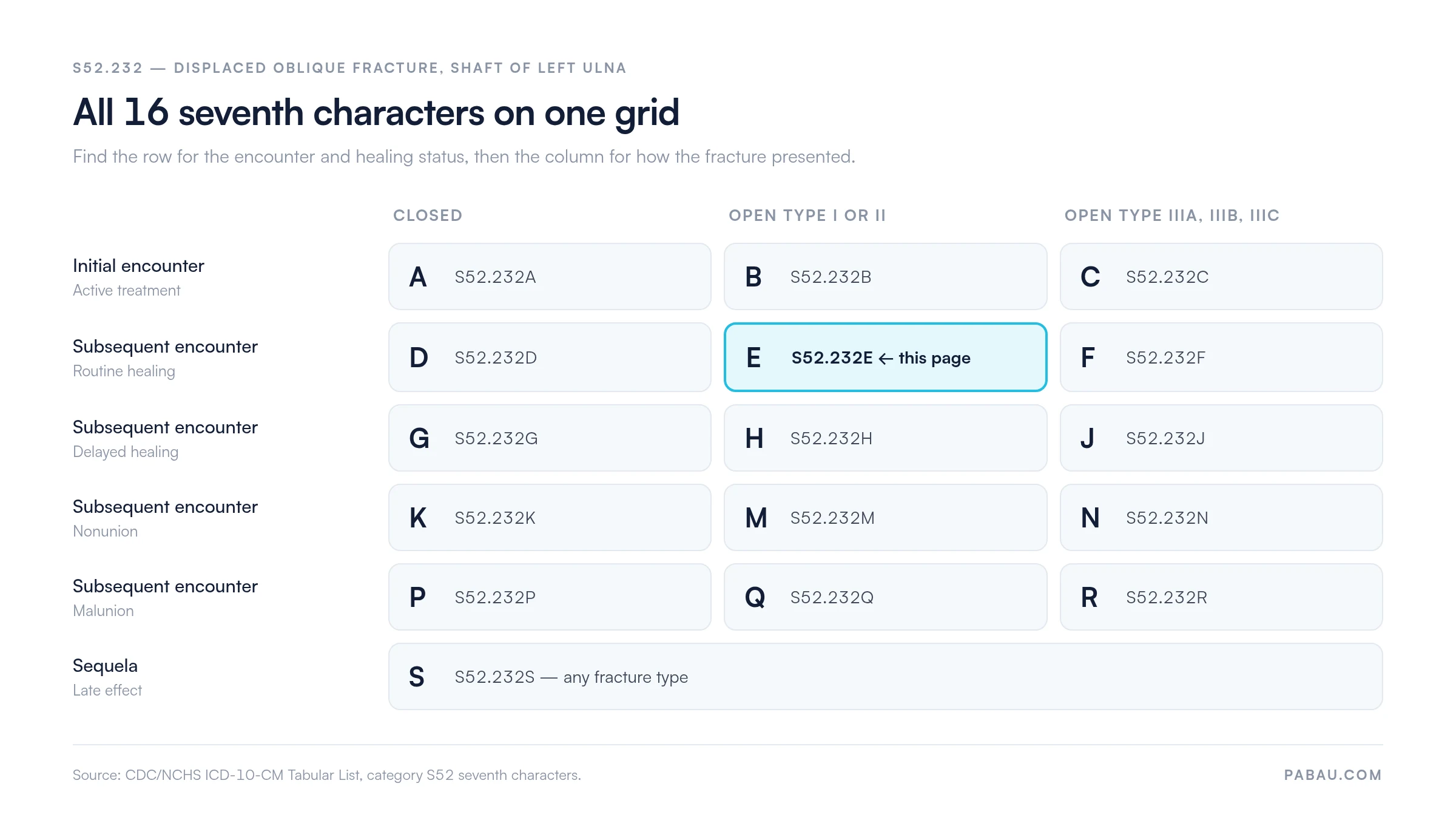
Grid of the 16 seventh characters for S52.232.
Read across a row and only the fracture type changes, so a wrong column is an open-versus-closed error. Characters follow the CDC/NCHS ICD-10-CM Tabular List for category S52.

The same 16 codes, written out in full:

CodeEncounter typeFracture typeHealing status
S52.232AInitialClosedN/A
S52.232BInitialOpen type I or IIN/A
S52.232CInitialOpen type IIIA, IIIB, or IIICN/A
S52.232DSubsequentClosedRoutine healing
S52.232ESubsequentOpen type I or IIRoutine healing
S52.232FSubsequentOpen type IIIA, IIIB, or IIICRoutine healing
S52.232GSubsequentClosedDelayed healing
S52.232HSubsequentOpen type I or IIDelayed healing
S52.232JSubsequentOpen type IIIA, IIIB, or IIICDelayed healing
S52.232KSubsequentClosedNonunion
S52.232MSubsequentOpen type I or IINonunion
S52.232NSubsequentOpen type IIIA, IIIB, or IIICNonunion
S52.232PSubsequentClosedMalunion
S52.232QSubsequentOpen type I or IIMalunion
S52.232RSubsequentOpen type IIIA, IIIB, or IIICMalunion
S52.232SSequelaAnyLate effect of fracture

S52.232E is bolded above. Its most error-prone neighbors are S52.232D (closed, routine healing) and S52.232H (open type I or II, delayed healing). Swapping E for D misstates whether the fracture was open. Swapping E for H misstates the healing status, and both errors generate denials.

S52.232E vs S52.232D: Open versus closed fracture on subsequent encounter

S52.232D applies to a closed fracture at the same site and healing status. S52.232E applies when the fracture was open, with a documented skin breach. The distinction depends entirely on the original injury record.

If the operative report or ED note documents an open wound communicating with the fracture, E is correct for every subsequent routine-healing visit. Coders who cannot locate that record should query the provider or pull the original chart before selecting D.

S52.232E vs S52.232A and S52.232B: Initial versus subsequent encounter

S52.232A (initial, closed) and S52.232B (initial, open type I or II) are correct only while the provider is actively treating the fracture. That covers the emergency visit, the surgery date, and visits where the surgeon is still managing acute complications.

Once the patient moves to scheduled follow-up and the provider’s role shifts to monitoring healing, the correct character becomes D or E for that visit. Carrying A or B forward onto a fourth post-op office visit is an encounter-type error, and payers deny it routinely.

How Gustilo classification decides the 7th character

Gustilo and Anderson published their open fracture classification in 1976, and Gustilo et al. refined it in 1984. It grades open fractures by wound size, contamination level, and soft tissue damage.

ICD-10-CM encodes the Gustilo grade directly into the 7th character. The surgeon’s documented grade therefore drives the claim as well as the treatment plan.

Gustilo gradeWound descriptionSubsequent encounter 7th characterCode (S52.232 + character)
Type IWound less than 1 cm, clean, minimal soft tissue damageE (routine) / H (delayed) / M (nonunion) / Q (malunion)S52.232E, S52.232H, S52.232M, S52.232Q
Type IIWound 1-10 cm, moderate soft tissue damage, no flap neededE (routine) / H (delayed) / M (nonunion) / Q (malunion)S52.232E, S52.232H, S52.232M, S52.232Q
Type IIIAWound greater than 10 cm, adequate soft tissue coverage possibleF (routine) / J (delayed) / N (nonunion) / R (malunion)S52.232F, S52.232J, S52.232N, S52.232R
Type IIIB / IIICExtensive soft tissue loss or vascular injury requiring reconstructionF (routine) / J (delayed) / N (nonunion) / R (malunion)S52.232F, S52.232J, S52.232N, S52.232R

S52.232E is valid only for Gustilo type I and II. A type IIIA, IIIB, or IIIC fracture takes F, J, N, or R, depending on healing status. If the operative report does not state the Gustilo grade, the coder cannot assign an open fracture character, so query the physician first. Grading is the surgeon’s clinical judgment, and a coder cannot infer it from wound dimensions.

Clinical documentation requirements for S52.232E

Every element of the S52.232E descriptor must appear in the medical record. If one is missing, a payer’s auditor can deny or downcode the claim. Good revenue cycle management for orthopedic practices includes a pre-submission documentation checklist tied to the code.

  • Laterality (left): The provider must document “left ulna.” If documentation says “ulna fracture” without laterality, the record is insufficient for S52.232E. Query the provider before coding.
  • Fracture pattern (oblique): The treating note or radiology report must describe the fracture as oblique. “Fracture of the ulna” alone does not support oblique.
  • Displacement status (displaced): Documentation or imaging must indicate the fragments are displaced. Nondisplaced changes the base code entirely.
  • Anatomical location (shaft): The fracture site must be documented as the shaft or diaphysis of the ulna, not the proximal or distal end.
  • Encounter type (subsequent): The visit note must describe aftercare, such as a routine follow-up, cast check, wound inspection, or physical therapy monitoring.
  • Open fracture classification: The operative report or original treating note must state Gustilo type I or type II explicitly. Surgeon documentation of “open fracture” without a Gustilo grade does not support E, so query the surgeon.
  • Healing status (routine): The progress note must indicate the fracture is healing on schedule. Radiology confirming callus formation or the physician noting “healing well” satisfies this element.

Attaching this checklist to the fracture follow-up appointment type lets staff flag an incomplete record before anyone builds the claim.

Associated CPT codes commonly billed with S52.232E

Fracture aftercare visits typically pair ICD-10 Code S52.232E with evaluation and management codes. A surgical procedure code appears only when a new procedure happens at that visit. The table below covers the most common CPT pairings at orthopedic follow-up.

CPT codeDescriptionNotes
99213 / 99214Established patient office visit, low-to-moderate complexityMost common pairing at routine fracture follow-up visits outside a surgical global period
25545Open treatment of ulnar shaft fracture, includes internal fixation when performedBilled on the surgery date. Not billed again at follow-up unless a new or revision procedure occurs.
99024Postoperative follow-up visit, included in global serviceReports the surgeon’s routine follow-up visits inside the 90-day global period of 25545
29125 / 29126Application of short arm splint (forearm to hand), static or dynamicBillable if a new splint is applied at the subsequent visit
73090Radiologic examination, forearm, 2 viewsBilled by radiology when follow-up X-ray is taken to assess healing

Under the CMS global surgery rules, the surgeon’s routine visits within the 90-day global period of 25545 are part of the surgical payment. Report them with 99024 alongside S52.232E. Billing 25545 again on a routine follow-up date, with no new or revision procedure, creates a duplicate-service conflict that payers deny.

When the follow-up includes a two-view forearm X-ray, radiology reports 73090 with S52.232E as the supporting diagnosis.

Pro Tip

Flag fracture follow-up appointments in your scheduling system with a documentation prompt: encounter type (subsequent vs initial), healing status (routine vs delayed), and Gustilo grade. Catching a missing Gustilo grade before the patient leaves takes one question to the surgeon. Catching it after a denial means rework, resubmission, and weeks of delayed payment.

Common claim denial reasons for ICD-10 Code S52.232E and how to prevent them

Fracture follow-up claims using ICD-10 Code S52.232E are denied for a predictable set of reasons, and encounter-type mismatches are the first to check. Catching them before submission is the core of denial management workflows for orthopedic practices.

Denial reasonRoot causePrevention action
Wrong 7th character (A or B used on follow-up)Coder did not transition from initial to subsequent encounter character after active treatment endedBuild a note-date trigger: any visit more than 2 weeks post-surgery flags for E/D review
Open vs closed mismatch (D used instead of E)Coder used closed fracture character without checking original injury record for open fracture documentationAttach original ED or operative note to the fracture follow-up coding workflow
Missing Gustilo classificationOperative report says “open fracture” without a Gustilo type, and the coder assigns E anywayAdd a physician query step for any open fracture chart where Gustilo grade is not explicit
Laterality error (right coded as left or vice versa)Coder used the wrong laterality variant; S52.231E (right) and S52.232E (left) are distinct codesVerify laterality in both the progress note and the radiology report before submitting
Healing status not documented (routine vs delayed)Progress note describes the visit but never states that healing is on track, so the record does not support EPrompt providers to include a healing status line in every fracture follow-up note
Surgical CPT billed on subsequent encounter date25545 submitted at a follow-up visit with no new surgical procedure in the recordReserve surgical CPTs for dates of service when a procedure is documented in the operative report

Practices with high fracture follow-up volumes gain most from denial-reducing claims management software, which tracks each claim and returns denials for rework. Getting a clean claim through on first submission cuts the cost of appeals on fracture accounts.
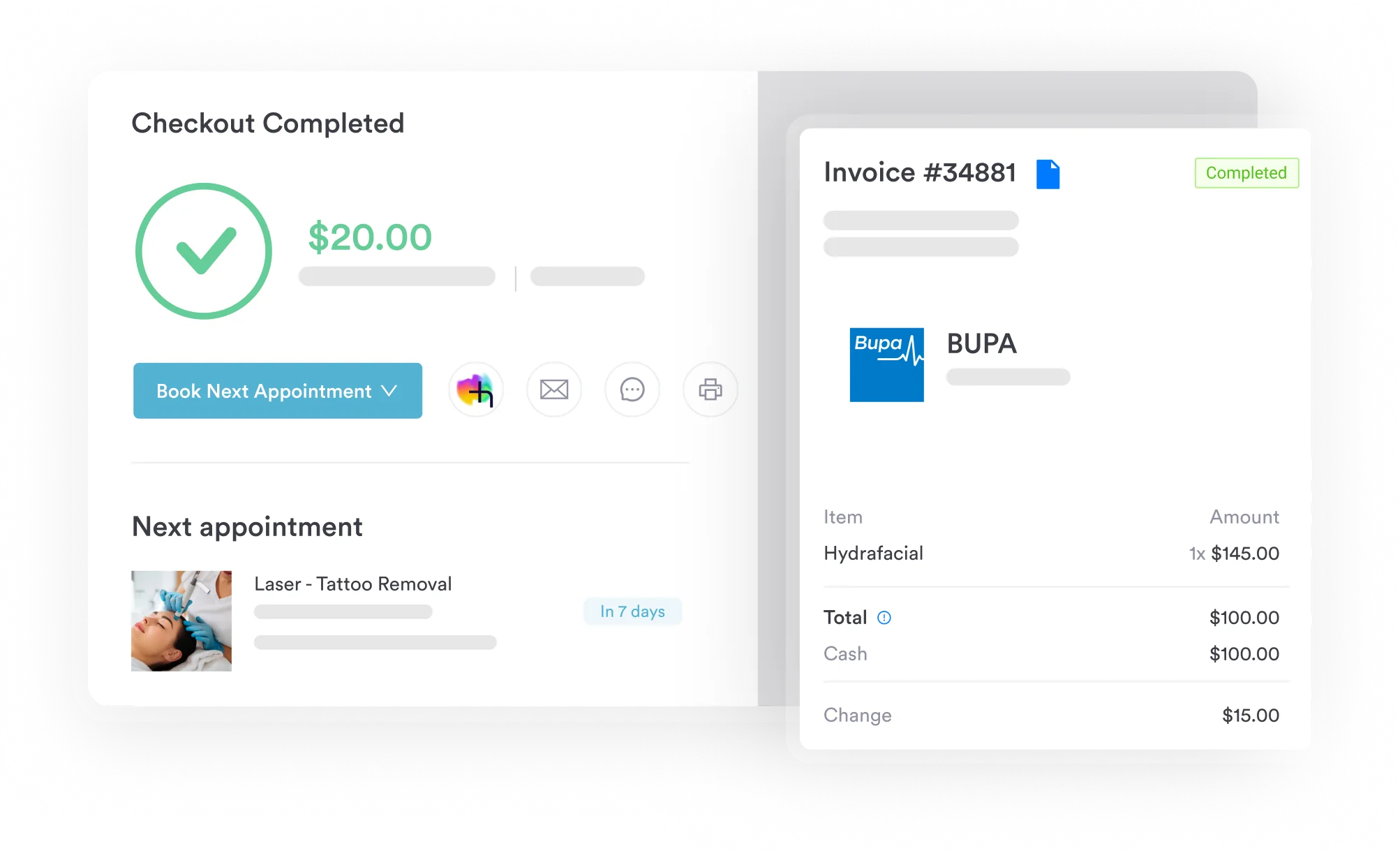
Pabau checkout screen beside a completed invoice billed to an insurer
Pabau’s checkout raises the invoice against the patient’s insurer, so an S52.232E follow-up visit becomes a claim without re-keying codes.

Payer requirements for ICD-10 Code S52.232E claims

Medicare and most commercial payers apply fracture-specific edit rules to subsequent encounter claims. Good medical billing compliance practice includes reviewing these requirements before submitting S52.232E to any high-volume payer.

  • Operative report on file: Keep documentation of the original procedure, such as ORIF or other open fracture management, to support a subsequent-encounter open fracture code. Not every claim is audited, but the record must be ready.
  • Gustilo grade in the chart: Payers processing open fracture claims for subsequent encounters expect the Gustilo classification to be traceable in the medical record. A missing grade is an audit vulnerability even if the claim initially pays.
  • Frequency alignment: Follow-up visit frequency should match the clinical timeline for the fracture type. Unusually frequent subsequent encounters for a routine healing fracture may trigger a utilization review flag.
  • External cause coding: ICD-10-CM guidelines encourage an external cause code (V00-Y99) to explain how the fracture occurred. Workers’ compensation and liability payers often expect one.

Medicare pays for a subsequent-encounter fracture visit through the paired E/M code, whose RVU values are updated annually. Check current rates in the CMS Physician Fee Schedule lookup rather than relying on prior-year figures. Rates also vary by geographic practice cost index.

Nonunion and malunion: When to switch away from ICD-10 Code S52.232E

ICD-10 Code S52.232E remains correct only as long as the fracture is healing routinely. When the clinical picture changes, the 7th character must change with it. The table below shows the transition logic.

Clinical findingTransition from S52.232E toDocumentation required
Delayed healingS52.232H (open type I or II, delayed healing)Physician documents “delayed healing” or radiology shows inadequate callus for expected timeline
NonunionS52.232M (open type I or II, nonunion)Physician explicitly documents “nonunion”; typically supported by X-ray showing no bridging callus at expected union time
MalunionS52.232Q (open type I or II, malunion)Physician documents “malunion” or imaging shows fracture healed in a malaligned position

Coders cannot make the delayed healing or nonunion determination independently. The physician must document the finding explicitly. A note reading only “patient still having pain” or “X-ray taken” does not justify a switch to H or M at all. The character changes only when the physician’s own wording supports it.

Excludes notes and additional-code instructions

Before finalizing S52.232E, review the instructional notes at the S52 category level and the S52.2 subcategory. They bind code selection as firmly as the code title does.

  • Excludes1 at S52: Traumatic amputation of forearm (S58.-). A forearm amputation at the same encounter cannot be coded with S52.232E; S58 codes take precedence for that injury component.
  • Excludes2 at S52: Fracture at wrist and hand level (S62.-). An Excludes2 note means the condition is not part of S52 but can occur alongside it. If the same injury also involves the wrist or hand, code that component separately from S62.
  • Upper end of ulna (S52.0-): Olecranon and coronoid process fractures code to S52.0-, outside the S52.2- shaft codes. Confirm the record documents the shaft and not the proximal end.
  • Use additional code for external cause: Add an external cause code (V00-Y99) to describe the mechanism of injury. This is particularly important for workers’ compensation, auto, and liability claims.
  • Code associated injuries separately: A radial fracture or a nerve or vessel injury treated at the same encounter gets its own code. An ulna shaft fracture with radial head dislocation is a Monteggia fracture, which codes to S52.27- instead.

The ICD List lookup tool displays the full tabular list hierarchy for S52.232E, including the notes at every parent level. To compare it with neighboring forearm fracture codes, browse the searchable ICD-10-CM code library.

How Pabau keeps fracture follow-up claims moving

In many orthopedic practices, the follow-up visit is coded in one system and billed in another. Staff re-key the diagnosis and CPT codes into a clearinghouse portal, and a denial surfaces weeks later in a remittance file.

In Pabau, the checkout invoice becomes the claim. It goes to thousands of US payers through the Claim.MD clearinghouse, with no X12 files and no re-keying. Real-time eligibility checks confirm coverage before the visit, and claim statuses update from the payer.

Denied claims come back flagged for rework, and electronic remittance ties each payment to the claim it settles. A follow-up billed with the wrong 7th character gets corrected and resubmitted within days. Our Claim.MD clearinghouse guide walks through the setup.

Reduce fracture claim denials with smarter submission workflows

Pabau turns each invoice into a claim, submits it through Claim.MD to thousands of US payers, and flags denials for rework. Built for orthopedic and multi-specialty practices.

Pabau claims management dashboard

Conclusion

S52.232E holds only while three facts stay true in the record. Active treatment has ended, the fracture was a Gustilo type I or II open fracture, and healing is on schedule. The practical move is to confirm all three during the visit, while the surgeon is still in the room.

Record the side, the Gustilo grade, and the healing status in every follow-up note. That saves the coder a query and the practice a denial. The trade-off is a few seconds of documentation per visit against weeks of rework later.

Book a demo to see how Pabau carries a fracture follow-up from checkout to a paid claim.

Continue your research

Continue your research

Need a reference for medical billing concepts behind fracture claims? Medical billing workflows explained covers the end-to-end process from claim creation through remittance.

Looking for guidance on 837 electronic claim file formats? 837 file format guide details how fracture diagnosis codes are structured in electronic claim submissions.

Frequently asked questions about ICD-10 Code S52.232E

What does ICD-10 Code S52.232E mean?

ICD-10 Code S52.232E is a billable ICD-10-CM code for a displaced oblique fracture of the left ulna shaft. It covers a subsequent encounter for an open type I or II fracture with routine healing. Coders use it at follow-up visits after active treatment ends, when the record confirms normal healing.

What is the difference between S52.232E and S52.232A?

S52.232A is the initial encounter code for a closed displaced oblique fracture of the left ulna shaft, used while the provider is actively treating it. S52.232E is the subsequent encounter code for an open type I or II fracture with routine healing. Using A on a follow-up visit is a common encounter-type denial trigger.

When should I use 7th character E versus D for a fracture?

Use D for a subsequent encounter when the fracture was closed, with no skin breach. Use E when the fracture was open, classified as Gustilo type I or II, and the record confirms routine healing. Both apply to aftercare encounters, and the original injury record decides between them.

What Gustilo open fracture types does S52.232E apply to?

S52.232E applies to Gustilo type I and type II open fractures only. Type I is a wound under 1 cm with minimal contamination. Type II is a wound of 1 to 10 cm with moderate soft tissue damage. Type IIIA, IIIB, and IIIC fractures take F for routine healing instead of E.

Does S52.232E apply to routine healing or delayed healing?

S52.232E applies to routine healing only. When the physician documents delayed healing for the same open type I or II fracture, the correct code is S52.232H. Nonunion moves the code to S52.232M, and malunion moves it to S52.232Q. The 7th character must match the physician’s documented finding.

Why would a claim using S52.232E be denied?

The usual causes are an initial encounter character (A or B) on a follow-up visit, or D used when the original fracture was open. Missing Gustilo documentation and a laterality mismatch also trigger denials. So does billing a surgical CPT code on a follow-up date with no new procedure.


Avatar photo
Anja Dodevska
Content Writer

Anja Dodevska writes about healthcare, dermatology, and the day-to-day realities of running a medical practice for Pabau. She enjoys breaking down complex topics into clear, accessible content and has a soft spot for the often-overlooked aspects of clinic life. When she's not writing, she's exploring cafes, walking her dog, or spending time with friends and family.
×

