ICD-10 Code S42.444P: Medial epicondyle fracture, right humerus
ICD-10 Code S42.444P: full descriptor and code validity ICD-10 Code S42.444P car...

Last Updated: Oct 13, 2026
Billable Code Specific Code
S52.131E is the billable ICD-10-CM code for a displaced right radial neck fracture, subsequent encounter for open fracture type I or II with routine healing.
The most common errors are submitting an initial-encounter code (S52.131A or S52.131B) for a follow-up visit, or selecting S52.131E without support in the record. The code applies only when the provider documents an open type I or II fracture with routine healing.
Let Pabau's smart automation suggest the right codes, reduce claim denials, and keep your practice compliant—effortlessly.
Automate repetitive tasks and focus on what matters most—your patients.
Reduce coding errors and ensure compliance with the latest regulations.
Clean claims, fewer denials, and faster reimbursements.
Powerful insights and reporting to help your practice thrive.
HIPAA compliant SOC 2 certified GDPR-compliant Trusted by 4,000+ clinics worldwide

S52.131E is a billable ICD-10-CM code for a displaced right radial neck fracture, subsequent encounter for open fracture type I or II with routine healing.
Seventh character E applies only when the original fracture was open, Gustilo type I or II, and the provider documents normal healing at follow-up.
A closed fracture with routine healing codes to S52.131D, and an open type IIIA, IIIB or IIIC fracture codes to S52.131F.
The top denial triggers are an initial encounter code (A or B) left on a post-treatment visit and E coded for a closed fracture.
Pabau, the practice management platform we build, checks required claim details before submission, but the seventh character still depends on the provider’s note.
ICD-10 Code S52.131E describes a displaced fracture of the neck of the right radius at a subsequent encounter. The original fracture was open, Gustilo type I or II, and the clinical record confirms routine healing.
The code sits within the S52 category (fractures of the forearm), under subsection S52.1 (fractures of the upper end of the radius). Within that, S52.13 covers fractures of the neck of the radius specifically.
The CDC/NCHS ICD-10-CM web tool confirms S52.131E as a valid, billable code maintained in the current fiscal year tabular list. Coders should verify the code against the annual CMS update file before each new fiscal year begins in October. Neighboring forearm fracture codes are covered in our ICD-10-CM guides for coders.
The radial neck is the narrow segment of the proximal radius just below the radial head. Here the bone transitions from the articulating surface into the radial shaft. A displaced fracture at this site means the bone fragments have shifted out of normal alignment, as documented by the provider.
This anatomy decides which S52 subcategory applies. Radial head fractures code to S52.12x, and radial neck fractures to S52.13x.
Coders who see “proximal radius fracture” in a note without a specific anatomical reference should query the provider before defaulting to S52.131E. Applying the wrong subcategory triggers medical necessity edits. Proper documentation in the clinical note is part of a broader revenue cycle management approach that reduces rework downstream.
ICD-10-CM distinguishes displaced from nondisplaced fractures at the code level. A displaced fracture of the neck of the right radius maps to S52.131x. A nondisplaced fracture maps to S52.134x.
Selecting between the two requires explicit provider documentation of displacement status. If the note says “fracture of the radial neck” without displacement language, ICD-10-CM Official Guidelines default to displaced. A query is still preferable to a default.
At the subsequent encounter, the provider must document that healing is proceeding as expected. Typical evidence is callus formation on imaging, decreasing pain with range of motion, and functional progress in line with the injury’s expected course. The coder cannot infer routine healing from the appointment type alone.
Seventh character E needs documented healing status, so a follow-up visit without it does not qualify. The record must also show that the original fracture was open, Gustilo type I or II.
The seventh character in ICD-10-CM fracture codes encodes three dimensions at once. The first is the encounter type: initial, subsequent, or sequela. The second is the fracture type: closed, open type I or II, or open type IIIA, IIIB or IIIC. The third is the healing status: routine, delayed, nonunion, or malunion.
The Centers for Medicare and Medicaid Services (CMS) Official Guidelines for Coding and Reporting, Section I.C.19.a, govern seventh-character assignment for traumatic fractures.
The American Health Information Management Association (AHIMA) and the AHA Coding Clinic both treat healing status as a clinical determination. The coder translates what the provider documents and leaves the healing assessment to the provider. If the record is ambiguous about healing, or about whether the fracture was open and its Gustilo type, query the physician before assigning E.
S52.131 is the base code for a displaced fracture of the neck of the right radius. Every valid seventh character produces a distinct billable code, each with a specific clinical meaning.
Coders working with medical billing workflows for orthopedic follow-up should keep this family visible during chart review. Having it in view stops a coder from defaulting to the initial encounter code out of habit.
The A-vs-E confusion is the most common S52.131 coding error in orthopedic practice. According to the CMS ICD-10-CM guidelines, an initial encounter character (A, B or C) applies while the patient is receiving active treatment for the fracture. That holds no matter how many times the provider has seen the patient.
Once active treatment shifts to monitoring of healing, subsequent encounter characters apply.
For a patient who ends up at S52.131E, the matching initial code is S52.131B, because the fracture was open type I or II. S52.131A belongs to a closed fracture, whose routine follow-up codes to S52.131D.
One pattern worth flagging for billing teams: some EHR systems map “subsequent encounter, routine healing” to one character for every fracture. In the S52.131 family that mapping breaks down, because the character also records whether the fracture was open.
D covers a closed fracture, E an open type I or II fracture, and F an open type IIIA, IIIB or IIIC fracture.
Check the original injury record for open or closed status and Gustilo type before you pick the character. When in doubt, query the AAPC Codify ICD-10-CM lookup for the tabular definition alongside the official CMS guidelines.
Parent category S52 (fracture of forearm) carries Excludes1 and Excludes2 notes that affect how S52.131E is combined with other codes.
Gustilo type is not coded separately. ICD-10-CM builds it into the seventh character. B, E, H, M and Q cover open type I or II fractures. C, F, J, N and R cover open type IIIA, IIIB or IIIC fractures.
S52.131E therefore already states that the original fracture was open type I or II. If the original fracture was closed, use S52.131D instead. If it was open type IIIA, IIIB or IIIC, use S52.131F. The grid below maps every combination of fracture type and visit to its character.
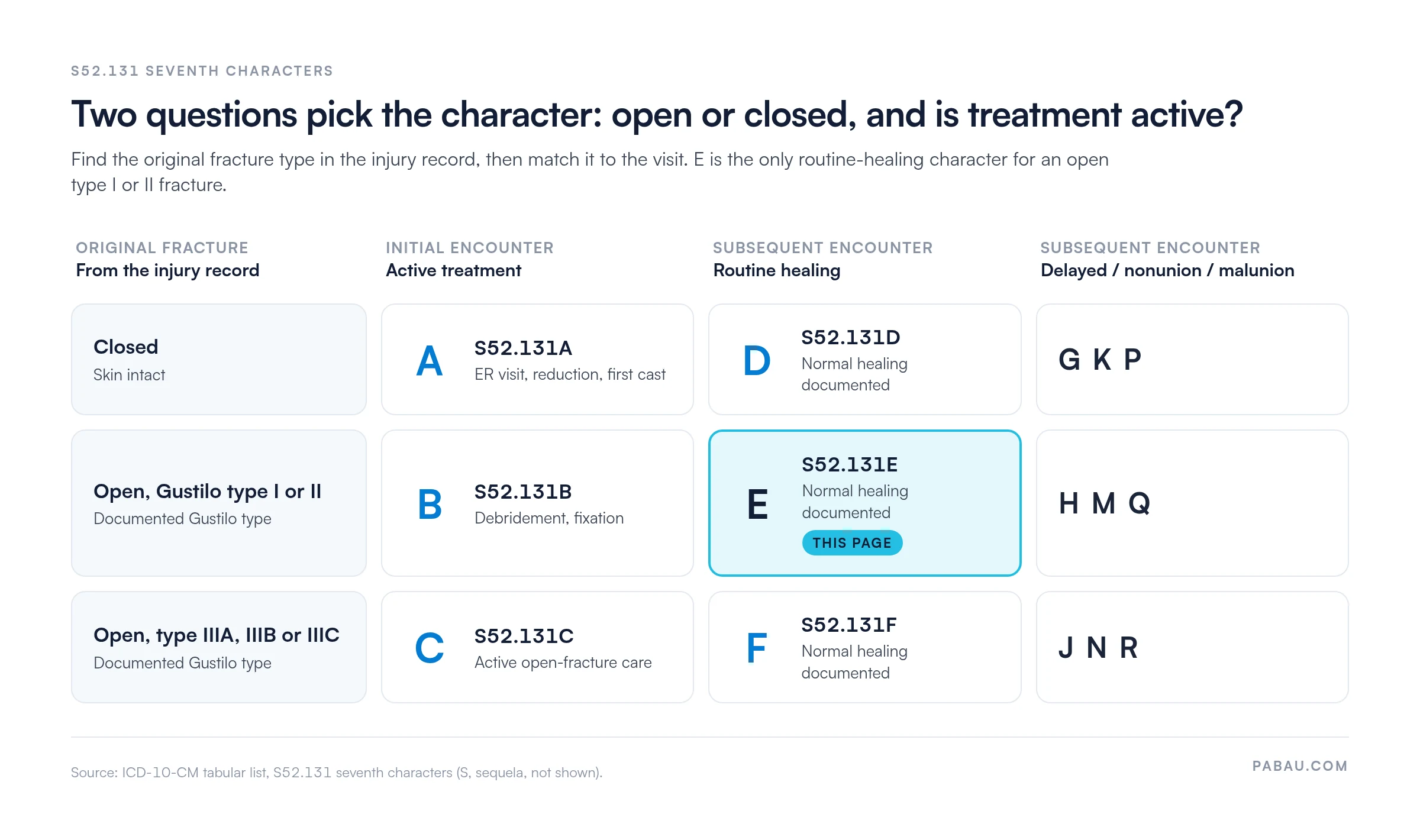
The clinical note must support every component of the code, beyond naming the appointment type. Pabau’s claims software for practices checks that required claim details are present before submission. It cannot judge the seventh character, so that choice still rests on a complete note.
Per American Hospital Association (AHA) Coding Clinic guidance, coders must not assign a healing-status seventh character based on inference. If the note says “patient doing well” without linking that to fracture healing specifically, that statement alone does not support S52.131E. A query to the provider is the correct step before code assignment.
Build a standardized fracture follow-up note template with discrete fields for healing status and for the original fracture’s open or closed status and Gustilo type. This removes ambiguity at the source and cuts most coder queries on S52.131 follow-up visits.
Denials on S52.131E cluster around five recurring problems, set out below. A clearinghouse edit can stop some of them before submission. The documentation fixes still happen in the clinical note, before the claim is built. Knowing the pattern supports a stronger denial management workflow.
A clean claim submission for S52.131E needs the diagnosis code, the CPT code and the place-of-service indicator to tell one consistent clinical story. A subsequent-encounter ICD-10 code paired with a new-patient E/M CPT creates a payer edit that the billing team has to resolve manually after the fact.
Run a monthly audit on all claims billed with any S52.131x code. Extract the seventh character used and cross-reference it against the visit type in the EHR (initial vs follow-up). Any claim where S52.131A appears on a visit dated more than 30 days after the injury date should be reviewed before submission. Also confirm that every S52.131E claim traces back to an open type I or II fracture in the injury record.
Medicare Local Coverage Determinations (LCDs) for orthopedic fracture aftercare vary by Medicare Administrative Contractor (MAC) jurisdiction. Most commercial payers follow CMS guidance on seventh-character assignment but may require additional documentation for fracture follow-up visits beyond six weeks. Practices should verify prior authorization requirements directly with each payer at the time of scheduling.
S52.131E is a diagnosis code. The procedure performed at the visit drives the CPT selection. The pairing of diagnosis and procedure affects both medical necessity review and electronic remittance advice interpretation when a denial reason code appears. Orthopedic and physical therapy workflows commonly pair S52.131E with the following CPT codes.
The WHO ICD-10 classification framework that underlies ICD-10-CM does not dictate CPT pairing, but CMS medical necessity policies do. When billing an E/M code alongside a fracture care CPT in the global period, check how the visit is classified. It may be a separately reportable service, or it may fall within the surgical global package of the original treatment.
Fracture follow-up billing often runs across three places. The open or closed status sits in an ER note and the visit note lives in the EHR. The claim then goes out through a separate portal.
Pabau keeps the patient record, the invoice and the claim in one system. US practices submit claims through the Claim.MD clearinghouse, run real-time eligibility checks and post ERA remittances from the same dashboard. Before a claim is sent, Pabau checks that required details such as membership numbers and authorization codes are filled in.
Every claim then moves through clear statuses, from pending to paid or error. A rejected S52.131E claim shows up in the claims dashboard quickly, while the injury record that explains it is one click away.

Pabau keeps patient records, invoices and claims in one system, with Claim.MD submission and checks for required claim details before sending. Rejected claims surface fast in one claims dashboard.

S52.131E is easy to assign once the record states three facts. The fracture was open, it was Gustilo type I or II, and healing is routine. Denials follow when a follow-up note leaves one of those out, or when an EHR default carries the initial character forward.
So the fix starts in the note template, well before billing. Capture open or closed status and Gustilo type at the first visit, and carry them into every follow-up. Query the provider whenever healing status is unclear. D, E and F then stop being a guess.
Pabau lets the billing team work from the same record the provider signed, from checkout to paid claim. Book a demo to see how it handles fracture follow-up claims for orthopedic practices.

Coding the initial visit for this fracture? S52.131B covers active treatment of the same displaced right radial neck fracture when it was open type I or II.
Healing went wrong after an open type I or II fracture? S52.131Q codes malunion of the same fracture at a subsequent encounter.
Want to understand how denial codes on remittances translate back to coding errors? Denial management in healthcare breaks down CARC denial reasons and the workflow to correct and resubmit.
Need to decode a payer’s denial reason? Denial codes in medical billing explains the codes payers return on rejected and denied claims.
Looking for guidance on what makes a claim clean before it leaves the practice? Clean claim submission covers the pre-submission checklist that prevents the most common ICD-10 and CPT pairing errors.
ICD-10 Code S52.131E is a billable diagnosis code. It describes a displaced fracture of the neck of the right radius, subsequent encounter for open fracture type I or II with routine healing. It applies once active treatment of that open fracture is complete and the provider documents normal healing at follow-up.
In S52 forearm fracture codes, seventh character E designates a subsequent encounter for open fracture type I or II with routine healing. It tells payers that active treatment is complete and the provider has documented normal healing. A closed fracture with routine healing takes D, and an open type IIIA, IIIB or IIIC fracture takes F instead. Delayed healing, nonunion and malunion each have their own characters.
Use an initial encounter code while the patient receives active treatment, such as surgery, debridement or the first casting. For an open type I or II fracture that code is S52.131B, since S52.131A covers a closed fracture. Switch to S52.131E once active treatment is complete and the visit monitors routine healing. The switch follows the treatment phase, whatever the date.
Yes, S52.131E is a valid, billable ICD-10-CM diagnosis code confirmed in the current fiscal year tabular list maintained by the CDC/NCHS. It can be submitted on CMS-1500/837P professional claims (and on facility claims for outpatient and inpatient stays).
The clinical note must document a subsequent (not initial) encounter and routine healing based on imaging or clinical findings. It must place the fracture at the neck of the right radius. It must also state that the original fracture was open, Gustilo type I or II. Provider signature and credentials must be present. “Patient doing well” without a fracture-specific healing statement is not sufficient.
The most common pairings are established-patient E/M codes (99213, 99214), elbow X-ray codes (73070, 73080), splint application codes (29105), and physical/occupational therapy codes (97110, 97530). The CPT selected must match the procedure performed at the visit and must not conflict with the global period of the original fracture treatment.