ICD-10 Code V91.84XS: Other burn due to burning watercraft
ICD-10 Code V91.84XS: overview and key facts ICD-10 Code V91.84XS identifies the...

Last Updated: Oct 30, 2026
Billable Code Specific Code
S52.109C is the billable ICD-10-CM code for unspecified fracture of upper end of unspecified radius, initial encounter for open fracture type IIIA, IIIB, or IIIC.
The Gustilo grade decides the suffix, since type I and II open fractures take S52.109B. The most common error is assigning B to a documented IIIA fracture, or C to a type I or II fracture. When the chart names the arm, the laterality codes S52.101C (right) and S52.102C (left) apply instead.
Let Pabau's smart automation suggest the right codes, reduce claim denials, and keep your practice compliant—effortlessly.
Automate repetitive tasks and focus on what matters most—your patients.
Reduce coding errors and ensure compliance with the latest regulations.
Clean claims, fewer denials, and faster reimbursements.
Powerful insights and reporting to help your practice thrive.
HIPAA compliant SOC 2 certified GDPR-compliant Trusted by 4,000+ clinics worldwide

S52.109C covers an initial encounter for an open fracture of the upper end of the radius graded Gustilo type IIIA, IIIB, or IIIC.
Gustilo type I and II open fractures take the B suffix (S52.109B), so the B vs C line falls between type II and type IIIA.
The most common suffix error is assigning B to a documented IIIA fracture, or C to a documented type I or II fracture.
Physician documentation must state the Gustilo grade explicitly; coders may not infer it from wound size or contamination language alone.
Pabau’s claims management software checks eligibility through Claim.MD before treatment and flags denied claims, so suffix errors get corrected quickly.
ICD-10 code S52.109C is defined as: Unspecified fracture of upper end of unspecified radius, initial encounter for open fracture type IIIA, IIIB, or IIIC.
It is a valid, billable ICD-10-CM code and has been part of the code set since ICD-10-CM took effect on October 1, 2015. Code set updates take effect each October 1, with some on April 1, so confirm it against the current tabular before you submit.
“Unspecified” in this context means the documentation does not name the sub-site within the upper end of the radius. That sub-site could be the radial head, the radial neck or the tuberosity. It does not mean the fracture type is unknown. The open fracture grade and encounter phase must still be precisely documented.
S52.109C is built from seven characters, and each one narrows the code. The 7th character carries the encounter phase and the Gustilo grade together.
An open fracture is one in which the bone communicates with the external environment through a wound in the skin. The distinction from a closed fracture must be stated explicitly in the emergency department note or operative report.
Coders may not infer open status from language like “significant soft tissue injury” or “contaminated wound” without the physician directly documenting the fracture as open.
The 7th character C applies to open fractures graded Gustilo type IIIA, IIIB, or IIIC. Gustilo type I and II fractures take the B suffix instead. Suffix errors cluster at that boundary, such as a documented IIIA coded as B or a documented type II coded as C.
The Gustilo-Anderson classification grades open fractures based on wound size, contamination level, and degree of soft-tissue and vascular injury. Per the CMS ICD-10-CM coding guidelines, the 7th character for open fractures in the S52 category is assigned according to this classification.
The Gustilo grade must be assigned by the treating physician or surgeon. Coders should query the provider when the operative report describes extensive periosteal stripping or vascular repair without explicitly stating the Gustilo grade. Assigning C without a documented type IIIA, IIIB, or IIIC grade is a coding error. So is assigning B when the surgeon has documented IIIA.
The full S52.109 suffix set covers every encounter phase and fracture type. At the initial encounter, S52.109A covers a closed fracture and S52.109B covers an open fracture type I or II. S52.109C covers an open fracture type IIIA, IIIB, or IIIC. Every subsequent-encounter suffix keeps the same split between type I/II and type IIIA/IIIB/IIIC, as the grid below shows.
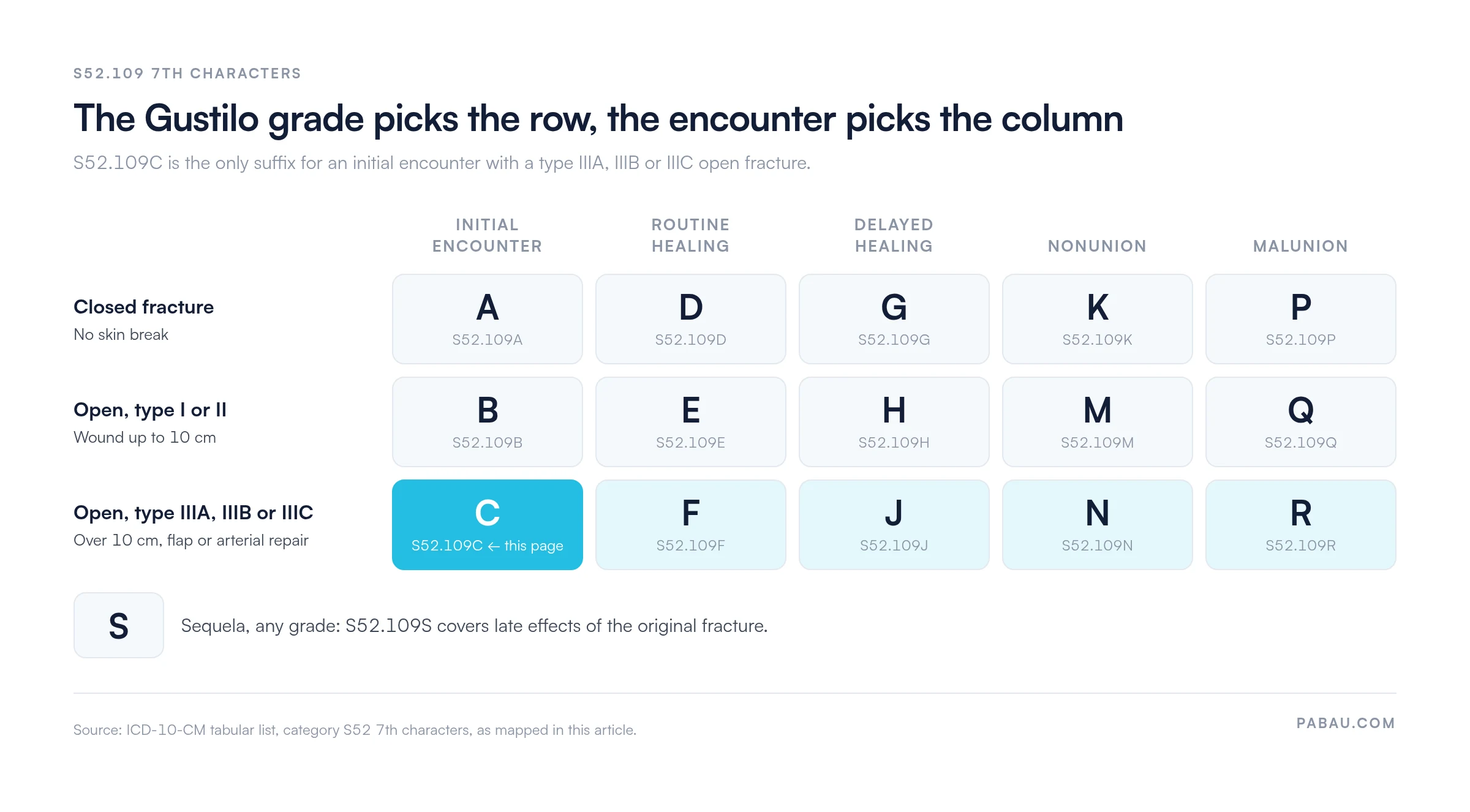
Active treatment includes the initial ED visit, surgical procedures, and any encounter where the provider is actively managing the fracture. Once the patient transitions to rehabilitation or routine follow-up, the suffix shifts from A/B/C to the appropriate D-through-S code.
Claims for ICD-10 code S52.109C require specific documentation elements across the emergency department note, operative report, and any pre-procedure imaging report. Missing any one of these is the fastest route to a denial.
When documentation is incomplete, the coder must query the provider before assigning S52.109C. Choosing C without an explicit type III grade is an overcoding risk that payers audit. Choosing B for a documented IIIA undercodes the injury and understates its severity.
Under Section I.C.19.b, the most serious injury, as determined by the provider and the focus of treatment, is sequenced first. When that is S52.109C, it leads the claim. External cause codes (Section I.C.20) are additional codes and never principal.
A place-of-occurrence code (Y92 series) and patient activity code (Y93 series) are recommended when the information is available in the documentation. They are not required on every claim, but their presence reduces the risk of a medical necessity query.
Type III open fractures of the upper end of the radius usually need surgical debridement, and most need some form of stabilization. The CPT codes below are the common pairings with this diagnosis.
Payer edits vary, so verify coverage with the applicable payer before you rely on any pairing. Debridement depth decides between CPT 11010 and its deeper-level codes. A temporary frame placed before definitive fixation is billed with CPT 20690.
CPT 24665 is the usual definitive pairing when the operative report describes open fixation or excision of the radial head or neck. Avoid distal radius codes such as 25600 or 25607 here, because S52.1 describes the upper end of the bone.
Build a crosswalk step into your claims management software workflow before submission. It confirms the CPT descriptor matches what the operative report documents. The AAPC ICD-10-CM lookup offers CPT-to-ICD crosswalks for checking a pairing by payer.
Run a CPT-to-ICD crosswalk check for every S52.109C claim before submission. Payer medical necessity edits for open fracture codes are stricter than for closed fractures. A quick crosswalk check at the clearinghouse level catches mismatches that would otherwise land as CO-4 or CO-197 denials.
Open fracture codes at the type III severity level attract closer payer scrutiny than routine closed fracture codes. The table below maps the most common reasons to their root causes and resolution steps. Good denial management workflows address these at the source rather than on appeal.
The remittance denial codes associated with these scenarios are typically CO-4 (modifier/procedure mismatch), CO-11 (diagnosis inconsistent with procedure), and CO-197 (precertification/authorization absent). Tracking these CARC codes against your S52.109C volume helps prioritize which documentation workflows to tighten first.
If you use a clearinghouse, build a clean claim submission checklist into the workflow. Checking the Gustilo grade and the external cause code before transmission prevents most of these denials.
The CDC/NCHS ICD-10-CM web tool provides current tabular list guidance for verifying code-specific inclusion and exclusion notes. Reference the CMS ICD code lists when confirming whether S52.109C appears on a payer’s valid diagnosis code list for a given service date.
Most S52.109C denials start long before the claim reaches the payer. A surgeon documents IIIA, a coder reads it as a lower grade, and the claim goes out with the wrong suffix. Weeks later, the denial arrives and someone has to rebuild the story from the chart.
Pabau, the practice management platform we build, keeps that work in one place. Claims are generated from the invoice and sent electronically through the Claim.MD integration. Real-time eligibility checks run before treatment, so a missing authorization shows up before the patient reaches the OR.
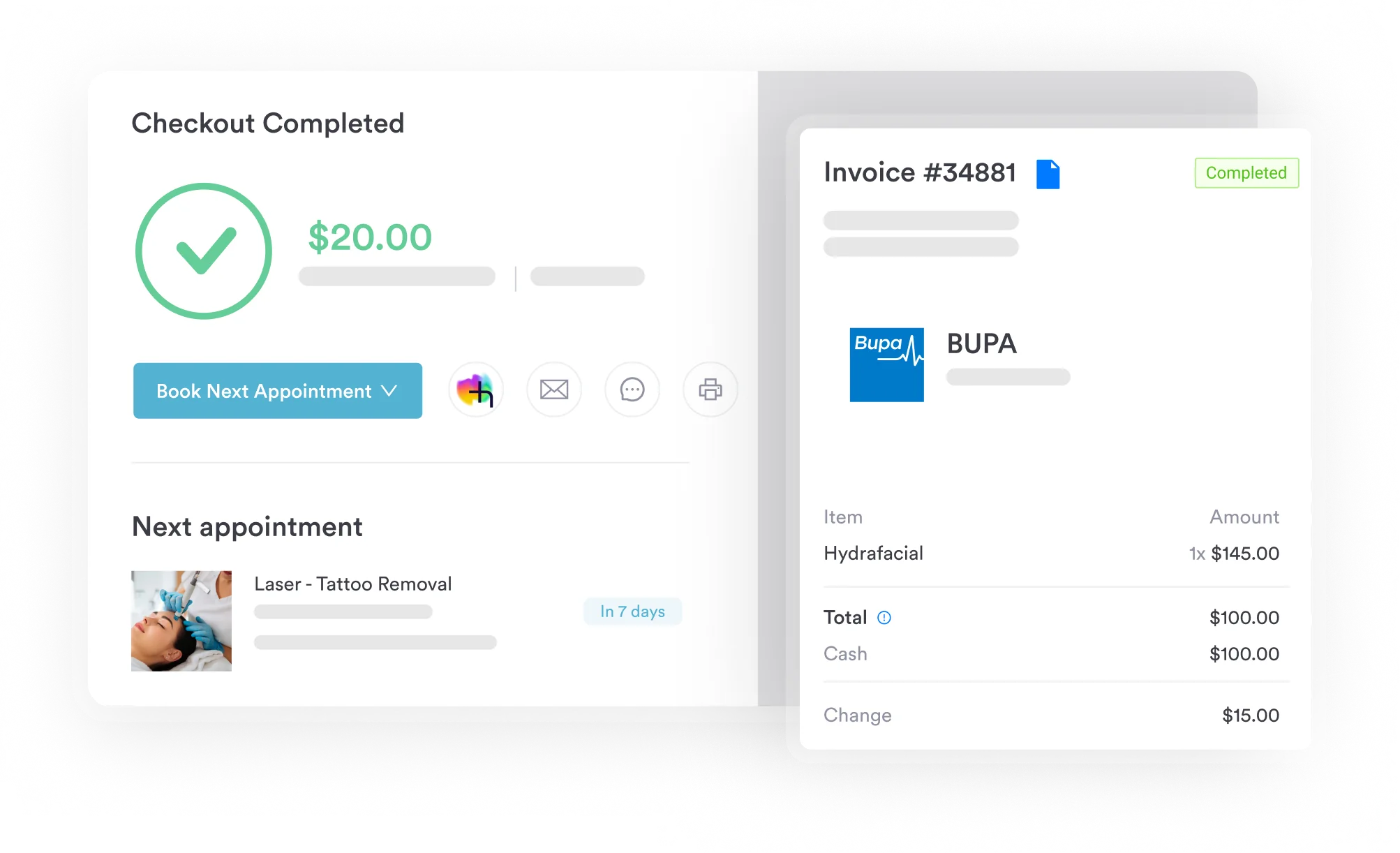
Once a claim is out, Pabau tracks its status through acceptance, payment or denial. Electronic remittance advice comes back into the system and links to the claim it settles. Denied claims are flagged for rework on one dashboard, so a wrong suffix gets corrected and resubmitted quickly.

Pabau’s claims management software sends claims through Claim.MD, checks eligibility before treatment and flags every denial for rework. Orthopedic and emergency medicine practices fix suffix errors faster and resubmit cleaner claims.

S52.109C is a grade-driven code. Use it only when a physician has documented an open fracture of the upper end of the radius as Gustilo type IIIA, IIIB, or IIIC. Type I and II injuries belong to S52.109B, however severe the wound looks in the note.
Build your coding check around that boundary rather than around wound size. If the operative report names a grade, code to it. If it does not, query the surgeon and hold the claim. That single habit removes the B vs C denials that cost orthopedic billing teams the most rework.
Then make sure laterality, encounter phase and the external cause code match the chart before transmission. Book a demo to see how Pabau tracks every open fracture claim from submission to payment.

Need to understand open fracture claim submissions end to end? Claim.MD clearinghouse overview explains how electronic claim routing and real-time eligibility checks work for orthopedic and trauma practices.
Seeing ERA codes you do not recognize on denied S52.109C claims? Electronic remittance advice guide maps CARC and RARC codes to their denial meanings and resolution steps.
Want to verify insurance eligibility before an open fracture surgery? Insurance eligibility verification covers real-time benefit checks that flag prior-authorization requirements before the patient reaches the OR.
ICD-10 code S52.109C means an unspecified fracture of the upper end of an unspecified radius, at the initial encounter for an open fracture. The fracture must be graded Gustilo type IIIA, IIIB, or IIIC. Unspecified refers to the sub-site within the upper end and to the arm, not to the fracture severity. The C suffix confirms active treatment of a type III open fracture.
S52.109A applies to an initial encounter for a closed fracture of the upper end of the radius. S52.109C applies to an initial encounter for an open fracture graded Gustilo type IIIA, IIIB, or IIIC. Open type I or II fractures sit between them and take S52.109B.
S52.109C requires a documented Gustilo type IIIA, IIIB, or IIIC open fracture. Gustilo types I and II map to S52.109B instead. The physician must assign the grade in the operative or emergency department note. Coders may not infer the grade from wound description language alone.
No. S52.109C is limited to initial encounters where the provider is actively treating the fracture. For routine follow-up, use S52.109F (open fracture type IIIA, IIIB, or IIIC, routine healing). Use S52.109J if healing is delayed. Using S52.109C for a follow-up visit is an encounter-type mismatch that triggers denial.
Yes, S52.109C is a valid, billable ICD-10-CM code. It has been in the code set since October 1, 2015. Code set updates take effect each October 1, with some on April 1, so verify it in the current tabular before each billing cycle. The CDC/NCHS ICD-10-CM web tool is the authoritative source for current code validity.
CPT 24665 (open treatment of radial head or neck fracture) is the most common definitive surgical pairing. CPT 24666 applies when the radial head is replaced with a prosthesis. CPT 11010 covers skin-level debridement at the open fracture site, and 11011 or 11012 covers deeper debridement. CPT 20690 applies when temporary external fixation is needed. Verify all pairings against payer medical necessity edits before submission.