ICD-10 Code S52.101P: Right radius fracture with malunion
ICD-10 Code S52.101P: definition and code details ICD-10 Code S52.101P is a bill...

Last Updated: Oct 19, 2026
Billable Code Specific Code
S46.899S is the billable ICD-10-CM code for other injury of other muscles, fascia and tendons at shoulder and upper arm level, unspecified arm, sequela.
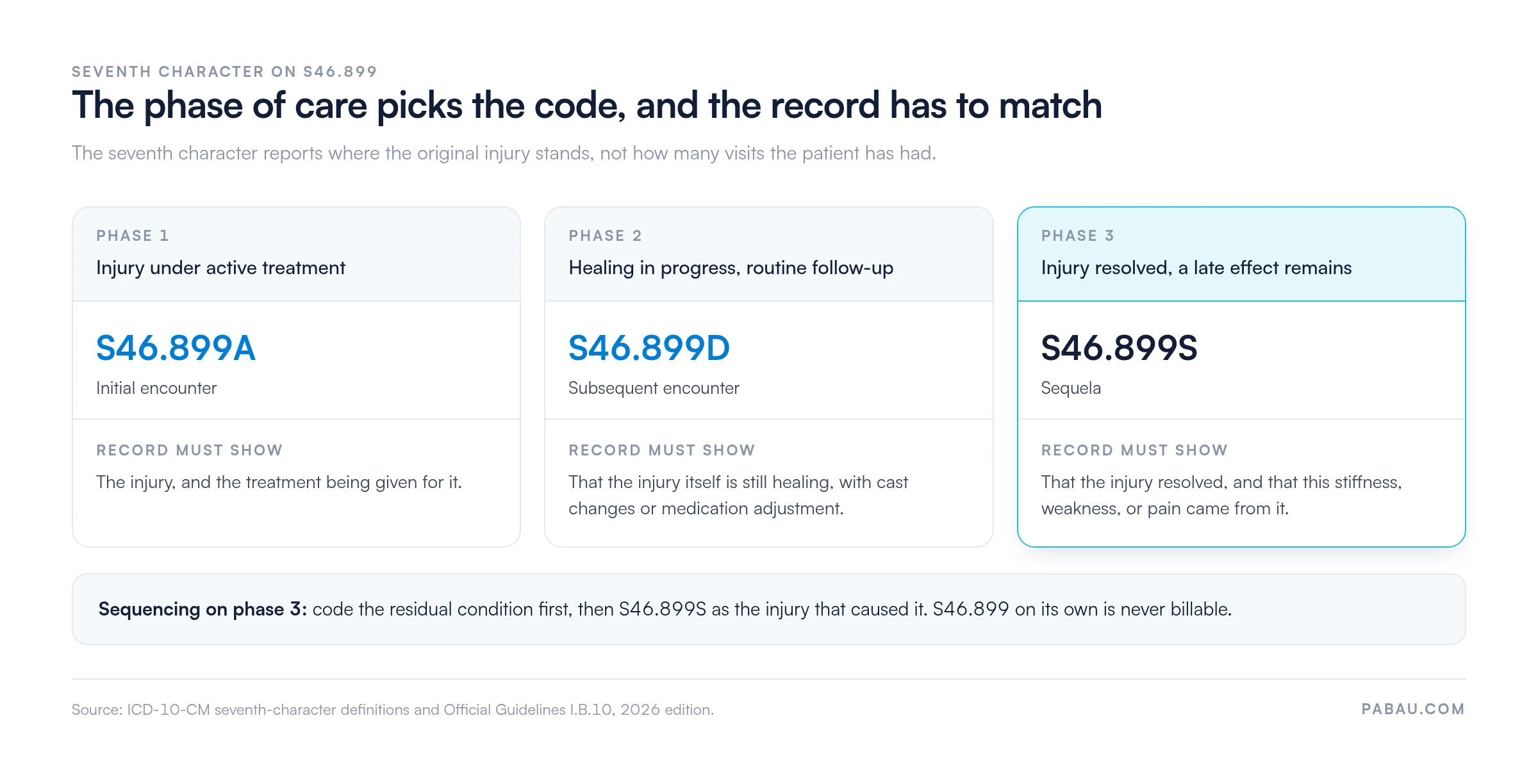
That seventh character is where S46.899 claims commonly go wrong. A coder picks S46.899D, the subsequent-encounter code, when the original injury has already healed. One character turns a clean claim into a denial.
Let Pabau's smart automation suggest the right codes, reduce claim denials, and keep your practice compliant—effortlessly.
Automate repetitive tasks and focus on what matters most—your patients.
Reduce coding errors and ensure compliance with the latest regulations.
Clean claims, fewer denials, and faster reimbursements.
Powerful insights and reporting to help your practice thrive.
HIPAA compliant SOC 2 certified GDPR-compliant Trusted by 4,000+ clinics worldwide

S46.899S is a billable ICD-10-CM code for other injury of other muscles, fascia and tendons at shoulder and upper arm level, unspecified arm, sequela. It is valid for the 2026 edition, effective October 1, 2025.
The seventh character S means sequela. Use it once the original shoulder or upper arm injury has resolved and the patient presents with its lasting effect.
S46.899 without a seventh character is not billable. Append A, D, or S, or the claim gets rejected on submission.
On a sequela claim, code the residual condition first and S46.899S second, per ICD-10-CM Official Guidelines I.B.10.
Practice management software like Pabau carries built-in ICD-10 and CPT catalogs and submits claims through the Claim.MD clearinghouse.
S46.899S is a billable and specific ICD-10-CM code. It can be submitted directly on a claim without further specification. The code is valid in the 2026 edition of ICD-10-CM, which took effect on October 1, 2025. That date comes from data published by CMS and the National Center for Health Statistics (NCHS).
The descriptor “unspecified arm” means laterality was not documented in the medical record. Wherever clinically possible, pursue left- or right-specific documentation to support more precise coding. When laterality genuinely cannot be established, S46.899S remains the appropriate billable option.
ICD-10-CM requires a seventh character extension on most injury codes in the S00-T88 range. Three extensions apply to the S46.899 family. Each one signals a different phase of care, and picking the wrong one is a common denial trigger in orthopedic and rehabilitation billing.
Sequela coding needs two codes, in a set order. Under ICD-10-CM Official Guidelines section I.B.10, the residual condition is sequenced first. S46.899S goes second, as the injury responsible for that condition. Chapter 19 guidance in section I.C.19 gives the same order for injury codes, and adds that the S is appended to the injury code only. You can check descriptors against the AAPC’s ICD-10-CM code reference while you work.
Coders frequently use S46.899D when the correct code is S46.899S. Both represent visits after the initial injury encounter, which is where the confusion starts. D applies while the body is still healing the original injury. S applies once the original injury is fully resolved and the patient has a residual condition caused by it.
Take a patient presenting with persistent rotator cuff weakness six months after a shoulder muscle tear, with the original injury considered healed. That encounter is S46.899S, not S46.899D. Mapping the three characters onto the phase of care makes the test quicker to apply.
The parent-child structure shows whether you have reached the most specific code available. S46.899S sits five levels deep. Each level adds specificity, and the seventh character is what turns the parent concept into a billable code.
Verify code validity each year using the CDC/NCHS official ICD-10-CM lookup tool. Annual code set updates take effect October 1. A code that is billable in one fiscal year may be retired or revised in the next.
S46.899S applies when a patient presents with the direct late effect of a prior injury. That injury must have involved the muscles, fascia, or tendons at shoulder and upper arm level. It also requires that the affected arm was not specified in the record. The original injury must be fully resolved, and the visit must address only the resulting sequela.
Clinical presentations that may warrant this code include:
The code does not apply to acute injuries still under active care. Nor does it apply to follow-up visits where the original injury is still healing. If the original injury involved a named structure, such as the biceps tendon, a more specific S46 code may exist. Check for that code before defaulting to the “other” category, because specificity is what keeps a claim out of an audit queue.
Before using S46.899S, confirm the documentation says the original injury is fully resolved. The attending provider should note that the current condition is a late effect of a prior injury. Naming the shoulder or upper arm structure involved makes the link explicit. Without that clinical link in the record, the sequela code has no audit support.
Sequela codes carry heightened audit risk because they assert a causal link between a prior injury and a current condition. Medicare and commercial payers may request records to verify that the code is clinically supported. Proactive documentation is the best defense against a denial management problem after submission.
A claim submitted with S46.899S should be supported by medical records that include:
Two sections of the ICD-10-CM Official Guidelines for Coding and Reporting govern this. Section I.B.10 sets the sequencing rule, and section I.C.19 covers the seventh character on injury codes. Read the current year’s guidelines directly, since payer-specific LCD policies can add documentation thresholds on top of them. The medical billing compliance framework your practice follows should include an annual review of both.
The S46.899 family sits within a broader set of injury codes for shoulder and upper arm soft tissue. When laterality is documented, more specific codes exist and should be used instead. The table below shows the sibling codes most relevant to coders working with S46.899S.
Prefer S46.891S or S46.892S over S46.899S whenever the affected arm is documented. Laterality codes are more specific and less likely to trigger a payer request for additional records. The Check ICD-10 lookup database mirrors the official CMS and NCHS data, so you can verify a sibling descriptor and its billable status quickly.
Physical therapists and rehabilitation specialists are among the heaviest users of sequela codes in the S46 family. Take a patient referred for therapy six to twelve months after a shoulder soft tissue injury. If they present with residual weakness or reduced range of motion, that is the classic sequela scenario. The original injury is resolved, and the functional limit is what is being treated.
Payers often apply medical necessity criteria more strictly to sequela claims than to acute injury claims. Each visit has to justify continued care against measurable functional goals. The documentation also has to trace the current limit back to the original injury, visit after visit.
Common CPT pairings for S46.899S in therapy billing are therapeutic exercise (97110), neuromuscular reeducation (97112), and manual therapy (97140). Coverage for these services varies by payer and plan, and it is not uniform for sequela-linked care. Documentation has to support both the sequela diagnosis and each service billed. State rules add another layer, since physical therapy clinic requirements differ on documentation frequency and functional outcome reporting.ICD-10 code S46.899S: sequela vs subsequent encounter
A physical therapy EMR software with a built-in ICD-10 catalog cuts code selection errors. It filters the available codes by anatomical region and encounter type. It also flags the sequela option when the visit type says follow-up for a prior injury.
A sequela claim carries two diagnosis codes, sequenced as section I.B.10 requires. Clearinghouse validation catches formatting errors and missing required fields before the claim reaches the payer, which cuts outright rejections. Electronic submission through a Claim.MD clearinghouse integration also brings real-time eligibility verification and ERA processing.
Both matter on sequela claims, where coverage often turns on plan-specific medical necessity thresholds. A medical claims clearinghouse guide walks through the submission workflow from code entry to reconciliation. Practices that track electronic remittance advice systematically spot sequela denial patterns early, rather than a billing cycle later.
Run a quarterly audit of the S46.899S claims your practice submitted. Filter for medical necessity denials (CO-50) and diagnosis-inconsistent-with-procedure denials (CO-11). A cluster in either bucket means your sequela documentation is not carrying the causal link payers want.
Most practices code a sequela claim in one system and chase it in another. The coder picks S46.899S in the chart, someone re-keys it into a billing portal, and the remittance lands somewhere else again. Every hop is a chance for the seventh character to change.
Practice management software like Pabau keeps that on one record. Built-in ICD-10 and CPT catalogs mean the coder selects S46.899S in the chart instead of typing it into a claim form. Pabau’s claims management software then submits the CMS-1500 or 837P through the Claim.MD clearinghouse.
The same record carries the rest of the cycle. Real-time eligibility checks confirm coverage before the visit, which is where sequela claims most often fall over. Claim status tracking and ERA then show what the payer did, so a run of sequela denials surfaces in one place.

Pabau’s claims management tools include built-in ICD-10 and CPT catalogs, real-time eligibility verification through Claim.MD, and ERA tracking. Your team submits clean sequela claims and sees denials as they land.

Sequela coding errors are largely preventable. Once a practice writes down its documentation protocol, the line between S46.899D and S46.899S stops being blurry. If the original injury is healed and the current condition is its lasting result, S46.899S applies.
The harder part is the record, not the code. A sequela claim asks the provider to state two things: that the original injury resolved, and that this condition came from it. Build both into the note template and the code selection follows on its own.
Book a demo to see how Pabau handles ICD-10 code entry, eligibility checks, and ERA reconciliation on one patient record.

Need to understand how clearinghouse billing works end to end? Revenue cycle management explained walks through the full claim lifecycle from code entry to payment posting.
Looking for guidance on clean claim submission standards? What makes a clean claim covers the formatting, coding, and documentation requirements payers check before processing.
Want to reduce shoulder injury claim denials before they happen? Insurance eligibility verification explains how real-time eligibility checks catch coverage issues before sequela claims are submitted.
S46.899S is a billable ICD-10-CM code for other injury of other muscles, fascia and tendons at shoulder and upper arm level, unspecified arm, sequela. It applies when a patient presents with a late effect of a prior shoulder or upper arm soft tissue injury. That original injury must have resolved. The 2026 edition became effective October 1, 2025.
Yes. S46.899S is commonly used in physical therapy and rehabilitation settings when treating residual functional limitations from a prior shoulder or upper arm soft tissue injury. PT practices should document measurable functional deficits, the causal link to the original injury, and medical necessity for each service billed alongside this code. Coverage varies by payer and plan.
Documentation must establish the original injury and confirm it has resolved. It must also describe the current sequela, such as weakness, stiffness or chronic pain, and attribute it causally to that injury. Objective findings such as range-of-motion measurements or strength test results strengthen the record. Payer-specific LCD policies may impose additional requirements beyond the ICD-10-CM official guidelines.
S46.891S covers the right arm sequela and S46.892S covers the left arm sequela. Both are more specific than S46.899S and should be used whenever arm laterality is documented in the medical record. Use S46.899S only when the affected arm is genuinely unspecified or cannot be established from the clinical documentation.