ICD-10 code S61.201A: Open wound of left index finger without nail damage
ICD-10 code S61.201A covers a left index finger wound of unstated type ICD-10 co...

Last Updated: Oct 16, 2026
Billable Code Specific Code
S44.90XA is the billable ICD-10-CM code for injury of unspecified nerve at shoulder and upper arm level, unspecified arm, initial encounter.
Three errors drive most rejections on this code. One is the wrong 7th character for the phase of care. Another is leaving laterality unspecified when the chart already names the arm. The last is keeping S44.90XA after an electrodiagnostic report identifies the nerve.
Let Pabau's smart automation suggest the right codes, reduce claim denials, and keep your practice compliant—effortlessly.
Automate repetitive tasks and focus on what matters most—your patients.
Reduce coding errors and ensure compliance with the latest regulations.
Clean claims, fewer denials, and faster reimbursements.
Powerful insights and reporting to help your practice thrive.
HIPAA compliant SOC 2 certified GDPR-compliant Trusted by 4,000+ clinics worldwide

ICD-10 Code S44.90XA covers injury of unspecified nerve at shoulder and upper arm level, unspecified arm, initial encounter. It became billable on October 1, 2025.
The 7th character A marks the initial encounter. Use S44.90XD for subsequent encounters and S44.90XS for sequela coding.
Use S44.90XA only when laterality is clinically undetermined. Once the record names the affected arm, S44.91XA (right) or S44.92XA (left) is correct.
Practice management software like Pabau connects to Claim.MD, so your team can submit these claims, check eligibility, and post payments in one place.
ICD-10 Code S44.90XA is a billable/specific ICD-10-CM code. Its full official description is: Injury of unspecified nerve at shoulder and upper arm level, unspecified arm, initial encounter. The code became effective on October 1, 2025, as part of the FY2026 ICD-10-CM edition and remains valid through September 30, 2026.
ICD-10 Code S44.90XA sits in a defined path through the ICD-10-CM tabular list. Reading that path helps you find the more specific alternative when documentation supports one. It also tells you which Chapter 19 conventions apply, including the mandatory 7th character. Our ICD-10-CM code archive covers the same hierarchy for other categories.
The 7th character in Chapter 19 injury codes is not optional. It tells the payer which phase of care the claim represents. Submitting S44.90XA for a visit that is clearly a follow-up creates a mismatch between the claim and the record. That mismatch is a common trigger for audits and denials.
Per the ICD-10-CM Official Guidelines for Coding and Reporting, “initial encounter” does not mean the patient’s first visit to any provider. It means the patient is still receiving active treatment for the injury. A patient referred from primary care to an orthopedic specialist for active management is still in the initial encounter phase. Earlier visits to other clinicians do not change that.
Laterality is one of the first fields payers check on shoulder and upper arm injury claims. S44.90XA specifies “unspecified arm,” which means the affected side is not documented. Using it when the record clearly states left or right is an error a payer can query on audit. The CDC/NCHS ICD-10-CM tool lists all three laterality options in subcategory S44.9.
If you query the treating provider and laterality is confirmed after coding, update the record and submit the more specific code. Querying beats defaulting to unspecified whenever the information can reasonably be obtained. The grid below maps every combination of arm and encounter phase in subcategory S44.9.
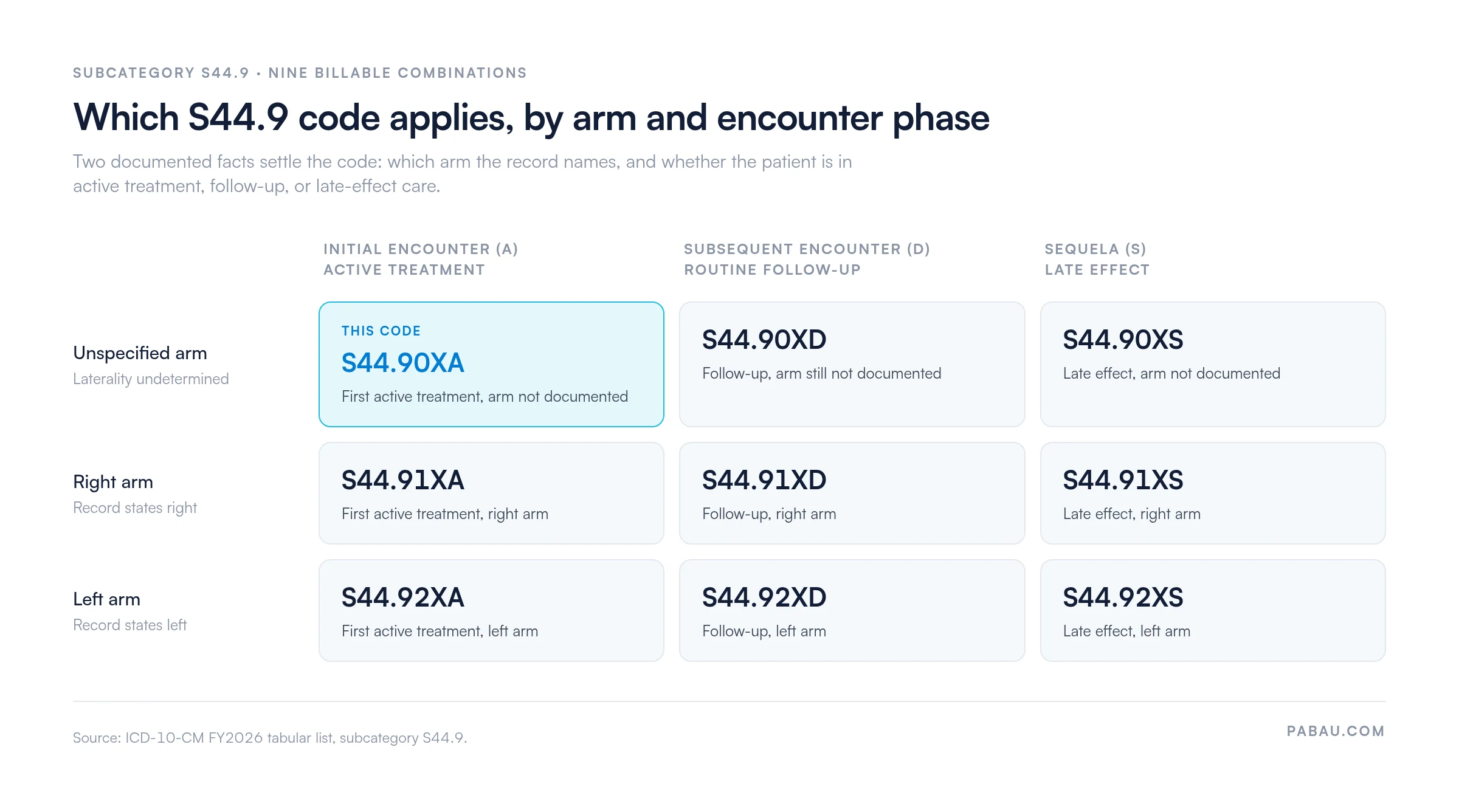
Category S44 covers nerve injuries at the shoulder and upper arm level, organized by the nerve affected. S44.90XA is the unspecified-nerve, unspecified-arm code. Once documentation identifies the nerve, meaning axillary, musculocutaneous, median, radial, ulnar or cutaneous sensory, a more specific S44 code applies. A documented left musculocutaneous injury, for example, codes to S44.42XA, and a left radial nerve injury to S44.22XA. Use the AAPC Codify ICD-10-CM lookup to browse the full category and check current-year validity.
Accurate coding of S44.90XA depends on what the record contains. Review these elements before you assign the code, and query the provider when any of them is missing. The same review protects the practice if a payer audits the claim later.
According to ICD-10-CM Official Guidelines (Section I.C.19) and the AHA Coding Clinic, unspecified codes are acceptable when documentation does not support a more specific code. This is a narrow exception. Coders should not reach for an unspecified code to avoid querying a provider. If the record holds enough information to support specificity and the coder bypasses it, the code is wrong. That holds even when the claim is paid.
S44.90XA is legitimately the best available code in a few situations. Emergency presentations where the patient cannot communicate laterality qualify. So does coding from an incomplete record when nerve conduction studies are still pending and the provider is unavailable to query.
Run a query in your EMR for all S44.90XA claims submitted in the past 90 days. For any case where the provider subsequently documented laterality in follow-up notes, correct the initial claim to S44.91XA or S44.92XA. Payers may not flag the original claim, but audit programs look at specificity patterns over time.
Shoulder and upper arm nerve injuries most often follow traumatic events. Anterior glenohumeral dislocation stretches the axillary nerve, and humeral shaft fractures are associated with radial nerve injury. Direct compressive trauma and post-surgical complications account for others. Sports injuries and motor vehicle accidents make up a large share of S44 presentations.
Presenting symptoms usually include weakness in shoulder elevation or arm rotation and sensory loss over specific dermatomes. Severe injuries can produce complete motor paralysis in the affected nerve’s distribution. Electrodiagnostic studies, meaning EMG and nerve conduction studies, confirm nerve involvement and identify which nerve is affected. For coders, that report is the trigger. If it names a nerve, a more precise S44 code replaces S44.90XA.
The same report can also place the injury below the elbow. Nerve injuries at the forearm level belong to category S54 rather than S44. A left radial nerve injury seen at follow-up codes to S54.22XD.
S44.90XA is a diagnosis code, so it needs companion CPT procedure codes on the claim. The pairing has to reflect what was performed during the encounter, because each pairing carries a medical necessity implication. Requirements vary by payer and by Local Coverage Determination (LCD), so check the table below against current payer policy. Practices using Pabau’s claims management software can send these pairings to payers through the Claim.MD clearinghouse integration.
Accurate CPT-to-ICD-10 pairing is what separates a clean claim from a denial on these encounters. Capture every rendered service before submission, and check the diagnosis code on the claim against the note the clinician signed. Where the two disagree, fix the record before the claim leaves the practice.
Orthotic devices supplied during recovery do not belong on this physician claim. They travel on a separate DMEPOS supplier claim. A knee brace billed as HCPCS code L1845, for example, needs modifier KX and its own supporting diagnosis.
Before submitting any S44.90XA claim with a nerve repair CPT code, verify the payer’s Local Coverage Determination (LCD) for peripheral nerve procedures. Some payers require prior authorization or additional supporting documentation, including electrodiagnostic reports, before approving nerve repair claims at the shoulder level.
Most practices code these encounters twice. The clinician writes the note in one system. A coder then re-reads it in another and types the diagnosis code onto a claim form. A laterality note added at the follow-up visit never reaches the claim that already went out.
Pabau, an all-in-one practice management system, keeps the treatment note, the diagnosis code, and the invoice on the same client record. When the provider documents the affected arm, the coder sees it against the encounter it belongs to. The Claim.MD integration then submits the claim, checks the patient’s eligibility, and tracks its status without a second system.
The result is fewer claims that carry an unspecified code the chart no longer supports. Remittances post back against the same invoice, so your team can see which nerve injury claims paid and which need a corrected code.

Pabau sends ICD-10-coded claims to payers through Claim.MD, runs real-time eligibility checks, and posts remittance advice back to the invoice. Your billing team spends less time on rework.

S44.90XA is a legitimate billable code when the record cannot name the nerve or the arm. Used as a default, it is the code most likely to draw an audit question. The fix is procedural rather than clinical. Query the provider, then re-code once the answer arrives.
Build the check into the workflow rather than the coder’s memory. Review the last 90 days of S44.90XA claims, and correct the ones a later note made specific. Book a demo to see how Pabau keeps the diagnosis code, the note, and the claim on one record.

Want to reduce claim denials on musculoskeletal codes? Denial management in healthcare covers payer-specific patterns and appeal strategies.
Need to capture every service on a nerve injury visit? Superbill explains what belongs on the form before a claim goes out.
Deciding how your claims reach payers? Medical claims clearinghouse compares submission routes and what each one checks.
Coding a compression rather than a traumatic injury? ICD-10 code G55 covers nerve root and plexus compressions.
ICD-10 Code S44.90XA describes an injury of an unspecified nerve at the shoulder and upper arm level, initial encounter. The affected arm is unspecified too. It sits in category S44 and is billable for FY2026.
Yes, S44.90XA is a billable/specific ICD-10-CM code, effective October 1, 2025, and valid through the FY2026 period. It can be submitted on claims as a primary or secondary diagnosis when clinical documentation supports its use.
S44.90XA means laterality is not documented or determinable. S44.91XA specifies the right arm. When the record states right arm, S44.91XA is the correct code. Using S44.90XA when the chart documents laterality is a coding error.
Use S44.90XA during the initial encounter phase, when the patient is actively receiving treatment for the nerve injury. Switch to S44.90XD for subsequent encounters, meaning routine follow-up, rehabilitation, or outpatient management visits after initial treatment is established.
Commonly paired CPT codes include 95860 (needle EMG, one extremity), 95900 (nerve conduction study), 97110 (therapeutic exercise), and standard E/M codes (99213-99215) for follow-up. CPT pairing must reflect the services performed and meet the payer’s medical necessity criteria. Verify against the applicable LCD before submission.
The record needs the mechanism of injury, a clinical description of the nerve injury symptoms, and the encounter type. It also needs an explicit statement that laterality is undetermined. If electrodiagnostic findings identify the nerve, a more precise S44 code replaces S44.90XA.