ICD-10 code S62.635G: Left ring distal phalanx, delayed healing
ICD-10 code S62.635G at a glance ICD-10 code S62.635G covers a displaced fractur...

Last Updated: Oct 16, 2026
Billable Code Specific Code
S54.22XD is the billable ICD-10-CM code for injury of radial nerve at forearm level, left arm, subsequent encounter. The 7th character D applies once active treatment has ended and the patient is receiving routine care while the nerve recovers.
These injuries cause wrist drop and sensory loss over the back of the hand. Orthopedics, neurology, physical therapy and occupational therapy may all report S54.22XD at follow-up visits, each with its own CPT codes.
Let Pabau's smart automation suggest the right codes, reduce claim denials, and keep your practice compliant—effortlessly.
Automate repetitive tasks and focus on what matters most—your patients.
Reduce coding errors and ensure compliance with the latest regulations.
Clean claims, fewer denials, and faster reimbursements.
Powerful insights and reporting to help your practice thrive.
HIPAA compliant SOC 2 certified GDPR-compliant Trusted by 4,000+ clinics worldwide

S54.22XD is a valid, billable ICD-10-CM code for FY2025 and FY2026 under category S54, injury of nerves at forearm level.
The 7th character D marks a subsequent encounter, meaning routine care while the injury heals after active treatment has ended.
The clinical note must name the left arm, or the claim no longer supports S54.22XD over the unspecified code S54.20XD.
Payers often question S54.22XD when the claim history holds no record of the original injury and its active treatment.
Practice management software like Pabau pre-fills claims from the patient record, then submits and tracks them through the Claim.MD clearinghouse.
ICD-10 code S54.22XD is the billable ICD-10-CM code for injury of radial nerve at forearm level, left arm, subsequent encounter. Use it once active treatment has ended and the patient is receiving routine care while the nerve recovers.
The table below lists the core attributes to confirm before you submit the claim. Every field reflects the CMS ICD-10-CM Tabular List for FY2025 and FY2026.
S54.22XD covers traumatic injury to the radial nerve at the forearm level, left arm, during the subsequent (healing or recovery) phase of care. At this level the radial nerve runs along the lateral forearm. It supplies the wrist and finger extensors and carries sensation from the back of the hand and the thumb web space. Lacerations, fractures, compression and traction at this level can disrupt both motor and sensory function.
Three boundaries define what this code does and does not cover:
The 7th character D means the patient is receiving routine care during healing or recovery. The visit count plays no part, so a patient still in active treatment stays on XA at the third or fourth visit.
According to the CMS ICD-10-CM Official Guidelines, the three 7th-character options for traumatic injury codes carry these definitions:
Take a physical therapist seeing a patient three weeks after a forearm laceration. Active treatment ended when the wound was closed and the nerve injury diagnosed, so the therapist reports S54.22XD, even at only the second clinical encounter. The 7th character follows the phase of care.
All three variants describe the same nerve injury at the same anatomical level. The 7th character alone signals the phase of care, and payers use it to validate clinical necessity for each encounter type. The diagram below walks through both choices, laterality first and then the phase of care.
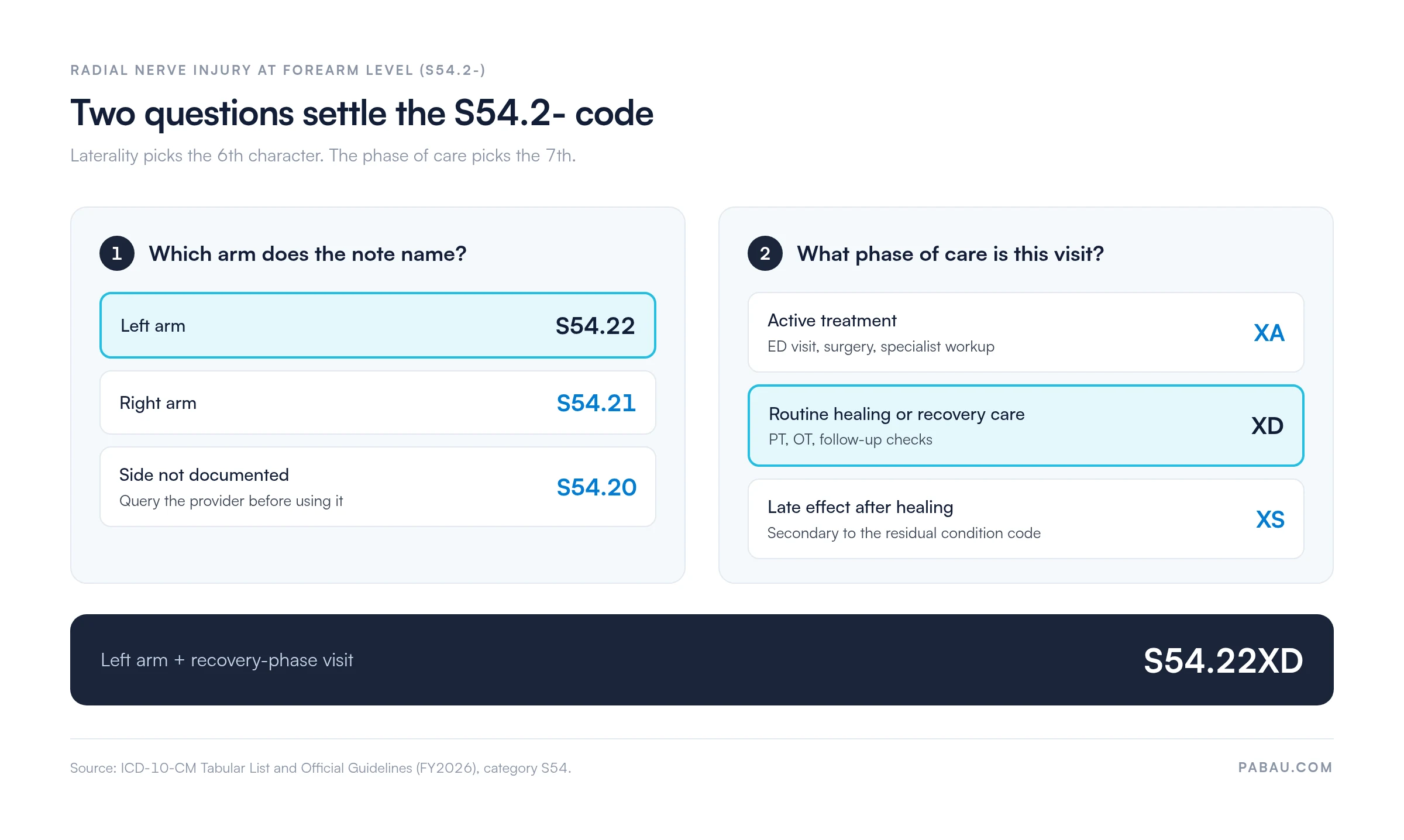
Document the care phase explicitly in every note. A phrase like ‘patient is in the rehabilitation phase following radial nerve laceration’ tells the payer why XD is correct. That holds even when the visit falls soon after the original injury.
S54.22XD sits within a precise code tree. Confirming its placement prevents laterality and level errors before submission.
S54.20XD (unspecified arm) should not be used when the provider’s note identifies the injured limb as left. Laterality specificity is a payer requirement and a clinical accuracy standard. Use S54.22XD whenever the note confirms left-arm involvement. For neighboring nerve and forearm injury codes, browse our ICD-10-CM reference for coders.
S54.22XD carries inherited excludes notes from its parent category S54. These define what cannot be coded alongside it and which conditions belong elsewhere. Coders should review these before pairing S54.22XD with other nerve-related codes.
For the full Chapter 19 tabular notes, check the CDC/NCHS ICD-10-CM web tool.
Wrist drop is the hallmark of radial nerve injury at or proximal to the forearm-level extensor compartment. Coders validating documentation against S54.22XD should look for these clinical findings, which confirm the nerve injury is at the correct anatomical level.
A nerve conduction study (NCS) or EMG/NCS confirms radial nerve involvement at the forearm level. It also distinguishes it from a higher lesion, such as a spiral groove injury at the humerus.
ICD-10-CM expects the documentation to support the specific code reported. An NCS report showing a forearm-level conduction abnormality strengthens the case for S54.22XD over adjacent codes. It is also the strongest laterality anchor when the clinical note uses vague phrasing such as “affected arm.”
Payer requirements for subsequent encounter codes vary by plan, but five documentation elements consistently support S54.22XD across commercial and Medicare claims. Missing any one of them is a common denial trigger.
The same five elements carry you through a payer audit. Reviewing the electronic remittance advice from each payer shows how your S54.22XD claims are adjudicated, so a denial pattern surfaces while it is still small.
The CPT codes submitted alongside S54.22XD reflect the care phase and the treating discipline. Physical and occupational therapy codes dominate subsequent-encounter claims. Electrodiagnostic codes appear when NCS/EMG is performed at the same visit. The table below covers the most common pairings, and AAPC Codify offers crosswalk lookups for medical necessity checks.
Denials for ICD-10 code S54.22XD cluster around a small number of predictable errors. Most stem from 7th-character misapplication or thin supporting documentation. Several of them trip automated claim edits before a human reviewer ever sees the case.
Run a five-point check before submitting any S54.22XD claim. Confirm a prior XA on record, the word left in the note, and no acute-injury language. Then confirm no excluded diagnosis is paired and the encounter reads as follow-up or rehabilitation.
Many therapy and neurology practices still copy the diagnosis, the side and the visit details from the note into a separate billing tool. Each copied field is one more place for a left-arm claim to go out coded as unspecified, or to stall without anyone noticing.
Pabau’s claims management for practices pre-fills each claim from the data already in the patient record. It then submits the claim and tracks its status through the Claim.MD clearinghouse.
The software doesn’t pick the 7th character or check laterality for you, so the five-point review above still sits with your coder. What changes is the rework. The claim carries what the note says, and you see which S54.22XD claims are paid, pending or denied in one place.

Pabau pre-fills each claim from the patient record, then submits and tracks it through the Claim.MD clearinghouse. See how that fits your therapy or specialist practice.

S54.22XD holds up when the note names the left arm, links the visit to a documented injury, and places the patient in recovery. When one of those is missing, fix the note before you touch the code.
The trade-off is speed. An addendum request holds up one claim, while a swapped-in unspecified code or a wrong 7th character invites a denial and an appeal.
Book a demo to see how Pabau pre-fills, submits and tracks radial nerve injury claims for physical therapy and specialist practices.

Need to understand how claims move from code to payment? Revenue cycle management overview walks through the full claim lifecycle from coding to remittance.
Getting denials you can’t explain? Denial codes in medical billing maps the most common CARC codes to their corrective actions.
Submitting NCS or EMG claims alongside this code? Superbill documentation guide covers how to structure multi-procedure encounters for clean first-pass submission.
Want fewer claims bouncing back? What makes a clean claim lists the fields payers check before they accept a submission.
Building a denial follow-up routine? Denial management in healthcare covers how to track, appeal and prevent repeat denials.
ICD-10 code S54.22XD is the billable diagnosis code for injury of radial nerve at forearm level, left arm, subsequent encounter. It means the patient is receiving routine care while a traumatic left-arm radial nerve injury heals, after active treatment has ended.
Use S54.22XD when active treatment of the original radial nerve injury is complete and the patient is now in the healing or recovery phase. Typical settings are physical therapy, occupational therapy, or a routine neurology follow-up. Use S54.22XA when the patient is still receiving active treatment for the injury, regardless of how many visits have occurred.
Yes. S54.22XD is a valid, billable ICD-10-CM code for FY2025 and FY2026, confirmed by the CMS annual Tabular List update and NCHS coding guidelines.
S54.22XD is used during the healing phase while the nerve is still recovering. S54.22XS applies after the acute injury has fully resolved but a late effect persists, such as permanent wrist extensor weakness. It is reported as a secondary code, after the code for the specific residual condition.
The most frequent CPT pairings are 97161-97163 (PT evaluation), 97110 (therapeutic exercise), 97530 (therapeutic activities), 95907-95913 (nerve conduction studies), and 29125 (wrist splint application). The correct CPT code depends on the treating discipline and the specific service rendered at that encounter.
The most common reasons are a missing prior S54.22XA encounter and a clinical note that never states the left arm. Acute-injury language that conflicts with the 7th character D, or pairing with an excluded diagnosis, also triggers denials. Correcting these before submission heads off the most common denials.