ICD code S44.22XA – Radial nerve injury, left upper arm
Billable Code•Specific Code
Code Definition
S44.22XA is the billable ICD-10-CM code for injury of radial nerve at upper arm level, left arm, initial encounter. It applies while the patient is in active treatment for a left radial nerve injury at the humerus. A shaft fracture or compression in the spiral groove is a typical cause.
Three details decide whether it's the right code: the left arm, the upper arm level rather than the forearm or wrist, and the treatment phase. A slip in any one of them is a common cause of denials.
Related Information
Chapter
S00-T88 Injury, poisoning and certain other consequences of external causes
Category
S44 Injury of nerves at shoulder and upper arm level
Group
S44.22 Injury of radial nerve at upper arm level, left arm
Billable
Yes
Code also known as
radial nerve palsy, wrist drop upper arm, radial nerve lesion upper arm, Saturday night palsy left arm
Save time. Improve accuracy. Get paid faster.
Automate coding with Pabau
Let Pabau's smart automation suggest the right codes, reduce claim denials, and keep your practice compliant—effortlessly.
S44.22XARadial nerve injury, left upper armHigh match
Confidence score
98%
Why this code?
Matches patient diagnosis
Supported by clinical notes
Commonly used for this condition
Why practices choose Pabau
Save hours every week
Automate repetitive tasks and focus on what matters most—your patients.
Improve accuracy
Reduce coding errors and ensure compliance with the latest regulations.
Get paid faster
Clean claims, fewer denials, and faster reimbursements.
Grow with confidence
Powerful insights and reporting to help your practice thrive.
HIPAA compliant•SOC 2 certified•GDPR-compliant•Trusted by 4,000+ clinics worldwide
Key takeaways
S44.22XA is the billable ICD-10-CM code for a radial nerve injury at the upper arm level, left arm, initial encounter.
The 7th character A covers all active treatment visits, not just the first emergency department contact.
Laterality errors are a common cause of denials: S44.21XA (right arm) and S44.20XA (unspecified arm) are distinct, non-interchangeable codes.
The documented level picks the category: forearm injuries go to S54.2- and wrist or hand injuries to S64.2-.
Pabau’s claims management software pre-fills claims from the patient record, offers ICD-10-CM and CPT code lookup libraries, and checks required fields before submission.
ICD-10 code S44.22XA covers a left radial nerve injury in the upper arm
ICD-10 code S44.22XA is the billable ICD-10-CM code for injury of radial nerve at upper arm level, left arm, initial encounter. It sits in subcategory S44.2 (injury of radial nerve at upper arm level), inside category S44 (injury of nerves at shoulder and upper arm level). You can confirm both in the CDC/NCHS ICD-10-CM lookup tool.
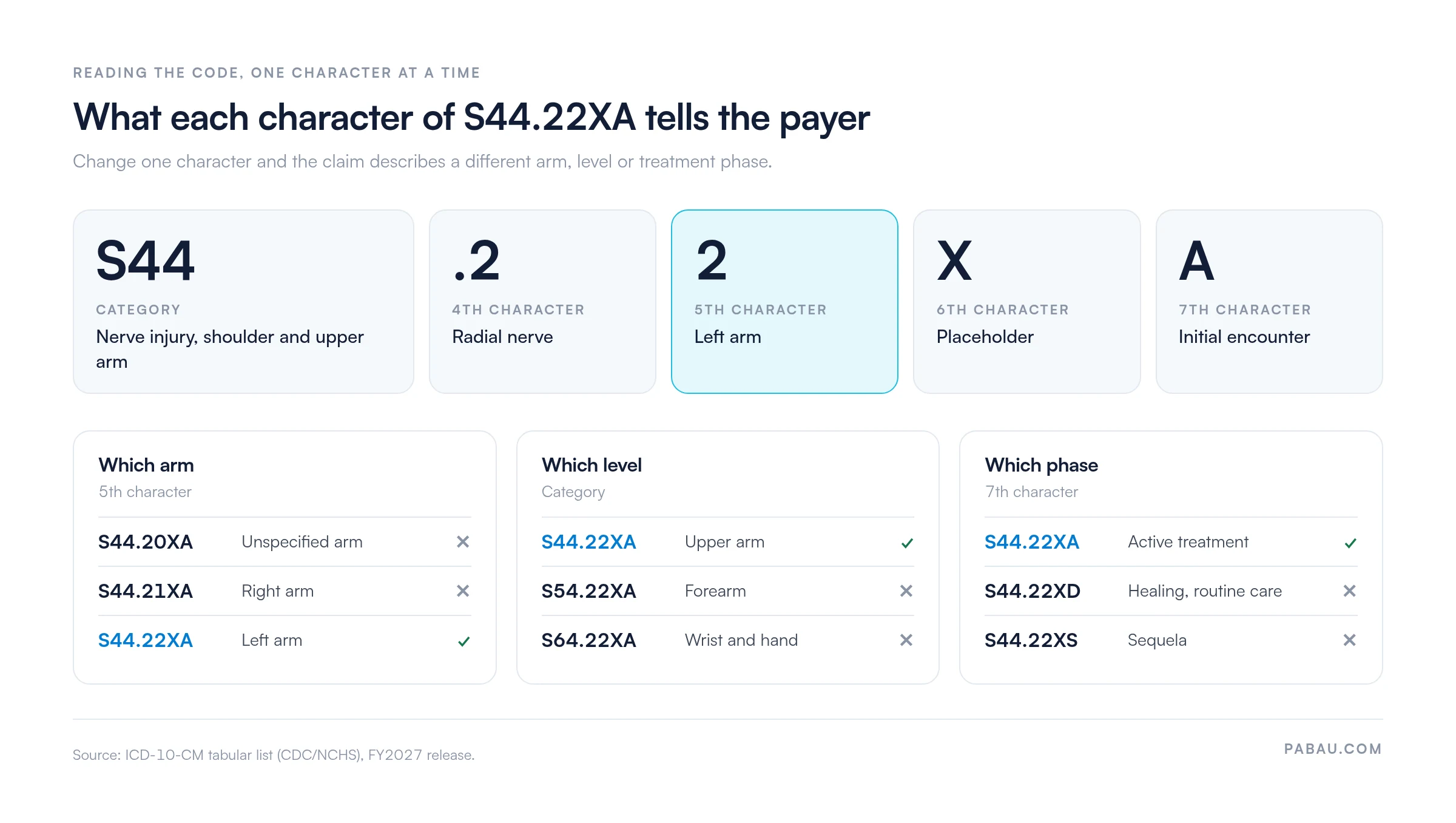
Each character carries one fact from the medical record. Read it left to right:
S44: the category, nerve injury at the shoulder and upper arm.
.2: the 4th character, which names the radial nerve.
2: the 5th character, which specifies the left arm (0 is unspecified arm, 1 is right arm).
X: a placeholder that holds the 6th position open.
A: the 7th character, initial encounter.
Every one of those characters has to match the record. As the diagram shows, a single swap turns the claim into a different code.
One wrong character moves the claim to another arm, another level of the limb or another treatment phase. Code structure from the ICD-10-CM tabular list.
Field
Value
Full code
S44.22XA
Official descriptor
Injury of radial nerve at upper arm level, left arm, initial encounter
ICD-10-CM version
Valid for the current ICD-10-CM release (FY2027, effective October 1, 2026); in effect since FY2016
Billable status
Billable / specific
Category
S44 (Injury of nerves at shoulder and upper arm level)
Payers may reject an unspecified code when the record supports a specific one. So S44.20XA (unspecified arm) isn’t a safe stand-in when the notes document the left arm.
The injury level decides between S44, S54 and S64
At the upper arm level, the radial nerve runs through the spiral groove of the humerus. That’s where compression and laceration injuries tend to happen. Here the nerve hasn’t yet split into its posterior interosseous and superficial branches, so the deficit looks different from a lower injury.
Wrist drop is the hallmark sign. A complete injury at this level leaves the patient unable to extend the wrist or fingers against gravity. Sensory loss usually covers the back of the hand on the thumb side. Record these findings in the notes, because they support both the side and the level.
Upper arm / spiral groove (S44.2-): wrist drop, finger drop, sensory loss over the dorsolateral hand
Forearm or posterior interosseous level (S54.2-, with S54.22XA for the left arm): finger drop without wrist drop, no sensory deficit
Wrist and hand level (S64.22XA): superficial sensory deficits only, no motor deficit to the wrist extensors
So the level in the note picks the category. A left radial nerve injury at the forearm is S54.22XA, and at the wrist or hand it’s S64.22XA. Payers can spot the mismatch when an upper arm nerve repair is billed with a forearm or wrist diagnosis.
The 7th character follows the treatment phase, not the visit count
The 7th character is the element of S44.22XA that coders misapply most often. Three characters apply to S44.22, and each one creates a separate billable code.
Code
7th character
Descriptor
When to use
S44.22XA
A
Initial encounter
The patient is receiving active treatment, such as emergency care, surgery, or evaluation and continuing treatment by a new physician. It applies to every active-treatment visit, not only the first.
S44.22XD
D
Subsequent encounter
Active treatment is finished, and the patient gets routine care while the injury heals, such as a post-op check.
S44.22XS
S
Sequela
A residual condition, such as permanent wrist drop, results from the earlier injury. Code the residual condition first, then S44.22XS.
Per the ICD-10-CM Official Guidelines, Section I.C.19.a, the 7th character A applies throughout active treatment. Switching to D while treatment is still under way is a common error, and auditors look for it.
Worked example: One injury, three codes over a year
Here’s how the code changes for one patient. She falls, breaks the shaft of her left humerus, and the emergency department notes wrist drop.
Emergency visit: a fracture code from S42.3- plus S44.22XA. The provider’s judgment of the most serious injury sets the order.
Surgical repair the next week: still S44.22XA, because surgery is active treatment.
Post-op check: S44.22XD, because treatment is done and she’s healing.
A year later, with wrist drop that never resolved: the wrist drop code first, then S44.22XS.
Five look-alike codes that pull S44.22XA claims off course
Five codes sit close enough to S44.22XA to cause regular mis-selection. They differ by side, by level or by nerve, and none of them can stand in for another.
Code
Nerve
Level
Laterality
Key differentiator
S44.22XA
Radial
Upper arm
Left
Target code
S44.21XA
Radial
Upper arm
Right
Right-arm counterpart, with a different 5th character (1 vs 2)
S44.20XA
Radial
Upper arm
Unspecified arm
Use only when the record never documents the side. Payers may deny it if the notes name an arm.
S64.22XA
Radial
Wrist and hand
Left
Different category (S64), for injury at wrist and hand level (forearm is S54.2-)
S44.10XA
Median
Upper arm
Unspecified arm
Different nerve (median, not radial) with a different clinical presentation
S44.90XA
Unspecified
Shoulder/upper arm
Unspecified arm
Non-specific fallback, to avoid when the nerve and side are documented
Watch the last row on rushed claims. S44.90XA is the fallback for an unnamed nerve, so it has no place on a claim whose notes name the radial nerve.
Tabular notes that change what goes on the claim
Category S44 and subcategory S44.2 carry notes that decide which codes sit beside S44.22XA.
Code also (category S44): any associated open wound (S41.-). A laceration that cut the nerve gets its own wound code.
Excludes2 (category S44): injury of brachial plexus (S14.3-). If the notes describe plexus involvement rather than an isolated radial nerve injury, S14.3- codes apply. Both may be coded when they are separate injuries.
Excludes1 (subcategory S44.2): radial nerve injury NOS (S54.2-). A note that says “radial nerve injury” with no level doesn’t support S44.22XA.
External cause codes: Section I.C.20 of the guidelines covers these codes (V00-Y99). There’s no national mandate to report them, but state rules and some payers require them. They explain how the injury happened, such as a fall or a machinery laceration.
Place of occurrence and activity codes: a place-of-occurrence code (Y92) and an activity code (Y93) can follow the external cause code.
Principal diagnosis: S44.22XA can be listed first when the nerve injury is the main reason for the visit. With multiple injuries, Section I.C.19.b puts the most serious one first, as the provider determines.
Six facts the record must state before you code S44.22XA
Six details need to be in the medical record to support S44.22XA. Miss one and the valid code drops to a less specific option, which invites downcoding or denial. Most come out of a standard initial assessment, but each must be stated rather than implied.
Laterality: The record must state “left” explicitly. “Contralateral” to a documented right-side injury works if it’s unambiguous, but a direct “left” is better.
Anatomical level: The record must place the injury at the upper arm, not the forearm or wrist. References to the spiral groove of the humerus, the brachial region or the upper arm support this.
Nerve identified: The note must name the radial nerve. “Peripheral nerve injury” alone isn’t enough for S44.22XA.
Mechanism of injury: This supports any external cause code. Examples include a motor vehicle collision, a fall, a laceration, a crush injury, or injury during a procedure.
Clinical findings: Wrist drop, sensory loss over the dorsolateral hand, or weak wrist and finger extensors support the diagnosis. EMG or nerve conduction results give the strongest objective support, though payers don’t universally require them for initial encounter coding.
Encounter type: The record should show active treatment to justify A as the 7th character. Operative notes, wound care documentation or a nerve repair treatment plan all meet this standard.
Prior authorization attaches to the procedure, not the diagnosis
Medicare and Medicaid don’t require prior authorization for the diagnosis code itself. Authorization rules apply to the procedures billed with S44.22XA.
Check eligibility and coverage before you schedule nerve repair or grafting. Build that step into your medical billing compliance routine, so the authorization number is on file before the claim goes out.
Rules for nerve repair, nerve grafting and neurolysis vary by payer. Track code updates through the CMS ICD-10 resources, then confirm authorization with each payer before scheduling. Policies change with annual updates.
Medicare/Medicaid: No LCD or NCD restricts S44.22XA itself. Coverage decisions apply to the procedure codes billed with it. The AAPC ICD-10-CM lookup helps you check for payer policies tied to S44.22.
Private payers: Many require prior authorization for nerve repair (CPT 64835-64858) and nerve grafting (CPT 64890-64895). Payer policies vary, so verify per payer. Request authorization with the procedure CPT code and S44.22XA as the supporting diagnosis.
Supporting documentation insurers commonly require: a physician narrative of the clinical findings, EMG/NCS results where available, and operative planning notes for surgical cases.
Before you submit: A five-point S44.22XA check
Run these checks on every S44.22XA claim before it leaves the practice. Each one maps to a denial pattern in the next section.
Side: the 5th character (2) matches the left arm in the note and the procedure site.
Level: the note places the injury in the upper arm, not the forearm or wrist.
Phase: the 7th character matches the treatment phase on the date of service.
Companion codes: an open wound code (S41.-) is present if there’s a wound, plus any external cause code the payer requires.
Authorization: the number for any nerve repair or grafting is on the claim.
Six denial patterns and how to fix each one
Denials on S44.22XA tend to follow the same patterns, and each traces back to a fixable coding or documentation step. A steady denial management process catches most of them before submission.
Denial reason
Root cause
Corrective action
Wrong laterality code
S44.21XA (right arm) or S44.20XA (unspecified arm) submitted when the record documents the left arm
Cross-check the procedure site against the 5th character before submission. Correct and resubmit with S44.22XA.
Wrong anatomical level
S64.22XA (wrist and hand) or S54.22XA (forearm) submitted when the injury is at the upper arm
Confirm the operative or clinical note specifies the upper arm or spiral groove. Correct to S44.22XA and appeal with the supporting documentation.
Incorrect 7th character
S44.22XD submitted during active treatment, or S44.22XA submitted at a routine healing visit
Audit the encounter type against the clinical notes. A means active treatment, and D means routine care while healing.
Missing external cause code
No external cause code submitted when the payer or a state rule requires one
Add the external cause code that matches the documented mechanism of injury.
Missing prior authorization
Nerve repair submitted without authorization from a private payer
Obtain authorization before the procedure date. Keep the authorization number for the claim.
E/M bundled into the surgery
Nerve repair and an E/M visit billed on the same date without a modifier
Nerve repair carries a 90-day global period. Apply modifier 57 when the visit led to the decision for surgery, or 25 for a significant, separately identifiable E/M.
Match each denial to the CARC reason code on the remittance advice. Our guide to medical billing denial codes explains each one, so your fix targets the stated reason.
CPT codes that usually travel with S44.22XA
S44.22XA often appears beside surgical and diagnostic CPT codes. The right pairing depends on the procedure performed. Check each pairing against current NCCI edits, which CMS updates quarterly.
CPT code(s)
Procedure
Notes
64835-64858
Nerve repair (sutured repair of named nerve)
The most common surgical pairing. Payers often require prior authorization. NCCI edits apply if it’s paired with an E/M on the same date.
64890-64895
Nerve grafting
Used when primary repair isn’t feasible. Many private payers require prior authorization. Check NCCI when it’s combined with 64835-64858.
95907-95913
Nerve conduction studies (NCS)
A diagnostic pairing that may need separate authorization. The number of studies billed must match the number performed.
95860-95872
Electromyography (EMG)
Often ordered with NCS to evaluate a radial nerve injury. EMG and NCS are separately billable, but both face medical necessity review.
99202-99215
Office and outpatient E/M
Nerve repair carries a 90-day global period. Apply modifier 57 when the visit led to the decision for surgery, or 25 for a significant, separately identifiable E/M. Document each service separately.
A good diagnosis-procedure match is central to a clean claim. Payer edits compare the procedure site with the diagnosis, so a level mismatch can bounce the claim before anyone reviews it.
How Pabau keeps nerve injury claims complete before submission
Many billing teams still copy codes from the chart into a payer portal by hand. One missing membership number or authorization code sends the claim back, and the coding work stalls on admin fixes.
Pabau’s time-saving claims management software pre-fills each claim from the patient record. ICD-10-CM and CPT code lookup libraries sit inside the claim form. Required fields are checked before submission, so incomplete claims don’t go out.
US claims go through Claim.MD, with real-time eligibility checks, ERA posting and claim status tracking. Pabau won’t choose the side, level or 7th character for you. It takes the admin work off your coders, so they can spend their time on those three decisions.
Pabau pre-fills the claim from the patient record and checks required fields first, so an S44.22XA claim doesn’t bounce for a missing detail.
Send nerve injury claims out complete
Pabau pre-fills claims from the patient record, offers ICD-10-CM and CPT code lookup, and checks required fields before submission. US claims run through Claim.MD with real-time eligibility checks.
S44.22XA rewards coders who read the note before the code list. Side, level and treatment phase each come from a documented finding, so the fix for most errors starts in the record.
Make one habit stick: confirm the arm, the level and the phase before you open the claim. It adds a minute per claim, which costs far less than working an appeal.
Want claims that arrive pre-filled from the record, with required fields checked before they go out? Book a demo to see how Pabau handles it for orthopedic and neurology billing teams.
Continue your research
Need to understand how clearinghouse submissions work?Medical claims clearinghouse overview explains how claim routing, validation, and ERA processing connect to ICD-10 code accuracy.
Seeing denials with CARC codes you don’t recognize?Electronic remittance advice guide covers how to read 835 ERA files and map CARC reason codes back to the specific coding errors causing them.
Working with multiple nerve injury codes across a practice?Revenue cycle management fundamentals shows how ICD-10 specificity fits into the broader billing workflow from charge capture to payment posting.
Frequently asked questions
Is radial nerve palsy from sleeping on the arm coded S44.22XA?
Usually not. S44.22XA is an injury code. A non-traumatic radial neuropathy, such as compression during sleep, usually goes to G56.32 (lesion of radial nerve, left upper limb). Code from the cause the provider documents.
How do you code radial nerve injuries in both upper arms?
Subcategory S44.2 has no bilateral code. Report S44.21XA for the right arm and S44.22XA for the left, per the laterality rule in Section I.B.13 of the guidelines.
What was the ICD-9 code for a radial nerve injury?
ICD-9-CM used 955.3, injury to radial nerve. It captured neither side nor encounter phase, so it maps to a family of ICD-10-CM codes rather than to S44.22XA alone.
When does S44.22XA change to S44.22XD?
Switch to D once active treatment ends and the patient is in routine healing care, such as a post-op check. Evaluation by a new physician still counts as active treatment.
Is S44.22XA billable for Medicare?
Yes. It’s a valid, billable code for Medicare and Medicaid. Coverage for nerve repair or EMG/NCS depends on medical necessity documentation and any Local Coverage Determination that applies.