ICD-10 code I21.4: Non-ST elevation myocardial infarction
ICD-10 code I21.4: Official descriptor and code details ICD-10 code I21.4 is a v...

Last Updated: Nov 10, 2026
Billable Code Specific Code
G89.4 is the billable ICD-10-CM code for chronic pain syndrome. The tabular list describes it as chronic pain associated with significant psychosocial dysfunction.
Assignment turns on the clinical record. The provider must name chronic pain syndrome and document the psychological, behavioral or social factors behind it, such as depression, fear-avoidance or lost work capacity. Persistent pain without that documentation is coded G89.29, other chronic pain.
Let Pabau's smart automation suggest the right codes, reduce claim denials, and keep your practice compliant—effortlessly.
Automate repetitive tasks and focus on what matters most—your patients.
Reduce coding errors and ensure compliance with the latest regulations.
Clean claims, fewer denials, and faster reimbursements.
Powerful insights and reporting to help your practice thrive.
HIPAA compliant SOC 2 certified GDPR-compliant Trusted by 4,000+ clinics worldwide

G89.4 is a valid, billable ICD-10-CM code for chronic pain syndrome, current for fiscal years 2026 and 2027.
The code requires documented psychosocial dysfunction alongside persistent pain. Without it, G89.29 (other chronic pain) is the correct code.
G89.4 is most often reported as an additional diagnosis. It may be principal only when the encounter is specifically for pain management.
Claims are most often denied for missing psychosocial documentation or incorrect sequencing. Fibromyalgia is coded M79.7, with G89.4 added only when chronic pain syndrome is documented separately.
Pabau’s claims management software supports ICD-10 code entry and electronic claim submission through Claim.MD (US).
ICD-10 Code G89.4 is the official ICD-10-CM code for chronic pain syndrome. It sits in Chapter 6 (Diseases of the Nervous System), category G89 (Pain, not elsewhere classified).
The CDC/NCHS ICD-10-CM tabular list confirms G89.4 as a fully billable code with no additional characters required.
Chronic pain syndrome differs from simple chronic pain in a clinically meaningful way. The syndrome designation captures patients whose pain experience is amplified or maintained by psychological, behavioral, or social factors, on top of nociceptive or neuropathic processes. Think of a patient with low back pain who has developed significant depression, activity avoidance, and occupational impairment as a result of their pain. That presentation points toward G89.4. A patient with the same low back pain and no documented psychosocial involvement points toward G89.29.
Use this table to verify the code at a glance before entering it in your EHR or billing system.
G89.4 applies when a patient’s chronic pain presentation includes a significant psychosocial component. The pain is shaped or perpetuated by psychological, behavioral, or social factors beyond the underlying physical cause. This component distinguishes chronic pain syndrome from other chronic pain categories in the G89 block.
Clinical documentation should reflect several of the following elements to support the code:
When those elements are present and documented, G89.4 is the appropriate code. When the record documents persistent pain with no psychosocial dimension, coders should consider G89.29 instead.
The G89 category carries two kinds of exclusion note. An Excludes1 note means the two codes are never reported together. An Excludes2 note means the condition is not part of G89, but both codes may appear on one claim when both conditions are documented.
The F45.41 exclusion is the one with the most consequence, and the next section explains it. Fibromyalgia is a separate question, because G89 carries no Excludes1 note for it. When fibromyalgia is the documented diagnosis, M79.7 is the code. G89.4 is added only when the provider separately documents chronic pain syndrome.
Three codes are routinely confused with G89.4: G89.29, F45.41 and M79.7. The decision path below shows which one the documentation supports, and the sections after it explain each comparison.
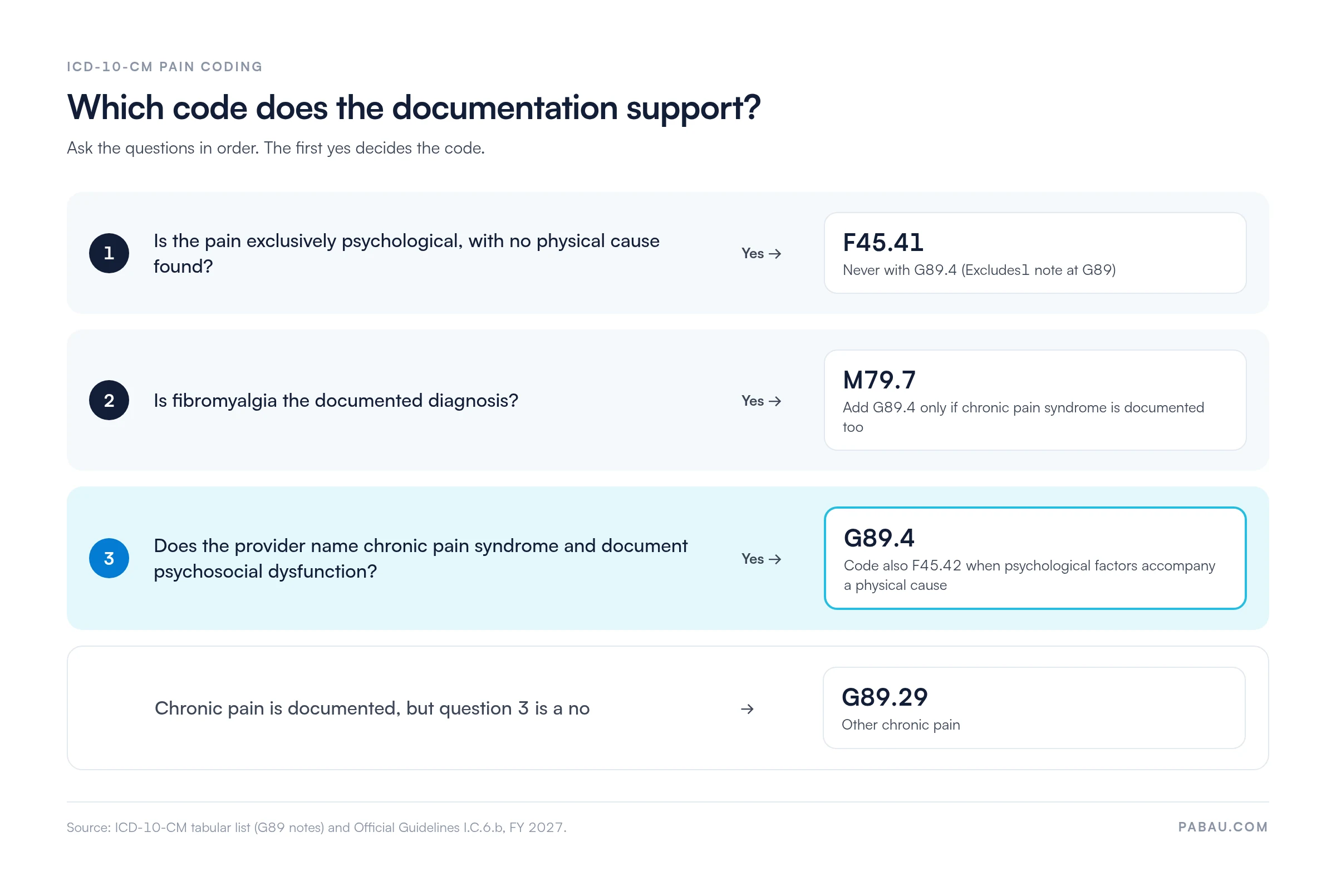
G89.29 (other chronic pain) is the correct code when pain is chronic but psychosocial dysfunction is not documented. G89.4 applies only when that psychosocial layer is explicit in the clinical record.
F45.41 (pain disorder exclusively related to psychological factors) is a Chapter 5 mental and behavioral code. It applies when no physical cause explains the pain and psychological factors account for it entirely. F45.42 (pain disorder with related psychological factors) covers pain with a physical cause where psychological factors also play a part.
G89.4, by contrast, sits in Chapter 6 (Nervous System) and captures pain where physical pathology is present but psychosocial factors complicate recovery. The three codes address different clinical scenarios:
G89 carries an Excludes1 note for F45.41, so G89.4 and F45.41 are not reported together. Where psychological factors accompany a physical cause, G89 notes “code also” F45.42.
Under the ICD-10-CM Official Guidelines for Chapter 6 (Section I.C.6), G89 codes may be the principal diagnosis or an additional diagnosis. The reason for the encounter decides which. Getting sequencing wrong is a frequent denial trigger.
When G89.4 may be the principal diagnosis: The encounter is specifically for pain management. The pain is not incidental to another condition being managed at the same visit. An outpatient pain management specialist visit focused solely on managing the chronic pain syndrome fits this scenario.
When G89.4 must be an additional code: The encounter is primarily for the underlying condition causing or contributing to the pain. Typical examples are a spine diagnosis, a post-surgical follow-up, or a cancer-related visit. In these cases, the underlying condition is sequenced first, and G89.4 follows as an additional code.
Inpatient context: The Uniform Hospital Discharge Data Set (UHDDS) definition of principal diagnosis governs inpatient sequencing. G89.4 may be the principal inpatient diagnosis only when it was the condition chiefly responsible for the admission after study. This is uncommon. Most inpatient admissions list an underlying condition first.
Run a documentation check before sequencing G89.4 as principal. Ask: is the reason for today’s encounter the chronic pain syndrome itself, or the underlying condition producing it? If the underlying condition is being managed, that code leads. A claim that sequences G89.4 first on a visit primarily for a spine procedure is likely to be denied.
Payers and auditors look for specific documentation elements before accepting G89.4. Generic chronic pain language is not sufficient. The clinical record should contain all of the following to support the code:
CMS requires medical necessity documentation for all diagnosis codes submitted on Medicare claims, and G89.4 is no exception. Per CMS ICD-10 coding guidance, the diagnosis code must accurately reflect the documented condition. The medical record must also support both the diagnosis and the services billed.
Commercial payers vary significantly in how they handle G89.4-related claims. Practices should verify the following before submission:
An eligibility check before the appointment catches a coverage problem while there is still time to fix it. In Pabau, the practice management platform we build, US practices run eligibility checks through Claim.MD. Prior authorization codes, dates and sessions are tracked on the patient’s case, with a warning when one is missing. Clean claim submission still depends on the documentation and sequencing described above.
G89.4 denials cluster around a predictable set of documentation and sequencing errors.
When a G89.4 denial arrives, the Claim Adjustment Reason Code (CARC) is the fastest way to identify the objection. Medical necessity denials (CARC 50) need a documentation appeal. Sequencing and diagnosis-mismatch denials, such as CARC 11 (diagnosis inconsistent with the procedure), are often resolved by submitting a corrected claim. The CARC denial codes reference maps each reason to its resolution path. A denial management workflow that tracks G89.4 rejections stops the same error recurring across claims.
Entering ICD-10 Code G89.4 correctly in a practice management system takes more than typing the code. Sequencing, the link to the supporting note and the claim itself all affect whether the payer accepts it.
Pabau’s claims software for practices supports ICD-10 code entry and electronic claim submission through Claim.MD in the US. For a G89.4 claim, the workflow looks like this:
For teams handling complex pain patients, a grounding in medical billing fundamentals shows clinicians and front-desk staff which documentation choices affect claim outcomes.

Pabau supports ICD-10 code entry and electronic claim submission through Claim.MD in the US. See how it keeps G89.4 documentation and the claim it supports in one system.

G89.4 belongs on a claim only when the provider has named chronic pain syndrome and documented the psychosocial factors behind it. Where the note stops at persistent pain, code G89.29 and query the provider before the next visit.
The trade-off is time at the point of care. Recording a scored psychosocial measure takes minutes during the visit, while appealing a medical necessity denial means rebuilding that evidence after the fact.
Pabau supports practices that manage claims in-house, from ICD-10 code entry to Claim.MD submission and ERA remittances. Book a demo to see how it handles G89.4 claims for your specialty.

Coding a fibromyalgia patient? ICD-10 code M79.7 covers the fibromyalgia code and when it travels with a chronic pain code.
Is the pain localized to the lower back? ICD-10 code M54.50 explains the low back pain code that replaced M54.5.
Want to understand what happens after a denial? Electronic remittance advice explained shows how ERA files map CARC codes back to specific claim lines so your team resolves G89.4 denials faster.
Looking for the broader billing framework? What is revenue cycle management explains how ICD-10 coding accuracy connects to the full payment collection process.
ICD-10 Code G89.4 is the billable ICD-10-CM diagnosis code for chronic pain syndrome. It applies to persistent pain beyond the normal healing period combined with documented psychosocial dysfunction, such as depression, anxiety, fear-avoidance behavior or occupational impairment. It sits in Chapter 6 (Diseases of the Nervous System), category G89 (Pain, not elsewhere classified), and is valid for FY 2027.
G89.29 (other chronic pain) applies when pain is chronic but no psychosocial dysfunction is documented. G89.4 (chronic pain syndrome) applies when the clinical record explicitly documents psychological, behavioral, or social factors contributing to the pain. If the chart contains only pain scores and physical findings, G89.29 is the correct code.
G89.4 may be the principal diagnosis only when the encounter is specifically for pain management. When the underlying condition (such as a spine disorder, post-surgical state, or cancer) is the reason for the visit, that condition is sequenced first. G89.4 is then reported as an additional code.
The most common reasons are insufficient psychosocial documentation and incorrect sequencing, where G89.4 is submitted as principal when the underlying condition should lead. A third is reporting G89.4 for documented fibromyalgia, which is coded M79.7, without separate documentation of chronic pain syndrome. Checking documentation before submission addresses all three.
F45.41 is pain disorder exclusively related to psychological factors, a Chapter 5 code for pain with no identifiable physical cause. G89.4 is a Chapter 6 code for chronic pain with a physical basis and documented psychosocial dysfunction. G89 carries an Excludes1 note for F45.41, so the two are not reported together. Where psychological factors accompany a physical cause, G89 instructs coders to also code F45.42.
Only when both conditions are documented. Fibromyalgia is coded M79.7, and G89 carries no Excludes1 note for it. If fibromyalgia is the documented diagnosis, M79.7 is the code. Add G89.4 only when the provider separately documents chronic pain syndrome.