ICD-10 Code S42.444P: Medial epicondyle fracture, right humerus
ICD-10 Code S42.444P: full descriptor and code validity ICD-10 Code S42.444P car...

Last Updated: Oct 13, 2026
Billable Code Specific Code
S42.445G is the billable ICD-10-CM code for nondisplaced fracture (avulsion) of medial epicondyle of left humerus, subsequent encounter for fracture with delayed healing. It applies at a follow-up visit where the treating provider documents that the fracture is healing more slowly than expected.
The code is often confused with S42.445D, which describes the same injury with routine healing. The medial epicondyle sits on the inner side of the elbow. It anchors the flexor-pronator tendon and the ulnar collateral ligament, so valgus stress can pull a fragment away.
Let Pabau's smart automation suggest the right codes, reduce claim denials, and keep your practice compliant—effortlessly.
Automate repetitive tasks and focus on what matters most—your patients.
Reduce coding errors and ensure compliance with the latest regulations.
Clean claims, fewer denials, and faster reimbursements.
Powerful insights and reporting to help your practice thrive.
HIPAA compliant SOC 2 certified GDPR-compliant Trusted by 4,000+ clinics worldwide

S42.445G is a billable ICD-10-CM code for a nondisplaced avulsion fracture of the left medial epicondyle, valid from FY2024 through FY2027. It applies at a subsequent encounter where the provider documents delayed healing.
The 7th character G means subsequent encounter for fracture with delayed healing. Use it only when the treating provider documents that healing is slower than expected, and use D for routine healing.
Laterality is required: S42.445G specifies the left humerus. Use S42.444G for the right side and S42.446G for an unspecified side. Picking the wrong side, or leaving it unspecified when the record names one, can trigger payer edits.
Pabau, the practice management platform we build, flags 7th character mismatches and laterality errors before submission, which cuts denials on follow-up fracture claims.
ICD-10 Code S42.445G is the full-specificity billable diagnosis code for a nondisplaced fracture (avulsion) of the medial epicondyle of the left humerus. It is reported at a subsequent encounter where the treating provider has documented delayed healing.
The code sits in category S42 (fracture of shoulder and upper arm), under subcategory S42.4 (fracture of lower end of humerus). It is valid for discharges and encounters from FY2024 through FY2027, starting October 1, 2023.
The medial epicondyle is the bony prominence on the inner side of the distal humerus, just above the elbow joint. It is the origin of the common flexor-pronator tendon and the anchor for the ulnar collateral ligament.
That ligament is the main restraint against valgus stress at the elbow. The ulnar nerve runs in a groove directly behind the epicondyle.
Avulsion fractures happen when these soft tissues pull a fragment of bone away from the epicondyle. Typical mechanisms are valgus traction from repetitive throwing, a fall on an outstretched hand, or an elbow dislocation. The injury is most common in adolescents, whose medial epicondyle growth center has not yet fused.
In a nondisplaced fracture the fragment stays in place, so the fracture line can be subtle on plain radiographs. Comparison views of the other elbow, CT, or MRI may be needed to confirm the injury and its displacement status.
Clinical context coders will see in physician notes:
The 7th character G means subsequent encounter for fracture with delayed healing. It applies once active treatment has ended and the treating provider documents that the fracture is healing more slowly than expected.
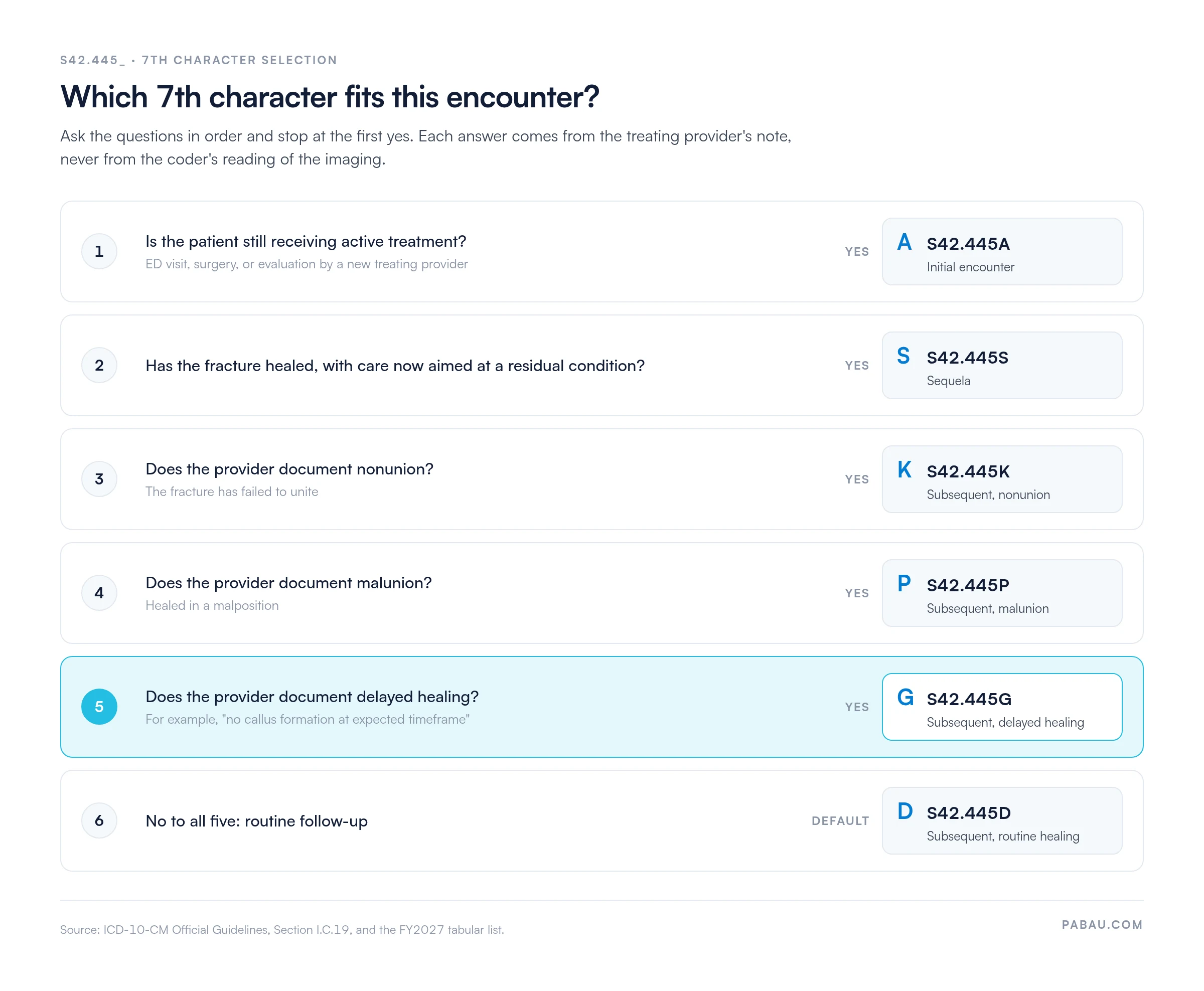
Under ICD-10-CM Official Guidelines Section I.C.19, fracture encounter characters follow a defined hierarchy.
“A” covers the initial encounter while the patient is receiving active treatment. That includes ED visits, surgical treatment, and evaluation and management by a new treating provider.
The characters D, G, K, P and S cover the encounters that follow. Coders rely on provider documentation to pick the subsequent character, because they cannot judge for themselves whether healing is delayed.
The distinction between D and G is frequently misapplied. “D” is the default for uncomplicated follow-up. “G” requires affirmative provider documentation that healing is delayed.
Phrases such as “fracture line still visible,” “no callus formation at expected timeframe,” or “delayed ossification noted on imaging” support the G character. Without that kind of language, a routine follow-up check does not. The ladder below sets out the order in which to test the six characters.
S42.445G is one code in a tightly related family. Subcategory S42.44- splits by displacement and side: S42.441-S42.443 are displaced, S42.444-S42.446 are nondisplaced, and S42.447-S42.449 are incarcerated fractures. Each trio runs right, left, then unspecified. The table below maps the codes most often confused with S42.445G.
Imaging decides displacement status, which separates S42.442x (displaced) from S42.445x (nondisplaced). Mechanism and clinical presentation alone do not settle it. A displaced fracture means the fragment has moved away from the epicondyle.
Nondisplaced means the fragment remains anatomically aligned. Under the ICD-10-CM guidelines, a fracture not documented as displaced or nondisplaced is coded as displaced.
When imaging is ambiguous, coders should query the ordering provider before relying on that default. Selecting the wrong displacement code is a documentation-integrity issue that can trigger medical necessity denials if the clinical record and the code conflict.
Four elements must be present in the medical record to support ICD-10 Code S42.445G. If the record lacks any one of them, payers can deny the claim or request additional clinical records.
According to the CMS ICD-10-CM coding guidelines, delayed healing is a clinical judgment that rests with the treating provider. The ICD-10-CM Official Guidelines (Section I.C.19) require that the 7th character reflect the provider’s documented assessment of healing status at each encounter. A coder’s inference from imaging alone does not qualify.
Query the provider before assigning G if the note says ‘follow-up’ without explicitly characterizing healing status. A note that lacks language about healing progression supports D by default. Flag these for a provider addendum rather than guessing, because an unsupported G creates compliance risk at audit.
Section I.C.19 of the Official Guidelines for Coding and Reporting governs ICD-10-CM fracture coding. CMS and the National Center for Health Statistics (NCHS) publish the guidelines each year. Key rules that directly affect S42.445G:
The CDC/NCHS ICD-10-CM web tool provides the official annual tabular list and index. Use it to verify code descriptions, excludes notes, and instructional notes for S42.445G and its parent categories.
Subsequent encounter fracture claims are among the more denial-prone submissions in orthopedic billing. For ICD-10 Code S42.445G specifically, five denial patterns appear most frequently.
Most of these denials come back with a reason code on the remittance advice. Our guide to denial codes in billing explains the codes payers attach to rejected claims and what each one asks you to fix.
S42.445G is mostly reported on follow-up care rather than on the initial fracture treatment. The CPT codes below are the ones most often billed alongside it in orthopedic and sports medicine settings.
When delayed healing leads the provider to consider open fixation of the fragment (24575), the E/M level should reflect that more complex decision-making. A visit like this often supports 99214 rather than 99213. Document the treatment alternatives considered and the rationale for the chosen approach.
Fracture care codes such as 24560 and 24575 carry a 90-day global period. Routine follow-up by the same provider inside that window is not billed as a separate E/M visit.
Codes 24565 (closed treatment with manipulation) and 24566 (percutaneous fixation) describe care for displaced fragments, so they rarely pair with a nondisplaced code. Therapy from a separate therapist, such as 97530 functional retraining, falls outside the surgeon’s global package.
S42.445G inherits the excludes notes from its parent codes S42.4 and S42. Coders must check these before adding additional codes to the claim.
In the ICD-10-CM Tabular List, S42 carries an Excludes1 note for traumatic amputation of shoulder and upper arm (S48.-). It also carries an Excludes2 note for periprosthetic fracture around an internal prosthetic shoulder joint (M97.3).
S42.4 adds Excludes2 notes for fracture of shaft of humerus (S42.3-) and physeal fracture of lower end of humerus (S49.1-). An Excludes1 note means the two conditions are never coded together. An Excludes2 note means the excluded condition is not part of the code, but both may be reported when both are documented.
No further excludes notes sit at the S42.44 subcategory or at S42.445G itself. Coders should still verify the current tabular list each year in the CDC/NCHS ICD-10-CM web tool. Excludes notes change with each fiscal year release, and changes at the parent level carry down to child codes.
Medicare covers subsequent encounter fracture visits coded with S42.445G when the claim documents medical necessity. A valid, billable code does not guarantee coverage for a fracture follow-up visit on its own.
Medicare Administrative Contractors (MACs) publish Local Coverage Determinations (LCDs) that define the clinical criteria for covered musculoskeletal services. Prior to billing S42.445G with an E/M code, confirm that the provider’s note addresses:
Prior authorization requirements vary by payer and plan year. Commercial payers – particularly for workers’ compensation claims involving elbow injuries – frequently require pre-authorization for continued fracture management beyond a standard number of visits.
Payers’ policies treat G-coded visits differently from D-coded routine follow-up, as delayed healing implies a longer and more resource-intensive course of care. Confirm prior auth requirements with each payer before scheduling the visit.
Checking eligibility and benefits before the appointment lowers the risk of billing S42.445G against lapsed or non-covered benefits. Our guide to insurance eligibility verification walks through those checks. If a claim is denied anyway, denial management covers root-cause analysis and appeals by CARC code.
For workers’ compensation claims involving S42.445G, check whether the carrier requires a separate ICD-10 code for the work-related injury mechanism (Chapter 20 external cause codes). Many WC payers flag claims that carry S42.445G without an accompanying Y93 or W-code explaining how the elbow injury occurred. Add the external cause code when the mechanism is documented.
In many orthopedic practices, a wrong 7th character only surfaces when the payer rejects the claim. A biller then rereads the note, recodes the line and resubmits, while payment waits on that loop.
Pabau moves that check ahead of submission. Its claims management software runs pre-submission edits that catch 7th character mismatches and laterality errors before the claim reaches the clearinghouse.
Through the Claim.MD clearinghouse integration, Pabau also checks eligibility before the visit. Electronic remittance advice (ERA) maps CARC denial codes back to individual line items, so a G-versus-D edit is quick to trace. Your billing team spends less time on rework and more follow-up claims are paid on the first pass.
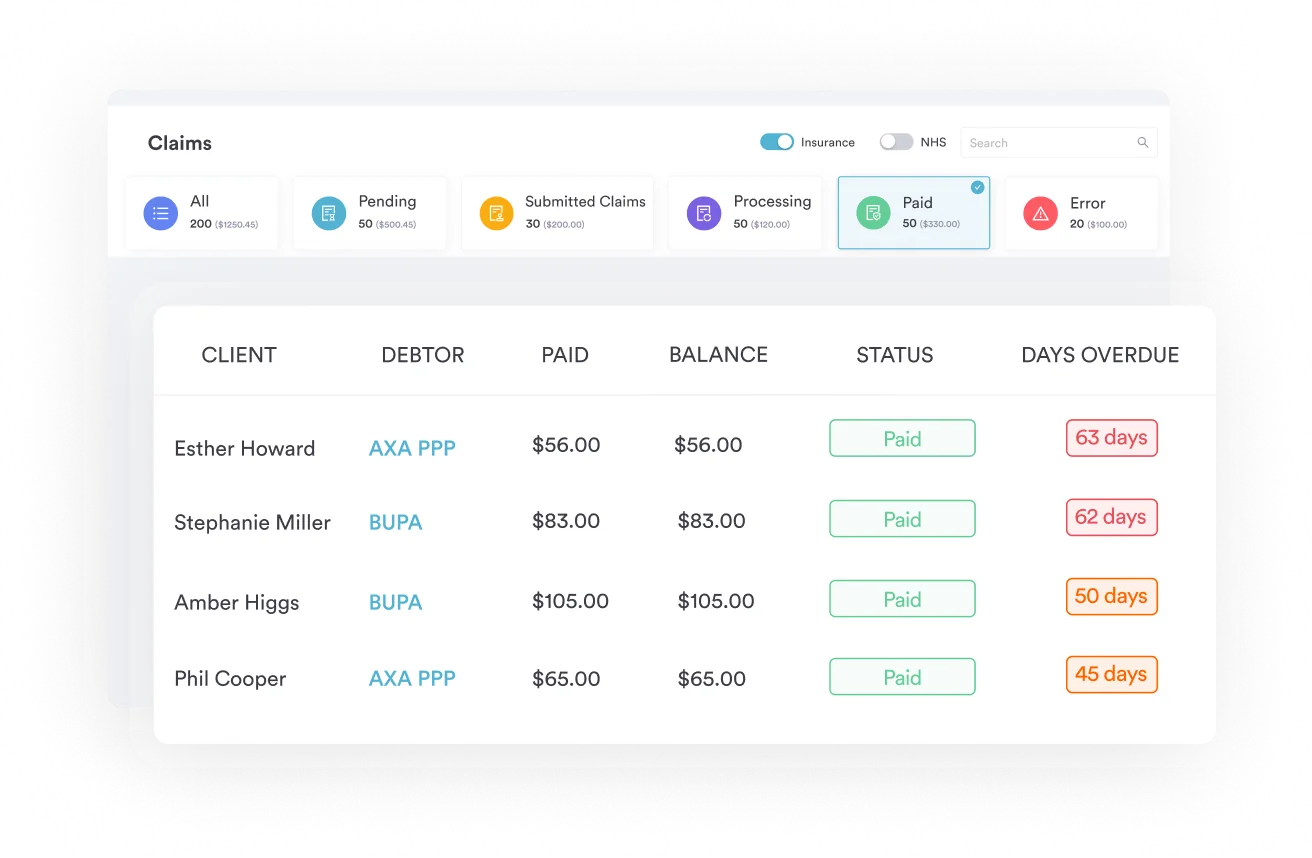

Pabau’s claims management software validates 7th character assignments and laterality before submission, helping orthopedic and sports medicine practices catch S42.445G coding errors at the source.

Before you assign S42.445G, find the sentence in the provider’s note that says healing is delayed. If that sentence is missing, the claim belongs under S42.445D, or it goes back to the provider as a query.
Make that check a habit and your G-coded claims will hold up at audit. The trade-off is a little more querying up front in exchange for far fewer appeals later.
Pabau runs the 7th character, laterality and medical necessity checks on every claim before it leaves the practice. Book a demo to see how it handles subsequent encounter fracture claims from charge to payment.

Looking for the broader ICD-10 fracture coding framework? Medical billing fundamentals explains how diagnosis codes interact with procedure codes and payer edits.
Want to reduce claim errors at the source? What makes a clean claim outlines the pre-submission checks that prevent the most common denial reasons in orthopedic billing.
ICD-10 Code S42.445G is the billable diagnosis code for a nondisplaced fracture (avulsion) of the medial epicondyle of the left humerus. It is reported at a subsequent encounter where the treating provider has documented delayed healing. It is valid from FY2024 through FY2027.
Yes. S42.445G is a full-specificity, billable ICD-10-CM code. It can be reported directly on claims without requiring a more specific code. It is not a header or category code.
Both codes describe a subsequent encounter for a nondisplaced avulsion fracture of the left medial epicondyle. D indicates routine healing, while G indicates delayed healing. Use G only when the treating provider’s note explicitly documents that healing is not progressing at the expected rate.
The 7th character G means subsequent encounter for fracture with delayed healing. It applies once active treatment has ended and the treating provider documents that the fracture is consolidating more slowly than expected. The coder cannot make that clinical call, so the provider must document it.
The most common CPT codes paired with S42.445G are 99213 or 99214 for E/M visits, 73070 for elbow radiographs, and 97110 or 97530 for therapy. Fracture care code 24560, or 24575 if surgery follows, may also apply. The appropriate E/M level depends on medical decision-making complexity documented at the encounter.
Medicare may cover subsequent encounter visits under S42.445G when medical necessity is established through clinical documentation. Coverage depends on applicable MAC Local Coverage Determinations (LCDs) and whether the provider’s note supports the complexity of the service billed. There is no automatic coverage guarantee based on code validity alone.
The record needs imaging that confirms a nondisplaced medial epicondyle fracture, plus left-side laterality. It must also show the encounter is a follow-up and carry explicit provider language characterizing healing as delayed. Missing the delayed healing documentation is the most common reason claims under S42.445G are denied or downgraded to S42.445D.
The most common reasons are a G without documented delayed healing and the wrong side, such as the left-side code for a right-side injury. Others are thin medical necessity documentation, using G after the fracture has healed, and missing external cause codes on workers’ compensation claims. Pre-submission edits that validate the 7th character and laterality catch most of these before the claim reaches the payer.