ICD-10 code S61.201A: Open wound of left index finger without nail damage
ICD-10 code S61.201A covers a left index finger wound of unstated type ICD-10 co...

Last Updated: Oct 16, 2026
Billable Code Specific Code
W56.32XD is the billable ICD-10-CM code for struck by other marine mammals, subsequent encounter. It applies when a patient returns for follow-up care after a strike by a seal, porpoise, manatee, walrus, or similar marine mammal.
Dolphins, sea lions, and orcas have their own codes, so they never fall under W56.32. As an external cause code, W56.32XD always follows the S-chapter code for the injury itself.
Let Pabau's smart automation suggest the right codes, reduce claim denials, and keep your practice compliant—effortlessly.
Automate repetitive tasks and focus on what matters most—your patients.
Reduce coding errors and ensure compliance with the latest regulations.
Clean claims, fewer denials, and faster reimbursements.
Powerful insights and reporting to help your practice thrive.
HIPAA compliant SOC 2 certified GDPR-compliant Trusted by 4,000+ clinics worldwide

W56.32XD is a billable ICD-10-CM external cause code for follow-up visits after a seal, porpoise, manatee, walrus, or similar marine mammal strikes a patient.
Dolphin, sea lion, and orca strikes have their own codes (W56.02-, W56.12-, and W56.22-), so W56.32 never covers them.
The 7th character D marks the healing phase after active treatment ends. Use XA for the initial active-treatment visit and XS for sequela.
W56.32XD never stands alone. Pair it with the S-chapter injury code, such as a contusion or laceration, which goes first on the claim.
Practice management software like Pabau checks each claim for missing details before it’s sent, so fewer external cause claims come back rejected.
ICD-10 code W56.32XD is the billable ICD-10-CM code for a patient struck by other marine mammals, presenting for a subsequent (follow-up) encounter.
It sits in Chapter 20, External causes of morbidity (V00-Y99), under section W50-W64, Exposure to animate mechanical forces. Its parent category is W56, Contact with nonvenomous marine animal.
According to the CDC/NCHS ICD-10-CM web tool, W56.32XD is valid for FY2025 and FY2026, with FY2026 effective October 1, 2025. No deletions or revisions are scheduled. The parent code W56.32 isn’t billable on its own, because every code in this category needs a 7th character.
The 7th character D means the patient is presenting for a subsequent encounter. The ICD-10-CM Official Guidelines define that as a visit during the healing or recovery phase, after active treatment for the injury has ended. It doesn’t mean a second injury event. It tells the payer this visit is routine follow-up care.
Three 7th characters are valid for W56.32. Each maps to a distinct phase of care, and mixing them up is a common cause of denials on external cause claims.
A subsequent encounter doesn’t require a set number of days to pass. What decides it is whether active treatment has ended. Say a patient leaves the ED and sees their primary care provider five days later for a wound check. That visit is a subsequent encounter, even if the wound hasn’t fully healed.
W56.32 covers marine mammals that don’t have a subcategory of their own. Dolphins (W56.0-), sea lions (W56.1-), and orcas (W56.2-) each have separate codes, which is why the ICD-10-CM Tabular List calls this group “other marine mammals.” W56.32 applies to nonvenomous marine mammals including:
So a dolphin strike codes to W56.02- and a sea lion strike to W56.12-, never to W56.32. A sea lion bite follows its own subcategory, and the follow-up visit codes to W56.11XD. The chart below walks through the three choices that lead to W56.32XD.
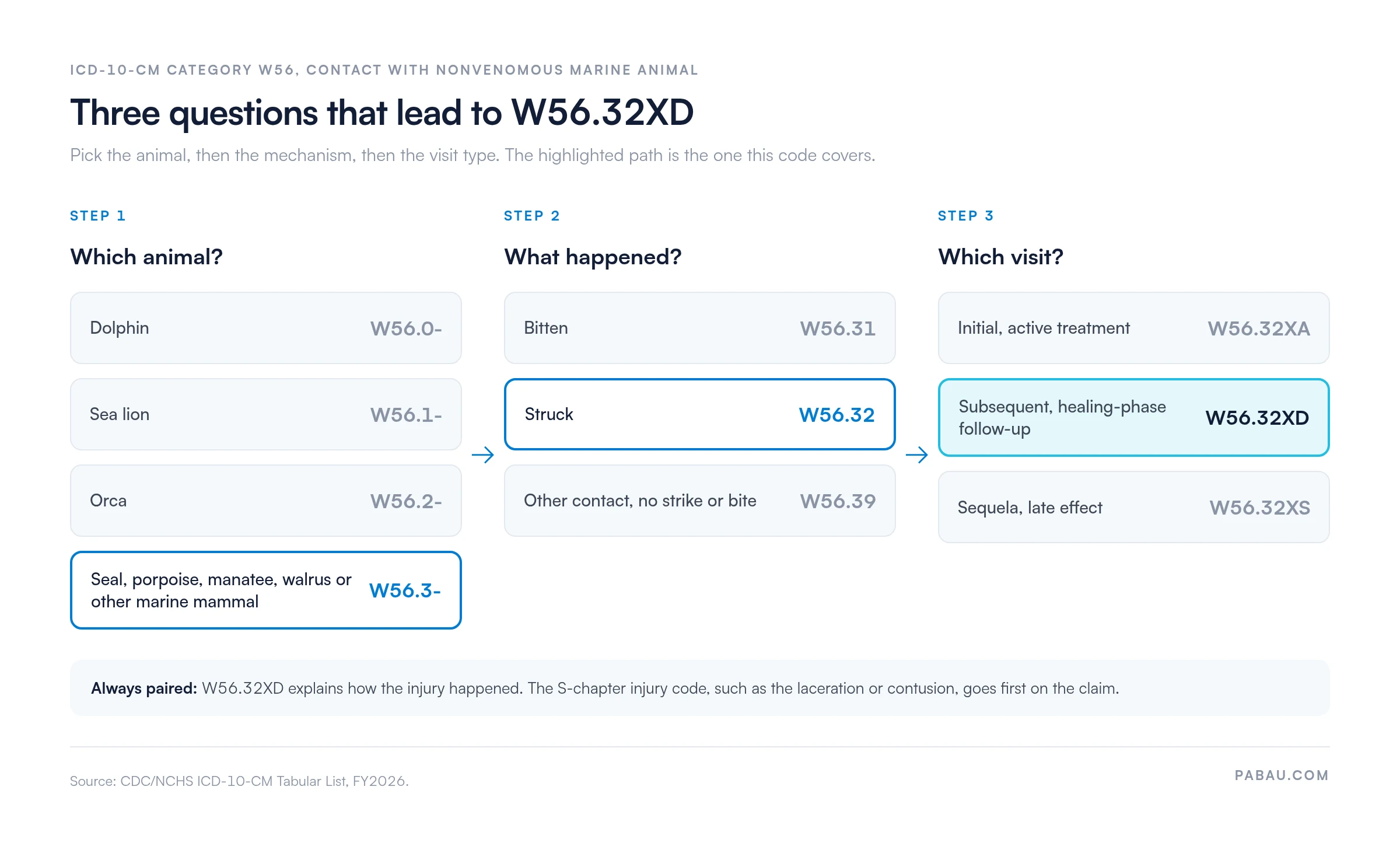
W56.32 covers being “struck by” these animals only. A bite codes to W56.31 (Bitten by other marine mammals). Contact without a strike or bite codes to W56.39 (Other contact with other marine mammals). The distinction matters because some payers audit external cause code specificity during utilization review.
Every animal in category W56 is classified as nonvenomous, per the category header, so no species under W56.32 counts as venomous.
Coders most often confuse W56.32XD with two kinds of codes. One is the wrong 7th character, such as XA coded when the patient is in follow-up. The other is the wrong subcode, such as W56.39 for contact instead of W56.32 for a strike, or W56.32 used for a dolphin. The table below maps the key decisions, based on the AAPC ICD-10-CM code lookup.
Always add a companion S-chapter injury code to identify the nature of the injury. A patient returning for a wound check after a seal strike that caused a skin laceration carries both codes. The S-chapter laceration code is the primary diagnosis, and W56.32XD follows it.
Each scenario below involves a patient who has already received initial treatment and is now in the follow-up phase of recovery.
In each scenario, the external cause code describes the mechanism. The injury itself, whether a laceration, contusion, or fracture, carries the S-chapter principal diagnosis code. W56.32XD never stands alone.
External cause codes need specific clinical documentation to survive payer audit. Assigning W56.32XD without it can trigger a retroactive denial during compliance reviews. The medical record should contain these elements before the code is assigned:
W56.32XD is an external cause code, so it describes how an injury happened. The injury itself is coded separately, and that split has direct reimbursement implications. Under the WHO ICD-10 framework and CMS implementation guidance, external cause codes don’t drive payment directly. Payment rests on the companion S-chapter injury code.
Payer requirements differ by line of business:
Review your payer contracts before submitting W56.32XD on commercial claims. Some payers auto-deny external cause codes submitted without a matching Y92 place-of-occurrence code. Pull the payer’s EDI companion guide or call provider relations to confirm their policy before the first submission.
External cause codes draw denials when billing teams treat them as administrative add-ons instead of coded fields that need checking. The denial patterns for W56.32XD are predictable, and they cluster around six failure points.
Teams seeing repeat denials on external cause codes can work through a clean claim submission checklist before batching these claims. Each failure point above can be caught at the pre-submission scrub stage.
Without automated checks, external cause codes get reviewed by hand, if at all. A coder who picks the unbillable parent W56.32 instead of W56.32XD often finds out only when the rejection comes back.
Practice management software like Pabau runs validation checks every time a claim is sent. Its claims management software confirms the details insurers need are in place. If something is missing or doesn’t match, the Send button stays disabled until the claim is complete.
In the US, Pabau connects to the Claim.MD clearinghouse. Your team can run real-time eligibility checks, submit claims electronically to thousands of payers, and track each claim’s status from one dashboard. Denied claims are flagged for rework, so a claim missing its Y92 code gets fixed and resubmitted quickly.
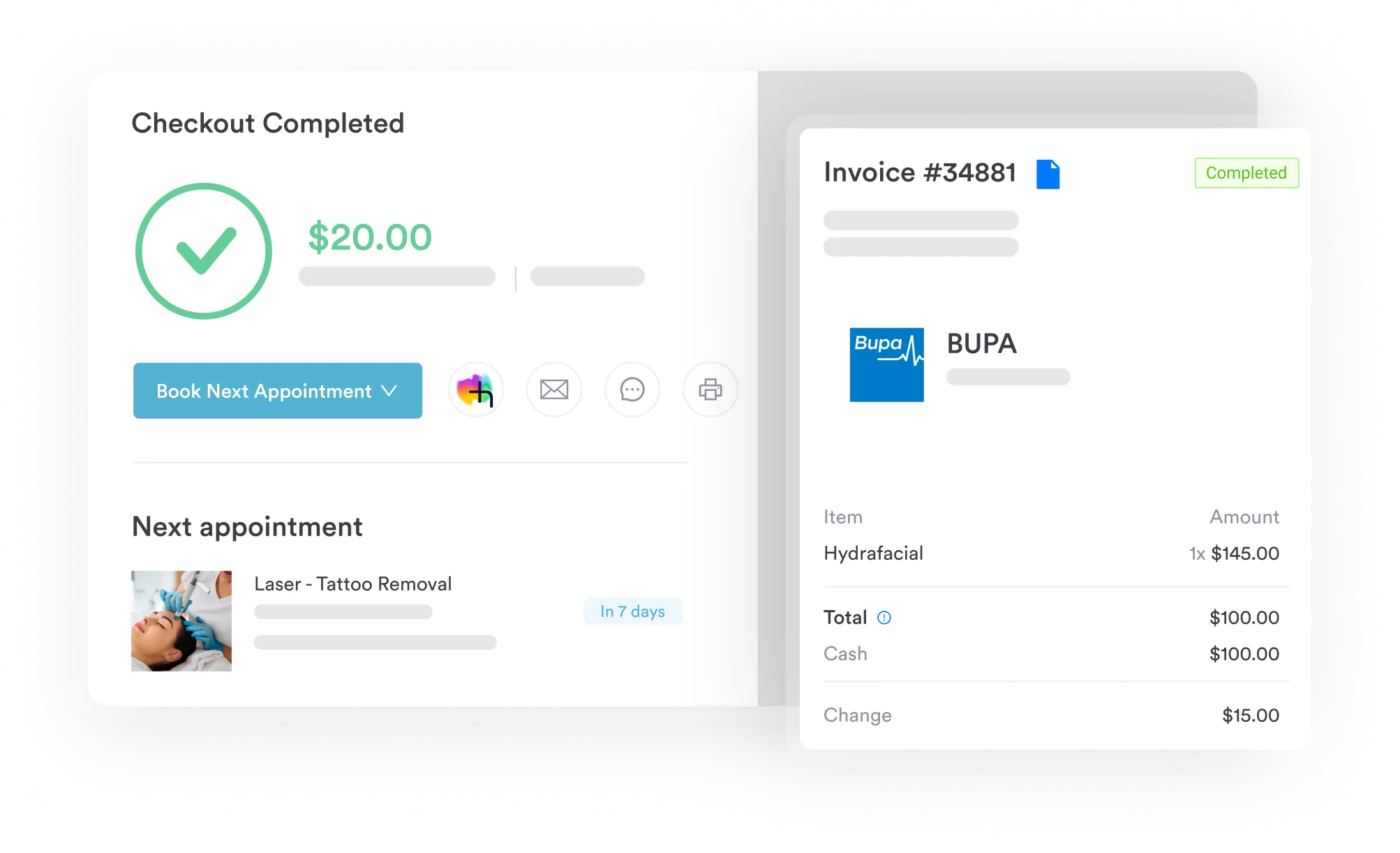

Pabau checks every claim for missing details before it’s sent. Denied claims get flagged for rework, so W56.32XD errors don’t cost you a payment cycle.

W56.32XD is simple to assign once three choices are settled: the animal, the mechanism, and the visit type. Confirm the species first, because a dolphin or sea lion strike never belongs here. Then check that active treatment has ended before choosing D over A.
External cause codes rarely pay on their own, but they can still sink a claim. Pair W56.32XD with its S-chapter injury code every time, and add Y92 and Y93 codes wherever the payer asks for them.
Book a demo to see how Pabau checks claims for missing details before they reach the payer.

Need help with external cause code denials? Denial management in healthcare covers how to build a systematic process for identifying and appealing common external cause code rejections.
Want to understand the full clearinghouse submission process? Pabau’s Claim.MD clearinghouse guide explains how electronic claims are checked and routed to thousands of US payers.
Looking for broader coding context? Medical billing fundamentals covers how diagnosis codes, external cause codes, and companion codes work together in a compliant claim.
Preparing for a payer audit? Medical billing compliance explains the documentation and coding checks that keep external cause claims defensible.
Want the bigger picture? What is revenue cycle management shows where coding accuracy fits between patient intake and final payment.
ICD-10 code W56.32XD is the billable ICD-10-CM external cause code for “Struck by other marine mammals, subsequent encounter.” It’s used when a patient returns for follow-up care after active treatment for a strike by a seal, porpoise, manatee, walrus, or similar marine mammal. Dolphins and sea lions have their own codes.
Yes. W56.32XD is a valid, billable ICD-10-CM code for FY2025 and FY2026. The parent code W56.32 isn’t billable without its 7th character (A, D, or S).
Use W56.32XA for the initial active-treatment visit, such as the ED presentation, urgent care visit, or first specialist encounter. Use W56.32XD for follow-up visits once active treatment has ended, including wound checks, suture removal, physical therapy, and outpatient follow-up. The encounter type in the clinical note must match the 7th character on the claim.
No. W56.32XD is an external cause code from the V00-Y99 chapter, so it’s always supplementary. It follows a primary injury diagnosis from the S-chapter, such as a laceration, contusion, or fracture code. Submitting it as the sole or primary diagnosis leads to claim rejection.
The top denial triggers are a missing S-chapter injury code and XA coded for a follow-up visit. Claims also fail when the unbillable parent W56.32 goes out without a 7th character. Payers that mandate Y92 place-of-occurrence codes deny external cause claims that leave them off.
Traditional Medicare accepts external cause codes but doesn’t require them for claim processing. Medicare Advantage plans and state Medicaid programs may set their own requirements. Liability and workers’ compensation payers typically require external cause codes to determine cause of injury, so check the payer’s policy before submission.