ICD-10 code X78.1XXD: Knife self-harm follow-up coding guide
ICD-10 code X78.1XXD covers knife self-harm at follow-up visits ICD-10 code X78....

Last Updated: Oct 13, 2026
Billable Code Specific Code
S37.62XA is the billable ICD-10-CM code for contusion of uterus, initial encounter.
Two errors commonly trigger denials on this code. One is using the wrong 7th character, such as D instead of A on an active-treatment visit. The other is omitting an external cause code when a payer requires one.
Let Pabau's smart automation suggest the right codes, reduce claim denials, and keep your practice compliant—effortlessly.
Automate repetitive tasks and focus on what matters most—your patients.
Reduce coding errors and ensure compliance with the latest regulations.
Clean claims, fewer denials, and faster reimbursements.
Powerful insights and reporting to help your practice thrive.
HIPAA compliant SOC 2 certified GDPR-compliant Trusted by 4,000+ clinics worldwide

S37.62XA is a billable ICD-10-CM code for uterine contusion at an initial (active-treatment) encounter, valid for fiscal year 2025 and 2026.
The 7th character A means active treatment is ongoing, not that it is the patient’s first visit: use D (S37.62XD) once active treatment ends.
External cause codes from the V/W/X/Y series are optional under national ICD-10-CM guidelines but often required by payers. A missing one is a common denial trigger when a payer requires one.
If the patient is pregnant, an O9A.2- code is sequenced first. Report S37.62XA as the additional code identifying the injury once the physician documents it.
ICD-10 Code S37.62XA is the specific, billable ICD-10-CM code for contusion of uterus, initial encounter. It is valid for reimbursement per the CMS ICD-10-CM official code files. It belongs to chapter 19 (Injury, Poisoning and Certain Other Consequences of External Causes) and category S37 (injury of urinary and pelvic organs). Its block is S30-S39, covering injuries to the abdomen, lower back, lumbar spine, pelvis and external genitals.
The table below summarizes the key attributes of the code for quick reference.
A uterine contusion is bruising of the uterine wall caused by blunt force, where tissue integrity remains intact. No laceration, perforation, or open wound is present. That distinction is what separates contusion of uterus from S37.63XA (laceration of uterus) and S37.69XA (other specified injury of uterus).
Common mechanisms documented in the medical record include motor vehicle collisions, falls with direct abdominal impact, and direct blows to the lower abdomen. The physician’s note must name the mechanism explicitly. A note reading “pelvic pain after MVA” alone does not support ICD-10 Code S37.62XA.
Typical documented signs include lower abdominal tenderness and suprapubic bruising or ecchymosis. Expect imaging findings too, from CT abdomen/pelvis or pelvic ultrasound, showing uterine wall edema or hematoma without disruption. Verify against the CDC/NCHS ICD-10-CM web tool if the documentation is ambiguous about injury type.
The 7th character extension in ICD-10 Code S37.62XA defines the type of encounter, not simply the order of visits. Character A means active treatment is still being provided, regardless of whether this is the patient’s first or fifth appointment. Character D means the injury is receiving routine aftercare. Character S captures sequelae of the original uterine contusion.
Common coder error: switching to S37.62XD at a second visit while active treatment continues. The attending may still be monitoring for internal hemorrhage or deciding whether surgery is needed. Per AAPC ICD-10-CM guidance, active treatment continues until the clinical decision-making around the injury is complete. Keep A until the physician’s documentation clearly signals that active management has ended.
Tracing ICD-10 Code S37.62XA through its hierarchy helps coders validate the code path and understand adjacent codes they may need to report alongside it. Other chapter 19 injury codes can be checked the same way in our ICD-10-CM code library.
The placeholder X in position 6 is required to fill the sixth-character slot before the 7th character extension can be appended. Omitting it produces an invalid code that will fail claim edits.
Four neighboring codes are easy to confuse with S37.62XA. The table below shows the key differentiator for each.
S37.62XA applies exclusively to injury episodes unrelated to an obstetric cause. When the patient is pregnant, the claim routes through Chapter 15 instead. The ICD-10-CM Official Guidelines (Section I.C.15.a) direct coders to sequence an O9A.2- code as the principal diagnosis. O9A.2 is “Injury, poisoning and certain other consequences of external causes complicating pregnancy, childbirth and the puerperium.” Report S37.62XA as the additional code identifying the injury once the physician documents it.
Send a CDI query whenever the record shows a pregnant patient with blunt abdominal trauma. The trigger is a missing physician statement separating the obstetric context from the traumatic injury.
Three checks settle the code for any blunt uterine injury. The flow below puts them in the order a coder meets them in the record.
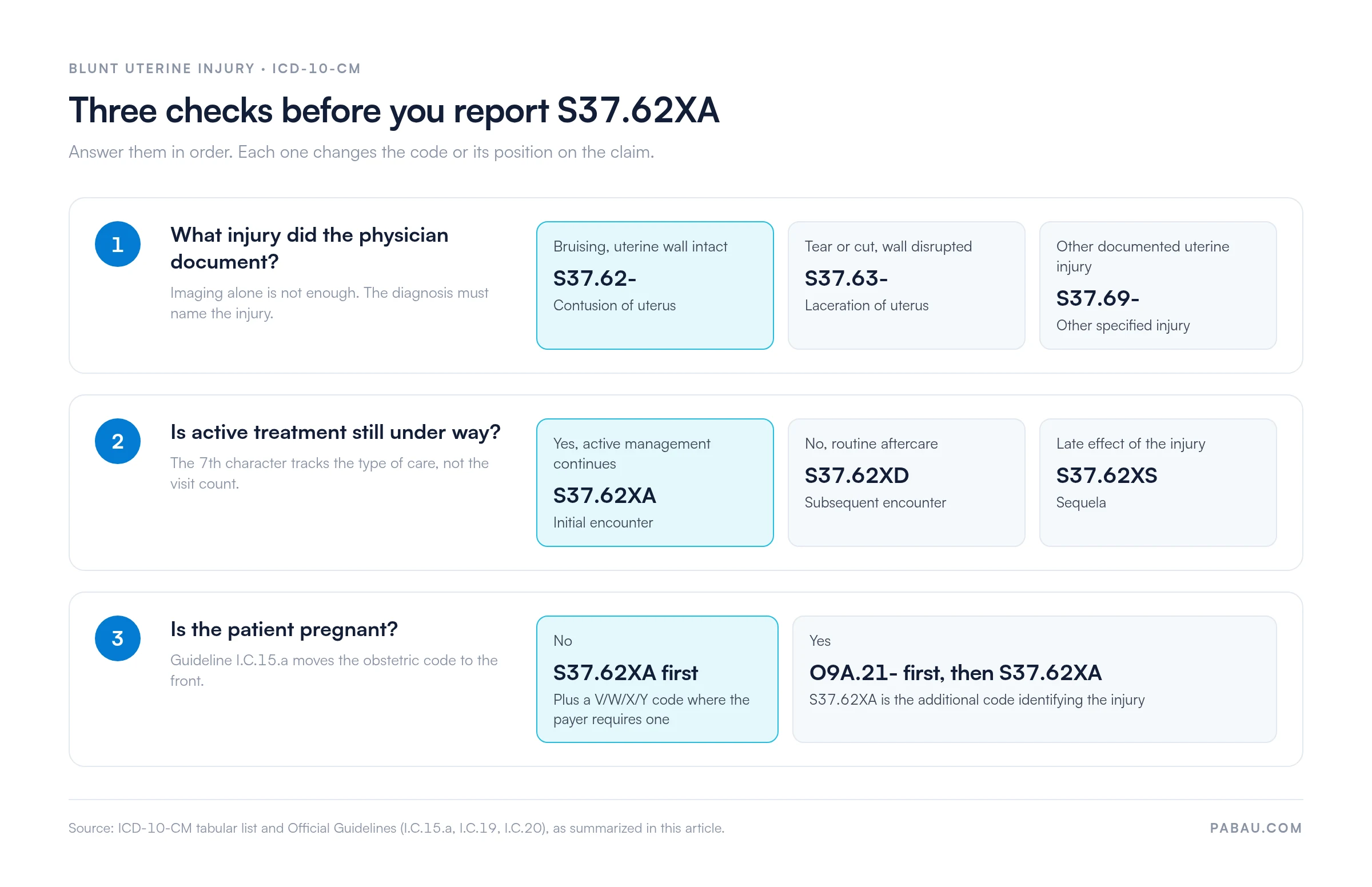
ICD-10-CM Official Guidelines Section I.C.20 make external cause reporting optional nationally, but many payers and states require at least one V/W/X/Y code, so add one. That code identifies the mechanism of injury behind S37.62XA. Meeting clean claim requirements before submission prevents a common denial when a payer requires one.
Pick the row that matches the documented mechanism. Add activity and place codes only when the record supports them.
Run a claim scrub before submission to flag missing external cause codes. Some payers and clearinghouses reject a chapter-19 injury claim that carries no V/W/X/Y code. Build a charge-entry prompt that stops coders from saving a uterine contusion claim without a mechanism code.
A defensible claim for ICD-10 Code S37.62XA starts with the physician’s own words. A coder cannot infer a uterine contusion from imaging findings alone. The medical record must contain all of the following to make the code defensible on audit.
The table below lists six denial reasons to check for on ICD-10 Code S37.62XA, with the root cause and fix for each. Working through them supports a denial management workflow that closes the loop before accounts age.
ICD-10 Code S37.62XA does not have a specific Local Coverage Determination (LCD) or National Coverage Determination (NCD) restricting its use. Claims are generally billable without prior authorization in most payer scenarios.
For inpatient stays, DRG assignment for S37.62XA depends on the principal diagnosis and the comorbidities reported alongside it. Verify the grouping against current CMS IPPS tables rather than assuming it from the code category. Reviewing your electronic remittance advice after each claim cycle identifies payer-specific patterns for this code quickly.
Understanding medical billing fundamentals for trauma cases means knowing which CPT codes pair with S37.62XA. The table below covers the most frequently reported companion procedures, organized by clinical setting.
A short pre-submission checklist catches each denial reason above before the claim leaves the practice.
Set up a charge-entry scrub rule that flags any S37.6x code submitted without a V/W/X/Y external cause code. If your billing platform supports custom claim edits, build the rule once. It then flags this denial for every payer that requires an external cause code.
Without a system check, a coder learns about a missing 7th character or external cause code only when the denial comes back. By then, the claim needs a correction, a resubmission and another wait for payment.
Pabau, the practice management platform we build, offers cleaner claims management by running validation checks on required claim details before submission. The checks run while the encounter is still open, so the coder can fix a gap before the claim leaves the practice.
Pabau also connects to Claim.MD for eligibility checks and claim status. Your team can confirm coverage before the ED visit is billed, then follow each trauma claim until it is paid. Coders spend their time on CDI queries instead of rework.

Pabau runs validation checks on required claim details before submission. It connects to Claim.MD for eligibility checks and claim status, so your team sends cleaner trauma claims.

Treat S37.62XA as a documentation code first and a billing code second. When the physician’s note names the contusion, the mechanism and the treatment stage, the code holds up on audit and on appeal.
The trade-off is time at the front of the process. A CDI query costs a few minutes before submission, while a denied trauma claim means rework, resubmission and a longer wait for payment.
Book a demo to see how Pabau checks required claim details before a uterine contusion claim leaves your practice.

Need to understand how clearinghouse claim scrubbing works? Medical claims clearinghouse guide explains how clearinghouses validate ICD-10 codes, flag missing companions, and route claims to payers.
Want to reduce denial volume across all your trauma codes? Denial codes in medical billing covers the CARC and RARC reason codes you will see on S37.62XA remittances and how to resolve each one.
Want your trauma coding to hold up on audit? Medical billing compliance guide covers documentation standards and claim integrity practices that apply to injury diagnoses.
ICD-10 Code S37.62XA is the billable ICD-10-CM diagnosis code for contusion of uterus, initial encounter. It applies when blunt force bruises the uterus without disrupting the uterine wall, during an active-treatment encounter.
Yes. S37.62XA is a specific, billable ICD-10-CM code valid for claim submission in fiscal year 2025 and 2026, confirmed by CMS and NCHS annual code releases.
S37.62XA is contusion of uterus (bruising, intact wall); S37.63XA is laceration of uterus (wall disrupted, tissue torn). Use S37.63XA only when the physician explicitly documents a tear or cut of the uterine wall.
Use S37.62XA as the principal diagnosis only when the patient is not pregnant. If the patient is pregnant, sequence O9A.2x as principal per ICD-10-CM guideline I.C.15.a. Then report S37.62XA as the additional code identifying the injury once the physician documents it.
Use A (S37.62XA) as long as active treatment is ongoing, regardless of visit number. Switch to D (S37.62XD) only once the physician’s documentation signals that active management has ended and the patient is receiving routine aftercare.
National ICD-10-CM guidelines make external cause codes optional, but they are often required by payers. Report at least one V/W/X/Y code identifying the injury mechanism alongside S37.62XA. Common examples include V20-V89 (motor vehicle collision), W00-W19 (fall), and Y04/Y09 (assault). A place-of-occurrence code (Y92.x) is also reported when documented.
The medical record must include an explicit physician diagnosis of uterine contusion and a documented mechanism of injury. It also needs imaging or operative findings confirming the injury without wall disruption. Finally, it should show the encounter type (active treatment or routine aftercare).
The most common CPT companions are 99281-99285 (emergency department E&M) and 74176-74178 (CT abdomen and pelvis without, with, or with and without contrast). Others are 76856 (pelvic ultrasound) and, for admitted patients, 99232-99233 (subsequent hospital care).